TL;DR
- Build and deploy enterprise business agents: Lyzr Agent Studio, for teams wanting a low-code, configurable environment.
- Self-hostable visual automation: n8n, which is source-available rather than classic open source.
- Visual multi-app automation: Make or Zapier, depending on integration needs and budget.
- LLM apps with visual workflows: Dify.
- Enterprise process orchestration: UiPath, or Microsoft Copilot Studio with Power Automate if you run Microsoft.
- Developer-led stateful or multi-agent systems: LangGraph or CrewAI.
A conventional workflow moves data between applications reliably. It struggles when requests are ambiguous, conditions change, several systems are involved and someone has to make a judgment call. Agentic workflow automation combines AI agents with tools, data and orchestration so a system can handle that kind of work.
The market now holds visual automation tools, enterprise process platforms and code-first frameworks, all marketed for AI automation and built for different jobs. This guide compares the best platforms for agentic workflow automation, including Lyzr Agent Studio, with their strengths, limits and best-fit use cases.
What is agentic workflow automation?
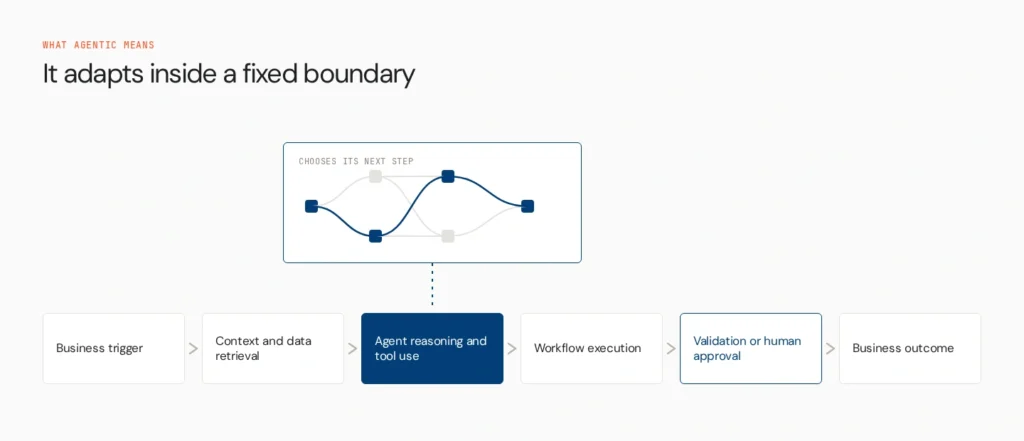
Agentic workflow automation uses AI agents to interpret a goal, retrieve information, choose or call tools and complete several steps within a business process. It differs from two neighbours. Traditional automation runs predefined triggers, conditions and actions. AI-assisted automation adds AI for classification, extraction or drafting inside a fixed flow. Agentic automation lets agents reason through parts of a task and adapt their next actions inside set boundaries.
Agentic doesn’t mean fully autonomous. Production workflows often mix deterministic steps, permission limits, validation and human approval.
What should buyers look for?
Judge every platform on five questions:
- Building: can teams configure agents, tools, instructions and knowledge without heavy custom code?
- Orchestration: can it combine fixed logic with agent-driven decisions, and coordinate several agents?
- Integrations: can agents securely reach your applications, APIs, databases and documents?
- Testing and oversight: can you test behaviour, inspect failures and route high-impact decisions to a person?
- Deployment and operations: can it run where you need it, with monitoring and permission control?
These categories overlap. They describe each platform’s primary strength, not a hard boundary.
How we compared them
We assessed agent building, orchestration, ease of use, integrations, multi-agent support, testing and oversight, deployment flexibility and pricing model, using official documentation and product pages. This is a feature-and-fit comparison, not a hands-on test of every platform.
The 10 platforms
1. Lyzr Agent Studio
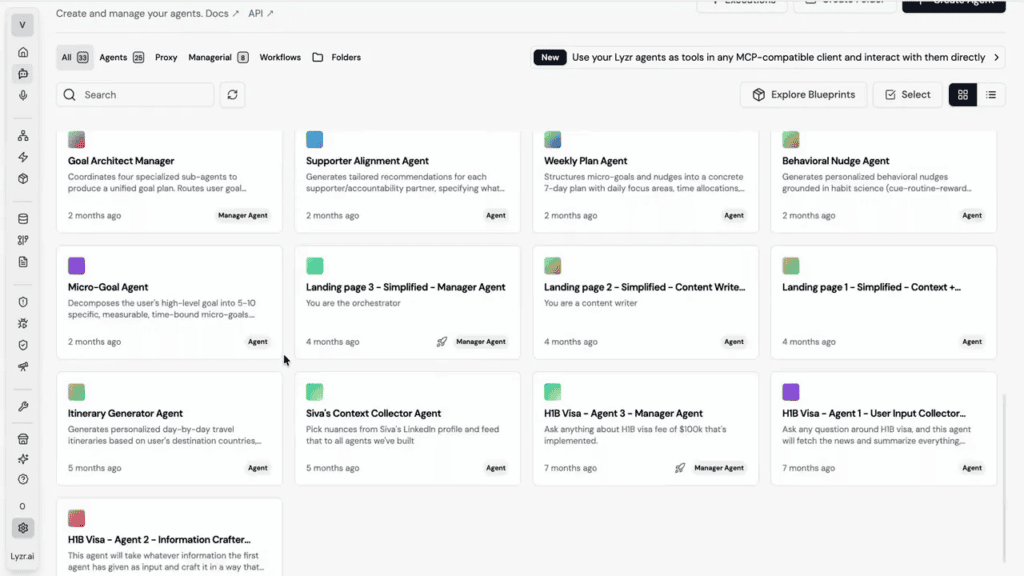
Lyzr’s Agent Studio is a no-code and low-code environment for building, testing, deploying and monitoring agents. It supports single agents and multi-agent systems through a dynamic Manager Agent or SuperFlow, a visual DAG-based workflow. Knowledge bases include classic RAG, a Neo4j knowledge graph and text-to-SQL, and a Traces section shows runs, latency and token usage.
Every agent built in Studio is also reachable through a REST API. Lyzr says deployment options include SaaS, VPC and on-premise, and that it aligns with HIPAA, GDPR and ISO 27001. Consider a support request: an agent retrieves account data, classifies the issue, calls an internal system and routes an exception to a person.
- Strengths: configurable agent building, mixed orchestration styles, API-first access
- Limits: advanced governance across many teams may need additional Lyzr modules, and deployment options vary by plan
Best for: teams that want to build and deploy business agents integrated with existing workflows.
2. n8n
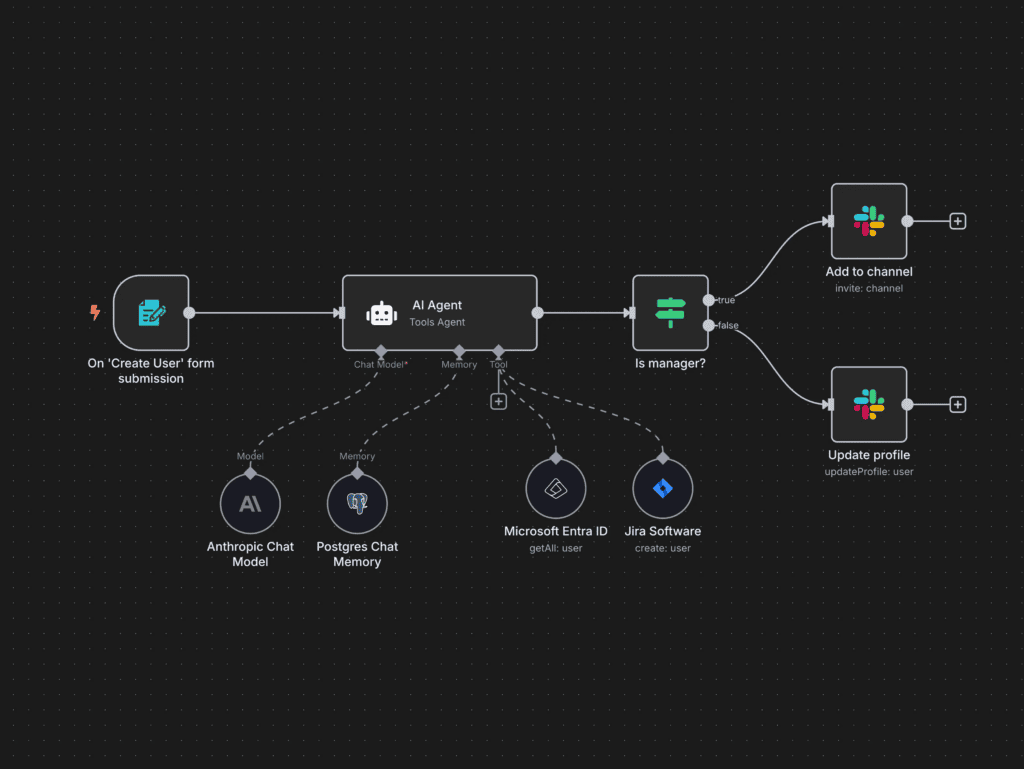
n8n is a visual automation platform with 400+ integrations and an AI Agent node. It is fair-code under the Sustainable Use License, meaning source-available and self-hostable. That is different from classic open source. The Community Edition is free to self-host, but you pay for infrastructure and maintenance.
- Strengths: flexibility, code when needed, deployment control
- Limits: licence restrictions on reselling as a service, operational burden
Best for: technical teams wanting integration-heavy workflows they can host themselves.
3. Make

Make is a visual builder for multi-step scenarios that connect apps, transform data and call AI services. An AI step can sit inside a scenario without every step being autonomous.
- Strengths: clear visual design, wide app coverage
- Limits: complex scenarios get hard to maintain, and execution limits shape cost
Best for: teams that prefer visual design for cross-application automation.
4. Zapier

Zapier prioritises accessibility and app connectivity. Zapier Agents extend it beyond trigger-and-action Zaps, though the two are different products.
- Strengths: fast start, huge app catalogue
- Limits: task-based pricing needs modelling at volume, and deep custom logic is harder
Best for: business teams connecting SaaS tools without custom orchestration.
5. Dify

Dify is a platform for building LLM applications with visual workflows, retrieval and agent capabilities. It offers an open-source project alongside hosted and enterprise options, and the terms differ between them.
- Strengths: prompts, retrieval and workflow steps in one environment
- Limits: check licence terms and which features sit in hosted tiers
Best for: teams building LLM applications who want a visual environment with open-source options.
6. UiPath
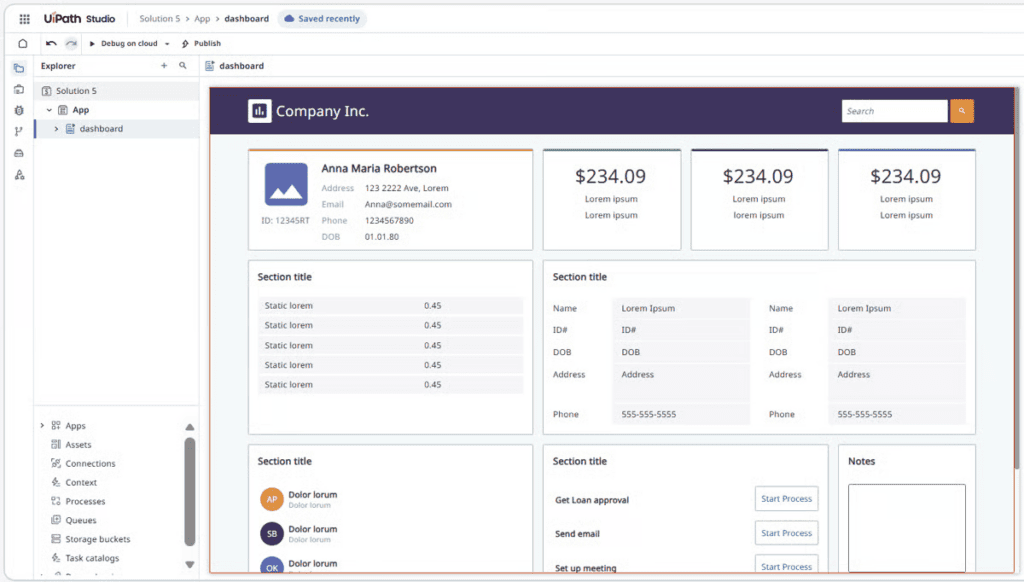
UiPath coordinates software robots, AI agents and people across business processes, with agent-building and orchestration capabilities layered on its automation platform.
- Strengths: fits legacy and structured processes
- Limits: licensing and implementation can be heavy
Best for: enterprises extending RPA programmes into agentic processes.
7. Microsoft Copilot Studio and Power Automate

These are complementary products. Copilot Studio creates agents, and Power Automate flows connect them to processes and application actions, with Microsoft 365 integration and connectors.
- Strengths: native fit with Microsoft identity and data
- Limits: licensing, capacity and architecture affect cost
Best for: organisations invested in Microsoft 365, Azure and the Power Platform.
8. LangGraph

LangGraph is a developer framework for stateful, long-running agent workflows, with persistence and human-in-the-loop patterns.
- Strengths: explicit control of state and execution
- Limits: you build integrations, deployment and operations yourself
Best for: engineering teams needing custom agent workflows with precise control.
9. CrewAI

CrewAI is a code-first framework for role-based agents that collaborate on tasks through crews and flows.
- Strengths: intuitive multi-agent modelling
- Limits: reliability, permissions and evaluation are your responsibility
Best for: developer teams building role-based multi-agent workflows.
10. Oracle AI Agent Studio
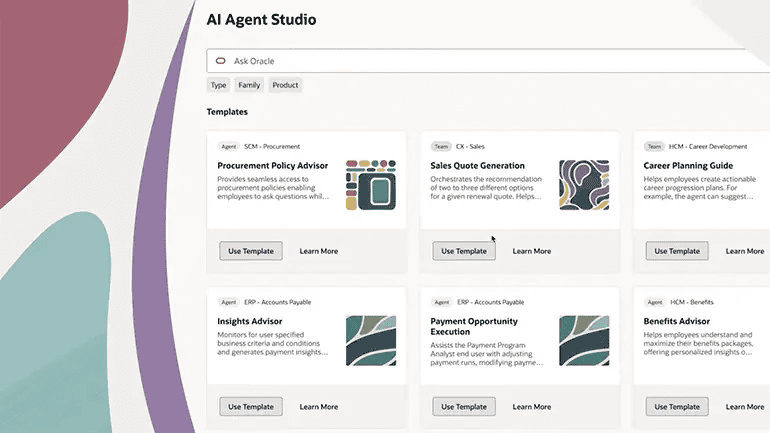
Oracle AI Agent Studio builds agents for Oracle’s enterprise applications and processes.
- Strengths: deep integration with Oracle applications
- Limits: its advantage may not carry to non-Oracle stacks
Best for: organisations running Oracle enterprise applications.
Side-by-side comparison
| Platform | Primary strength | Best-fit team | Building approach | Key consideration |
| Lyzr Agent Studio | Building and deploying business agents | Business and technical teams | No-code and low-code | Fit with your integrations |
| n8n | Integration-heavy visual workflows | Technical teams | Visual plus code | Fair-code licence, you run the infrastructure |
| Make | Visual cross-app automation | Operations teams | Visual | Scenario complexity and pricing |
| Zapier | Ease of use, app connectivity | Business teams | No-code | Task-based pricing |
| Dify | LLM apps and workflows | Product and AI teams | Visual | Check licence and hosting terms |
| UiPath | Enterprise automation and RPA | Large enterprises | Low-code | Licensing, implementation effort |
| Copilot Studio and Power Automate | Microsoft ecosystem agents | Microsoft-centred orgs | Low-code | Licensing and capacity |
| LangGraph | Stateful agent orchestration | Engineers | Code-first | You build the surrounding platform |
| CrewAI | Role-based multi-agent systems | Developers | Code-first | You design reliability and operations |
| Oracle AI Agent Studio | Oracle application agents | Oracle customers | Low-code | Strongest inside Oracle’s ecosystem |
How to choose
- Pick a visual builder for quick app-to-app automation with little engineering.
- Pick an enterprise platform when the process spans RPA or a specific vendor ecosystem.
- Pick an agent-building platform when you need configurable instructions, tools, knowledge and multi-step execution.
- Pick a developer framework for fine-grained control of state and logic.
Check deployment and operations early if agents touch sensitive data or take consequential actions. Choose by process, team and production needs, not by demo features. For rollout, see how to take agents to production, and for context, AI agents for workflow automation and agentic AI for enterprises.
Where Opencontroller fits
Agent Studio helps teams build and deploy agents. Opencontroller is relevant later, when an organisation must govern agents across teams, frameworks and environments. Most teams start with building.
Choose the platform that fits the process
The best platform for agentic workflow automation depends on what you automate, how much control you need and where workflows must run. If you’re moving from isolated AI experiments to multi-step business workflows, start with the process, the systems your agents must reach and the control you need in production. Explore Lyzr Agent Studio to see how it fits your use case, or book a demo to discuss your requirements.
FAQs
It depends on whether you prioritise visual automation, enterprise orchestration, configurable agent building or code-first control. Examples include Lyzr Agent Studio, n8n, UiPath and LangGraph.
There’s no universal winner. The right choice depends on your workflow, integrations, team skills and deployment needs.
Yes, with caveats. LangGraph and CrewAI are open-source frameworks, and Dify has an open-source project. n8n is source-available under a fair-code licence. Free software still carries hosting and maintenance costs.
A platform provides a broader environment to build and operate agents. A framework supplies components for implementing agent behaviour, so you build the surrounding system.
Book A Demo: Click Here
Join our Slack: Click Here
Link to our GitHub: Click Here