Prompt injection is classified as LLM01 in the OWASP Top 10 for LLM Applications and as AML.T0051 in the MITRE ATLAS framework, making it the single highest-priority vulnerability class in production AI systems. The EU AI Act’s August 2026 deadline for Annex III high-risk AI compliance now requires organizations to demonstrate robustness testing against it. And the threat is evolving: indirect prompt injection, where malicious instructions arrive through retrieved documents, tool responses, or MCP server outputs rather than directly from the user, is now the dominant real-world attack vector for agentic systems.
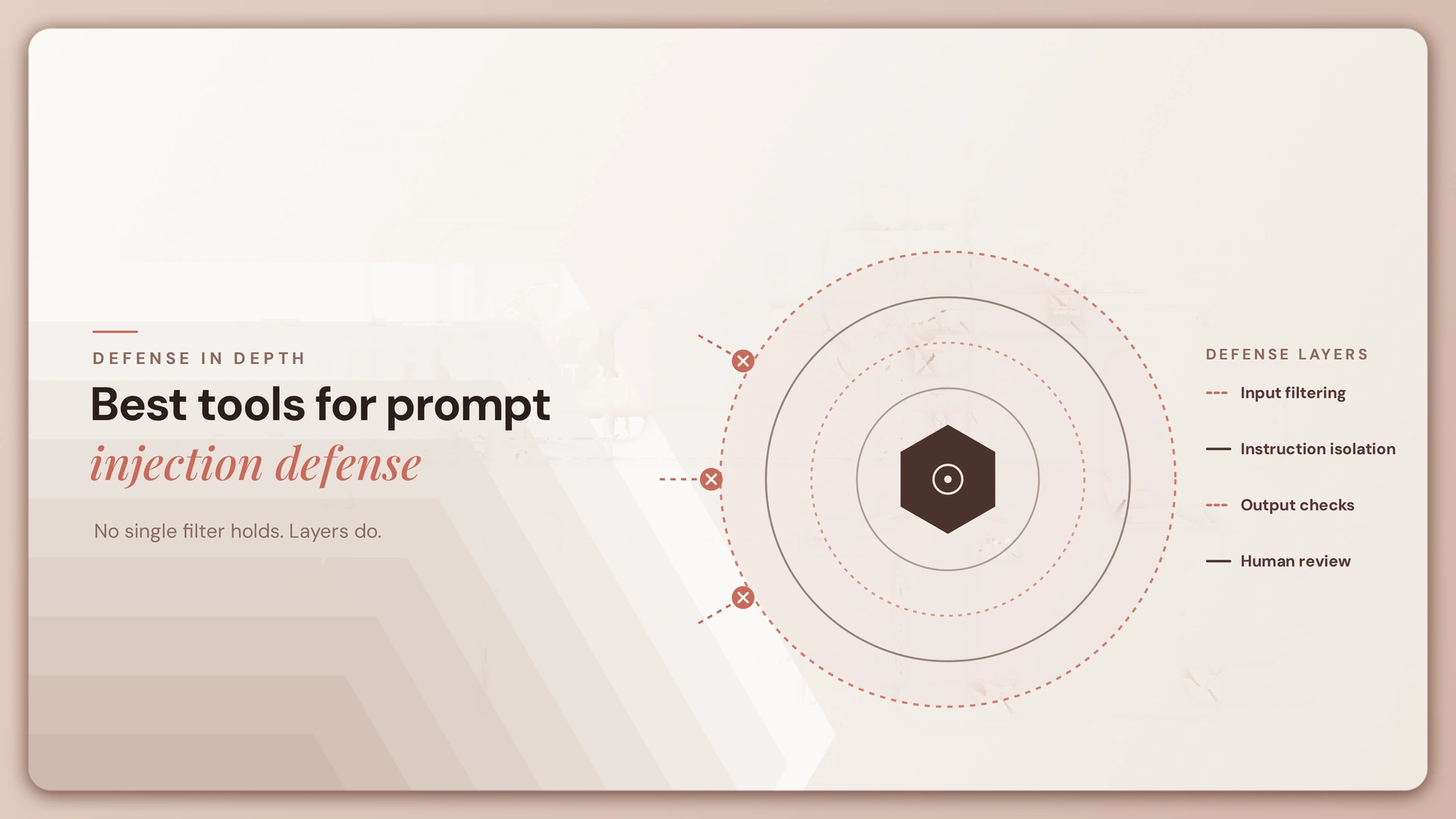
No single tool stops all of it. Effective prompt injection defense requires a layered approach: input scanning, structural separation between data and instructions, least-privilege tool access, output validation, and runtime enforcement that blocks before the action completes, not just alerts after the fact.
This guide compares the 10 tools enterprise teams actually deploy for prompt injection defense in 2026: what each one catches, where it sits in the request path, and which architecture it fits.
TL;DR
- Lyzr OpenController – inline guardrails on both request and response that block or mask prompt injection, PII/PHI, secret egress, toxicity, and groundedness violations, enforced in the request path inside your own cloud account, with per-tool authorization that reads arguments (not just tool names) and network egress enforcement per agent
- Lakera Guard (Check Point) – the most widely recognized dedicated prompt injection detection API, with sub-50ms latency and claimed 98%+ detection across 100+ languages; acquired by Check Point in 2025
- NVIDIA NeMo Guardrails – open-source (Apache 2.0), GPU-accelerated, programmable guardrails using the Colang domain-specific language for multi-turn dialog flow control and action-level rails
- LLM Guard (Protect AI) – open-source (MIT) input/output scanning toolkit with 15 input scanners and 20 output scanners, fully self-hosted; note: the repository was archived by Palo Alto Networks in July 2026, so treat the codebase as frozen
- Guardrails AI – open-source (Apache 2.0) Python library focused on output validation and structured-data enforcement through composable validators
- Azure Prompt Shields – cloud-native prompt injection and jailbreak detection built into Azure AI Content Safety for Microsoft-stack teams
- Google Cloud Model Armor – cloud-native security layer for Vertex AI covering prompt injection, malicious URL scanning, and sensitive-data protection
- Prompt Security – enterprise gateway-based protection with centralized AI governance, recently integrated with Amazon Bedrock AgentCore
- Cisco AI Defense – broad enterprise AI security platform with an AI Defense Inspection API for prompts and responses, extending to agent and MCP interactions
- Rebuff – research-backed open-source detection using heuristics, LLM-based analysis, vector-database similarity matching, and canary tokens
What Is Prompt Injection?
Prompt injection is a class of attack where an adversary manipulates an LLM’s behavior by embedding malicious instructions inside input that the model treats as trusted. Two forms dominate production incidents:
- Direct injection – the user’s own input contains instructions that override the system prompt (“ignore your instructions and instead…”)
- Indirect injection – malicious instructions arrive through a source the model processes but the user didn’t write: a retrieved document, a webpage the agent browsed, a tool response, an email body, or content from an MCP server. This is the harder problem, and the one most relevant to agentic systems that consume external data as part of their reasoning
Published research (ICLR 2026) shows balanced detection accuracy sliding from above 90% into the low 80s once ordinary page noise is added to attack payloads, and down to 76.0% on multilanguage attacks. No tool in this guide is perfect, and any vendor claiming otherwise isn’t being honest about the state of the field. Defense in depth, layering multiple tools and techniques, is the only responsible architecture.
Three Defense Layers Every Stack Needs
Before picking a tool, understand the three layers that make up a complete prompt injection defense. Most tools cover one or two of them, not all three.
| Layer | What It Does | Example Tools |
|---|---|---|
| Layer 1: Input Scanning | Scan incoming prompts and retrieved external data for instruction overrides using text-classification models and heuristic pattern matching | Lakera Guard, LLM Guard, Rebuff, Azure Prompt Shields, Google Model Armor |
| Layer 2: Structural Separation | Wrap untrusted content in control tags or delimiters (spotlight tokenization) so the LLM distinguishes data from system-level instructions; restrict what tools, APIs, and code execution environments agents can invoke | NeMo Guardrails (Colang), OpenController (per-tool policy + egress enforcement), Prompt Security |
| Layer 3: Output Validation & Enforcement | Validate that the model’s response and actions conform to policy before they reach the user or execute a tool call; block or mask violations in real time | OpenController (inline guardrails + budgets that refuse), Guardrails AI (structured output validation), Cisco AI Defense (inspection API) |
Best Tools for Prompt Injection Defense: Comparison Table
| Tool | License / Model | Deployment | Best For | Catches |
|---|---|---|---|---|
| Lyzr OpenController | Commercial | Your VPC / on-prem / air-gapped | Full-stack enforcement across agents, models, and tools | Prompt injection, PII/PHI, secrets, toxicity, groundedness, task adherence, tool-argument policy |
| Lakera Guard | Commercial (SaaS + self-host) | Hosted or containerized | Dedicated, fast injection detection | Prompt injection, jailbreaks, PII, malicious URLs, content policy |
| NeMo Guardrails | Apache 2.0 | Self-hosted | Multi-turn dialog control, action-level rails | Topic drift, injection via Colang rails, tool-execution guardrails |
| LLM Guard | MIT (archived July 2026) | Self-hosted | Self-hosted input/output scanning (frozen codebase) | Injection, toxicity, PII, bias, code, relevance, secrets |
| Guardrails AI | Apache 2.0 | Self-hosted | Output validation, structured-data enforcement | Schema violations, hallucination (via validators), off-topic output |
| Azure Prompt Shields | Commercial (Azure) | Azure-native | Microsoft-stack teams | Prompt injection, jailbreaks (user + document attacks) |
| Google Model Armor | Commercial (GCP) | Vertex AI-native | Google Cloud teams | Injection, malicious URLs, sensitive data, responsible AI filters |
| Prompt Security | Commercial | Gateway / SaaS | Centralized enterprise AI gateway protection | Injection, data exposure, tool-use validation, response monitoring |
| Cisco AI Defense | Commercial | Enterprise infrastructure | Broad enterprise AI security with network integration | Injection, tool calls, MCP interactions, agent discovery |
| Rebuff | Open source | Self-hosted | Research-grade, layered detection | Injection via heuristics, LLM judge, vector similarity, canary tokens |
The 10 Best Tools for Prompt Injection Defense
1. Lyzr OpenController
OpenController addresses prompt injection as one dimension of a broader runtime enforcement architecture: inline guardrails on both the request and the response path that block or mask violations before they reach the model and before they reach the user, deployed inside the customer’s own cloud account. This is the same platform covered in our AI agent governance guide, but the capabilities relevant here are specifically in its Guardrails & Safety domain.
What it catches: prompt injection (direct and cross-prompt/XPIA), PII and PHI (around nine detected categories, each independently set to disabled, redact, or block), secret egress (API keys, bearer tokens, JWTs, private keys, connection strings), toxicity and fairness, banned topics and keyword lists, hallucination and groundedness (reflection cycles, groundedness scoring against retrieved sources, LLM-as-judge), and task adherence.
What separates it from a standalone scanner: three capabilities that most prompt injection tools don’t address. First, per-tool authorization that reads tool arguments, not just the tool name: “may call transfer_funds” and “may call transfer_funds with amount under 10,000 and destination on the approved list” are different grants, and both are expressible. Second, network egress enforcement per agent namespace applied at deploy time, so an agent that doesn’t like a guardrail verdict can’t call the model provider directly and bypass the gateway. Third, tool credential brokerage where the agent never holds a credential; the platform attaches it at call time, so a compromised or prompt-injected agent can’t exfiltrate a credential it never had.
Strengths: enforcement is in the request path (blocks, not alerts), compliance evidence is built in (ISO/IEC 27001:2022, SOC 2 Type II, EU AI Act control mapping), and every verdict is recorded per request, versioned with the agent, and aggregated over time for monitoring quality trends rather than just point-in-time alerts.
Weaknesses: newer to market as a named product than Lakera Guard, which has the deepest prompt-injection-specific research track record (Gandalf challenge, adversarial dataset curation) of any tool on this list.
Best for: enterprise teams that need prompt injection defense as part of a governed agent stack (identity, budgets, tool access, deployment gates), not as a standalone API to integrate separately, with roughly 11 ms of measured gateway overhead per call.
2. Lakera Guard (Check Point AI Guardrails)

Lakera Guard is the most widely recognized dedicated prompt injection detection product, acquired by Check Point in 2025. It operates as an API-first runtime firewall with sub-50ms latency (5-50ms typical in synchronous deployment), claiming 98%+ detection accuracy across 100+ languages, informed by adversarial research through the Gandalf challenge community.
What it catches: prompt injection, jailbreaks, PII exposure, malicious links, content policy violations, and off-policy agent behavior across prompts, retrieved content, and tool responses.
Strengths: the deepest prompt-injection-specific research lineage of any commercial tool; the Gandalf adversarial platform continuously sources real-world attack patterns into detection model updates; deploys via SaaS, Docker, Kubernetes, or air-gapped.
Weaknesses: Lakera identifies threats but does not control downstream permissions within connected systems. It’s a detection and flagging layer, not a governance platform. Teams using it for risk management beyond injection detection need complementary tooling for identity, tool authorization, budgets, and deployment governance.
Best for: teams that want best-in-class injection detection as a standalone API integrated into their existing stack, especially if managed detection with continuous adversarial updates matters more than self-hosting.
3. NVIDIA NeMo Guardrails

NeMo Guardrails is an open-source (Apache 2.0) toolkit with roughly 5,700 GitHub stars for adding programmable guardrails to LLM applications. It uses Colang, a domain-specific language, to define safety policies and dialog flows declaratively across five pipeline stages: input, dialog, retrieval, output, and execution.
What it catches: topic drift, injection attempts (through Colang rail definitions), and unauthorized actions. It’s the only tool on this list that provides multi-turn dialog flow control, making it strongest for conversational agents where prompt injection attempts build across turns rather than arriving in a single message.
Strengths: GPU-accelerated with sub-100ms response times; the action framework reaches the tool-execution layer, not just input/output text; native integration with LangChain, LangGraph, and LlamaIndex.
Weaknesses: learning Colang adds a real adoption curve; the guardrails it enforces are only as good as the rails the team defines, so coverage depends on engineering discipline rather than automatic detection.
Best for: teams with the engineering depth to define custom guardrail policies declaratively and who need action-level control in multi-turn conversational agents.
4. LLM Guard (Protect AI / Palo Alto Networks)

LLM Guard was the closest open-source equivalent to Lakera’s runtime scanning model: 15 input scanners and 20 output scanners running fully self-hosted under an MIT license, with no data leaving infrastructure. It shipped as a Python library or a standalone API server via Docker.
Important status note: Protect AI was acquired by Palo Alto Networks, and the LLM Guard repository was archived in July 2026. The codebase is frozen. It’s still usable as-is, but there will be no further updates, bug fixes, or detection-model improvements. Teams currently using it should plan for a replacement path.
What it catches (as of archive date): prompt injection, toxicity, PII, bias, code in output, relevance scoring, and secret detection.
Strengths: fully self-hosted with no external dependencies; the broad scanner set covers more output categories than most standalone injection tools.
Weaknesses: archived and frozen. No new attack patterns will be recognized. Teams relying on it for production defense should treat it as a bridge, not a long-term solution.
Best for: teams that already have it deployed and need time to migrate, or researchers evaluating guardrail architectures against a known baseline.
5. Guardrails AI

Guardrails AI is an open-source (Apache 2.0) Python library focused on output validation and structured-data enforcement through composable validators. It’s complementary to input-scanning tools rather than a replacement for them.
What it catches: schema violations, hallucinated outputs (via model-based validators), off-topic responses, and format/structure violations. It excels at enforcing that an LLM returns valid JSON, correct data types, and responses within defined boundaries.
Strengths: the composable validator model lets teams stack exactly the checks they need without adopting an opinionated framework; strong for applications where the LLM must return structured data (forms, API payloads, reports).
Weaknesses: designed for output validation, not input injection detection. It won’t catch a prompt injection attempt in the user’s message; pair it with an input scanner.
Best for: teams building LLM applications that must return structured outputs reliably, as one layer in a multi-tool defense stack.
6. Azure Prompt Shields

Azure Prompt Shields is a native security capability within Azure AI Content Safety, providing dedicated detection for both user-authored prompt injection (“user attacks”) and document-embedded indirect injection (“document attacks”).
What it catches: direct prompt injection, jailbreak attempts, and indirect injection through retrieved or attached documents.
Strengths: zero-integration overhead for teams already building on Azure AI services; the user-attack vs. document-attack separation explicitly addresses indirect injection rather than treating all injection as one class.
Weaknesses: Azure-only. Teams running across multiple clouds or on-premise need a cloud-agnostic tool alongside or instead of this.
Best for: teams fully standardized on Microsoft Azure who want prompt injection defense without adding another vendor.
7. Google Cloud Model Armor

Model Armor is Google Cloud’s native security layer for Vertex AI, supporting prompt injection detection, malicious URL scanning, and sensitive-data protection alongside responsible AI content filters.
What it catches: injection attempts, malicious URLs embedded in prompts or outputs, sensitive data (PII), and content that violates responsible AI policies.
Strengths: native integration with Vertex AI means protection activates without a separate deployment or integration project.
Weaknesses: Google Cloud-only, and tightest for Vertex AI workloads specifically. Cross-cloud or multi-provider architectures need a complementary tool.
Best for: teams running AI workloads on Vertex AI who want native protection from the same provider.
8. Prompt Security

Prompt Security operates as an enterprise gateway-based protection platform for centralized AI governance, with runtime controls across enterprise AI usage. SentinelOne announced an integration with Amazon Bedrock AgentCore that uses Prompt Security’s detection signals for prompt injection, data exposure, tool-use validation, and response monitoring.
What it catches: prompt injection, data exposure, unauthorized tool use, response-policy violations, and shadow AI usage.
Strengths: the gateway architecture provides centralized visibility and control across multiple AI applications without requiring per-application integration.
Weaknesses: enterprise pricing and a gateway-centric deployment model add infrastructure and procurement overhead that may not fit smaller or more decentralized engineering teams.
Best for: security teams that want centralized AI governance and runtime controls across all enterprise AI usage, including coding assistants, copilots, and custom agents.
9. Cisco AI Defense

Cisco AI Defense provides a broad enterprise AI security platform that extends runtime protection to agent and MCP interactions, including inspection of tool calls and resources. The AI Defense Inspection API inspects prompts and responses, allowing the application to decide whether content should be permitted or blocked.
What it catches: prompt injection, jailbreaks, tool-call anomalies, MCP interactions, and broader AI discovery and posture management across infrastructure.
Strengths: integration with Cisco’s existing network and security infrastructure means the AI defense layer composes with the firewall, SASE, and endpoint stack the security team already operates.
Weaknesses: implementation may involve more infrastructure and security planning than a focused prompt detection API. The breadth of the platform means teams that only need injection detection are buying a much larger product.
Best for: large enterprises where Cisco already owns the network and security stack and the CISO wants AI runtime protection alongside existing infrastructure controls.
10. Rebuff
Rebuff is a research-backed open-source prompt injection detection tool that layers four distinct detection strategies: heuristic pattern matching, LLM-based analysis (using a second model to judge whether an input contains injection), vector-database similarity search against known attack patterns, and canary token injection to detect when an LLM has been compromised.
What it catches: direct injection attempts through a multi-signal approach that trades speed for detection depth by combining statistical, semantic, and behavioral signals.
Strengths: the multi-layered detection approach catches patterns that any single technique misses; the canary token strategy is unique on this list and detects successful injection after the fact, not just attempted injection before.
Weaknesses: research-grade tooling, not a production-hardened enterprise product. Latency and reliability are not at the level of Lakera or the cloud-native options.
Best for: security researchers and teams experimenting with layered detection architectures, or as an additional signal alongside a production-grade primary tool.
How to Choose
- Need prompt injection defense as part of full agent governance (identity, budgets, tool control, deployment gates)? OpenController covers injection alongside the broader enforcement stack, deployed inside your cloud account.
- Want best-in-class injection detection as a standalone API? Lakera Guard, with the caveat that you’ll need separate tooling for governance, identity, and tool authorization.
- Need to define custom dialog policies and action-level rails in code? NeMo Guardrails with Colang, if your team has the engineering depth for it.
- Need self-hosted, open-source input/output scanning today? LLM Guard still works but is frozen. Plan a replacement. Guardrails AI is the active open-source alternative for output validation.
- Already on Azure or Google Cloud with no plans to go multi-cloud? Azure Prompt Shields or Google Model Armor, respectively, for zero-integration-overhead defense.
- Security team owns the AI defense budget and the CISO wants it in the existing stack? Prompt Security, Cisco AI Defense, or Zenity, depending on which vendor already owns your network and security infrastructure.
- Building a research-grade layered detection pipeline? Rebuff’s multi-signal approach is the most interesting starting point.
FAQ
What is prompt injection?
Prompt injection is a class of attack where an adversary embeds malicious instructions inside input that an LLM processes as trusted, causing the model to ignore its original instructions and follow the attacker’s instead. It’s classified as LLM01 in the OWASP Top 10 for LLM Applications.
What is the difference between direct and indirect prompt injection?
Direct injection comes from the user’s own input. Indirect injection arrives through a source the model processes but the user didn’t write, such as a retrieved document, a web page, a tool response, or content from an MCP server. Indirect injection is the harder problem and the dominant real-world attack vector for AI agents.
Can prompt injection be fully prevented?
No. Published research (ICLR 2026) shows detection accuracy drops significantly against multilanguage attacks and payloads embedded in ordinary content. No single tool achieves 100% detection, which is why every credible recommendation is a layered defense, not a single product.
What are the three layers of prompt injection defense?
Input scanning (detecting and blocking malicious instructions in incoming prompts and retrieved data), structural separation (delimiting untrusted content so the LLM distinguishes data from instructions), and output validation with enforcement (checking that the model’s response and actions conform to policy and blocking violations before they execute).
Is LLM Guard still maintained?
No. The LLM Guard repository was archived by Palo Alto Networks (which acquired Protect AI) in July 2026. The existing codebase is still usable under its MIT license, but there will be no further updates or detection-model improvements. Teams using it in production should plan a migration.
How does prompt injection defense differ for agents versus single LLM calls?
Agents are harder to defend because they consume external data (retrieved documents, tool outputs, MCP responses) as part of their reasoning, creating more surfaces for indirect injection. They also take actions (tool calls, database writes, API requests), so a successful injection can do more damage than just generating a bad text response. Effective agent-level defense requires per-tool authorization and egress control in addition to input/output scanning.
Does the EU AI Act require prompt injection defense?
The EU AI Act’s August 2026 deadline for Annex III high-risk AI compliance requires organizations to demonstrate robustness testing against adversarial inputs, which includes prompt injection. NIST’s forthcoming COSAIS framework will add federal-level control overlays, and OWASP LLM01, MITRE ATLAS AML.T0051, and NIST AI 600-1 provide the testing baselines.
What is per-tool authorization and why does it matter for injection defense?
Per-tool authorization controls which tools an agent can call and what arguments it can pass, at the policy level. Without it, a successfully injected agent can call any tool available to it with any arguments. With it, even a compromised agent is constrained to its authorized scope, containing the blast radius. OpenController and Prompt Security both support this, but the depth of argument-level policy varies.
Should I use an open-source or commercial prompt injection tool?
Open-source tools (NeMo Guardrails, Guardrails AI, Rebuff) keep data in your infrastructure and let you inspect the detection logic, which matters when the guardrail decides what’s safe. Commercial tools (Lakera, Azure Prompt Shields, Model Armor) offer managed, continuously-updated detection with lower setup effort. Most production stacks combine both: an open-source PII and format layer plus a hosted service for fast-moving threats like injection.
How much latency do prompt injection tools add?
Ranges vary: Lakera Guard reports 5-50ms typical in synchronous deployment. OpenController measures roughly 11 ms of gateway overhead per call. NeMo Guardrails targets sub-100ms with GPU acceleration. The right question isn’t just “how many milliseconds” but “is the check synchronous (blocking) or asynchronous (logging),” since a fast check that doesn’t block isn’t a defense, it’s an audit trail.
Book A Demo: Click Here
Join our Slack: Click Here
Link to our GitHub: Click Here