TL;DR:
Guardrails are a placement decision before they’re a product decision.
- Three layers exist: gateway, application middleware, and agent runtime. Each sees different failures and misses different ones.
- Gateway tools (Lakera Guard, Bifrost, AWS Bedrock Guardrails, Azure AI Content Safety) screen every model call but can’t see agent reasoning.
- Middleware tools (NeMo Guardrails, Guardrails AI) see app logic but nothing that bypasses them.
- Only the agent runtime layer can gate a tool call before it executes. Text screening cannot stop an agent from calling the right-looking tool with the wrong arguments.
A security review for an agentic deployment used to be a content filter checklist. Toxicity, PII, jailbreak resistance, done.
That checklist still matters. It also misses the failure that actually takes down agentic systems in production: an agent that reasons its way to calling the correct tool with plausible-but-wrong arguments, and nothing downstream of the model call is positioned to stop it.
Every vendor page in this category ranks its own product first. This one doesn’t sell a guardrail platform, so the comparison below is built around a different question: not “which tool wins,” but “where does each tool actually sit, and what can it never see from there.”
What AI Guardrail Platforms Do
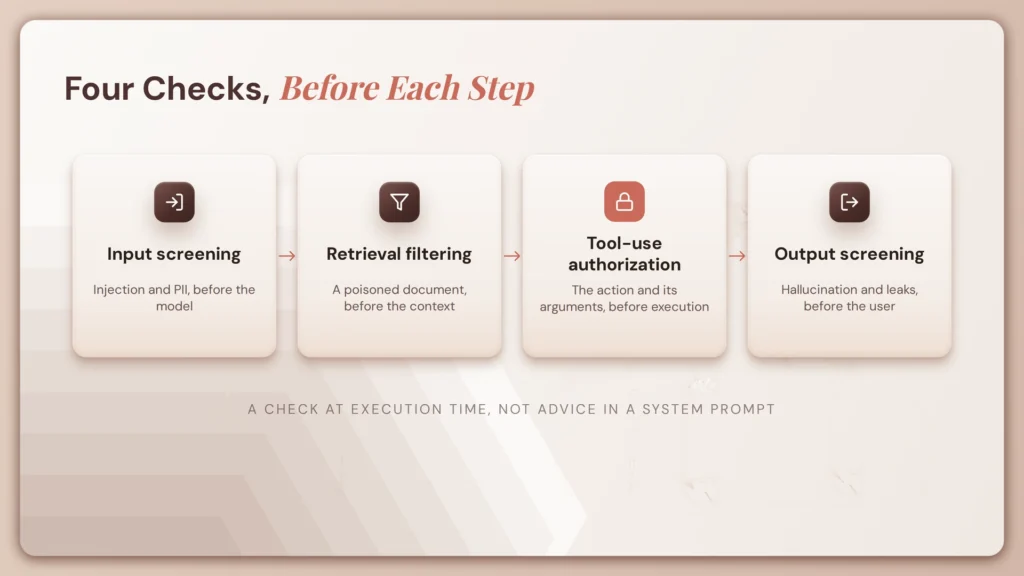
AI guardrail platforms enforce policy on LLM traffic in real time, blocking, redacting, or flagging content and actions that violate a defined rule before they cause damage, a concern that scales fast as more AI agents for enterprises move from pilot to production. Unlike a system prompt, which is advisory and can be overridden by prompt injection, a guardrail is a policy check that runs on every LLM request and response at execution time, evaluating content against rules for safety, privacy, security, and compliance. That distinction is the entire reason the category exists. See the guardrails glossary entry for a fuller definition.
Coverage breaks into four control points:
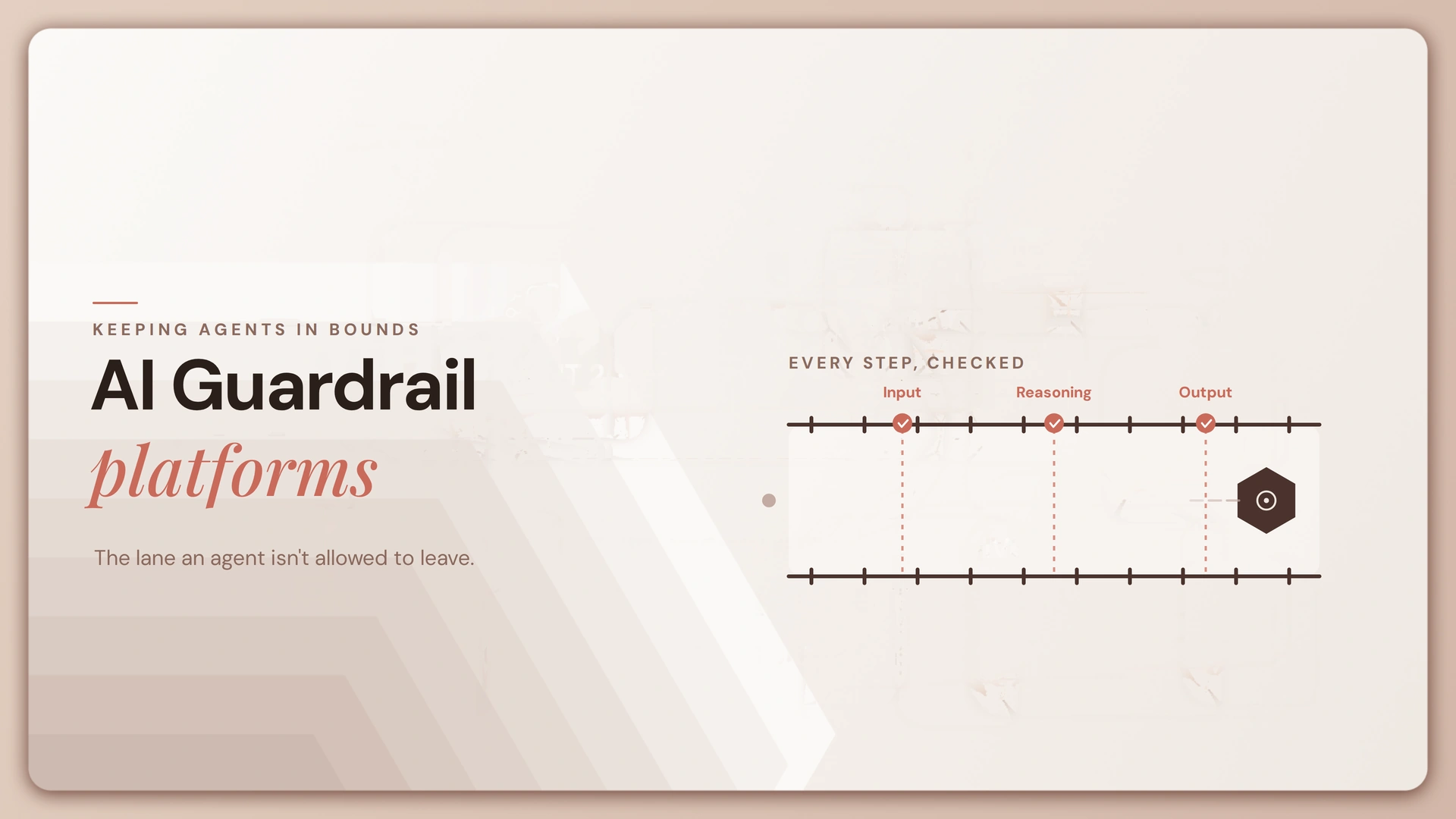
- Input screening. Catches prompt injection and PII before the prompt reaches the model.
- Retrieval filtering. Screens RAG chunks before they enter the context window, since a poisoned document is as dangerous as a poisoned prompt.
- Tool-use authorization. Gates whether an agent’s chosen action and arguments are allowed to execute, a control point most vendors still bolt on rather than design for.
- Output screening. Checks the response for hallucination, toxicity, or leaked data, feeding directly into a broader responsible AI posture.
The Three Placement Layers
Every guardrail decision starts with where the check runs, because location determines visibility. Miss this and the tool you buy will faithfully do its job while the failure happens somewhere it was never positioned to look.
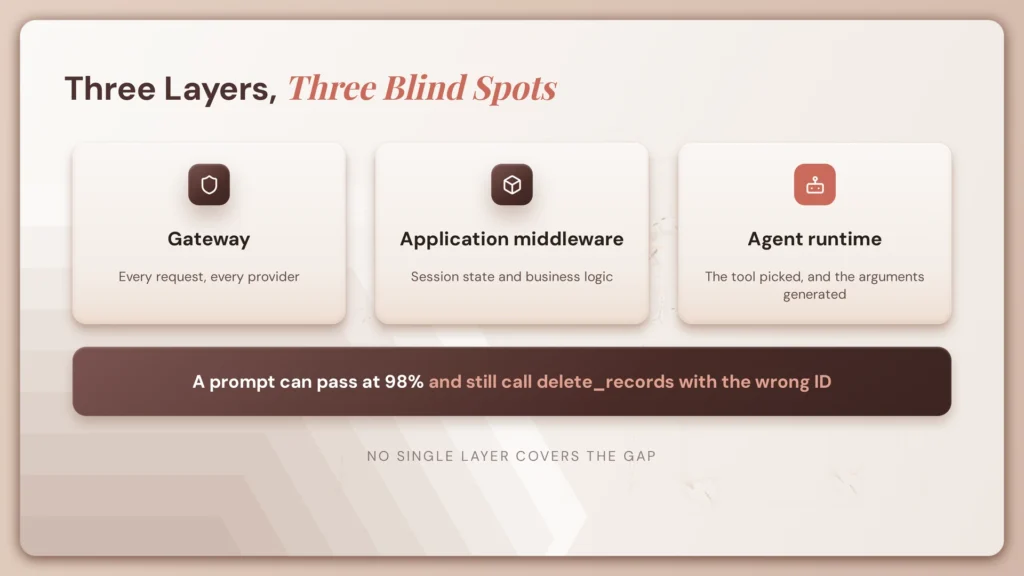
Gateway layer. Sits in front of every model call, regardless of which application made it. One policy, every request, every provider. Bifrost, the open-source AI gateway built by Maxim AI, implements AI guardrails at the gateway layer so those checks run on every request regardless of which application or model made it. What it misses: agent reasoning, tool selection, and anything that happens between the prompt and the final answer.
Application middleware. Lives inside the app’s own code, with access to session state and business logic. Good for enforcing app-specific rules, like blocking a support bot from discussing pricing. What it misses: traffic from other apps, and it can be routed around if a developer forgets to call it.
Agent runtime. The only layer with visibility into the reasoning loop itself, the tool the agent picked, the arguments it generated, and the sequence of steps that led there. Research on agent safety architecture frames this precisely: “alignment without authorization is probabilistic enforcement, and authorization without sandboxing lacks blast-radius containment.” Runtime is where an action can actually be gated before it fires, which is why coverage here maps directly to agent types running in production.
The consequence: a gateway filter can pass a prompt with a 98% confidence score and still let an agent call delete_records with the wrong ID, because the classifier was never looking at the tool call. That failure lives in a gap none of the three layers cover alone, which is why multi-agent architectures increasingly stack more than one.
Seven AI Guardrail Platforms at a Glance
No single vendor here covers all three layers well, and the ones that claim to usually mean they’ve bolted a second layer onto a first. Use this table to shortlist by layer and license, then read the honest limitations below before committing.
AI Guardrail Platform Comparison Table
| Platform | Best for | Open source | Self-host | Layer | Injection defence | Tool-use control |
|---|---|---|---|---|---|---|
| NVIDIA NeMo Guardrails | Programmable dialogue rails (Colang) | Yes | Yes | Middleware | Yes | Limited |
| Guardrails AI | Python validators, structured output | Yes | Yes | Middleware | Via validators | No |
| Lakera Guard | Dedicated injection/jailbreak classifier | No | No | Gateway | Deep | No |
| Future AGI | End-to-end agentic coverage | Yes | Yes | All | Yes | Yes |
| Bifrost (Maxim AI) | OSS gateway plus enterprise governance | Yes | Yes | Gateway | Yes | Yes |
| AWS Bedrock Guardrails | AWS-native stacks | No | n/a | Gateway | Yes | No |
| Azure AI Content Safety | Azure-native stacks | No | n/a | Gateway | Yes | Limited |
The AI Guardrail Platforms in Depth
NVIDIA NeMo Guardrails
An open-source AI security toolkit for adding programmable guardrails to LLM-based conversational applications, Apache 2.0 licensed and maintained by NVIDIA. Its Colang modeling language handles multi-turn dialogue flow control that pure classifiers can’t touch. Honest limitation: Colang has a real learning curve for teams that just want a fast input filter, and its tool-related execution rails are newer and thinner than its dialogue rails. Best for teams already writing Python who need stateful conversation control, not a drop-in filter.
Guardrails AI
An open-source Python framework for building input/output guards that detect, quantify, and mitigate risks in LLM applications, with a Guardrails Hub providing pre-built validators covering toxicity, PII, hallucination, profanity, and bias. Honest limitation: it’s a library, not a network control point, so enforcement is per-service, and validator quality varies because most of the catalog is community-contributed. Best for Python teams that want structured-output guarantees living next to application code.
Lakera Guard
A managed API purpose-built for one job: catching prompt injection and jailbreaks fast. Lakera Guard uses a single endpoint, works with any LLM including OpenAI, Anthropic, Google, Azure OpenAI, AWS Bedrock, or self-hosted models, and handles high-volume production traffic with low latency, making it practical for customer-facing chatbots and real-time applications. Honest limitation: it’s narrow by design. No output screening, no tool-use visibility, and no self-hosting option since it’s a managed service, now under Cisco following the 2025 acquisition. Best for teams that need one excellent input classifier, not a full stack.
Future AGI
The most complete single-vendor answer to all four control points. Its named guardrails span input and output: prompt injection, jailbreak, PII, toxicity, off-topic, hallucination, faithfulness, groundedness, context adherence, task adherence, custom LLM judge, regex, schema, plus agent-specific rails for tool-call validation, scope enforcement, and step budget. Future AGI publishes a 65ms text / 107ms image median time-to-label figure for its Protect model, per its 2025 arXiv research paper. Honest limitation: breadth this wide means committing to one vendor’s ecosystem for a control surface most teams would otherwise compose from two or three specialists. Best for teams that want one runtime instead of stitching several.
Bifrost (Maxim AI)
An open source AI gateway written in Go and licensed under Apache 2.0, purpose-built for teams that need performance and reliability at scale, with integration for thirteen guardrail providers including native Secrets Detection and Prompt Guardrails plus AWS Bedrock, Azure Content Safety, Google Model Armor, and Lakera Guard. Honest limitation: the core gateway is free, but guardrails, governance, and audit logging are enterprise-licensed features layered on top, not part of the free tier. Best for teams standardizing many providers behind one policy engine.
AWS Bedrock Guardrails
Native to the Bedrock stack, with content filters detecting harmful text across categories including hate, insults, sexual, violence, misconduct, and prompt attack, plus PII redaction across dozens of entity types. Honest limitation: AWS’s own documentation notes that the PII filter evaluates text content only, meaning in tool-use workloads it does not evaluate PII the model generates into tool call arguments, a gap AWS documents itself. Best for teams already committed to Bedrock who accept the trade-off covered in model flexibility versus vendor lock-in.
Azure AI Content Safety
Pairs harm-category filtering with Prompt Shields to detect and block prompt injection attacks, groundedness detection to pinpoint ungrounded or hallucinated material, and protected material detection. Its newest feature identifies discrepancies between an LLM’s behavior and its assigned task, including misaligned tool invocations. Honest limitation: that tool-misalignment feature is recent and narrow compared to a true runtime authorization layer, and the whole suite is Azure-only. Best for teams standardized on Azure OpenAI who want groundedness checks included by default.
What Guardrails Don’t Catch
Four gaps persist across every platform above, gateway or middleware, open source or managed.
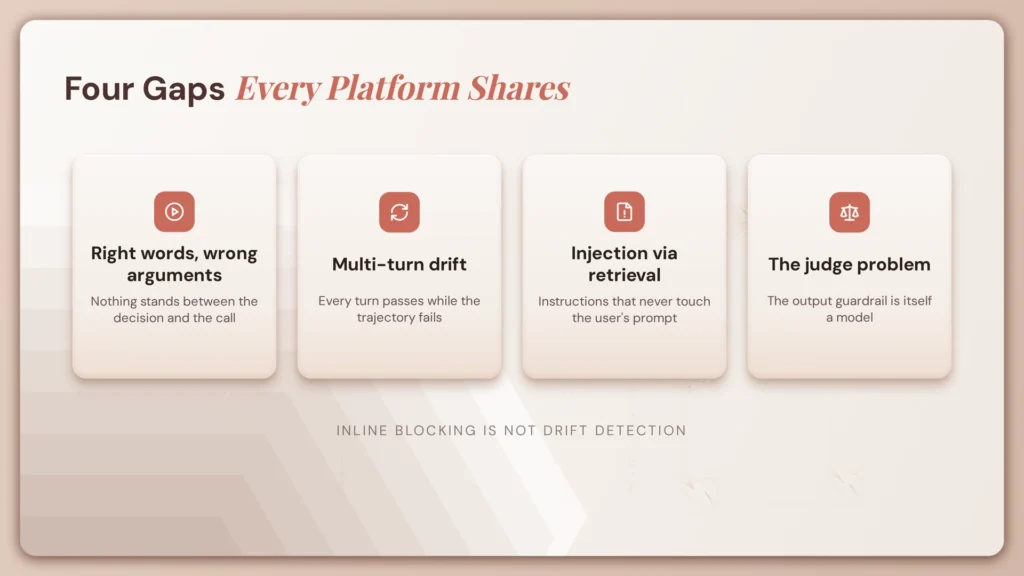
Correct-looking tool calls with wrong arguments. A text classifier scores language, not intent behind an action. An agent can pass every input and output check and still be told not to do something dangerous, refuse in words, and still call the tool anyway, because nothing actually stands between the model’s decision and the tool’s execution.
Multi-turn drift. Guardrails scoped to a single exchange assume one request, one response. An agent runs a loop: it calls a model, reads the result, picks a tool, calls the model again, and repeats without a human between the steps, which changes what a guardrail has to constrain. Each turn can pass while the trajectory fails.
Retrieved-content injection reaching tools. A poisoned PDF or web page can carry instructions that never touch the user-facing prompt, flow through retrieval, and reach a tool call untouched by an input filter scoped to user text.
The judge problem. Most output guardrails are themselves models, with their own blind spots and jailbreak surface, a limitation that maps directly onto AI agent risk management programs that treat guardrails as sufficient rather than as one control among several.
Guardrails block known-bad patterns inline. They don’t tell you how an agent is drifting over the last thousand runs. That’s a job for AI agent observability platforms, evaluation systems that score behavior after the fact rather than gate it in real time.
Selection Criteria for AI Guardrail Platforms

Placement layer first. Decide what failure you’re actually defending against before comparing features. A prompt injection problem needs gateway coverage. A rogue tool call needs runtime coverage. Most enterprises need both.
Latency budget, verified against your own traffic. Published numbers are vendor benchmarks, not guarantees for your payload size or network path. Future AGI’s 65ms figure and Lakera’s sub-50ms claims are both real published numbers, and both are still worth re-testing under your own load before trusting them in a customer-facing path.
Model agnosticism. A guardrail tied to one provider’s stack, like AWS Bedrock Guardrails or Azure Content Safety, inherits that provider’s lock-in. Weigh this against your own model flexibility versus vendor lock-in calculus before standardizing.
Self-host and auditability. Regulated teams need logs that hold up to a SOC 2 or European enterprise AI governance review, and open-source, self-hostable options remove the “trust us” step entirely.
Fit for compliance teams. The best guardrail on paper is the one your auditors can actually trace end to end, which ties directly into broader AI in risk and compliance programs.
Guardrails in the Agent Runtime: Where Lyzr Fits
Lyzr is not a standalone guardrail platform, and it isn’t trying to compete with Lakera, NeMo, or Bifrost on their turf. Lyzr is agent infrastructure, and its Responsible AI and Hallucination Manager modules ship as runtime features of that infrastructure, operating specifically at the third layer this article has been building toward.
That runtime placement gives Lyzr visibility a gateway filter structurally cannot have: when a user submits a question or instruction, the system validates it for potential prompt injection attacks before sending it to the underlying LLM, assigning an injection risk score based on its analysis of the prompt’s intent, and the Hallucination Manager addresses hallucination risk by allowing teams to configure Responsible AI controls at the platform level, so agents operate within defined boundaries while remaining useful and responsive. Permission scoping, approval gates on consequential actions, and full decision traces run through the OpenController, echoing the sequencing outlined in how to take agents to production, and documented further in how teams build responsible AI agents in Lyzr Agent Studio.
None of this replaces a gateway guardrail. It complements one. A common, sound pattern is Lakera or Bifrost screening every model call at the edge, with runtime controls gating what the agent is actually allowed to do once a request passes. That layered pairing shows up again in how Lyzr minimizes hallucinations on AWS Bedrock, and the runtime layer’s real-world resilience was independently stress-tested, not self-reported, in a third-party red-team validation with Repello.
Frequently Asked Questions
What are AI guardrails?
Controls that screen model inputs, retrieved context, tool calls, and outputs against a defined policy, blocking or altering anything that violates it before it reaches a user or a downstream system.
What are the types of AI guardrails?
Four categories map to the four control points: input screening for injection and PII, retrieval filtering for RAG, tool-use authorization for agents, and output screening for hallucination and toxicity.
Are there open source AI guardrails?
Yes. NeMo Guardrails, Guardrails AI, Future AGI, and Bifrost’s core gateway are all self-hostable, though Bifrost’s guardrail features specifically require its enterprise license.
Is Guardrails AI free?
The open-source core is free to install and use. Effectiveness varies because most validators in the Hub are community-contributed rather than centrally maintained.
What are AWS AI guardrails?
Amazon Bedrock Guardrails: managed content filters, denied-topic controls, and PII redaction native to the AWS Bedrock stack, callable across models both inside and outside Bedrock.
Do guardrails stop prompt injection?
They raise the cost of an attack and catch a large share of attempts, but prompt injection remains an unsolved research problem. No vendor should claim elimination.
What latency do guardrails add?
It varies by vendor and payload. Published figures like Future AGI’s 65ms median or Lakera’s sub-50ms claims are real benchmarks from those vendors, not guarantees for your specific traffic. Test before trusting.
Guardrails vs evaluation?
Guardrails block in real time, at request time. Evaluation platforms score behavior after the fact, across many runs, to catch drift a single-request guardrail would never see.
Do guardrails work for AI agents?
Input and output screening alone miss tool selection and multi-step trajectory failures. Agent systems need a runtime layer that can see and gate the reasoning loop itself.
Can I use multiple ai guardrail platforms?
Yes, and most serious deployments do. Gateway screening for every model call, paired with runtime controls for agent actions, is the standard layered pattern.
Where This Leaves the Buying Decision
Every vendor comparison in this category, including the tables above, will tell you which tool scores highest on its own benchmark. None of them can tell you which layer your actual failure lives in, because that depends on what your agents are authorized to touch.
Before the next guardrail RFP goes out, map the specific action an agent could take that would actually hurt the business, and trace which of the three layers would have to catch it. If the answer is “none of them, currently,” that’s the finding worth acting on.
Book a demo to walk through where runtime controls would sit against your own agent’s tool access before you finalize a gateway vendor.
Book A Demo: Click Here
Join our Slack: Click Here
Link to our GitHub: Click Here