A support agent’s faithfulness scores on refund questions have been sagging for three days. An engineer reads twenty traces, adds two sentences to the system prompt and ships. Refund scores recover by the afternoon.
A week later, the order-tracking flow starts inventing delivery dates. Nobody connects it to the refund fix, because no trace records which prompt version answered, and the fix was only tested against refund questions.
The team had observability. What it didn’t have was a loop.
Key takeaways
- Closing the loop means every production failure is traced to what produced it, turned into a regression test, fixed and re-verified before the next version ships.
- The loop usually breaks at the handoffs between tools, not for lack of tools: traces that can’t say what changed, failures that never become tests, releases nobody signs off.
- Output can drift with no prompt edit, so traces must record the model, parameters, tools and retrieval source too, or every regression gets blamed on the prompt.
- Not every failure is a prompt failure. Label it first, then pick the fix: a prompt edit, few-shot examples, schema validation, or a retrieval or upstream change.
- A fix has to pass the cases that failed and the cases that already worked, then clear shadow traffic and a canary.
- Automate detection, scoring and regression testing, but keep a human sign-off on promotion.
What it means to close the loop between observability and prompt fixes

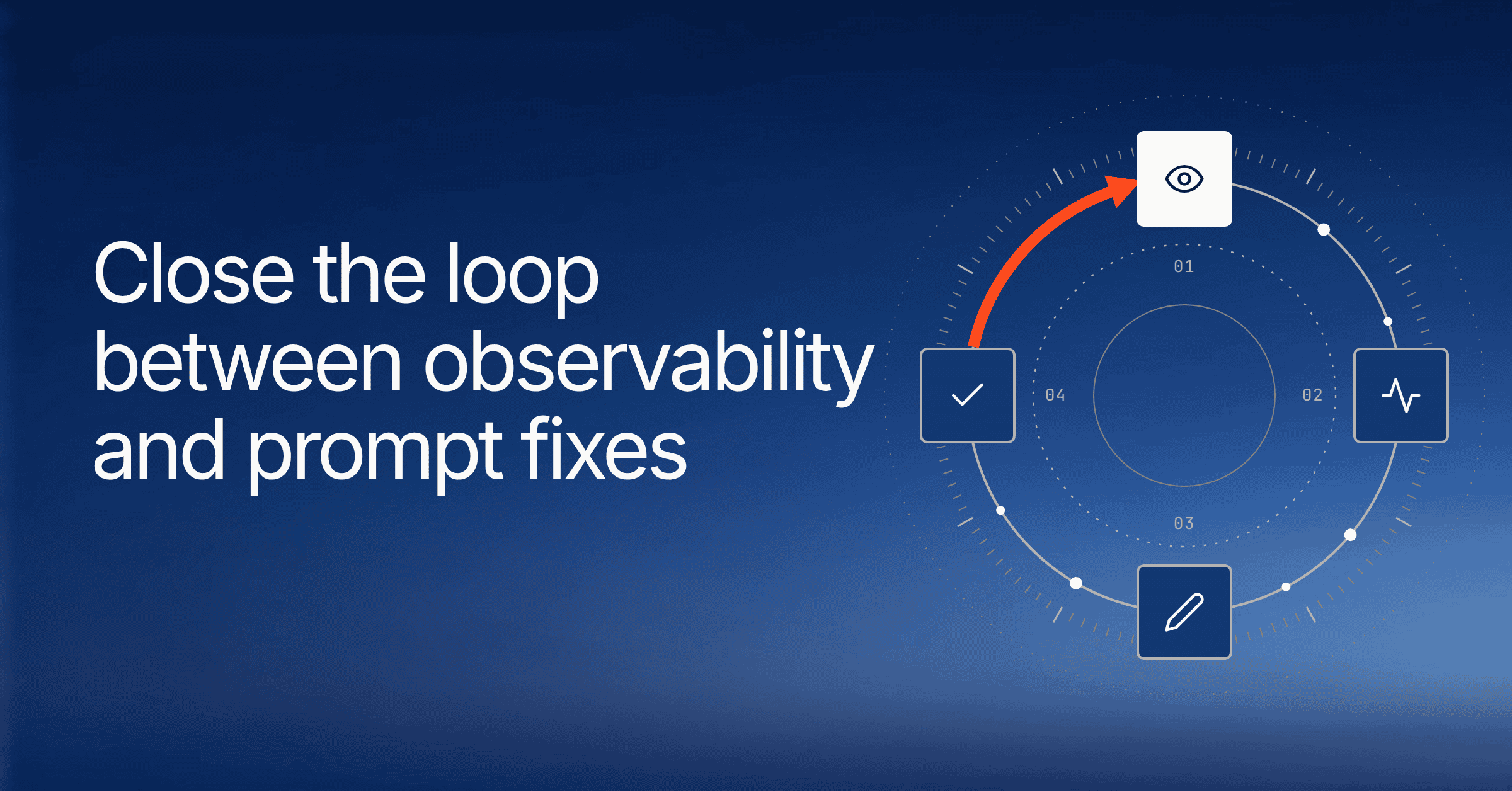
To close the loop between observability and prompt fixes is to wire production telemetry, evaluation and prompt release into one process, so every flagged failure can be traced to what produced it, becomes a regression test, and must be passed by the next version before it ships.
It has to be deliberate because LLM failures are quiet: a hallucinated answer still returns HTTP 200, so uptime dashboards stay green while quality slides.
Gartner predicts that by 2028, demand for explainable AI will drive LLM observability investments to 50% of GenAI deployments, up from 15% today. Senior Principal Analyst Pankaj Prasad says the priority is “moving toward deeper quality measures such as factual accuracy, logical correctness and sycophancy.”
But a quality score nobody acts on is just a more expensive dashboard.
Where the loop usually breaks
Most teams already own the pieces. The loop breaks in the gaps between them.
The first gap is attribution: a trace shows the bad answer but not whether the prompt, the model or the retrieval index changed. The second is evidence that evaporates: someone fixes the prompt by eye and the failures never become tests. The third is the opening scenario, a fix checked only against the cases that failed. The fourth is release: prompts buried in code wait for a release train, while prompts edited live change far too easily.
In a lot of teams, “the loop” is a Slack thread and one engineer’s memory. Lyzr’s white paper on what separates production AI deployments from the pilots that preceded them looks at how teams measure that difference.
The five steps of a closed loop between observability and prompt fixes
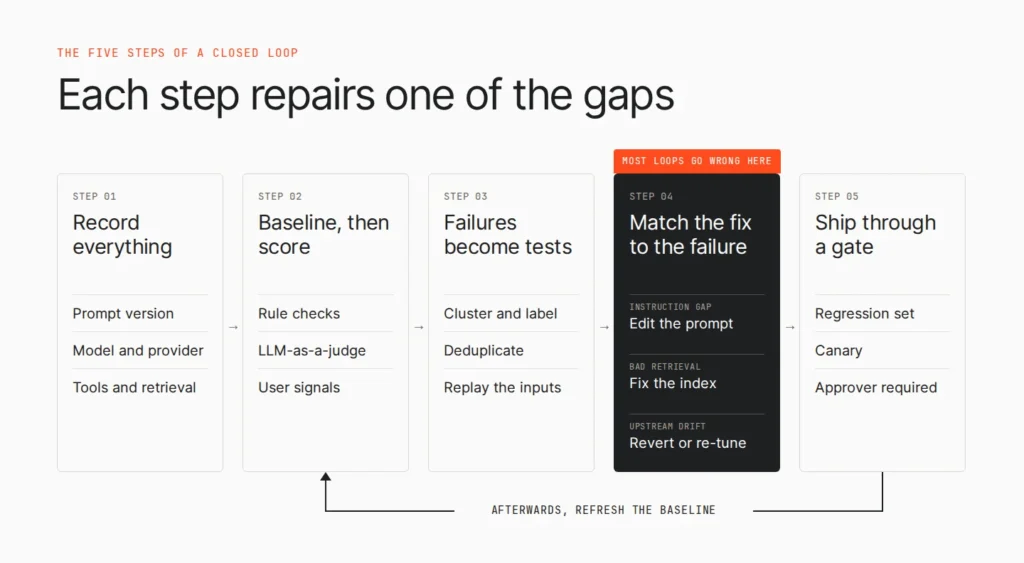
Each step below repairs one of the gaps.
Record everything that shapes an output, not just the prompt
Tagging traces with a prompt version isn’t enough. Output also changes when a provider updates a model, someone forgets to revert an experimental temperature, a tool’s schema is edited, or the retrieval index is rebuilt.
So every span should carry the prompt version, model and provider, runtime parameters, tool definitions and retrieval source, plus segment tags and a conversation ID. The OpenTelemetry GenAI semantic conventions, still in development status, standardize names for the model, provider, temperature, tool definitions and conversation ID; prompt version and retrieval source need custom attributes. Message content capture is opt-in there for good reason, since raw prompts contain whatever users typed.
Baseline each version, then score live traffic against it
Baseline each prompt version over a full traffic cycle, then score a sample of live traffic with three kinds of signal: deterministic checks (valid JSON, required fields), LLM-as-a-judge scores for faithfulness and instruction adherence, and user signals. Regenerations, heavy edits and escalations tell you far more than rare thumbs-down clicks.
Segment the results, because a healthy average can hide one collapsed intent. Alert on sustained drops across a minimum number of scored traces, and calibrate the judge against human-labelled examples, or its blind spots become yours.
Turn failures into labelled, deduplicated test cases
When an alert fires, cluster flagged traces by embedding similarity to surface patterns like “billing questions asked in German.” Give each cluster one label from a short list: hallucination, bad retrieval, format error, policy issue.
Deduplicate, and add variations so the fix has to generalize. Then replay the failing inputs against the previous version. If it fails the same way, the prompt probably isn’t what changed.
Pick the fix that matches the failure
Most loops go wrong here, because every failure gets a prompt edit. The label should decide the fix.
| Failure label | Likely cause | Fix |
| Instruction ignored or wrong tone | Instruction gap | Edit the prompt |
| Fails on one recurring intent | Missing examples | Dynamic few-shot examples for that intent |
| Format error | Output structure | Structured output or schema validation |
| Hallucination traced to retrieval | Bad retrieval | Fix the index or source |
| Shift after a model, tool or parameter change | Upstream drift | Revert or re-tune that component |
An automated prompt optimizer can help with the first two rows. For the last three, a prompt edit only hides the real problem.
Ship fixes through a gate, not a deploy
Keep prompts in a registry outside application code, with production as a pointer to an immutable version, so rollback means moving the pointer back.
The gate starts with a regression set covering the new failure cases and the cases that already passed; that second half would have caught the refund fix. Set the pass bar explicitly and below 100%, because LLM output isn’t deterministic. Then shadow traffic, a small canary, and promotion, with an approver required to move the production pointer. Afterwards, refresh the baseline.
How to tell whether your loop is actually closed
Teams rarely measure the loop itself. Four numbers cover it:
- Conversion rate: share of flagged failures that became test cases.
- Time to verified fix: first alert to a promoted, regression-tested version.
- Repeat-failure rate: how often a fixed cluster returns.
- Gate pass rate over time.

High conversion with a falling pass rate means failures outpace fixes; a high pass rate with low conversion means the gate only tests what you knew.
Should prompt fixes be fully automated?
No. Automate everything up to the decision, and keep the decision with a person.
Detection, clustering, candidate rewrites and regression runs should be automated. Promotion shouldn’t. An optimizer rewarded for raising a judge’s score learns to please the judge, which is Goodhart’s law in miniature, and the two are often similar models with shared blind spots.
The human review is small: the diff, regression scores, shadow results. It’s also what the NIST AI Risk Management Framework expects: MANAGE 4.1 calls for post-deployment monitoring plans that include “mechanisms for capturing and evaluating input from users” alongside change management. A signed-off promotion is documented change management. A self-rewriting prompt is not.
How Lyzr OpenController keeps the loop closed across every agent
All of this can be held together by hand for one agent. It stops holding at fifty agents across five teams, each with its own tracing, evals and approval habits. At that scale, the loop is only as strong as the agent nobody remembered to wire in.
That’s the problem Lyzr OpenController is built for: one control plane for every agent, model and environment, with four stages that line up with the loop.
- Find automatically discovers agents, models, tools, data and workflows across the AI estate, so every production agent sits inside the loop.
- Run monitors agents, applications, APIs and infrastructure in real time, giving every team the same observe step.
- Improve turns real-world usage, performance, cost and security signals into actionable insights.
- Ship evaluates, validates and governs every agent and workflow before it reaches production, so the gate works the same way for every team.
Run the opening scenario through it, and the refund fix is evaluated before production, while the order-tracking regression surfaces in monitoring instead of a customer complaint.
Book a demo to see OpenController close the loop across your agents.
FAQ
Record what produced every output, score live traffic against a per-version baseline, turn failures into labelled regression tests, match the fix to the failure, and release through a gate that an approver signs off.
For an LLM application, it means tracing one request through every step that shaped the answer: user input, prompt version, retrieval, tool calls, model calls, output and user feedback. It shows where a failure started, not just that it happened.
Use models where volume outruns people: LLM-as-a-judge to score sampled traffic, embeddings to cluster similar failures, and models to summarize long traces or draft candidate fixes. Keep deterministic checks for objective rules, and a human approving anything that reaches production.
Label it first. Ignored instructions and wrong tone usually need a prompt edit. Format errors need structured output, retrieval-driven hallucinations need a better source, and shifts after a model or tool change need that component fixed.
Test every candidate against new failure cases and cases the current version already passes, then use shadow traffic and a canary. Keep the previous version one pointer move away.
It discovers every agent across the AI estate, monitors them in real time, turns usage, performance, cost and security signals into insights, and evaluates and governs every agent before production.
Book A Demo: Click Here
Join our Slack: Click Here
Link to our GitHub: Click Here