A ticket comes in: the claims-triage agent’s replies are too long. A coding agent picks it up, edits one sentence in the system prompt and opens a pull request. Lint passes, unit tests pass, the build goes green, and the change merges before anyone is awake.
By lunch, the claims agent is calling the wrong tool on a small but steady share of requests, and every log line looks reasonable. Nothing in the pipeline failed, because every check in it was written for software that does the same thing twice.
The pipeline wasn’t broken. It was answering a question the release no longer asks.
Key takeaways
- “Agent CI/CD” means two things: pipelines that ship agents, and pipelines that agents help run. Most teams now face both at once.
- The root difference is determinism. One green run proves very little about an agent, so quality is judged by pass rates across repeated runs.
- An agent release is a bundle of prompt, model, tools and config, not just code. Version it, promote it and roll it back as one unit.
- Exact-match assertions give way to tiered evals: cheap deterministic checks on every commit, scored evals on merge and a golden dataset before promotion.
- Agents can triage and patch builds, but they should never approve their own fixes.
- The fundamentals still hold: version control, staged rollouts, one-step rollback and a named approver for production.
- A pipeline governs what gets promoted. Something else has to govern what runs.
What agent CI/CD actually means
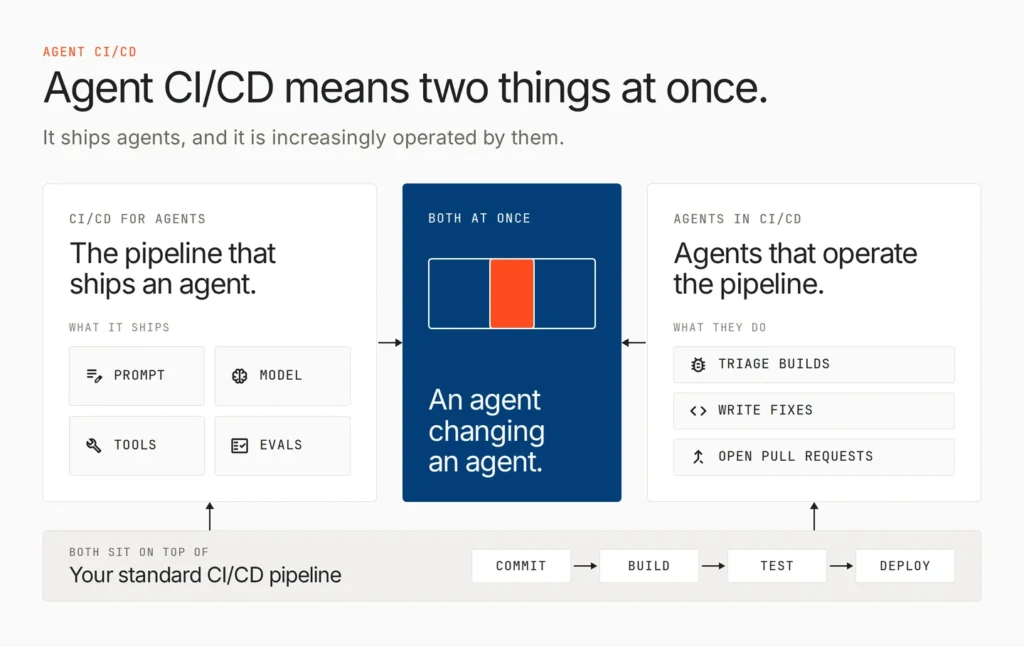
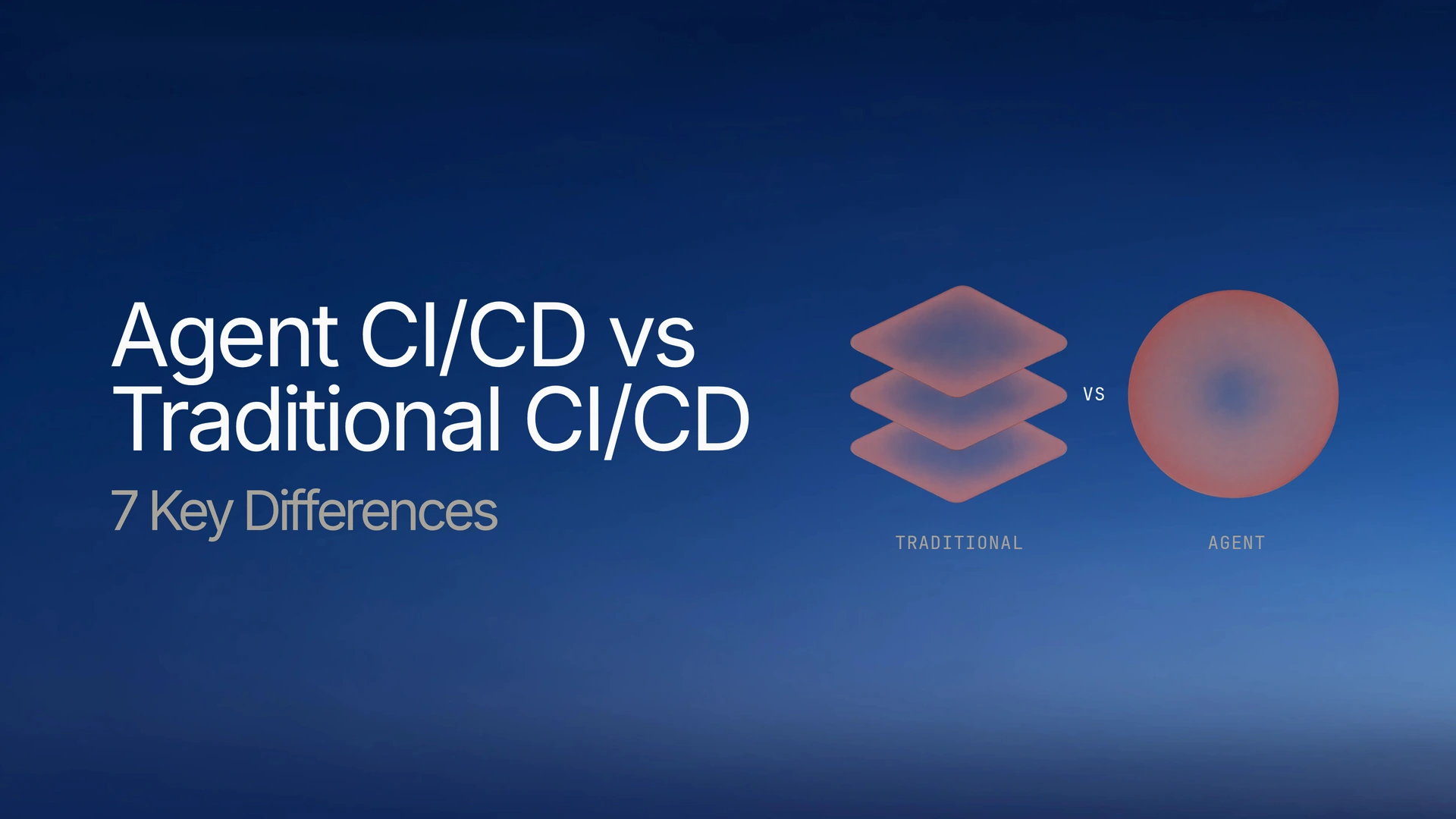
The difference between agent CI/CD vs traditional CI/CD is what the pipeline can assume. Traditional CI/CD assumes code behaves identically every run. Agent CI/CD ships, and is increasingly operated by, AI agents whose outputs vary, so it tests behavior across many runs, versions prompts and models with code, and governs what agents may change.
This piece assumes you already run a standard CI/CD pipeline. The phrase “agent CI/CD” covers two different things on top of it:
- CI/CD for agents: the pipeline that ships an agent’s prompt, model, tools and evals.
- Agents in CI/CD: agents that operate the pipeline, triaging builds, writing fixes and opening pull requests.
They’re colliding: the opening scenario was both at once, an agent changing an agent. Gartner predicts at least 15% of day-to-day work decisions will be made autonomously through agentic AI by 2028, up from 0% in 2024, and software delivery is an obvious place for that to show up.
Agent CI/CD vs traditional CI/CD at a glance
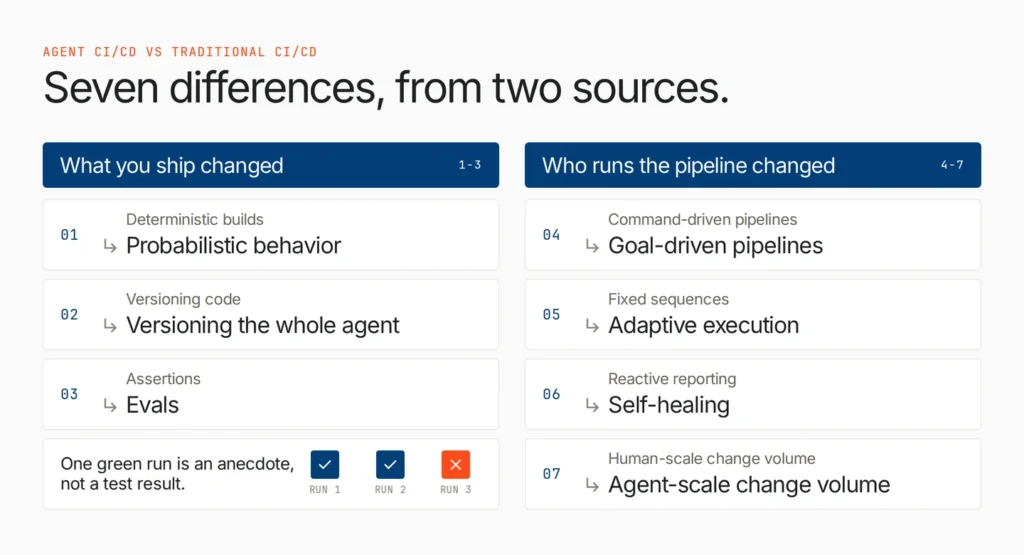
The seven differences side by side, with the meaning each one comes from:
| Difference | Traditional CI/CD | Agent CI/CD | Comes from |
| System behavior | Deterministic: same input, same result | Probabilistic: same input, varying output | Shipping agents |
| What gets versioned | Code and build artifacts | Code plus prompts, model versions, tool schemas and config | Shipping agents |
| How quality is tested | Exact assertions, pass or fail | Evals scored across repeated runs | Shipping agents |
| Pipeline logic | A command list written in advance | A goal the agent plans against at runtime | Agents running it |
| Execution path | Fixed sequence of steps | Steps adapted to logs and context | Agents running it |
| Failure handling | Report and wait for a human | Triage, patch and open a fix PR | Agents running it |
| Change volume | Human-paced pull requests | Machine-paced pull requests across repos | Agents running it |
The 7 key differences, explained
The first three come from what you ship, the last four from who runs the pipeline.
1. Deterministic builds vs. probabilistic behavior
Traditional CI/CD trusts a single run because code repeats itself. Agents don’t, even when you try to force them. A 2024 study of LLMs configured to be deterministic found accuracy variations of up to 15% across naturally occurring runs, and concluded that none “consistently delivers repeatable accuracy across all tasks, much less identical output strings.”
One green run is an anecdote, not a test result.
There’s no industry-standard confidence threshold either, whatever you may read. Teams that design around non-deterministic LLMs set a pass rate per metric based on risk, measure it across runs, and rerun borderline results.
2. Versioning code vs. versioning the whole agent
A one-sentence prompt edit can change an agent more than a thousand-line diff, and a code-triggered pipeline may never see it. The release unit is a bundle: prompt, model version, tool schemas, retrieval settings and guardrail config, pinned together and immutable. A prompt registry and proper agent versioning let the CI trigger watch all of it. Rollback reverts the whole bundle, because an old prompt against a new model is a release nobody tested.
3. Assertions vs. evals
Exact-match tests reject correct answers that are worded differently. Agent CI/CD tests the outcome: the right tool, the right parameters, the task finished, the policy respected.
Tier it. Deterministic checks (schema, PII, tool-call format) run on every commit, scored evals on merge, and the full golden dataset before promotion, alongside red-team cases. Score tool selection separately, since an average hides it. LLM-as-judge graders add their own variance, so use a deterministic grader wherever one exists.
4. Command-driven vs. goal-driven pipelines
A traditional pipeline is a YAML file executed line by line. A pipeline agent gets a goal, such as “get this build green” or “patch this CVE,” and plans its own steps. It handles cases nobody scripted, but two runs on one commit can diverge, and debugging means reading the prompt and tool calls too. Failures stop being loud and become quiet and plausible.
5. Fixed sequences vs. adaptive execution
Agents can skip, reorder or rerun steps based on logs, which helps with flaky suites. That’s fine for how the pipeline reaches a gate. It’s never fine for whether the gate applies. Keep deployment rules in policy as code the agent can read but not edit. If an agent can skip the security scan to get green faster, eventually it will.
6. Reactive reporting vs. self-healing
Traditional pipelines fail and wait. Pipeline agents triage the failure, separate flaky tests from regressions, write a patch and open a fix PR. It’s the most valuable difference here, and the riskiest.
Two rules keep it safe: the agent that writes the fix never approves it, and any test it quarantines gets an owner and a ticket. The OWASP Top 10 for Agentic Applications explains the first rule with ASI09, Human-Agent Trust Exploitation, where “confident, polished explanations misled human operators into approving harmful actions.” A well-written agent PR description is exactly that.
7. Human-scale vs. agent-scale change volume
Review processes were sized for people opening a few pull requests a week. Coding agents open many short-lived branches at once, so the bottleneck moves from writing code to reviewing and merging it.
More changes aren’t safer changes, especially when one agent’s output becomes the next agent’s input. OWASP’s ASI08, Cascading Failures, is the worst case: “false signals cascaded through automated pipelines with escalating impact.”
What stays the same in agent CI/CD
None of this means replacing your pipeline. A pipeline that gates a probabilistic system should itself be deterministic and boring.
Every change still goes through version control and review. Releases still promote through stages, starting with shadow traffic and a small canary, though agents need longer soak times because drift can take hours to surface. Rollback is still one step, and rollback patterns still handle side effects that already happened. What changes is what each gate measures, which the How to take agents to production playbook covers stage by stage.
The pipeline is still the right place to decide what gets promoted. It was never built to decide what an agent does after that.
Where a pipeline stops protecting you
CI/CD controls the release. It doesn’t control the runtime or the agents that operate it, and three gaps follow.
Agents that skip the pipeline. Agents built in a SaaS tool or another team’s cloud, and prompts edited live in production, never reach a gate. That’s why shadow AI agents are a release problem as much as a security one.
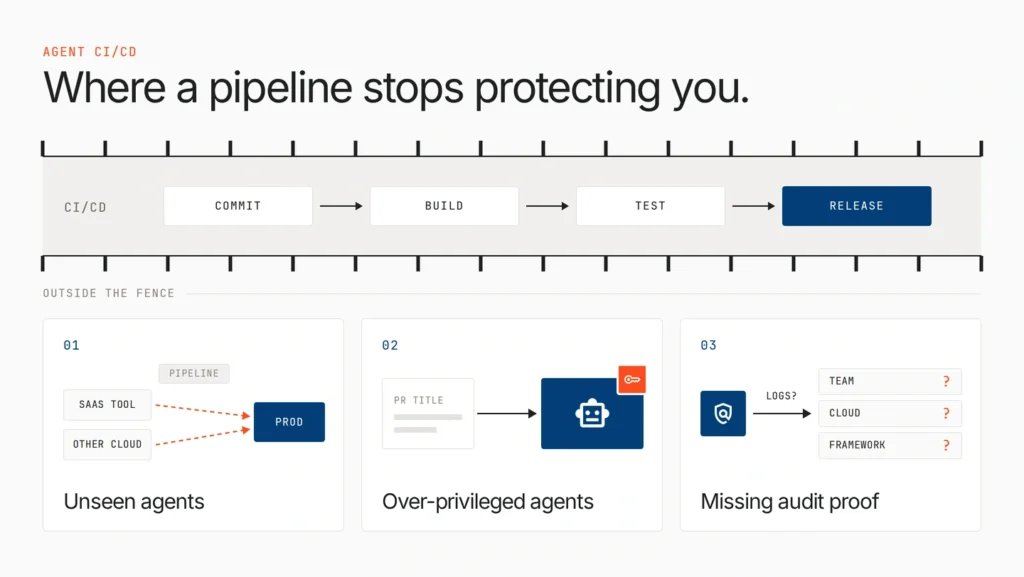
Pipeline agents hold real power. A build-triage agent reads untrusted text, such as PR titles, issues and dependency READMEs, while holding credentials. OWASP’s LLM01 calls this indirect prompt injection, which occurs “when an LLM accepts input from external sources, such as websites or files.” Its advice: “Restrict the model’s access privileges to the minimum necessary for its intended operations.” Skip that and you get ASI03, Identity and Privilege Abuse, where leaked credentials let agents operate far beyond their intended scope. The fix is per-agent identity and access control enforced in the request path, which a YAML file can’t provide.
Proof across the estate. Approvals, separation of duties and logs have to hold across every team, cloud and framework. NIST SP 800-218A extends the Secure Software Development Framework to AI model development, and Article 12 of the EU AI Act requires high-risk systems to “technically allow for the automatic recording of events (logs) over the lifetime of the system.”
Gartner expects over 40% of agentic AI projects to be canceled by the end of 2027, citing “escalating costs, unclear business value or inadequate risk controls.” A pipeline can’t fix the last one on its own.
How Lyzr OpenController governs agent CI/CD from promotion to runtime
What closes those gaps isn’t a new pipeline. It’s one control layer around what your pipeline promotes and what runs afterwards. Lyzr OpenController is explicit that it “does not build or package your containers,” and that “your team continues to own the agent code, container images, and deployment process.” It sits beside your CI/CD.
- Find closes the first gap, built to “automatically discover agents, models, tools, data, and workflows across your entire AI estate,” including the ones that skipped your pipeline.
- Ship covers differences two, three and six: “evaluate, validate, and govern every agent and workflow before it reaches production,” with “ordered promotion, separation of duties on prod” and “immutable versions, rollback as a pointer move.”
- Run closes the second gap. OpenController “refuses the call in the request path” and governs “who can run it, what it can spend, what it can access, and what happened when it did.”
- Improve turns “real-world usage, performance, cost, and security signals into actionable insights,” the raw material for your next eval set.
The third gap is the product’s own promise: “Every identity attributable. Every decision traceable. Every policy enforceable.”
Back to the claims agent. The coding agent’s prompt change would have needed a separate approver before production, the previous bundle would be one pointer move away, and a call to the wrong tool could be refused in the path instead of discovered at lunch.
Book a demo to see OpenController govern agent releases across your existing pipelines.
FAQ
Traditional CI/CD assumes deterministic code and checks it with exact assertions. Agent CI/CD ships non-deterministic agents, so it scores behavior across repeated runs, versions prompts, models and tools as one bundle, and governs agents that fix builds or open pull requests.
Yes, as the backbone. Trigger on prompt, model and config changes, replace exact-match tests with evals scored across runs, and add shadow and canary stages with longer soak times.
Run each eval several times and judge the pass rate, not one result: deterministic checks on every commit, scored evals on merge, a golden dataset before promotion, and more trials for borderline results.
Pipelines are usually grouped by how far automation goes. Continuous integration pipelines build and test every merge, continuous delivery pipelines keep each change releasable behind a manual approval, and continuous deployment pipelines release automatically once checks pass. Agent pipelines add eval gates and staged rollouts on top of whichever type you run.
Safe for proposing fixes, not approving them. Give the agent short-lived, least-privilege credentials, keep deployment rules in policy it can’t edit, and require a separate approver before its change reaches production.
The 7 C’s are a commonly cited grouping of DevOps practices rather than a formal standard: continuous development, integration, testing, deployment, feedback, monitoring and operations. Agent CI/CD keeps all seven, but testing becomes repeated evals and monitoring has to track behavior and drift, not just uptime.
Book A Demo: Click Here
Join our Slack: Click Here
Link to our GitHub: Click Here