In March, your distilled support model answered most tickets on its own and sent only the hard ones up to the frontier model. Finance loved the chart. By September, close to a third of requests are escalating again, latency is creeping up because each escalation waits for two model calls, and nobody can say when it started.
Nothing crashed. Customers began asking about a pricing plan that didn’t exist in spring, and the student was still answering last spring’s questions.
That’s what most guides to model cascading and distillation for production AI leave out. Both get pitched as a one-time cost cut. In production they behave like a loop, and a loop needs an owner.
Key takeaways
- Model distillation trains a small student model on a large teacher model’s outputs, so it handles your specific tasks at a fraction of the cost. Model cascading decides, request by request, whether that student’s answer is good enough or should go to the teacher.
- With hosted frontier APIs, distillation usually means training on the teacher’s text responses, because its internal probabilities and layers aren’t available to you.
- A cascade saves money only while escalations stay low, since every escalated request pays for both models in cost and latency.
- The requests that escalate are the best training data for the next student, which turns the two techniques into one loop.
- Left alone, that loop decays as traffic, thresholds and teachers change, so model versions need release-grade governance across every team that runs them.
What are model distillation and model cascading?
Model distillation and model cascading are two techniques for getting close to frontier-model quality without paying frontier prices on every request. They work at different moments, which is why production teams usually end up needing both.
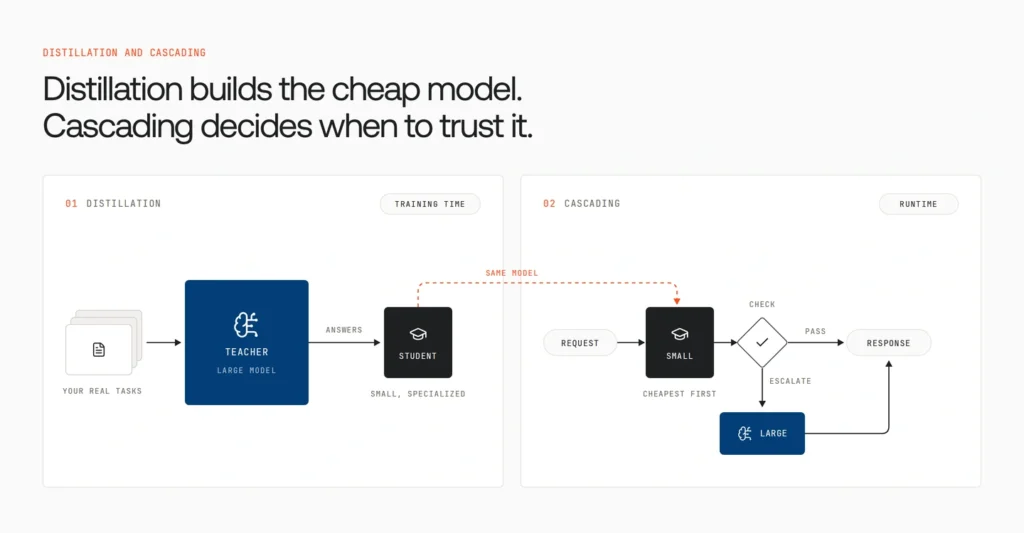
Model distillation happens at training time. A large, capable “teacher” model answers examples of your real tasks, and a much smaller “student” model is fine-tuned to reproduce those answers. The result is a cheap model that’s specialized in your workload rather than in everything.
Model cascading happens at runtime. Each request goes to the cheapest capable model first. A check decides whether the answer is good enough, and if it isn’t, the request escalates to a larger model.
Put simply, distillation builds the cheap model and cascading decides when to trust it. That’s also what separates a cascade from small model routing, which picks a model before the call instead of checking the answer after it. Neither idea is new. What has changed is how much production traffic they now apply to.
Why “frontier model for everything” stops scaling
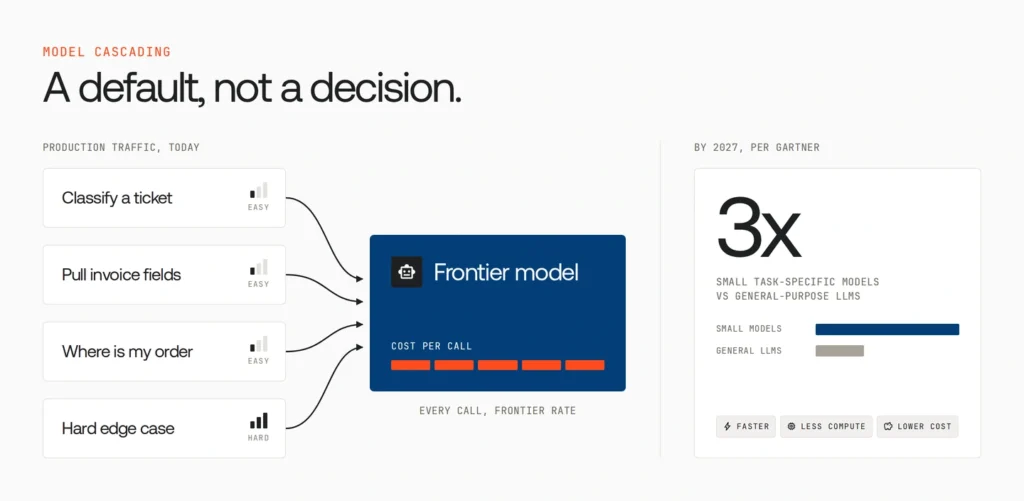
Most production traffic isn’t hard. Classifying a ticket, pulling fields from an invoice, answering “where’s my order”: a much smaller model handles these well. Yet in many stacks they’re billed at frontier rates because that’s the model the app was first built against. That’s a default, not a decision.
Gartner predicts that by 2027, organizations will use small, task-specific AI models at least three times more than general-purpose LLMs, because these models respond faster, use less computational power and cost less to operate and maintain.
Acting on that shift safely means getting two things right: a student good enough to trust, and a rule for when not to trust it.
How model distillation works for LLMs
The key detail in distillation is what the student learns from. Instead of only right-or-wrong labels, it learns from the teacher’s outputs, which carry more information about how the teacher reasons and where it’s unsure.
For LLMs, that increasingly means learning the teacher’s reasoning as well as its answers. When DeepSeek distilled its R1 reasoning model into open Qwen and Llama models ranging from 1.5B to 70B parameters, it used about 800,000 curated samples. The distilled 32B model beat the same base model trained with large-scale reinforcement learning on every benchmark the team reported.
A 2025 survey of LLM distillation groups current methods into task-specific alignment, rationale-based training and multi-teacher frameworks. Your teacher decides which you can use. A hosted frontier API returns text and, at most, limited token log-probabilities, so you’re training on its outputs and reasoning. Methods that match the teacher’s internal probabilities or layers need its weights.
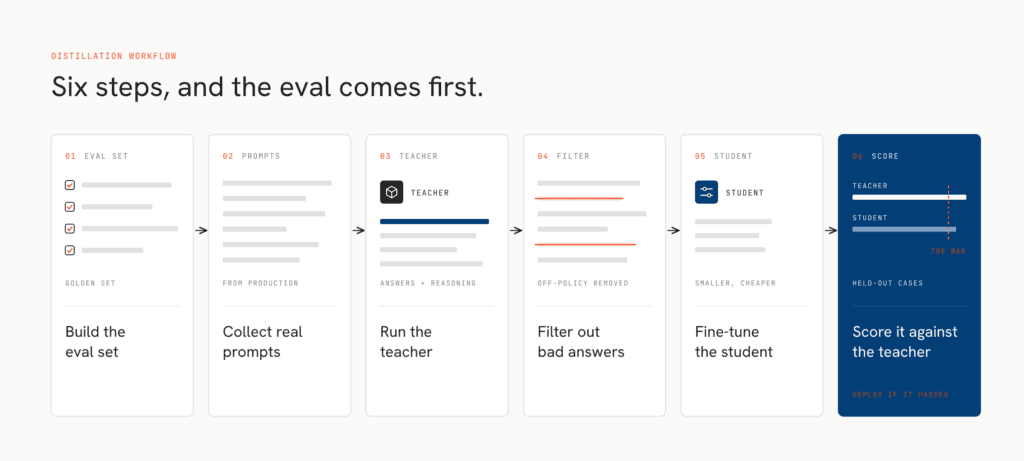
The workflow that holds up in production starts with the eval, not the data:
- Define the task and build the evaluation set.
- Collect real production prompts.
- Run them through the teacher and keep its responses.
- Filter out wrong or off-policy answers.
- Fine-tune the student on what’s left.
- Score it against the teacher on held-out cases, and deploy only if it clears the bar.
For step six, our roundup of LLM evaluation tools is a good starting point.
How model cascading works
Once the student exists, the design questions in a cascade sit between the tiers: what triggers an escalation, and whether the escalations leave any savings behind.
What triggers an escalation
Token log-probabilities give a cheap confidence estimate, but they aren’t the strongest signal. A 2025 study of semantic agreement found that checking whether several sampled answers agree in meaning is more reliable than token-level confidence. Its cascades matched the larger model’s quality at 40% of the cost and cut latency by up to 60%, and the method works through black-box APIs. A learned scorer can also predict whether an answer will be accepted. Deterministic validators check schema, sources and policy.
Run the deterministic checks first. A confidence score from the model that might be wrong is the weakest signal in the stack. A semantic cache can sit in front as tier zero, and remember that a cascade is not failover: failover reacts to an outage, a cascade to a weak answer.
The cost math most guides skip
Every escalated request pays twice, in money and latency. So, roughly:
cost per request ≈ small-model cost + (escalation rate × large-model cost)
Take an illustrative case where the small model costs one-twentieth of the large one. At 20% escalation, you pay about 25% of the frontier-only cost. At 60%, you pay about 65%, and most users wait for two calls. Long before savings vanish, a high-escalation cascade becomes a slower, more complicated way to call your frontier model.
In production, the escalation rate comes down to how good the student is, which is exactly where the two patterns meet.
Model cascading and distillation for production AI: one loop, not two projects
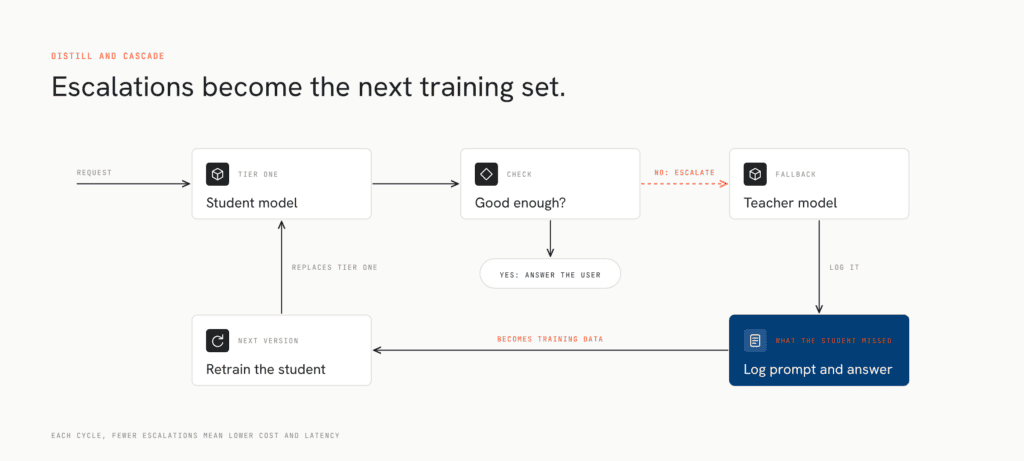
The distilled student sits at tier one and the teacher is the fallback. Every escalation gets logged with the teacher’s answer. Those pairs are, by definition, the cases the student gets wrong, which makes them your most valuable training data. Retrain on them, and the next student escalates less, which lowers cost and latency and pays for the next round.
Recent research backs this up. Inter-Cascade, published in 2025, treats the large model as a “long-term teacher”: each time it resolves a deferred query, it also writes a reusable strategy the small model can retrieve for similar queries later. Against a standard cascade, the authors report up to 48% fewer calls to the strong model and up to 50% lower fees. Whether you retrain the student or feed it retrieved examples, the escalations are where the learning is.
Watched, the loop improves the system every cycle. Ignored, the same loop quietly degrades it, which is how the September scenario happened. It’s the same discipline as closing the loop between observability and prompt fixes.
Four ways the loop decays in production
The traffic moves, the student doesn’t
Users ask about new products and policies the student never saw, so escalations climb and the bill follows. Treat escalation rate as a production metric with an alert, split by task type. A spike in one segment tells you exactly what to retrain on.
Treat escalation rate as a production metric with an alert, split by task type. A spike in one segment tells you exactly what to retrain on. If you’re deciding which production metrics matter beyond cost, our white paper on the measurement gap between AI pilots and production deployments is a good next read.
Thresholds rot quietly
A threshold tuned in March is wrong after the next retrain or prompt edit. Too strict and cost creeps up; too loose and wrong answers ship unnoticed. Version the threshold with the student, prompt and teacher as one bundle, and roll the bundle back together. Our posts on agent version history and rollback patterns go deeper.

A new teacher arrives
Providers ship new frontier models every few months, and swapping the teacher changes the fallback and the next training set at once. Treat it as a release: evals, staged promotion and approval by someone other than the author, the same discipline as agent CI/CD.
Students multiply
One team distills a support student, another a claims student, then v2 and v3. Soon nobody knows which models are live, who calls them or what each costs. Model sprawl is agent sprawl with worse paperwork.
The part one team can’t own
These fixes work for one team. Across an estate, with dozens of agents, students in your containers, hosted teachers in other clouds and every team setting its own thresholds and spend, it falls apart. You need one place that knows which models and agents exist, gates what reaches production, limits spend and access, and acts in the request path.
Gartner predicts over 40% of agentic AI projects will be canceled by the end of 2027 due to escalating costs, unclear business value or inadequate risk controls. A drifting cascade feeds the first and the last. Not sure how many students and agents you already run? Try our AI agent sprawl audit.
Governing the loop with Lyzr Opencontroller
Lyzr Opencontroller is an open control layer for every agent, model and environment in your estate, across any cloud, framework, model and runtime. It doesn’t replace your distillation pipeline or cascade logic, and existing containerized agents come under control without rewrites.
| Where the loop decays | How Opencontroller handles it |
| Students multiply unseen | Find: discovers agents, models, tools, data and workflows across the estate |
| Unchecked students and teachers reach production | Ship: evaluates and governs every agent before production, with ordered promotion and separation of duties |
| A bad student or stale threshold ships | Immutable versions; rollback is a pointer move |
| Escalations drive spend | Run: monitors agents in real time, while policies set who can run each agent and what it can spend and access, and refuse calls in the request path |
| Cost signals go unused | Improve: turns usage, performance, cost and security signals into insights |
| Models live in different clouds | Runs inside your cloud with no traffic to the vendor, and enforces on agents in other vendors’ clouds |
Back to September: the support student sits in the inventory with an owner. Its retrained replacement passes evaluation and is ordered for promotion, approved by someone other than its builder. Escalation-driven spend hits a limit in the request path, not in a quarterly review. And if the new student is worse, going back is a pointer move.
Lyzr says setup takes less than a week. Try the live Opencontroller demo.
FAQ
Build an evaluation set, collect real prompts, and run them through the teacher. Filter its answers, fine-tune the smaller student on what’s left, and compare it with the teacher on held-out cases before deploying. Check the teacher’s terms first.
It’s a training technique where a small student model learns to reproduce a larger teacher’s behavior from its answers, its reasoning or, with open weights, its internal probabilities. Current methods include task-specific alignment, rationale-based training and multi-teacher setups. With hosted LLMs, training on outputs and reasoning is the usual approach.
The technique is legal and widely used; what matters is the teacher’s terms. OpenAI’s terms of use, for example, prohibit using output “to develop models that compete with OpenAI,” and open-weight licenses vary. This isn’t legal advice, so check with counsel.
It means fine-tuning a smaller GPT model on a larger GPT model’s filtered outputs so it performs similarly on a specific task. OpenAI’s documentation describes this workflow, but it also notes that OpenAI is winding down its fine-tuning platform, which is no longer open to new users.
Book A Demo: Click Here
Join our Slack: Click Here
Link to our GitHub: Click Here