Your auditor asks which AI agents accessed customer data last quarter, who approved each one into production, and what guardrail violations were flagged. If the honest answer is “let me check with three teams and get back to you,” you have a compliance gap, not a tooling gap. The EU AI Act’s August 2026 deadline made that gap a fineable offense. This guide compares the 10 tools that close it.
TL;DR
- Lyzr OpenController – signed audit trail across every agent lifecycle event, model call, and tool execution, with separation of duties enforced structurally
- IBM watsonx.governance – end-to-end enterprise risk assessment and audit trail with regulatory alignment to EU AI Act and NIST AI RMF
- Credo AI – policy-driven lifecycle governance with pre-built regulatory policy packs
- Microsoft Purview – native AI visibility, risk management, and data security for Microsoft-stack organizations
- OneTrust AI Governance – AI inventory, automated compliance workflows, and risk assessment
- Tenet AI – cryptographic sealing for decision-level records and human override chains-of-custody
- PortEden – data-access audit trails mapping AI agent interactions with drives, email, and calendars to compliance clauses
- Centraleyes – AI-powered GRC platform connecting compliance operations, risk management, and regulatory tracking
- Anjuna – hardware-level confidential computing with cryptographic attestation for tamper-proof audit trails
- Drata – compliance automation across SOC 2, ISO 27001, HIPAA with continuous evidence collection
Two Categories of AI Audit Trail (Don’t Buy the Wrong One)
Before comparing tools, understand the split. “AI audit trail” means two different things, and buying the wrong category is the most common mistake in this space:
Category 1: What AI agents did in your systems. Logs which data an AI agent or assistant read, changed, or accessed: which email, which files, which database rows, what was redacted, what was allowed or denied. This is what compliance reviewers mean when they ask “what client data has touched an AI.” OpenController, PortEden, and Microsoft Purview sit here.
Category 2: How AI models you build and serve behave. Logs model performance over time: drift, bias, accuracy, and output safety. This is model governance, and it matters most when you train and deploy your own models. IBM watsonx.governance, Credo AI, and Fiddler sit here.
Most regulated organizations need both. The tools below are marked by which category they primarily serve.
Five Capabilities Every AI Audit Trail Needs
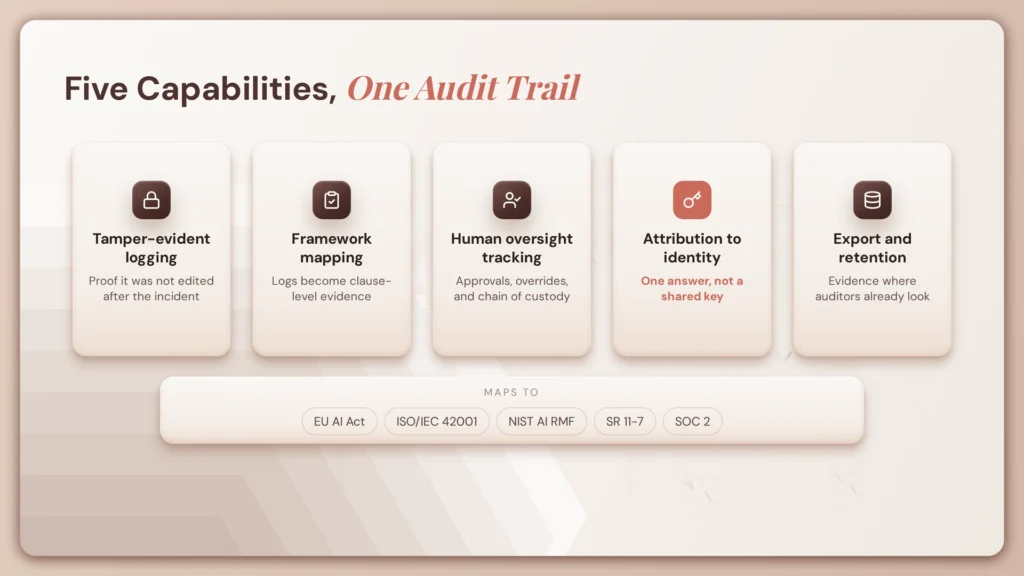
| Capability | What It Means | Why It Matters |
|---|---|---|
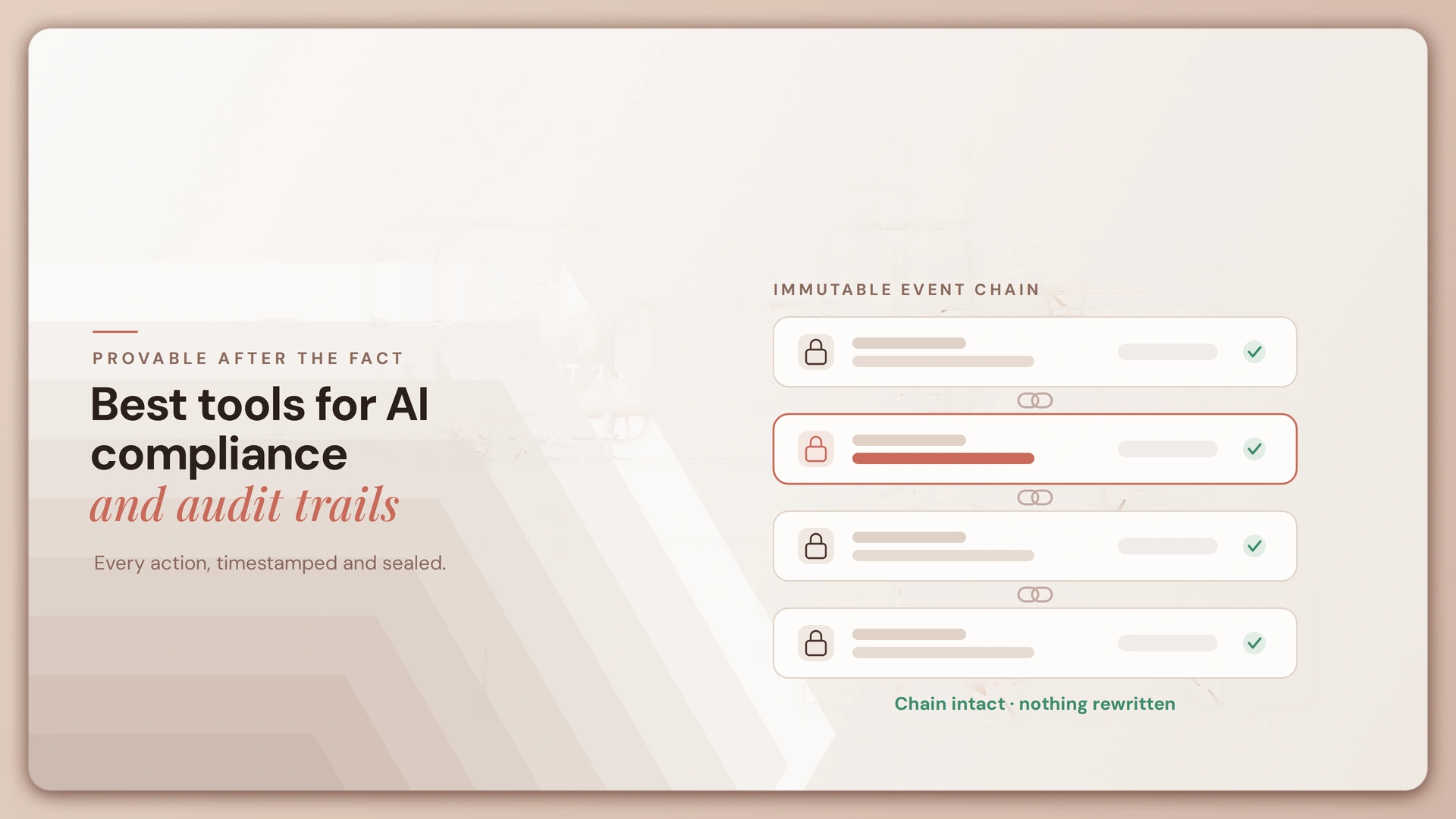
| Tamper-evident logging | Signed, time-stamped records that can’t be altered after the fact without detection | Regulators and auditors need to trust the log wasn’t edited post-incident |
| Regulatory framework mapping | Out-of-the-box alignment to EU AI Act (Article 12 logging), ISO/IEC 42001, NIST AI RMF, SR 11-7, SOC 2 | Translates raw logs into evidence that maps to the specific clauses auditors check |
| Human oversight tracking | Records of human approvals, overrides, and chain-of-custody for consequential decisions | EU AI Act Article 14 explicitly requires documented human oversight mechanisms |
| Attribution to identity | Every action attributed to a specific agent, user, version, and credential | “Who did this” needs exactly one answer, not “probably this team’s shared key” |
| Export and retention | SIEM export (Splunk, Datadog, Azure Sentinel), configurable retention windows, archive to S3/GCS | Audit evidence needs to live where auditors already look, retained as long as regulators require |
Best Tools for AI Compliance and Audit Trails Compared
| Tool | Primary Category | Deployment | Best For | Regulatory Coverage |
|---|---|---|---|---|
| Lyzr OpenController | Agent activity + model behavior | Your VPC / on-prem / air-gapped | Full agent lifecycle audit with enforcement | ISO 27001, SOC 2, GDPR, HIPAA, CCPA, EU AI Act |
| IBM watsonx.governance | Model behavior | Hybrid cloud / on-prem | Enterprise risk assessment and regulatory alignment | EU AI Act, NIST AI RMF, ISO/IEC 42001 |
| Credo AI | Model behavior | SaaS | Policy-driven lifecycle governance | Pre-built packs for EU AI Act, NIST, ISO 42001 |
| Microsoft Purview | Agent activity | Azure-native | Microsoft-stack organizations | SEC, FINRA recordkeeping, GDPR, EU AI Act |
| OneTrust AI Governance | Model behavior + compliance ops | SaaS / hybrid | AI inventory and compliance workflow automation | EU AI Act, NIST AI RMF, ISO/IEC 42001 |
| Tenet AI | Agent activity (legal) | SaaS / self-host | Production legal accountability | Contract-specific compliance evidence |
| PortEden | Data access | SaaS | Data-access audit trails for AI tools | SOC 2, HIPAA, GDPR mapped to access events |
| Centraleyes | Compliance operations | SaaS | Multi-framework GRC with AI assistance | SOC 2, ISO 27001, GDPR, PCI DSS, NIST |
| Anjuna | Infrastructure security | On-prem / cloud | Cryptographic attestation for tamper-proof trails | DORA, FINRA, banking-grade audit requirements |
| Drata | Compliance automation | SaaS | Continuous evidence collection across frameworks | SOC 2, ISO 27001, HIPAA, GDPR, PCI DSS |
The 10 Best Tools for AI Compliance and Audit Trails
1. Lyzr OpenController
OpenController produces a signed audit trail covering every agent lifecycle event, every model call, and every tool execution, timestamped to one-hundredth of a second, with approver identity on every promotion. This isn’t a log you query after the fact: it’s a record generated as a byproduct of enforcement that’s already in the request path.
What it logs: agent registration, version history (pinned to source commit and container image), every deployment with the approver’s identity, every model call with tokens/cost/latency attributed to organization/team/agent/version/user, every tool call with arguments and outcome, every guardrail verdict (pass/fail/mask per category), every approval decision, and every quarantine action.
Separation of duties: the approver cannot be the requester, including owners and administrators. This is a structural two-person rule enforced by the platform, not a policy document. Every AI governance questionnaire asks about publishing, modifying, disabling, and retiring agents: all four have configurable approval gates.
Export and integration: signed webhooks push audit events outward into ServiceNow, Jira, or any SIEM/GRC platform. Traces export via OTLP to Datadog, Grafana, or any collector. Version history carries the source commit; the deployment log carries the approver.
EU AI Act mapping: the control set maps directly onto high-risk-system obligations. Inventory and registration (agent registry with immutable IDs). Human oversight (approvals, separation of duties). Logging and traceability (request traces plus signed audit trail). Accuracy and robustness testing (simulation engine with multi-turn evaluation). Risk management and post-market monitoring (improvement engine and fleet observability). Technical documentation (versioned agent manifest and prompt history).
Certifications: ISO/IEC 27001:2022 certified, SOC 2 Type II attested, GDPR assessed, HIPAA and CCPA aligned.
Strengths: the audit trail is a byproduct of controls that already refuse (budgets, guardrails, promotion gates), not a separate logging layer bolted on. Deployed inside your own cloud account, with on-prem/air-gapped options, which closes data-residency objections other compliance platforms can’t address.
Weaknesses: newer to market as a named product than IBM watsonx.governance or Credo AI, so buyers evaluating analyst coverage specifically will find less third-party reporting.
Best for: enterprises that need audit-ready evidence generated as a side effect of runtime enforcement across agent frameworks (LangGraph, CrewAI, Google ADK, OpenAI Agents SDK, and others), particularly regulated industries where the audit trail and the enforcement must be the same system, not two.
2. IBM watsonx.governance

IBM watsonx.governance is the most established enterprise AI governance platform, with automated risk assessments, audit trails, and intelligent regulatory recommendations aligned to the EU AI Act, NIST AI RMF, and ISO/IEC 42001.
What it logs: model lifecycle events, risk assessment results, bias and drift monitoring results, factsheet documentation, and regulatory compliance evidence.
Strengths: the deepest regulatory alignment library of any tool on this list; intelligent recommendations surface which regulatory requirements apply to which model based on its risk classification. Hybrid deployment (cloud and on-prem) fits organizations with existing IBM infrastructure.
Weaknesses: pricing is based on virtual processor cores and enterprise contracts, adding procurement overhead for smaller deployments. The platform’s heritage is model governance, and some agent-specific runtime audit concepts (tool calls, A2A delegation, MCP interactions) are newer additions.
Best for: large enterprises with existing IBM ecosystem investments that need lifecycle model governance with deep regulatory framework coverage.
3. Credo AI

Credo AI provides policy-driven AI governance across the model lifecycle, with pre-built regulatory policy packs for EU AI Act, NIST AI RMF, and ISO 42001 that map governance activities directly to regulatory requirements.
What it logs: development audit events, policy compliance assessments, risk scoring, and governance workflow decisions across the model lifecycle.
Strengths: the pre-built regulatory policy packs are the fastest path to structured compliance evidence for teams starting a governance program from scratch. GAIA capability is cited directly in AI-generated search summaries for agentic oversight queries.
Weaknesses: positioned primarily as a compliance documentation platform rather than a runtime enforcement layer. Teams that need audit trails generated from runtime controls (tool calls, guardrail verdicts, budget enforcement) need complementary tooling.
Best for: governance and risk teams building a structured AI compliance program who need pre-built regulatory mappings and development-phase audit documentation.
4. Microsoft Purview

Microsoft Purview provides native AI visibility, risk management, and data security controls for organizations running AI workloads within the Microsoft ecosystem, integrated with Entra ID, Defender, and Microsoft 365 administration.
What it logs: AI interaction data, data access events, content safety signals, and administration changes across Microsoft and third-party AI tools.
Strengths: zero-integration overhead for Microsoft-stack organizations; compliance evidence feeds into the same Purview compliance portal already used for data governance, eDiscovery, and information protection.
Weaknesses: the value proposition narrows significantly outside the Microsoft ecosystem. Organizations running agents on AWS, GCP, or open-source frameworks need complementary tooling.
Best for: organizations standardized on Microsoft 365 with SEC, FINRA, or GDPR recordkeeping obligations who want AI compliance evidence in the same portal as their existing data governance.
5. OneTrust AI Governance

OneTrust AI Governance provides AI inventory management, risk assessment, and compliance automation, named a Visionary in the 2026 Gartner Magic Quadrant for AI Governance Platforms.
What it logs: AI asset inventory changes, risk assessment results, compliance workflow decisions, and policy attestation records.
Strengths: the strongest integration with existing privacy and data governance workflows for organizations already running OneTrust for GDPR, CCPA, or data-privacy compliance. AI governance extends an existing system of record rather than introducing a new one.
Weaknesses: oriented toward compliance documentation and inventory rather than runtime agent behavior logging. The audit trail covers governance decisions, not individual model calls or tool executions.
Best for: compliance and privacy teams that need AI governance integrated with existing OneTrust data-governance and privacy workflows.
6. Tenet AI

Tenet AI specializes in production legal accountability, offering cryptographic sealing for decision-level records, human override chains-of-custody, and compliance report generation tied to specific contractual and regulatory obligations.
What it logs: decision-level records with cryptographic integrity seals, human override events with chain-of-custody documentation, and compliance report generation artifacts.
Strengths: the cryptographic sealing approach produces the strongest tamper-evidence guarantee of any tool on this list. The chain-of-custody model for human overrides directly maps to EU AI Act Article 14 human oversight requirements.
Weaknesses: specialized for legal and contract-specific compliance; less coverage of broader IT governance frameworks (SOC 2, ISO 27001) than general-purpose GRC platforms.
Best for: legal and compliance teams in regulated industries that need cryptographically sealed decision records and defensible human-override documentation.
7. PortEden

PortEden focuses specifically on data-access audit trails, mapping what AI agents and assistants read, changed, and accessed in your systems (drives, email, calendars, databases) directly to compliance clauses.
What it logs: every data access event by an AI client or agent, the authorization decision (allowed/denied), any redactions applied, timestamps, and the policy version in force. Logs the tool call rather than the raw prompt or model output, keeping the record useful for evidence without storing sensitive content.
Strengths: the clearest answer to the specific question compliance reviewers actually ask: “What client data has touched an AI?” PortEden also enforces the access it audits, rather than just logging it.
Weaknesses: covers data-access audit trails specifically, not model governance, bias monitoring, or agent lifecycle management. Teams need complementary tooling for those categories.
Best for: organizations whose primary compliance concern is proving what data AI tools accessed, with SOC 2, HIPAA, and GDPR evidence mapped to access events.
8. Centraleyes

Centraleyes is an AI-powered GRC platform connecting compliance operations, risk management, regulatory tracking, and reporting in a single system.
What it logs: compliance control status, risk assessment results, framework mapping changes, evidence collection records, and remediation tracking across multiple regulatory frameworks.
Strengths: the broadest multi-framework GRC coverage on this list; AI capabilities classify evidence, map controls to frameworks, detect anomalies across audit data, and continuously monitor controls across SOC 2, ISO 27001, GDPR, PCI DSS, and NIST simultaneously.
Weaknesses: a general-purpose GRC platform rather than an AI-specific governance tool. It governs compliance broadly, not AI agent behavior specifically, so teams needing agent-level audit trails (model calls, tool executions, guardrail verdicts) need complementary tooling.
Best for: mature audit, risk, and compliance teams managing multiple frameworks who want AI to enhance compliance operations across the organization, not just AI-specific governance.
9. Anjuna

Anjuna provides hardware-level confidential computing with cryptographic attestation, enabling tamper-proof audit trails where the integrity guarantee comes from the hardware, not just the software.
What it logs: cryptographically attested processing records where the hardware itself certifies that data was processed in a secure enclave, providing attestation that goes beyond software-level tamper evidence.
Strengths: the strongest integrity guarantee on this list for organizations where software-level audit trail signing isn’t sufficient. Banks use Anjuna to securely process PII with provable attestation for regulators.
Weaknesses: requires infrastructure changes (confidential computing enclaves) that add deployment complexity beyond a SaaS compliance platform. The compliance value is in the infrastructure layer, not the application layer.
Best for: financial institutions and defense organizations with DORA, FINRA, or banking-grade audit requirements where hardware-level attestation is a regulatory necessity.
10. Drata

Drata provides compliance automation across SOC 2, ISO 27001, HIPAA, GDPR, and PCI DSS with continuous evidence collection that replaces periodic manual audits with always-on monitoring.
What it logs: continuous control-monitoring evidence, policy attestation records, vendor risk assessment results, and framework-mapped compliance artifacts.
Strengths: the most mature continuous-compliance platform on this list; strong integrations with existing infrastructure (AWS, Azure, GCP, GitHub, Jira, Okta) reduce manual evidence collection to near-zero for standard IT compliance.
Weaknesses: a general compliance automation platform, not an AI-specific governance tool. It produces SOC 2 and ISO 27001 evidence well, but doesn’t log individual AI model calls, tool executions, or agent behavior.
Best for: organizations that need to maintain continuous SOC 2, ISO 27001, or HIPAA compliance and want AI-assisted evidence collection across their full IT environment, not just their AI stack.
How to Choose
- Need audit trails generated as a side effect of runtime enforcement across any agent framework? OpenController produces the evidence from controls already in the request path, deployed in your own cloud account.
- Need deep regulatory framework mapping with model-lifecycle governance? IBM watsonx.governance for enterprises on IBM infrastructure, Credo AI for teams starting a governance program from scratch with pre-built regulatory packs.
- Already standardized on Microsoft 365? Microsoft Purview governs AI using the same compliance portal you already use for data governance.
- Primary concern is proving what data AI tools accessed in your systems? PortEden, purpose-built for data-access audit trails mapped to compliance clauses.
- Need hardware-level tamper-proof attestation for banking or defense? Anjuna’s confidential computing approach provides guarantees software-only tools can’t.
- Managing multi-framework GRC across the full organization, not just AI? Centraleyes or Drata, depending on whether you need AI-enhanced GRC operations or continuous compliance automation.
FAQ
What is an AI audit trail?
An AI audit trail is a chronological, tamper-evident record of every action an AI system takes: inputs received, model decisions made, tools called, data accessed, human approvals given, and configuration changes applied. It serves as the “flight recorder” for AI systems, producing the evidence regulators and auditors require.
What’s the difference between an AI audit trail and AI governance?
An audit trail is the record. Governance is the set of policies, controls, and processes that determine what’s allowed. The strongest tools produce audit trails as a byproduct of governance controls that are already enforcing policy, rather than maintaining two separate systems.
Does the EU AI Act require AI audit trails?
Yes. Article 12 of the EU AI Act requires automatic logging of events throughout the lifetime of high-risk AI systems, including design and operation decisions, input data references, and outcomes. Article 14 separately requires documented human oversight mechanisms. The August 2026 deadline for Annex III high-risk systems makes this an active compliance requirement, not a future consideration.
What should an AI audit trail log?
At minimum: the actor (agent and user identity), the action taken (model call, tool execution, data access), the authorization decision (allowed/denied/redacted), the policy version in force, timestamps, and the version of the agent or model that acted. For regulated industries, add: approver identity on every production change, separation of duties enforcement, and export to the SIEM or GRC platform where auditors already look.
What is tamper-evident logging for AI?
Tamper-evident logging uses cryptographic signing (HMAC or hardware attestation) so that any modification to a log entry after the fact is detectable. This matters because regulators need to trust that the audit trail wasn’t edited after an incident. Tenet AI and Anjuna provide the strongest tamper-evidence guarantees; OpenController produces signed audit trails with webhook-based export.
Do I need a separate AI audit trail tool if I already have Datadog or Splunk?
Usually yes, because general observability platforms log infrastructure and application telemetry but don’t have schemas for AI-specific events: agent identity, model version, tool-call arguments, guardrail verdicts, approval decisions, and separation-of-duties enforcement. The right pattern is an AI compliance tool that exports to your existing SIEM rather than replacing it.
What compliance frameworks require AI audit trails?
EU AI Act (Articles 12 and 14), ISO/IEC 42001 (AI management systems), NIST AI RMF (Govern and Map functions), SR 11-7 (US banking model risk management), SOC 2 (availability and processing integrity trust criteria), HIPAA (access logging for PHI), GDPR (processing records for personal data), DORA (digital operational resilience for financial services), and SEC/FINRA recordkeeping requirements for AI-assisted financial decisions.
Can one platform cover both model governance and agent activity audit trails?
Few platforms cover both categories well. OpenController covers agent activity and model-call logging with evaluation and improvement. IBM watsonx.governance covers model lifecycle governance deeply. Most enterprises end up with one tool per category, exported into a shared SIEM or GRC system where the unified audit view lives.
How long should AI audit trail data be retained?
Retention periods are framework-specific. EU AI Act doesn’t specify a minimum but requires logs to be available for the system’s entire lifecycle. SOC 2 typically requires 12 months. HIPAA requires 6 years for access logs. SEC/FINRA rules require 3-7 years depending on record type. Configure retention per framework rather than picking one number.
What’s the cost of not having an AI audit trail?
EU AI Act fines reach up to 35 million euros or 7% of global turnover for the most severe violations. Beyond fines: regulatory investigation delays (assembling evidence manually takes weeks), inability to contain incidents (no record of which agent accessed which data), and reputational damage from the appearance of operating AI systems without oversight.
Book A Demo: Click Here
Join our Slack: Click Here
Link to our GitHub: Click Here