Every major cloud vendor shipped an agent registry this year.
In 2026, AWS, Microsoft, Google, and MuleSoft each shipped a competing version of this catalog for their own platform.
That timing isn’t a coincidence. It’s a response to a problem enterprises can no longer ignore: nobody knows how many agents they’re actually running, who owns them, or whether the tool a new agent just called has been vetted by anyone.
But here’s the catch if you’re evaluating these products right now. “Agent registry” doesn’t mean one thing.
Some tools catalog agents and stop there. Others sweep in MCP servers (Model Context Protocol servers – the connectors that let an agent reach external tools and data), skills, prompts, models, and endpoints. Some are fully managed cloud services. Some are open-source projects you run yourself. A few aren’t agent registries at all – they’re skill registries or artifact catalogs wearing the same label.

Buying the wrong category doesn’t just waste budget. It leaves a gap in your governance story that surfaces during an audit, not during a demo.
This comparison walks through the real products, what each one actually catalogs, and the one question that should frame every evaluation: what does this registry manage, where does it sit in your stack, and what does it leave for something else to handle?
AI Agent Registry Tools: Quick Comparison
Comparison at a Glance
| Tool | What it catalogs | Deployment | Open source? | Governance | Best suited for |
|---|---|---|---|---|---|
| Google Cloud Agent Registry | Agents, MCP servers, tools, standalone skills, endpoints | Managed, inside Gemini Enterprise Agent Platform | No | IAM roles, project/region-scoped access | Teams standardized on Google Cloud and Gemini Enterprise |
| AWS Agent Registry | Agents, tools, skills, MCP servers, custom resources | Managed, part of Amazon Bedrock AgentCore | No | Draft-to-approved workflow, IAM/OAuth, CloudTrail audit | AWS-native orgs already running on Bedrock AgentCore |
| Solo agentregistry / Solo Enterprise | Agents, MCP servers, skills, prompts, plugins, models | Self-hosted, Kubernetes and multi-runtime; Enterprise adds supported distribution | Yes (CNCF open governance); enterprise support is commercial | Approved-catalog workflows, provenance checks, RBAC | Kubernetes platform teams unifying multiple runtimes under one catalog |
| JFrog AI Catalog / Agent Skills Registry | AI skills primarily, plus MCP servers, models, and plugins under the wider AI Catalog | Managed or self-hosted via the JFrog Platform | No | Scanning, signing, approval workflows, policy | Security teams treating skills as a governed software supply chain |
| Open-source registries (agentregistry and peers) | Varies – commonly agents, MCP servers, skills | Self-hosted | Yes | Varies by project | Teams needing full control, customization, or vendor neutrality |
Google Cloud Agent Registry
Google’s registry is a catalog scoped to what you’re already running inside Google Cloud, not a neutral hub for agents built anywhere.
Agent Registry is a centralized catalog that lets you store, discover, and govern Model Context Protocol servers, tools, standalone skills, and AI agents within Google Cloud, and it represents the governance pillar and unified inventory of agents, servers, skills, and endpoints in Gemini Enterprise Agent Platform.
Access is governed through IAM:
Setting up Agent Registry means enabling the required API and configuring IAM roles for your project.
Discovery works by performing keyword and prefix searches to find specific capabilities across the organization. On the protocol side, Agent Registry supports Agent-to-Agent (A2A) protocol version 1.0, letting you explicitly declare transport endpoints and bindings, in addition to the existing 0.3 schema support.
The limitation worth flagging before you commit:
To ensure compliance with data residency requirements, both Agent Registry and Agent Gateway resources are project-and-region-specific.
That’s a sound design for a Google Cloud-native catalog. It’s not the architecture of a multi-cloud registry, and Google doesn’t market it as one.
AWS Agent Registry
AWS entered this category later than Google but arrived with the most detailed governance mechanics of any product here.
AWS Agent Registry reached general availability on August 31, 2026, as part of Amazon Bedrock AgentCore.
It provides a private, governed catalog and discovery layer for agents, tools, skills, MCP servers, and custom resources within your organization.
Governance runs on a lifecycle model:
Admins govern the full lifecycle of everything in the registry by configuring approval workflows with role-based approver assignment that manage state transitions from draft through approval, with curators serving as human-in-the-loop reviewers.
Every action is logged – AWS CloudTrail captures a full audit trail of every action taken on the Registry. Access supports both IAM and OAuth (Custom JWT) based access.
Discovery isn’t purely manual, either.
Once an administrator enables the feature at the AWS Organizations level, agents deployed across multiple accounts appear in the central registry automatically, and cross-account sharing is supported through AWS Resource Access Manager.
One detail buyers need to track closely: the namespace itself is mid-migration.
Starting August 6, 2026, AWS Agent Registry moved to the generally available agent-registry namespace, replacing the public-preview bedrock-agentcore path.
The migration window for the old bedrock-agentcore namespace closed in September 2026. If you’re evaluating this now, build on agent-registry from day one.
Solo Enterprise for agentregistry
Solo takes a different starting position: rather than shipping a registry for one cloud, it built one that sits above all of them.
Agentregistry provides a unified, open source catalog for agents, MCP servers, skills, prompts, plugins, and models, with tools to build, publish, discover, and deploy agentic artifacts.
Critically, it doesn’t try to replace the underlying binary artifact registries – it sits on top of them, and you can pull MCP servers from npm, PyPI, OCI images, or remote endpoints and register them into your own catalog.
Lifecycle management runs through its CLI: through the arctl CLI, the project supports the end-to-end development, packaging, publication, and deployment of agentic artifacts. It’s designed to live alongside two sibling projects: agentregistry fits naturally next to kagent and agentgateway, where kagent serves as a target deployment platform for artifacts drawn from the registry, and agentgateway federates deployed MCP servers behind a single endpoint.
Runtime reach extends past Kubernetes: the role of agentregistry extends well beyond the catalog, integrating with multiple runtime platforms including Kubernetes, AWS AgentCore, and Google Vertex AI, enabling teams to deploy agents, MCP servers, and skills directly from the registry to whatever platform they choose. It also catches what it didn’t originate: runtime discovery detects shadow inventory by scanning connected runtimes to surface agents and tools that have been deployed independently, outside any governed workflow.
Solo Enterprise wraps that open source core in commercial support: the support offering is designed for teams who want enterprise-grade help directly on the open source distributions they’re using today, including 24×7 global support with predefined SLAs.
JFrog AI Catalog / Agent Skills Registry
Don’t compare this one head-to-head against the others above – it solves a narrower, sharper problem. JFrog isn’t cataloging agents; it’s securing the skills those agents load.
The Agent Skills Registry is the only private registry that serves up scanned, signed, and approved skills incorporating your standards and best practices organization-wide.
The mechanics look like a software supply chain, on purpose: it scans skills for vulnerabilities and malicious behaviors and blocks them before they’re consumed by an agent, signs approved skills to ensure their integrity, and sets strict approval workflows so agents only use skills formally vetted for specific projects or teams. Standards compliance is explicit too: it’s compliant with open standards like the AgentSkills format and the OpenClaw registry protocol.
It’s part of something wider inside JFrog’s platform. One registry covers every AI asset, stored as native artifacts in Artifactory alongside your other binaries. That said, coverage isn’t uniform across artifact types yet: shadow AI detection currently covers model packages only.
Worth stating plainly: this isn’t a replacement for an agent or MCP registry, and JFrog doesn’t position it as one. For a fuller breakdown of how skills differ from tools and prompts, see what a skill registry actually manages.
Open-Source AI Agent Registry Tools
“GitHub” is not a product category, and treating it as one is how buyers end up disappointed. The most notable actively maintained project here is Solo’s agentregistry itself, which its founder positioned deliberately as community infrastructure.
Idit Levine announced its donation during a keynote at KubeCon + CloudNativeCon North America, describing agentregistry as a centralized, curated open source registry for AI applications and artifacts, intended as a single source of truth for organizations that use agents.
It joined kagent and agentgateway under an open governance model for all contributors.
Before adopting any open-source registry, verify four things: how active the commit history is, what license governs it, whether it’s tied to one agent framework or genuinely neutral, and whether teams are actually running it in production or just experimenting. Community activity and a permissive license don’t automatically make a project “best” – they just make it worth a closer look.
What Actually Differs Between These Registries?
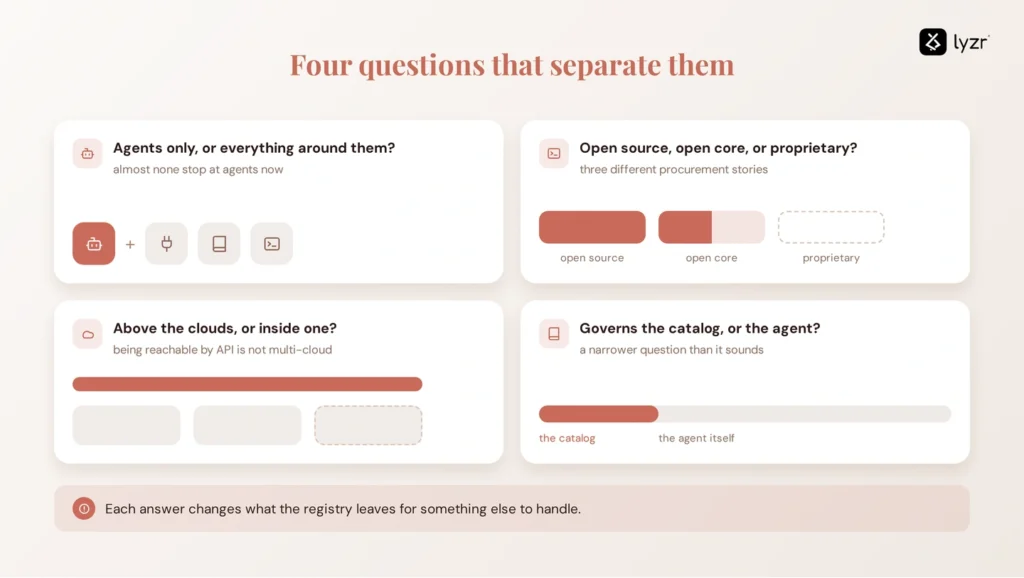
Which registries manage agents only, versus broader AI artifacts? Almost none of the current products stop at agents alone anymore. Google, AWS, Solo, and JFrog have all expanded into MCP servers, skills, and in Solo’s case, prompts and models too – because an agent without its dependencies catalogued is only half-inventoried. For a deeper look at where tool and MCP coverage specifically fits, see what an agent tool registry manages.
Which are actually open source? Keep three categories separate: pure open-source projects you deploy yourself (agentregistry’s community edition), commercial products built on an open core with paid support layered on (Solo Enterprise), and fully proprietary managed services (AWS, Google, JFrog). Calling all three “open source” muddies a real procurement distinction around control, cost, and support SLAs.
Which support multi-cloud environments? Being reachable over an API doesn’t make a registry multi-cloud. Google’s registry is project-and-region-scoped inside GCP. AWS’s is an AWS-account-native service, even though it can index agents wherever they run. Solo’s agentregistry is the one built to sit above multiple runtimes by design, integrating with Kubernetes, AWS AgentCore, and Google Vertex AI simultaneously rather than being anchored to one provider’s IAM model.
Do these registries actually govern agents? They govern the catalog, and that’s a real, useful function – approval, access control, versioning, audit trails. But catalog governance answers a narrower question than it sounds like it does.
A registry answers a narrow question well: does this agent exist, who’s accountable for it, and has it passed review. A registry proves an agent is approved to run. It doesn’t prove the agent’s business logic is still accurate – or, more broadly, what that agent is actually doing once it’s live.
How Do You Choose an AI Agent Registry?
Match the tool to your actual deployment shape, not to whichever vendor pitched you first.
The Lyzr Decision Matrix
| If your situation is… | Consider… |
|---|---|
| Agents live almost entirely in one cloud ecosystem, and native IAM integration matters most | A cloud-native registry (Google Cloud Agent Registry or AWS Agent Registry) |
| You need deployment control, customization, or want the registry running inside your own infrastructure | An open-source registry you operate directly |
| You’re managing agents alongside MCP servers, skills, prompts, models, or plugins as one connected set | A broader AI artifact catalog like Solo agentregistry |
| Your immediate problem is securely distributing, approving, and auditing reusable skills | A skills-focused registry like JFrog’s Agent Skills Registry |
| Your agents already span multiple registries, clouds, frameworks, and runtimes | A governance layer that sits above all of them |
That last row is where most of these comparisons quietly stop – and where the real operational risk usually starts.
AI Agent Registry vs. AI Control Plane: What’s the Real Difference?
An agent registry primarily provides a catalog and system of record for agents and related artifacts. An AI Control Plane governs those agents operationally across their entire lifecycle, not just at the point of registration.
That’s not a knock on registries – AWS built approval workflows and CloudTrail auditing directly into its product, Google ties its registry to IAM governance, and Solo includes provenance and RBAC controls. The distinction is about scope, not capability. For a fuller framework on where that governance responsibility sits, see the CIO playbook to AI agent governance.
Registry vs. Control Plane at a Glance
| Agent Registry | AI Control Plane |
|---|---|
| Discovery, metadata, versioning | Identity issued to every agent |
| Ownership and approval records | Evaluation before production |
| Registry-level audit trail | Runtime observability of live behavior |
| Reuse across teams | Policy enforcement during execution |
| Catalog of what exists | Lifecycle context for what’s running |
The five control points a Control Plane enforces are registry, identity, evaluation, staged promotion, and observability – the registry is one input into a governance system, not the whole system.
Where Lyzr OpenController Fits
Picture the realistic version of an enterprise agent estate: some agents registered in AWS Agent Registry, some in Google’s catalog, a few running through Solo’s agentregistry on Kubernetes, and skills governed separately through JFrog. Each registry does its job well within its own boundary. None of them talk to each other, and none answers the question that spans all of them: which agents, across every one of those systems, are actually behaving the way they were approved to behave right now?
That’s the gap OpenController is built for – not as a replacement for any registry, but as the layer above them, coordinating identity and lifecycle context across the same distributed environments discussed in agent cluster reconciliation.
It gives teams a central view of what agents exist, who owns them, which versions have been evaluated, where they’re deployed, what they’re doing, and what policies govern them, regardless of which registry or cloud originally catalogued the agent.
As Lyzr’s own positioning on registry sprawl puts it:
Everyone shipped a registry in 2026 – a registry tells you an agent exists. It does not deploy it, promote it, or refuse its next call.
OpenController doesn’t try to be another entry in the registry list. It’s the layer that decides what happens after the registry says yes.
To see how that governance layer fits into an existing agent stack, explore the OpenController Architecture, or book a demo to see how it can work with your organization’s agents and infrastructure.
Frequently Asked Questions
An AI agent registry is a governed catalog that records which agents, tools, skills, and MCP servers exist across an organization, who owns each one, its version, and whether it’s approved to run.
There isn’t a single winner, because these products serve different environments. Cloud-native buyers gravitate to AWS or Google’s registries, Kubernetes-native platform teams lean toward Solo’s agentregistry, and security teams focused specifically on skill distribution look at JFrog. The right fit depends on your deployment environment and governance requirements, not a universal ranking.
An agent registry catalogs agents themselves; an MCP registry catalogs the MCP servers agents connect through to reach tools and data. Most current products, including AWS and Google’s, catalog both under one roof rather than treating them as separate systems. See MCP registry vs. tool registry for the fuller distinction.
At minimum, metadata about each agent – identity, owner, version, and approval status. More capable registries also store related artifacts: tools, skills, MCP server connections, prompts, and in some cases models.
Yes. Agentregistry is a centralized, curated open source registry for AI applications and artifacts, intended as a single source of truth for organizations that use agents, and it’s one of the more actively maintained projects in the category.
Yes. AWS Agent Registry reached general availability on August 31, 2026, as part of Amazon Bedrock AgentCore.
Yes. Agent Registry represents the governance pillar and unified inventory of your agents, servers, skills, and endpoints in Gemini Enterprise Agent Platform.
Start by deciding what it needs to catalog – agents alone, or agents plus tools, skills, and MCP servers – then choose between a managed cloud registry, an open-source project you run yourself, or building a lightweight internal catalog on existing infrastructure. The harder design decision isn’t the schema; it’s who owns approval, how versioning works, and how the registry stays current as agents are added and retired.
It governs the catalog entry, not the agent’s live behavior. Approval workflows, access control, and versioning are real governance functions, but they confirm an agent was reviewed at registration – not that it’s still operating within scope today.
A registry is a system of record for cataloging agents and artifacts. A Control Plane governs those agents operationally across identity, evaluation, deployment, and runtime behavior – a broader scope that uses the registry as one input rather than the full picture.
Book A Demo: Click Here
Join our Slack: Click Here
Link to our GitHub: Click Here