Your compliance team can tell you, with confidence, that the large language model powering your customer operations was vetted, approved, and logged six months ago. Ask a harder question, though: which of the forty agents built on top of that model can write to your CRM, which can touch financial systems, and who signed off on each one. Most teams go quiet.
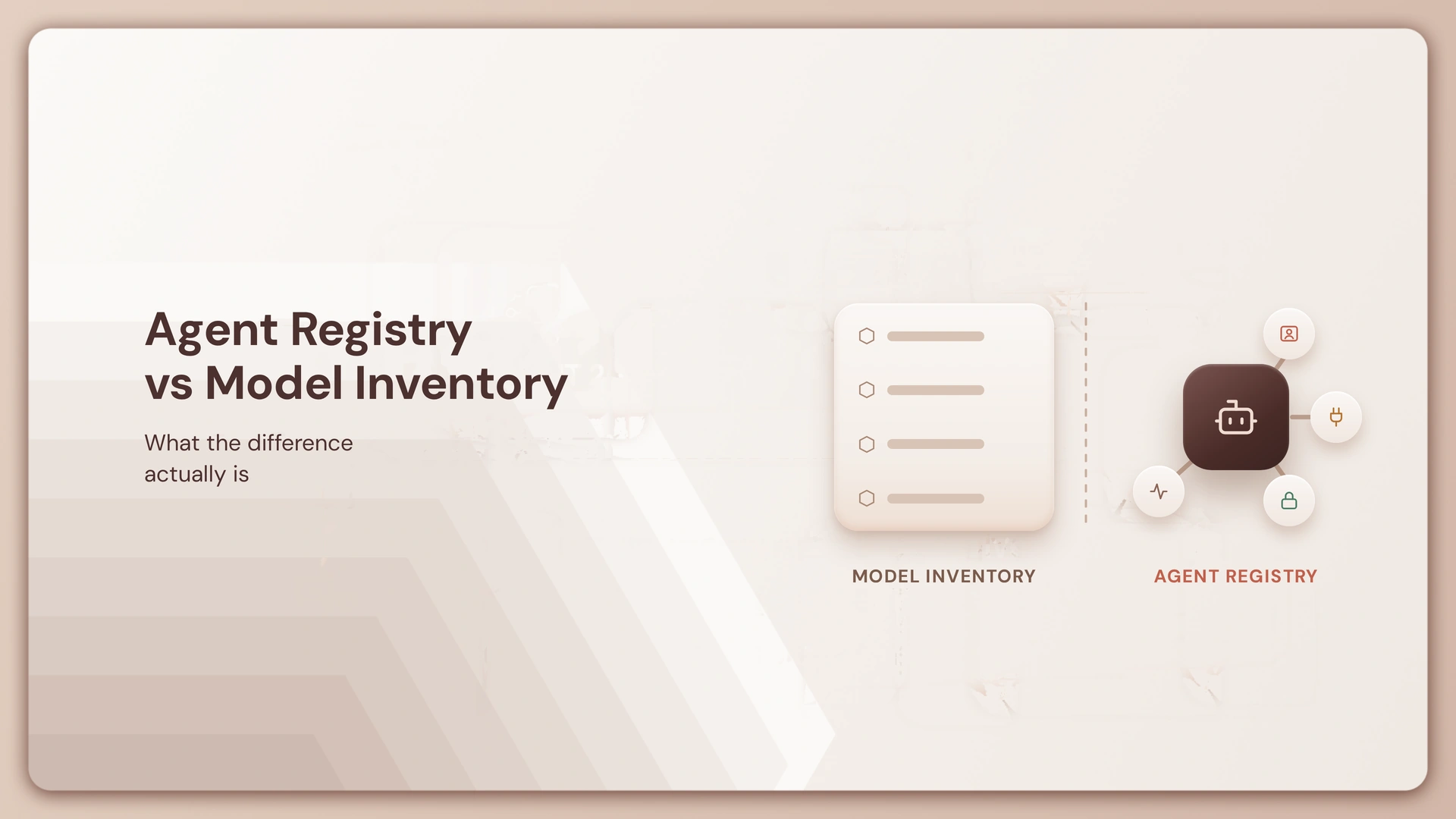
That gap is not a documentation failure. It is the natural result of using a model inventory to answer a question it was never designed to answer. A model inventory tracks the AI models an organization owns, uses, or deploys. An AI agent registry tracks the autonomous agents built around those models, and the operational context in which they actually run.
The same approved model can sit underneath a dozen different agents, and each one can carry a completely different set of tools, permissions, owners, and risk. Knowing the model is safe tells you almost nothing about what the agents built on it are allowed to do. This article works through both systems, where they overlap, and why most enterprises end up needing both.
What Is an AI Agent Registry?
An AI agent registry is a centralized system for discovering and maintaining information about the AI agents operating inside an organization, along with the operational context each one runs in. It is less a spreadsheet of names and more a live record of who built what, what it can reach, and whether anyone is still watching it.
Depending on how an organization implements it, an agent registry can track:
- Agent identity and a named human or team owner
- The purpose or business use case the agent serves
- The models it calls, and the tools, APIs, and skills it can invoke
- MCP servers it connects through
- Permissions and data access
- Deployment environment
- Evaluation status
- Runtime or operational metadata
Not every registry covers every one of these fields. Scope varies widely by implementation and by how mature the governance program behind it is. But the question an agent registry exists to answer stays consistent: who is this agent, what can it access or execute, and how is it operating right now.
That last part matters more than it sounds. Most organizations cannot answer a basic question: how many AI agents are running in their environment right now. Roughly one in five organizations keeps a real-time inventory of its agents, and under a third can reliably trace an agent’s actions back to a human or system across every environment it runs in. The same research found that most organizations have agents running somewhere in their infrastructure that nobody has catalogued. A model inventory was never built to catch that.

What Is an AI Model Inventory?
A model inventory is a centralized record of the models an organization develops, uses, deploys, or consumes, kept for governance, risk, and compliance purposes. It is the foundational layer most AI oversight programs start with, and for good reason: you cannot govern a model you haven’t logged.
A model inventory typically captures:
- Model name, provider, and version
- Whether it’s a foundation model or a fine-tuned variant
- The model owner
- Deployment location
- Training or model lineage, where available
- Evaluation results and risk classification
- Intended use and approval status
- Regulatory or compliance mapping
Worth flagging here: “model inventory” and “model registry” are not always the same thing, and organizations and vendors use the two terms inconsistently. Some use “registry” for the technical artifact store an ML team manages day to day, and “inventory” for the broader governance catalog that risk and compliance teams maintain. This article uses model inventory in that second, broader sense.
The question a model inventory answers is narrower than it might seem: which models are we using, where did they come from, and how are they approved and managed. It says nothing about what gets built on top of them once they’re approved.
AI Agent Registry vs Model Inventory: What’s the Difference?
The short answer: an agent registry governs the running system, a model inventory governs the underlying artifact. They track different assets, answer different governance questions, and sit at different points in the AI lifecycle.
Agent Registry vs Model Inventory: Side by Side
| Dimension | AI Agent Registry | AI Model Inventory |
|---|---|---|
| Primary asset | AI agents | AI models |
| Primary focus | Agent identity, capabilities, access, and operation | Model lineage, versions, ownership, and risk |
| Tracks | Agents, tools, skills, permissions, deployment | Models, versions, evaluations, lineage |
| Main question | What is this agent allowed to do? | Which models are we using and how are they governed? |
| Lifecycle | Creation, evaluation, deployment, runtime | Development, evaluation, approval, deployment |
| Runtime context | Important | Usually more limited |
| Ownership | Agent or team owner | Model owner or model team |
| Access/permissions | Agent-level access and capabilities | Model access and usage controls |
| Evaluation | Agent-level evaluation, where supported | Model evaluation |
| Audit | Agent activity and lifecycle, where supported | Model governance and approval records |
Neither system is a smaller or larger version of the other. A model inventory can be extremely mature and still leave every one of the agent-level questions in that table unanswered.
Why Can’t a Model Inventory Tell You Everything About an AI Agent?
Because the model is only one input into what an agent can actually do, and the inventory stops tracking once the model is approved. Everything that happens after that, which tools get attached, which data sources get connected, who’s allowed to deploy it, lives outside the model inventory’s scope entirely.
Take one approved, fine-tuned LLM. It could power:
- A customer-support agent with read access to CRM records
- A finance agent with write access to internal financial systems
- A research agent with open web search capability
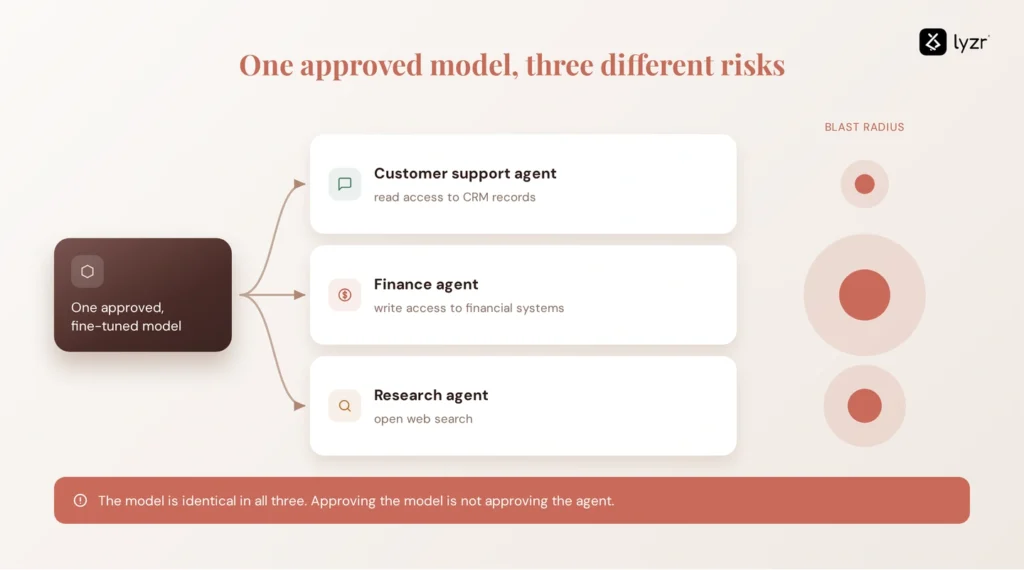
The model is identical across all three. The risk is not. The finance agent’s blast radius has nothing to do with the model’s training data or evaluation scores. It has everything to do with what that specific agent was wired up to touch.
Model approval does not automatically establish agent-level approval. Treating it as if it does is how a well-governed model list coexists with an ungoverned agent sprawl problem underneath it.
Agent Inventory vs Running Clusters: Why Your AI Agent List Is Never the Full Picture
AI Agent Registry vs Model Inventory Management
Because the assets differ, so do the management disciplines built around them. This is a useful way to think about the two processes, not a fixed standard either category follows uniformly.
Model inventory management tends to move through: develop, evaluate, approve, version, deploy, monitor, retire.
Agent registry management tends to move through a related but distinct path: design, build, evaluate, approve, deploy, observe, govern, retire.
The extra stages in the agent path (observe, govern) exist because agents keep acting after deployment in a way static models don’t. A deployed model serves predictions. A deployed agent takes actions, on a schedule you may not fully control.
How Do AI Agent Registries and Model Inventories Work Together?
They work as two connected layers rather than competing systems. A model inventory establishes which models are approved, which versions are in use, who owns them, and what evaluations they’ve passed. An agent registry picks up from there: which agents use those approved models, what tools and skills each one has, who owns each agent, where it’s deployed, and what its evaluation and permission status looks like.
Put together, the chain runs: Model → Agent → Tools/Skills → Permissions → Runtime activity.
When something goes wrong, you want to trace that whole chain in one direction. Start from an incident, work back through the agent’s permissions, its owner, and finally the model underneath it. A model inventory alone gets you to the model. It doesn’t get you the rest of the way.

What the Numbers Say About This Gap
According to IBM’s Institute for Business Value research presented at Think 2026, only 18% of organizations maintain a current and complete AI inventory, and 68% of executives worry their AI initiatives will fail for lack of deep integration. Most of those same organizations maintain reasonably mature model inventories.
The gap isn’t a lack of discipline. It’s that the modern AI stack connects models, agents, tools, skills, MCP servers, data, and infrastructure, and a model inventory gives you one layer of that without the relationships between layers. That gap is also how agents end up calling models directly and quietly, a pattern worth checking against your own environment via how to detect LLM calls that bypass your AI gateway.
AI Agent Registry vs AI Control Plane
An agent registry gives you visibility. An AI Control Plane gives you governance across the full lifecycle those agents move through. That’s the real distinction, and it’s worth being precise about it: a control plane is not just a registry with more fields.
A registry answers what exists. A control plane governs identity, evaluation, promotion and approval, configuration, permissions and policy, observability, and audit, as agents move from build to production and keep running. A registry tells you an agent exists and roughly what it’s for. It doesn’t stop that agent’s next API call if something looks wrong. A control plane sits in that path.
How Does Lyzr’s OpenController Fit?
OpenController is Lyzr’s governance layer for AI agents running across heterogeneous infrastructure, and it maps directly onto the gaps this article has walked through. It provides a central agent registry for visibility, identity and ownership assignment for every agent, evaluation gates before promotion to production, lifecycle governance from build through retirement, runtime observability, and an auditable record of what each agent actually did.
None of that requires replacing an existing model inventory. The model inventory keeps doing what it does well: governing which models are approved, versioned, and compliant. OpenController adds the governance layer around those models, covering the agents that use them, what those agents can access, and what they do in production.
If your model inventory can tell you which models are approved but can’t tell you which agents are using them, who owns those agents, or what they’ve done with that access, that’s the gap worth exploring with OpenController. For a broader look at where agent governance fits into enterprise accountability, see The CIO Playbook to AI Agent Governance.
Where This Leaves Governance Teams
The organizations getting this right aren’t the ones with the most complete model inventory. They’re the ones who stopped assuming a clean model list implies clean agent behavior.
If you can name every approved model in your stack but not every agent running on top of them, that’s not a documentation gap to schedule for next quarter. It’s the exact blind spot agent sprawl grows into.
Start by asking one question of your own environment: for your most-used approved model, how many agents are actually built on it, and could you name all of them right now.
Frequently Asked Questions
An AI agent registry is a centralized system for discovering and tracking AI agents, typically including their owner, purpose, models used, tools, permissions, and deployment status.
An AI model inventory is a centralized record of the models an organization develops, uses, or deploys, tracking versions, ownership, evaluation results, and approval status for governance purposes.
An agent registry tracks the running agents built on top of models, including their tools, permissions, and owners. A model inventory tracks the models themselves, including versions, lineage, and approval status.
No. A model is the underlying reasoning engine. An agent is a system built around one or more models, with tools, permissions, and a specific purpose that determines what it can do.
Yes. A single approved model can sit underneath many agents, each with different tools, data access, owners, and risk profiles, even though the model itself is identical across all of them.
No. They track different assets and answer different governance questions. Most organizations need both to get full visibility across models and the agents built on them.
Depending on implementation, it can track agent identity, ownership, purpose, models used, tools and skills, MCP servers, permissions, deployment environment, evaluation status, and runtime metadata.
Typically the model or provider, version, whether it’s a foundation or fine-tuned model, owner, deployment location, lineage, evaluation results, risk classification, and approval status.
It’s the process of managing a model’s lifecycle, generally moving through development, evaluation, approval, versioning, deployment, monitoring, and retirement.
Most do. A model inventory governs which models are approved. An agent registry governs which agents use those models and what those agents are allowed to do. One without the other leaves a visibility gap.
A registry provides visibility into which agents exist. A Control Plane governs how those agents move through their lifecycle, including identity, evaluation, permissions, observability, and audit, and can act on that governance in real time.
Book A Demo: Click Here
Join our Slack: Click Here
Link to our GitHub: Click Here