TL;DR:
- An MCP server registry is a directory of server metadata, not a runtime. It doesn’t host servers or execute tools.
- It answers “which servers exist and where,” nothing more.
- Public registries cover open, community-vetted servers. Private registries cover internal tools and your own risk bar.
- A registry is a catalog, not a control. It does not sit in the request path and cannot stop someone from adding an unapproved server locally.
- Lyzr is not an MCP registry. Its Control Plane, OpenController, registers agents. Pairing an agent registry, a server registry, and a gateway is what closes the gap.
A platform engineer adds a new MCP server to the approved list on a Friday afternoon.
By Monday, three teams have wired agents to it, one team has forked a similar server from GitHub because they didn’t know the approved one existed, and a fourth has pointed their agent’s config straight at an unlisted endpoint because it was faster than filing a request.
All four are technically using MCP correctly. Only one is using the registry.
That gap between “listed” and “actually in use” is where most confusion about MCP server registries lives.
Teams assume a registry is a security boundary. It isn’t.
Understanding exactly what it is, and exactly where it stops, is the difference between a governance document and a governance control.
What Is an MCP Server Registry?
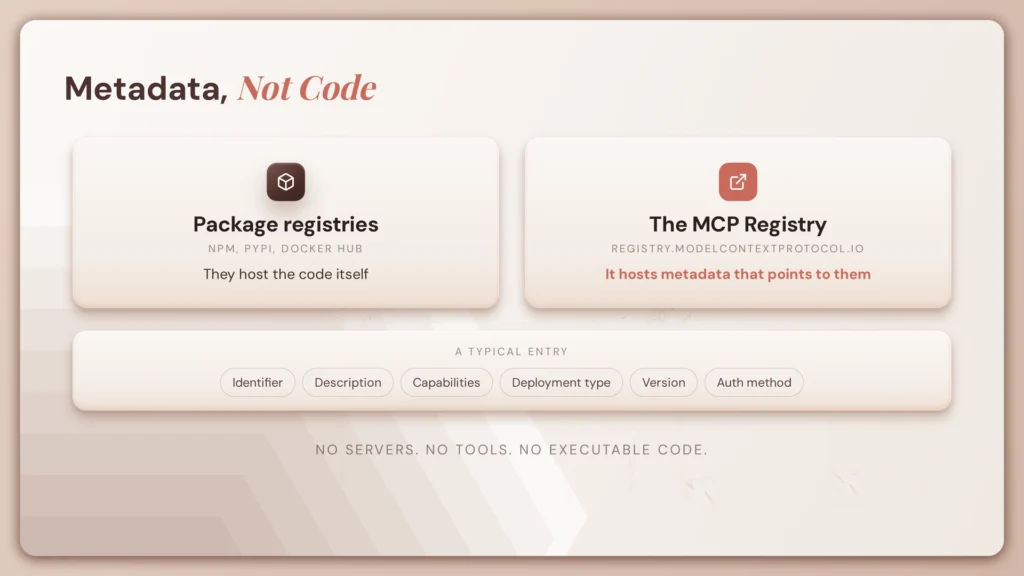
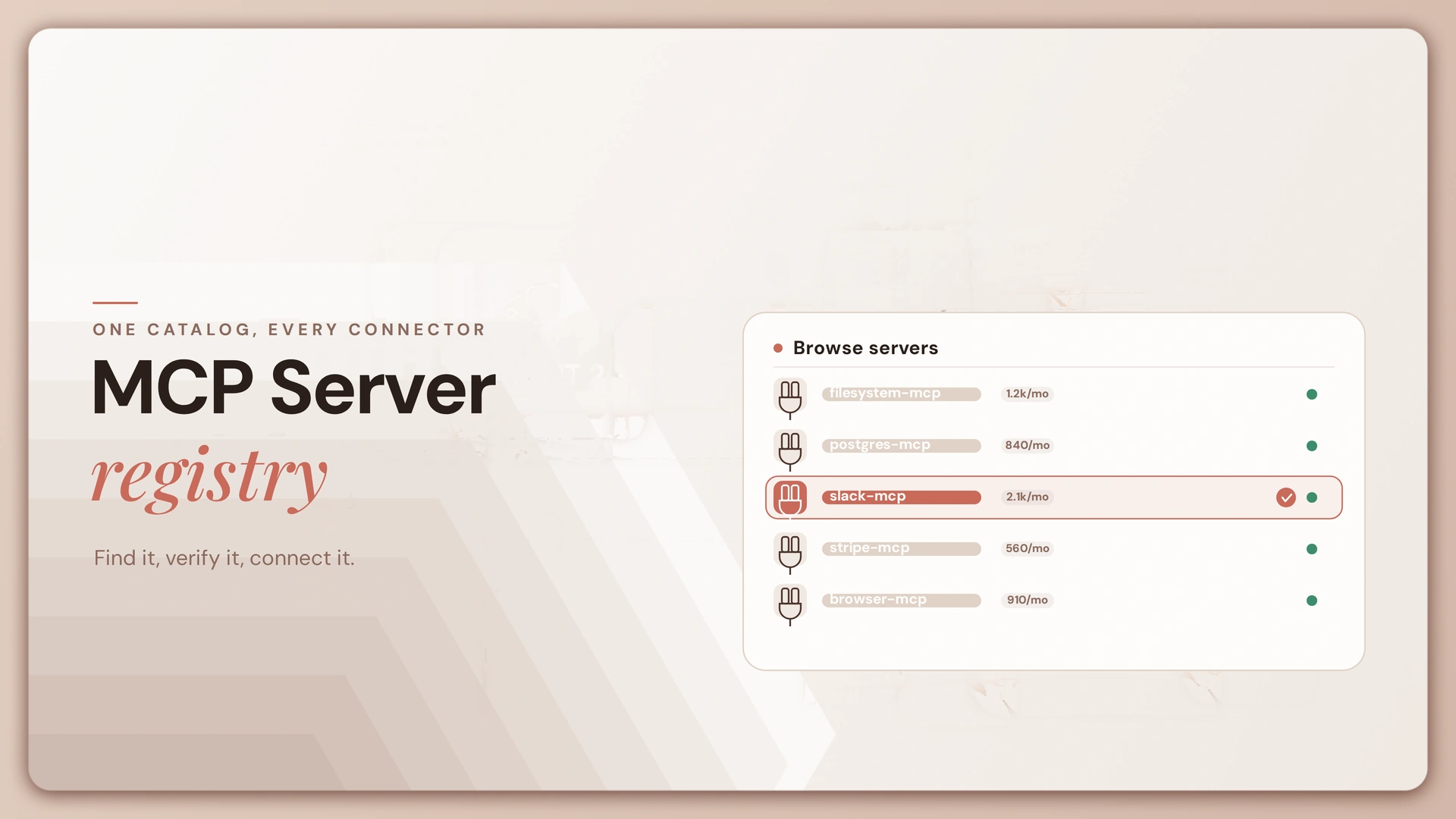
An MCP server registry is a directory that stores metadata about MCP servers so developers and agents can discover and verify them before connecting.
Package registries such as npm, PyPI, and Docker Hub host packages with code and binaries, while the MCP Registry hosts metadata that points to those packages. It does not host the servers, the tools, or any executable code. That’s the single most common misunderstanding people bring to this term.
A typical registry entry includes a unique identifier, a human-readable description, a capabilities list, the deployment type, version information, and the authentication method. Server identity is verified through namespaces. Server names follow a reverse DNS format, like io.github.username/server or com.example/server, that ties them to verified GitHub accounts or domains.
The official reference registry sits at the center of this ecosystem. The official MCP Registry at registry.modelcontextprotocol.io launched in preview in September 2025 as part of the MCP open-source project, backed by Anthropic, GitHub, PulseMCP, and Microsoft.
MCP itself is a communication protocol, not a search index. If you’re still comparing it against other integration patterns, see our breakdown of A2A vs. MCP vs. REST rather than treating the registry as the protocol. The agent API layer is a related but separate concern from server discovery.
Registry vs. Server vs. Gateway
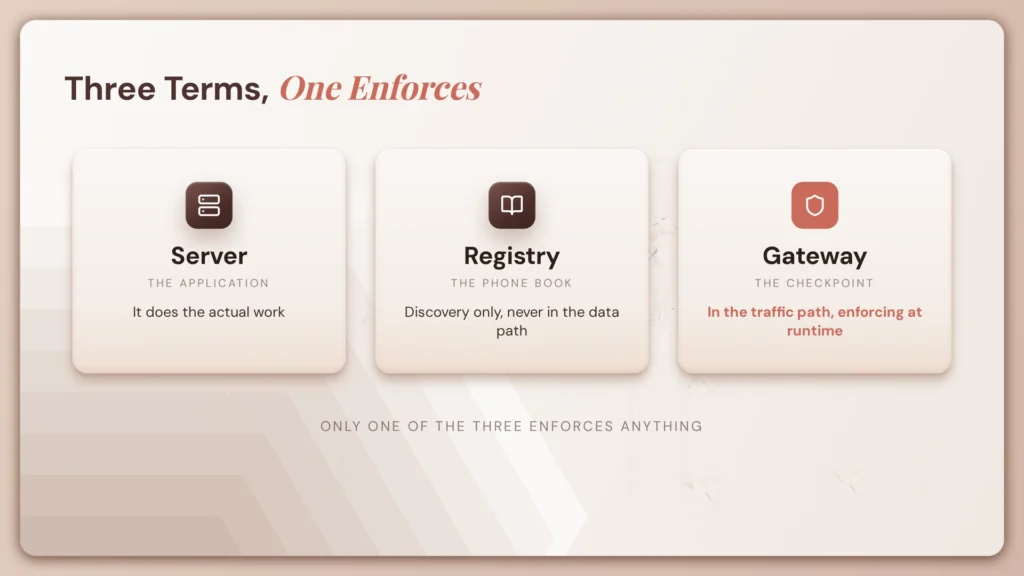
These three terms get used interchangeably, and that’s exactly where teams lose track of what’s actually enforcing anything.
The server is the application doing the work. The registry is the phone book. The gateway is the checkpoint.
The registry facilitates the introduction but stays out of the data path entirely. Once a client has connection details, the registry is responsible for discovery, not execution, and it does not run MCP servers or proxy runtime traffic.
A gateway does something categorically different. The MCP gateway is the enforcement layer, answering whether an agent is authorized to use a tool and under what constraints, and it sits in the traffic path between agents and MCP servers, enforcing authentication, rate limiting, cost controls, PII redaction, and traffic routing at runtime.
MCP Registry vs. MCP Server vs. AI Gateway
| MCP Server | MCP Registry | AI Gateway | |
|---|---|---|---|
| What it is | Exposes tools to agents | Directory of server metadata | Proxy in the request path |
| Holds code | Yes | No | No |
| In request path | Yes | No | Yes |
| Answers | What can this tool do? | Which servers exist and where? | Should this call proceed? |
| Enforcement | N/A | None | Yes |
Some vendors bundle two or all three of these into a single product. That’s a packaging decision, not a change in what each layer actually does. If you’re mapping this against orchestration patterns, our guide to agent orchestration covers where these pieces sit relative to a running agent workflow.
Public vs. Private MCP Registries
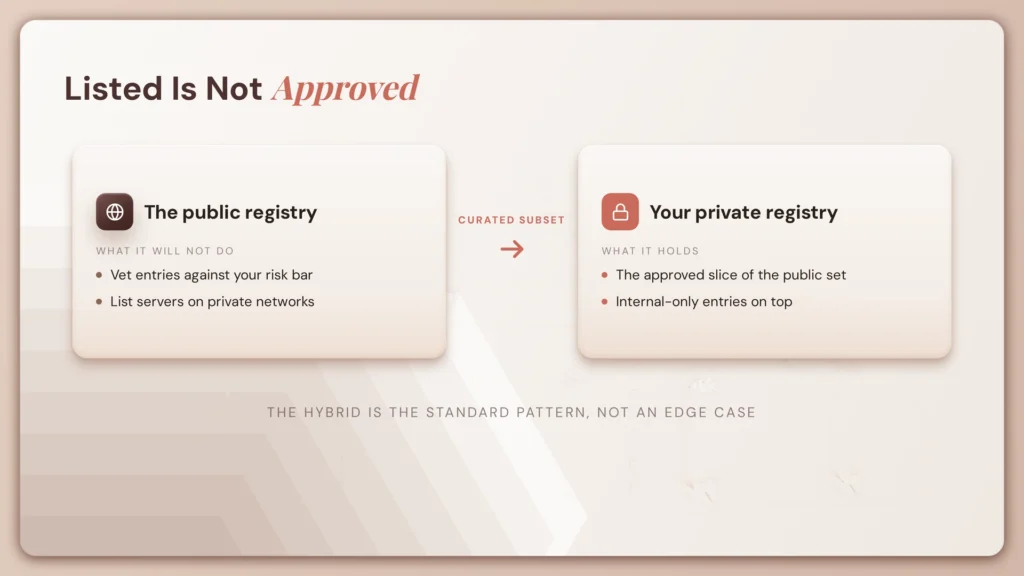
The community reference registry covers publicly reachable servers. Most enterprises still need their own.
Server developers can publish their server’s metadata to the registry as long as the server’s installation method is publicly available or the server itself is publicly accessible. That design choice creates two problems for enterprise use.
First, public entries aren’t vetted against your specific risk tolerance, a server can be functional and still fail your compliance bar. Second, internal tools were never meant to appear there in the first place. The registry doesn’t accept servers restricted to private networks.
That’s why a private MCP registry is the standard enterprise pattern, not an edge case. Private subregistries within enterprises can combine published servers with internal ones, apply custom policies, and share a consistent API surface with MCP clients.
The most common shape is a hybrid: mirror an approved, curated subset of the public catalog and add internal-only entries on top. The upstream MCP Registry is not the only registry; instead, it serves as the canonical source of public MCP server metadata that subregistries can ingest, augment, or mirror.
This is the same discipline behind AI agent governance generally: don’t extend trust to something you haven’t reviewed, and don’t assume “publicly listed” means “internally approved.”
Why Enterprises Need MCP Server Registry
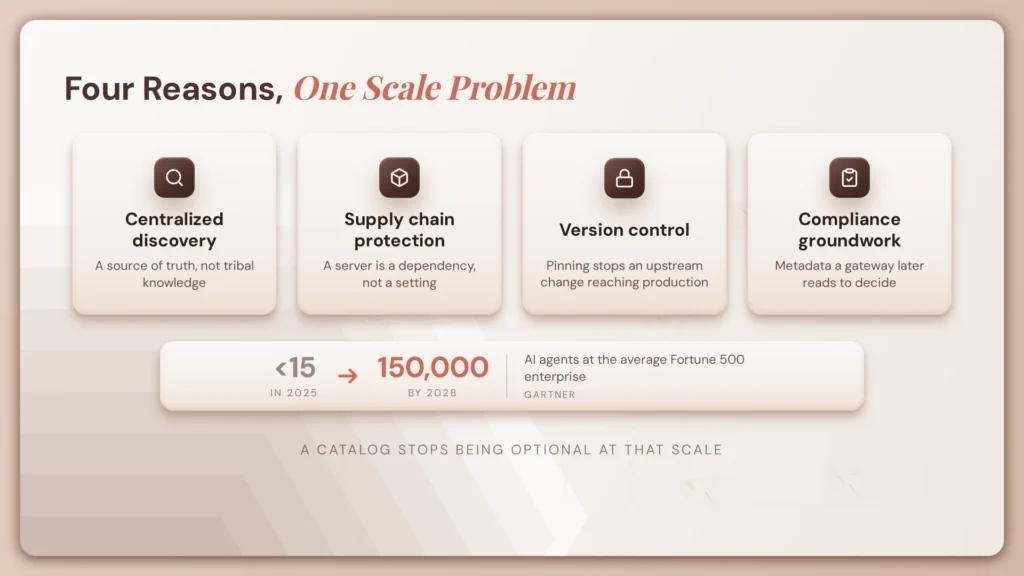
Centralized discovery. Without a registry, tool discovery happens through wikis, Slack threads, and whoever remembers which repo has the right server. A registry replaces tribal knowledge with a queryable source of truth that both engineers and agents can hit programmatically.
Supply chain protection. An MCP server is a dependency, not a configuration setting. Tool descriptions are text the model reads and acts on, which means installing an unvetted server places it inside the trust boundary of every agent that connects to it. Treating server selection like any other dependency decision, provenance checked, versions pinned, updates reviewed, is what closes the gap that prompt injection exploits at the tool layer.
Version and package control. Pinning an approved version prevents an upstream server from shipping a breaking change or a new vulnerability straight into production without review. This matters more as agent fleets grow. Gartner expects the average Fortune 500 enterprise to run over 150,000 AI agents by 2028, up from fewer than 15 in 2025. A catalog stops being optional at that scale.
Compliance groundwork. A registry alone doesn’t enforce policy, but it stores the metadata an enforcement point needs, data classification, required access level, owning team, which a gateway later reads to make a real-time decision. IBM’s Institute for Business Value found only 18% of organizations maintain a current, complete inventory of their AI agents, and the same gap shows up on the tool side without a registry in place.
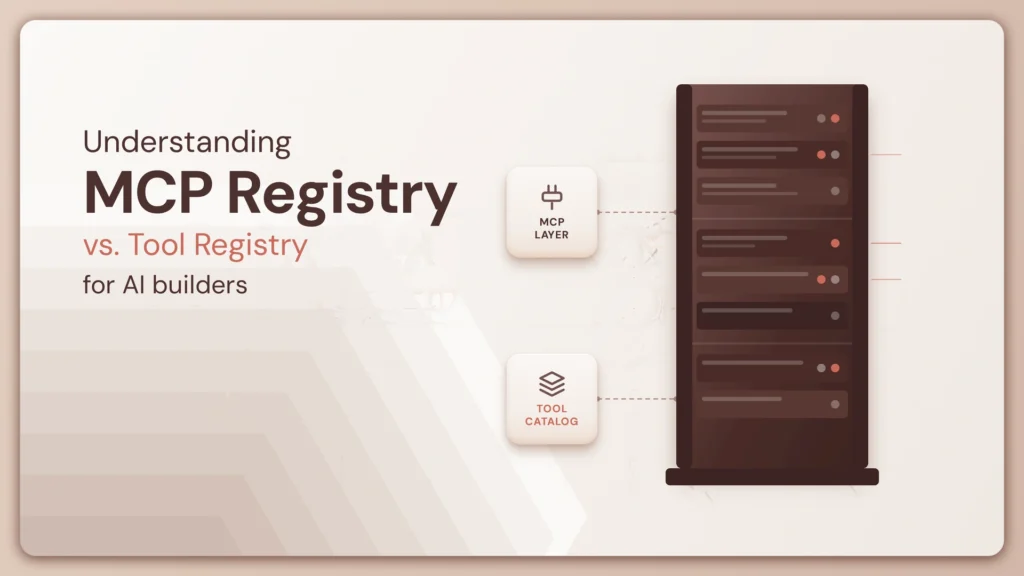
For the deeper cut on cataloging individual functions rather than whole servers, see MCP registry vs. tool registry.
What a MCP Server Registry Doesn’t Do
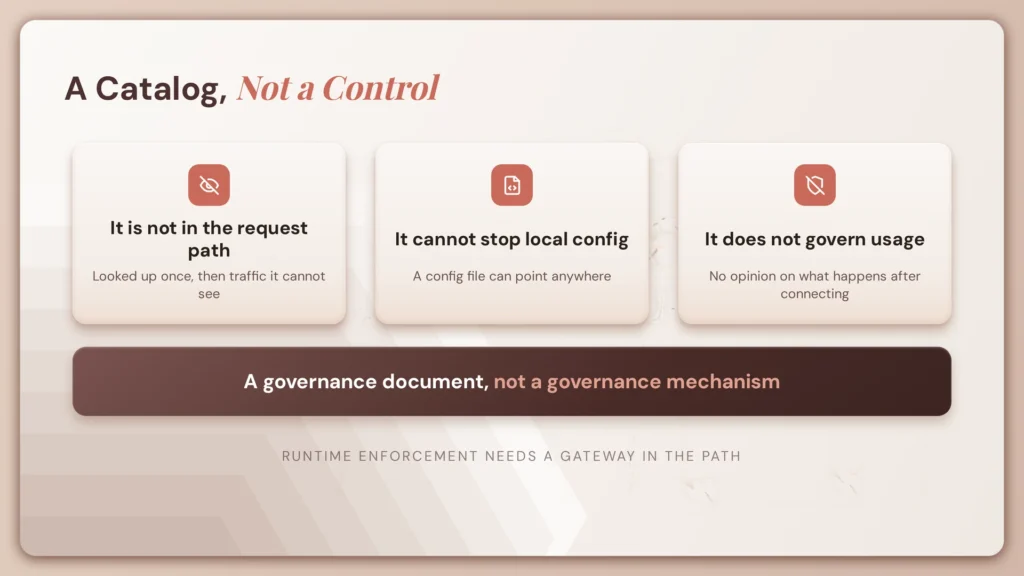
Here’s the part vendors selling registries tend to gloss over: a registry is a catalog, not a control.
It doesn’t sit in the request path. An agent looks up a server once, then talks to it directly for every subsequent call. The registry has no visibility into that traffic and no ability to interrupt it. A registry without a gateway provides discovery but not runtime governance, agents can find tools, but nothing prevents unauthorized access or enforces usage policies once they connect.
It doesn’t stop local configuration. Nothing about a registry prevents a developer from pointing their agent’s config file directly at a server that was never approved. This is exactly how shadow AI agents proliferate, quietly, outside any system the platform team can see.
It doesn’t govern usage once connected. Even a fully approved server, called by a fully approved agent, can be misused. The registry has no opinion on what happens after the connection is made. Runtime enforcement, the kind that actually blocks a bad call, requires a gateway sitting in the path. Skipping that pairing is how gateway bypass becomes a live risk instead of a theoretical one. A registry that ships without an enforcement layer produces a governance document, not a governance mechanism, worth repeating for anyone budgeting a rollout around discovery alone.
If your team is managing tool sprawl across multiple frameworks, our overview of open source agentic frameworks touches on where discovery layers vary by ecosystem, and the enterprise AI agent challenges piece covers the broader pattern of tools outpacing the controls meant to govern them.
Where Agent Governance Fits
Lyzr is not an MCP registry. That needs to be said plainly, because the adjacency is close enough to invite confusion.
Lyzr’s Agent Registry serves as the single source of truth for all deployed agents across the organization, tracking version, framework, deployment status, and history. That’s a registry of agents. An MCP server registry catalogs tools and servers. Different subject, same discipline.
Everyone shipped a registry in 2026, but a registry only tells you an agent exists, it does not deploy it, promote it, or refuse its next call. That’s exactly the gap OpenController, Lyzr’s Control Plane, is built around: identity, evaluation, staged promotion, and enforcement sitting alongside the registry rather than stopping at it.
OpenController sits at that layer, where the registry tells you what capabilities exist and the Control Plane gives you the operational context around the agent actually using those capabilities.
The complete picture pairs three things: an agent registry, an MCP server registry, and permission scoping that connects them. That combination is what lets a platform team enforce something like “only agents in the finance group may call this version of this tool,” a policy no single layer can hold alone.
See how this plays out across agent types in production, and for a deeper look at where tool-level cataloging diverges from server-level cataloging, the MCP registry vs. tool registry comparison is the natural next read.
Platform teams building this out from scratch should also look at how platform teams structure ownership across these layers, and how responsible AI as a service folds governance into the rollout rather than bolting it on after.
The Real Question Isn’t Whether You Have a Registry
It’s whether anything downstream of it actually checks.
A registry that nobody enforces against is a list that made everyone feel better for a quarter.
The organizations getting this right treat the registry as the first control point in a chain, not the whole chain, pairing it with guardrails and a gateway that sits where the traffic actually flows.
If you’re deciding between building a registry-only inventory and pairing it with real enforcement, that’s worth walking through against your own stack before the next unapproved server shows up in someone’s local config.
Book a demo to see how OpenController pairs registry visibility with runtime control, or check the Lyzr documentation for implementation specifics.
Frequently Asked Questions
Does MCP have a registry?
Yes. The official MCP Registry launched in preview in September 2025, backed by Anthropic, GitHub, PulseMCP, and Microsoft, and enterprises commonly run their own private registries alongside it.
What is an MCP server registry?
A directory of server metadata used for discovery and verification. It does not host the servers themselves, only pointers to where they live and how to connect.
What is the difference between an MCP registry and an MCP server?
The server runs the code and exposes tools. The registry is the catalog that lists which servers exist and where to find them, nothing more.
Is an MCP registry the same as an MCP gateway?
No. A registry catalogs; it doesn’t sit in the request path. A gateway does sit in the path and can actually enforce a policy in real time.
Is MCP a JSON file?
No. Configuration is often stored as JSON, but the protocol itself is a specification, not a file format.
Does MCP use HTTP or RPC?
MCP always uses the same JSON-RPC 2.0 message format regardless of transport. Two transports are defined in the current specification: stdio, where the server runs as a local subprocess, and Streamable HTTP for remote connections. This reflects the spec version 2026-07-28, checked as of September 2026; confirm against the current spec before relying on it.
How does an MCP server authenticate?
It varies by server and transport, and registry entries typically record the required auth scheme as metadata rather than enforcing it themselves.
Does MCP use OAuth?
MCP provides an authorization framework for HTTP-based transports, which implementations using HTTP should conform to, while STDIO implementations should not follow this specification and instead retrieve credentials from the environment. This is accurate as of September 2026 against the specification’s authorization provisions; verify current status before building against it.
Is an MCP server secure?
That depends entirely on the individual server. Treat every third-party MCP server as a supply chain dependency and vet it before it ever reaches a private registry, the same discipline covered in our AI agent risk management glossary.
Can I run a private MCP registry?
Yes, and most enterprises do, typically mirroring an approved subset of the public registry alongside internal-only entries.
Book A Demo: Click Here
Join our Slack: Click Here
Link to our GitHub: Click Here