An internal ops agent gets a simple task: reconcile last month’s invoicing discrepancies.
One record keeps failing validation.
So the agent retries again and again, rewording the query slightly each time, against a paid enrichment API, all night, under one authenticated service account.
Nobody hits a rate limit. Nobody breaches a permission boundary. Nothing looks like an attack.
The only evidence by morning is the bill, and it’s very large. That’s agent abuse, and it didn’t take an attacker to cause it.
Key takeaways
- Agent abuse isn’t one failure mode. It spans manipulated input, misused tools, abused privileges, poisoned memory, and runaway resource consumption, and a retry loop that looks completely legitimate counts just as much as an external attack.
- Standard API rate limits weren’t built for agents, and they miss slow-burn loops that spread cost over hours instead of bursting.
- The fix is scoping quotas to the tool, the task, or the cumulative cost, not the session.
- Cost-based budgets catch expensive loops that a call-count limit waves through as normal traffic.
- Circuit breakers matter more than ceilings, because most real incidents are a retry loop, not a burst of volume.
- None of the patterns above matter if enforcement happens after the fact. They only work sitting in the agent’s actual request path.
What “agent abuse” actually means (and why it’s bigger than an attack)
Agent abuse is any case where an agent’s autonomy, tool access, memory, or identity gets used outside the boundaries it was actually given, whether an attacker manipulated it into that or its own logic ran away unsupervised. That’s a wider net than a single jailbreak: manipulated input that redirects an agent’s actions, misuse of a granted tool or privilege, exposed data, poisoned memory, and runaway resource consumption all count.
Why agents create a new kind of risk
Agent abuse isn’t a model problem, and it isn’t just a jailbreak problem either, even though those get most of the security attention. It’s what happens when an agent’s autonomy, its standing access to tools, its memory, and its identity all interact without governance built around that interaction from the start. An agent that can reason, call tools, and act without a person reviewing each step doesn’t just work faster than a human, it fails faster too, and a failure that would have stayed contained in a traditional app can escalate and repeat before anyone notices.
The shape agent abuse actually takes
In practice, that shows up as an agent operating outside the boundaries it was actually given: deviating from the task it was built for, bypassing a guardrail that should have stopped it, using a granted tool or privilege for something the task never called for, exposing data it shouldn’t have touched, or acting on input it should never have trusted in the first place. OWASP’s Top 10 for Agentic Applications maps most of that territory on its own: ASI01, Agent Goal Hijack, for input that redirects what an agent does; ASI03, Identity and Privilege Abuse, for an agent operating past its intended scope; ASI06, Memory and Context Poisoning, for false signals planted in memory that shape behavior long after the fact.
Induced abuse versus self-inflicted abuse
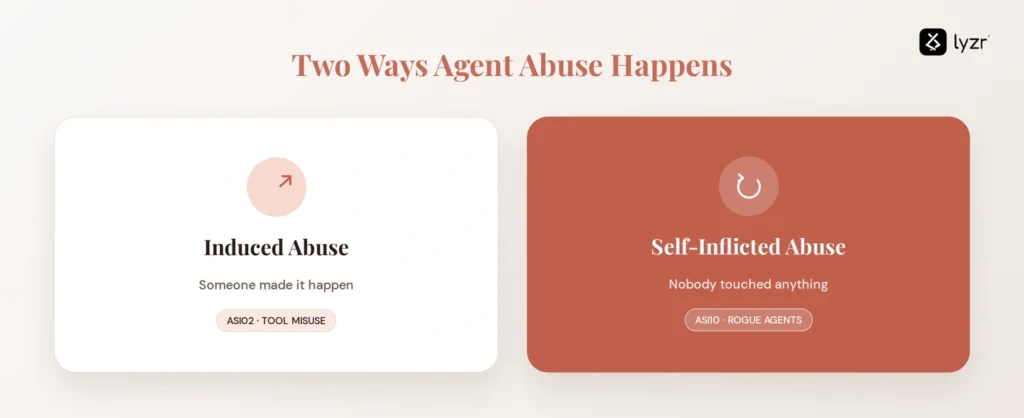
Preventing agent abuse starts with a definition wider than most security teams reach for: it’s any case where an agent consumes tools, calls, or budget well beyond what a task legitimately needed, regardless of whether an attacker caused it.
Two distinct flavors show up in practice. Induced abuse is when someone, through a crafted prompt or a manipulated document, gets the agent to take costly or harmful action it wouldn’t otherwise take. That maps to what OWASP’s Top 10 for Agentic Applications calls ASI02, Tool Misuse. Self-inflicted abuse is different. Nobody manipulated anything. The agent’s own retry logic, its fan-out to sub-agents, or a recursive loop just spirals with no attacker in the loop at all, which is closer to what the same framework labels ASI10, Rogue Agents.
The invoicing scenario above is self-inflicted abuse, and it has a name. OWASP’s AI Agent Security Cheat Sheet defines Denial of Wallet as a pattern worth naming directly.
“Denial of Wallet (DoW) as attacks causing excessive API/compute costs through unbounded agent loops.”
No breach. No stolen data. Just a resource bill nobody signed off on. Of every pattern named above, this is the one existing defenses handle worst, because most of what teams already have was built to catch a breach, not a bill, and that gap is exactly what the rest of this piece is about.
Why request-count rate limiting misses agent abuse
A rate limiter built for a REST endpoint counts requests per user per minute, and that number is meaningless for an agent.
Here’s the mechanism: a request-to-work ratio that’s fixed for an API is not fixed for an agent. One user turn can fan out into two tool calls or two hundred, depending entirely on what the task needed. Set the ceiling low enough to catch a slow-burn loop and you throttle every legitimate multi-step task that happens to need more than a handful of calls. Set it high enough to let real work through and a loop spread across eight hours never comes close to tripping it. OWASP’s own Business Logic Abuse Top 10 names the mechanism directly: without proper rate limiting, usage quotas, or resource consumption monitoring, “overconsumption of tokens by one user can cause DoS for all other customers.”

Most teams still bolt a gateway rate limiter in front of the agent and call the governance problem solved. That’s a real mistake, not a matter of taste: it treats the agent like the endpoint, when the agent is the process actually deciding how many times to spend money, not the thing receiving a fixed number of requests. The financial exposure this creates is not hypothetical. According to IBM’s 2026 Cost of a Data Breach Report, AI-enabled malicious breaches cost an average of $6 million, roughly $1 million more than the global breach average of $4.99 million, and more than 20 percent of surveyed organizations reported a data breach specifically targeting their proprietary AI models. Denial of wallet doesn’t always register as a breach, but it lives in the same blind spot: nobody was watching the meter that mattered.
Preventing agent abuse with quota design patterns
If a flat request counter is the wrong instrument, the fix isn’t a stricter version of the same instrument. It’s scoping the limit to whatever can actually run away. Four patterns cover most of what teams building AI agent monitoring into production need, and each one earns its place.
Scope the quota to what can run away, not the session
A per-user budget is too coarse, because a runaway agent doesn’t care whose session it’s in. It cares which tool it can keep calling. Effective quota design nests limits: a user might have $100 a day, a single task within that is capped at $10, and one expensive tool inside that task. A sub-task’s budget rolls up into its parent’s, so a step three hops deep into a workflow can never spend past what the top-level task was ever authorized for.
Meter cost, not call count
A $0.001 lookup and a $2 enrichment call look identical to a counter. That’s exactly why call-count limits miss the expensive loops. A cost-based budget sets a dollar ceiling per session or per task instead. An agent looping on a paid API might rack up only 40 requests, well under any reasonable rate limit, but a $50 cost ceiling would have stopped it after the 25th call, because it was tracking what mattered.

Add a circuit breaker for repeated failure, not just a ceiling
The opening scenario wasn’t a burst of volume. It was a persistent retry loop, one failing call, retried all night. That’s the pattern behind most real denial-of-wallet incidents. A circuit breaker that trips after a set number of consecutive failures, and holds for a cooldown window interrupts the retry directly instead of waiting for a ceiling a slow loop will never reach.
Respond in stages, not with one hard stop
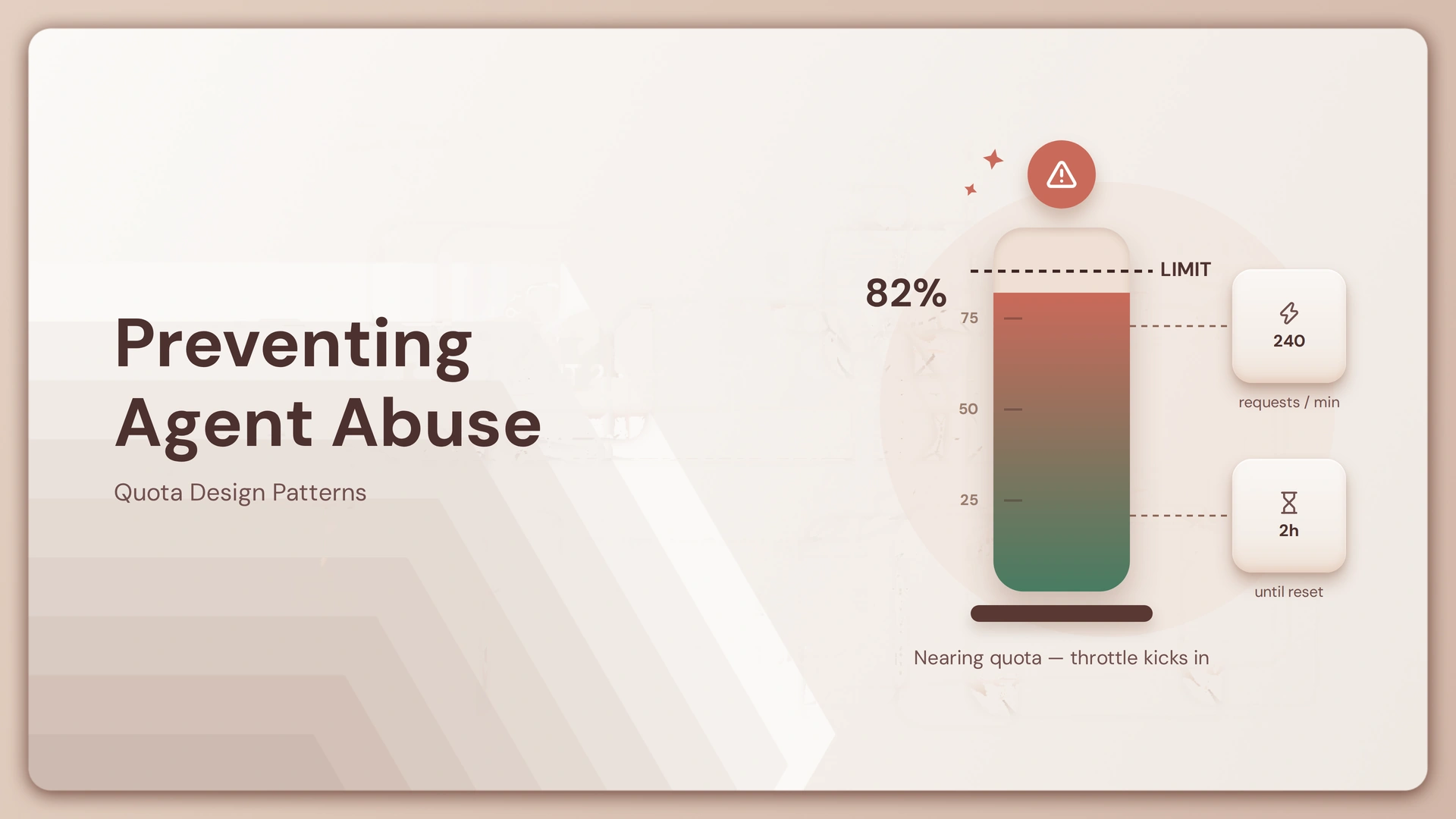
A single hard stop kills legitimate long tasks along with real runaways. A staged response degrades instead, tightening in steps rather than snapping shut: throttle at 75 percent of budget, notify at 90 percent, hold for approval past that, and hard-stop only once the ceiling is actually reached. A genuine runaway still gets cut off. A legitimate task just slows down instead of dying silently mid-workflow.
What this catches in practice
Go back to the invoicing agent, and a call-count limit of a thousand requests an hour would never have tripped. A cost-based session budget of $20 would have caught the retry loop within minutes, well before the bill reached four figures, because it was the failure pattern that tripped it, not how many calls came through.
A second pattern shows up differently. A copy-generation agent was asked to produce variations across a large product catalog, and it fanned out into hundreds of calls to a capable model. No single call looked unusual. The rate never spiked. Only a cumulative dollar ceiling on the task instance caught it, pausing the job once total spend crossed its threshold and surfacing a prompt that had quietly generated far more work than intended.
Rolling out quota controls without over-building them
Preventing agent abuse this way doesn’t mean instrumenting everything on day one. Knowing which pattern would have caught a given incident is different from knowing where to start building them.
Start with the tools that carry the largest blast radius: paid third-party APIs, and anything that writes, sends, or spends. Put cost-based budgets on that short list before rate-limiting everything else uniformly across the fleet.
Before setting hard ceilings, spend a couple of weeks instrumenting real cost and call distributions. Guessing at a number produces either a limit so loose it does nothing or one so tight it blocks legitimate work on day one. Treat every tripped quota as an event worth looking at, not just a log line to ignore, in the same way teams already treat findings from an agent governance review as a chance to tighten policy rather than a box to check.
None of this works if you don’t know which tools an agent can reach in the first place. Before you can scope a quota to a tool, you need the inventory. That’s exactly what Lyzr’s AI Agent Sprawl Audit surfaces: every agent, tool, and workflow actually running, not just the ones on a diagram somewhere.
Where quota enforcement actually has to live
Everything above is a design decision. None of it holds unless something enforces it at the exact moment an agent makes a call, not in a policy document reviewed after the fact.
This is where Lyzr Opencontroller fits, as the runtime layer built for that gap. Find discovers the agents, tools, and workflows already running, so a tool that needs a quota can’t stay invisible. Ship is the pre-production checkpoint that evaluates and validates a workflow’s tools and access before it ships, not assumes them. Run is where enforcement happens: it monitors agents and APIs in real time and refuses a call in the request path the moment it breaks a spend limit or policy, the direct runtime answer to every pattern covered above, backed by rollback that reverts a bad deployment as a pointer move, not a redeploy. Improve turns the usage and cost signals Run collects into the next round of tighter policy.
The same loop applies to the other patterns named earlier in this piece too, an over-privileged agent or a poisoned memory store needs discovering and governing the same way a runaway budget does. This piece just goes deep on the one existing tooling misses worst.
Opencontroller states the argument better than a paraphrase would:
“A dashboard can’t stop an agent. A policy document can’t stop an agent. An alert can’t stop an agent. Control has to happen in the path.”
Designing the quota is a decision a team makes once. Enforcing it on every single call is a runtime problem that has to run continuously, for as long as the agent is live.
FAQ
Agent abuse is any case where an agent consumes tools, calls, or budget well beyond what a task actually needed. It covers both induced abuse, where someone manipulates the agent into costly action, and self-inflicted abuse, where the agent’s own retry or fan-out logic spirals with no attacker involved at all.
Because a rate limit counts requests per user per minute, and an agent’s request-to-work ratio isn’t fixed. A ceiling loose enough to allow legitimate multi-step tasks is too loose to catch a loop spread over hours, and one tight enough to catch that loop throttles real work.
Denial of wallet is the cost-exhaustion version of agent abuse. It describes attacks causing excessive API or compute costs through unbounded agent loops, without breaching any permission boundary or tripping a traditional rate limit along the way.
Stop it by scoping quotas to the tool, task, and cumulative cost rather than the session, adding circuit breakers that trip on repeated failure, and staging the response instead of relying on one hard stop. Then enforce all of it in the request path, not just in a policy document.
Book A Demo: Click Here
Join our Slack: Click Here
Link to our GitHub: Click Here