You almost certainly use AI in marketing already. Nearly everyone does. So the real question for 2026 is not whether you’ve adopted it. It’s how it runs: as a drawer full of separate tools you prompt one at a time, or as a single system that runs the marketing function for you.
Most teams started with the drawer. ChatGPT for drafts, Jasper for blog copy, one tool for social, another for SEO, another for analytics. Each one helps. Each one is also a silo, and you become the glue: copying outputs between tabs, reconciling formats, remembering what went where. Whatever leverage the tools give you at the task level, you pay back in coordination at the human level.
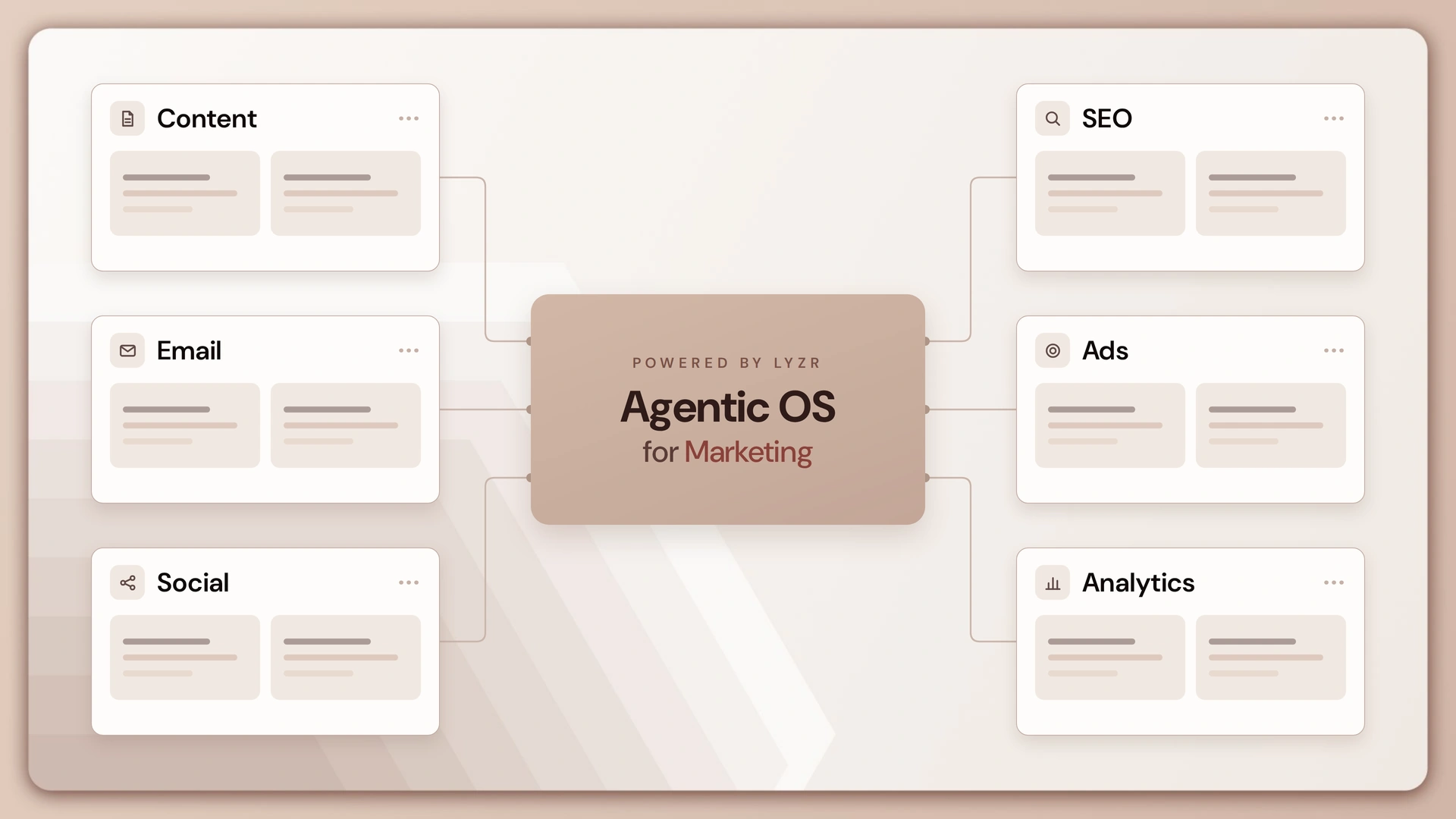
The shift happening now is to hand that coordination to the software. Instead of tools you stitch together, you adopt an Agentic OS for Marketing: one operating layer that runs content, social, email, SEO, ABM, and reporting, with specialist agents working underneath it. You set the goals and make the calls that need judgement. The OS handles the rest.
That shift, from tool collection to operating system, is what this guide is about.
What AI in marketing actually means in 2026
AI in marketing uses machine learning, large language models, natural language processing, and agentic systems to deliver customer insights, automate marketing decisions, and execute the work of running multi-channel campaigns. The underlying technology has not changed dramatically in the last two years. What has changed is the architectural pattern.
Through 2024 the dominant pattern was assistive AI: a human prompted a model, got an output, used the output. The model was a faster typist. Through 2025 the dominant pattern shifted to autonomous AI: agents that complete multi-step tasks without continuous human prompting. In 2026 the pattern has consolidated further into agentic operating systems: coordinated agent layers that run entire functions, with humans setting goals and reviewing outputs rather than driving each step.
Three categories of AI now sit inside marketing teams:
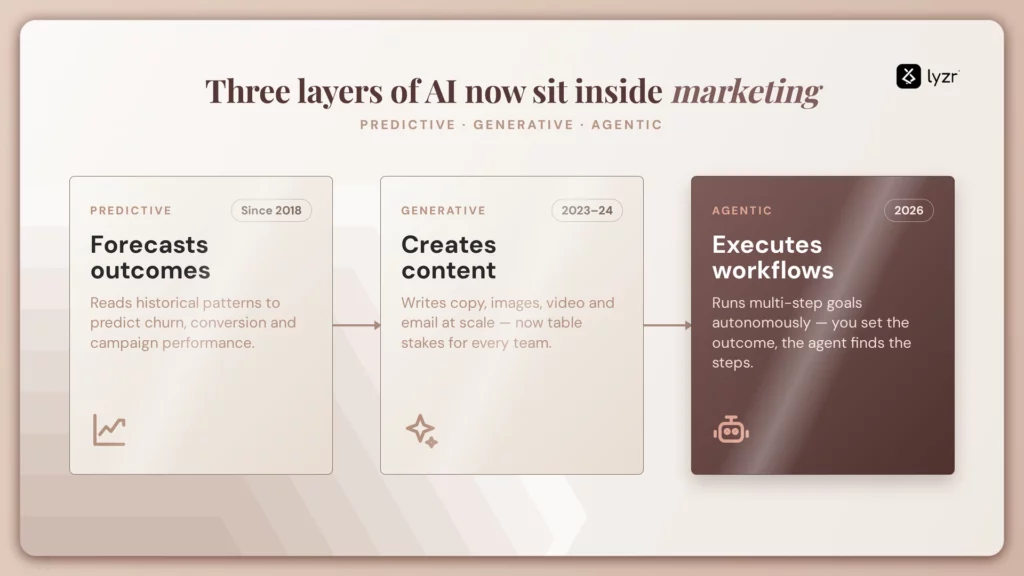
Predictive AI analyses historical patterns to forecast future outcomes. It predicts churn risk, identifies which customers are likely to convert, estimates campaign performance, and flags audience segments likely to respond to specific offers. Predictive models have been in marketing stacks since 2018; they are mature and well-understood.
Generative AI creates new content from learned patterns. It writes copy, generates images, produces video, and drafts emails. Marketers use generative AI for AI-generated content at scale, helping teams produce variations for testing, personalised messages for segments, and ad creative for paid campaigns. Generative AI is the layer that exploded in 2023-2024 and is now table stakes for any marketing team.
Agentic AI is the 2026 layer. Agents execute multi-step workflows autonomously, pulling on both predictive and generative capabilities as part of larger goals. An agent decides what content to create based on what a customer segment needs, generates it, places it in the right channel, monitors performance, and adjusts the campaign over time. The human sets the outcome; the agent figures out the steps.
The shift from generative to agentic is the architectural shift that defines this year. It is also the shift that determines whether your AI investment compounds or stays flat.
For a deeper definitional treatment of AI in marketing covering ground this guide compresses, see Lyzr’s longer companion piece, the comprehensive AI in marketing guide, which runs through every category at fuller length. For the agentic AI layer specifically, the agentic AI explainer is the foundational reference.
The underlying AI technologies briefly
Marketing leaders do not need to be experts in the underlying AI technologies, but a working vocabulary helps when evaluating vendors and platforms. Six technologies show up repeatedly:
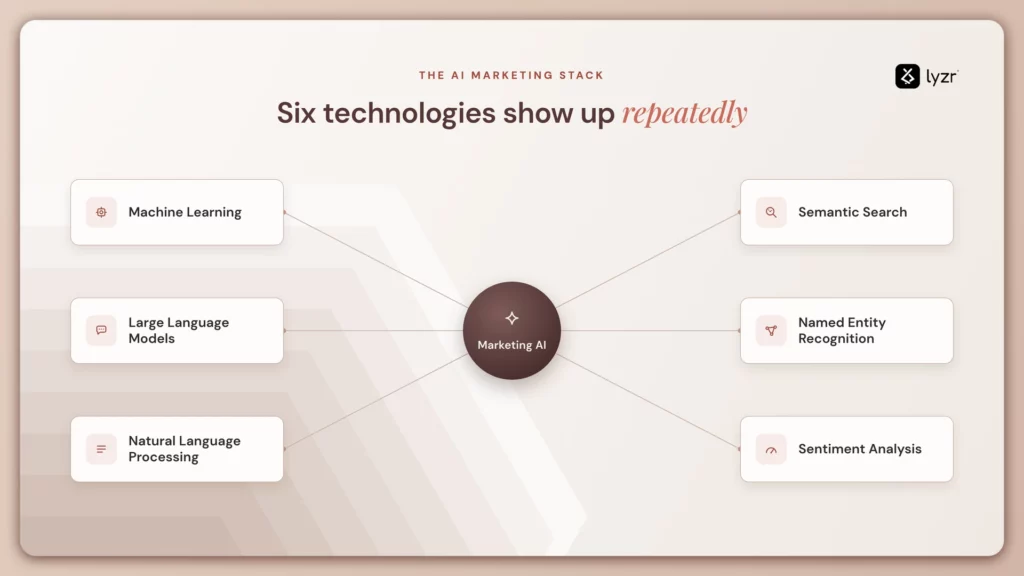
Machine learning (ML) is the broad category covering systems that learn from data and improve over time. Marketers use ML for customer segmentation, personalised recommendations, predictive analytics, and forecasting. ML applications extend beyond marketing into operations and security; the same techniques used for marketing personalisation also power things like machine learning in threat detection, which is a useful reminder that the technology is general-purpose and the marketing applications are one specific cut.
Large language models (LLMs) are the foundation of generative AI in marketing. Models like GPT-4, Claude, Gemini, and others generate copy, summarise documents, answer customer questions, and increasingly drive multi-step agent reasoning. LLMs differ in capability, cost, and deployment options (cloud vs on-prem vs sovereign), which matters for regulated industries.
Natural language processing (NLP) enables systems to understand and analyse human language at scale. Marketing teams use NLP for sentiment analysis on social media, automated tagging of support tickets, content analysis of competitor websites, and understanding query intent for search optimisation.
Semantic search clusters keywords and content based on meaning rather than exact-match phrasing. This is the underlying technology that lets AI tools surface related topics, recommend internal links, and optimise content for the way modern search engines actually rank pages.
Named entity recognition (NER) and neural networks identify entities, relationships, and patterns within large datasets. Marketers use NER to extract influencers, brands, products, and locations from unstructured text, which feeds into competitive intelligence and content strategy.
Sentiment analysis measures customer feedback and assigns polarity scores to text. Brands use sentiment analysis on reviews, surveys, and social mentions to track brand health, identify rising issues, and measure campaign reception.
These technologies are the building blocks. They sit inside the agents and the operating systems that marketing teams actually adopt. Knowing the building blocks helps with vendor selection; the real conversation, though, is about how the building blocks are assembled.
Why AI in marketing is no longer optional
Three forces have made AI in marketing structural rather than experimental.
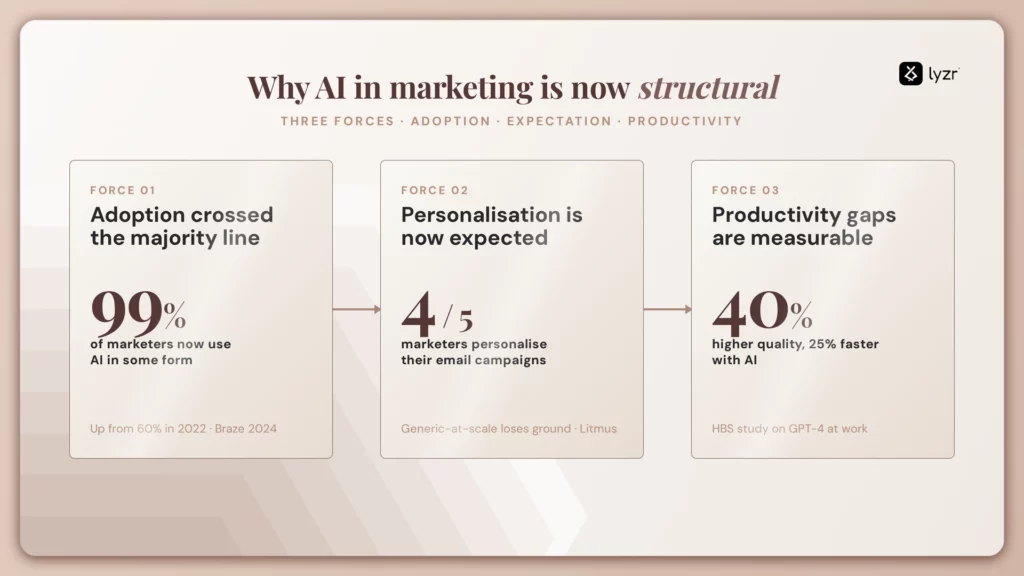
Adoption has crossed the majority threshold. Braze’s 2024 Global Customer Engagement Review found that 99% of marketers report their organisations are already utilising AI in some form. That number was 60% in 2022. The strategic question is no longer whether to adopt; it is whether your adoption is keeping pace with peers.
Personalisation has become an expectation. Today, 4 out of 5 marketers include personalisation in their email campaigns, per Litmus research. Customer expectations now anchor at the level that AI-driven personalisation makes possible. Teams that try to deliver generic messaging at scale are losing ground to teams that deliver tailored messaging at the same scale. This is one of the reasons content velocity has become a marketing-team KPI and one of the reasons content creation agents have moved from experimental to operational in most marketing stacks.
Productivity gaps have become measurable and large. Harvard Business School researchers studied the impact of ChatGPT-4 on a global management consulting firm’s daily operations and found that specialists using AI completed 12.2% more tasks, finished them 25.1% faster, and delivered 40% higher quality results compared to those who did not use AI. The research is summarised in Ethan Mollick’s centaurs and cyborgs on the jagged frontier write-up, which has become required reading for marketing leaders thinking about AI adoption.
The composite picture: AI in marketing is now adopted by almost everyone, expected by customers, and measurably more productive. The marketing leader’s question has shifted from “should we” to “how fast and how well.” For more on the implementation patterns Lyzr sees inside enterprise deployments, the GTM marketing playbook and the content marketing playbook walk through the architectural decisions in detail.
AI in marketing use cases that actually drive results
The 2024 Global Customer Engagement Review from Braze shows 99% of marketers using AI in some form. But adoption is not the same as effectiveness. Below are the eight use cases that consistently produce measurable results inside the enterprise marketing teams Lyzr works with.
1. Content generation at production scale
42% of marketers use AI for content creation and that number is rising every quarter. The use case has matured beyond simple blog drafting. Modern AI content workflows generate blog posts, marketing copy, email campaigns, subject lines, video subtitles, social posts, landing page variants, and AI-generated videos as part of integrated content systems rather than one-off prompts.
The shift that matters in 2026 is from generation to coordination. Generating one blog post is a tool problem (any LLM can do it). Generating a coordinated weekly content motion across blog, social, email, and video, with each piece informed by the others and routed to the right audience segment, is an operating system problem. That is the work that the AI content creation agent blueprint and the broader ebook generator agent, AI webinar agent, and press release writer agent blueprints are designed for.
For teams thinking about the comparison between AI content tools, the Skott vs Writesonic vs Copy.ai vs Jasper head-to-head and the AI content generators comparison walk through the trade-offs at the tool level. For the deeper agentic angle, the AI agent for content creation deep-dive covers the workflow patterns.
2. Audience segmentation that goes beyond demographics
AI helps marketing teams divide their customer base into specific groups based on behaviours, interests, demographics, intent signals, and predicted future actions. The shift in 2026 is from static segmentation (defined once, applied to campaigns) to dynamic segmentation (re-computed continuously based on new data).
Dynamic segmentation feeds personalisation, ABM, lifecycle marketing, and paid media targeting. It also feeds the workflow handoffs between marketing channels: a customer who shows high intent in one channel triggers personalised messaging in the next. For teams that combine AI segmentation with search and content workflows, working with the best SaaS SEO agency approach can sharpen targeting on the search side; the bigger lift, though, comes from the segmentation feeding multiple channels simultaneously under a single OS, which is what the ABM agent blueprint and the audience research and segmentation blueprint layers are built for.
3. Customer service chatbots that handle real complexity
AI-powered chatbots have moved beyond the FAQ-bot era. Modern chatbots and voice agents handle multi-turn conversations, route complex queries, surface relevant knowledge, and complete transactional workflows. The shift from typed to voice-driven interactions has been a quieter trend running underneath the chatbot evolution: roughly 71% of consumers prefer voice search over typing for everyday queries, which has reshaped what customer-facing chatbots need to handle. The marketing-adjacent use case is the pre-sales chatbot: the one that qualifies leads on the website, books meetings, surfaces relevant content, and feeds CRM enrichment.
For the deeper pattern across customer support specifically, Jeff, Lyzr’s Agentic OS for Customer Support, runs the same coordinated pattern across cross-channel support, email triage, phone support, and CRM case generation. The marketing-side workflow connects to support naturally: leads that come in through marketing chatbots get handed off into the support OS without breaking context.
4. Programmatic advertising with AI-driven optimisation
Programmatic advertising automates the buying and placement of digital ads. Partnering with top programmatic advertising agencies helps businesses maximise these capabilities, ensuring campaigns are data-driven, precisely targeted, and continuously optimised for better ROI. AI plays a central role: analysing customer data, predicting which placements convert, adjusting bids in real time, and rotating creative based on performance.
Similarly, a Google Ads agency leveraging AI can optimise bidding strategies, automate audience targeting, and refine ad creative continuously. The pattern across both is the same: AI handles the optimisation loop that humans cannot run fast enough manually.
The operating-system layer adds coordination on top: the same intent signals that drive paid placements also drive the email cadence, the content recommendations, and the sales handoff timing. For teams thinking about the agentic angle on paid specifically, the AI agents for paid advertising deep-dive covers the workflow patterns and the campaign automation agent reference covers the coordination layer.
5. Search engine optimisation in the age of AI search
AI tools help marketers improve search visibility across both traditional Google rankings and the newer AI search surfaces (ChatGPT, Perplexity, Claude, Google AI Overviews, Gemini). The work spans keyword research, content optimisation, technical SEO, internal linking, and increasingly answer engine optimisation (AEO) and generative engine optimisation (GEO).
In this process, working with a link building agency helps strengthen a site’s authority by earning relevant links that support content performance. The link-building work compounds with technical optimisation and content velocity to deliver compound rankings improvements.
This helps businesses create content that ranks higher in search results, driving more organic traffic. In SaaS environments, SEO strategies are often more technical and data-driven, similar to the structured approaches used by a SaaS SEO agency.
The agentic shift in SEO is where the leverage compounds. The AI agents for SEO pillar walks through how agents handle keyword research, competitor analysis, content optimisation, backlink outreach, and SERP monitoring as coordinated workflows rather than discrete tasks. The AEO/GEO Optimizer Agent blueprint is the operational version of this for AI-search visibility specifically.
6. E-commerce personalisation and lifecycle automation
AI is reshaping how e-commerce platforms manage customer journeys. AI tools recommend products, analyse shopping behaviours, automate inventory management, and personalise the post-purchase experience.
Beyond inventory automation, AI is reshaping how e-commerce brands engage customers through SMS. Platforms like TxtCart use conversational AI to deliver personalised SMS and MMS campaigns, power product recommendations, automate cart recovery and post-purchase flows, and segment audiences for targeted messaging. With built-in A/B testing and two-way conversations, brands can increase engagement, drive repeat purchases, and strengthen long-term customer relationships.
The operating-system pattern in e-commerce ties product recommendations to email cadence, SMS triggers, on-site personalisation, and paid retargeting under one coordinated layer. For teams building this pattern from the ground up, Lyzr’s agentic commerce solutions document how AI agents coordinate across the full e-commerce funnel.
7. Email marketing as an orchestrated channel
Email is the channel where AI in marketing produces some of the clearest measurable lift. AI handles segmentation, subject-line testing, send-time optimisation, content personalisation, list hygiene, and lifecycle automation. The 2026 shift is from rules-based email engines to agent-driven email engines that re-decide segmentation and content based on each new data point.
The AI agent for email marketing deep-dive covers the workflow patterns and the top 10 AI email automation tools roundup covers the tool landscape. For teams thinking about email inside the broader marketing OS, email is one of the workflows that Skott orchestrates natively.
8. Account-based marketing at scale
ABM has historically been labour-intensive: account selection, multi-touch coordination, personalised content, sales handoff. AI removes most of the labour. AI agents identify target accounts based on firmographic and intent signals, generate personalised content per account, coordinate touches across email, LinkedIn, ads, and direct mail, and surface accounts that have crossed the conversion threshold for sales.
The ABM agent blueprint handles the workflow end-to-end. ABM at scale is one of the use cases that most clearly justifies the operating-system architecture: ABM requires coordination across more channels and more handoffs than any other marketing motion, which means the cost of stitching tools together manually is highest, and the benefit of an OS is largest.
For the LinkedIn-specific layer that often sits inside ABM motions, the LinkedIn marketing agent deep-dive covers the workflow patterns.
The shift from point tools to operating systems
This is the architectural shift that defines AI in marketing in 2026. It is also the shift that most marketing teams are mid-transition on.
A point tool solves one problem. ChatGPT writes copy. Jasper drafts blog posts. Copy.ai generates outreach. A separate tool handles email. Another handles social. Each tool is competent at its job. The human marketer stitches them together: copying outputs from one tool into another, reconciling formatting, maintaining context across tools, deciding handoffs manually.
An operating system handles the stitching. It orchestrates point capabilities under one coordinated layer. The same context (customer segment, campaign goal, brand voice, performance data) flows across content, social, email, SEO, ABM, and reporting. Handoffs happen automatically. The human marketer moves up the stack into strategy, judgement, and creative direction.
The difference matters more at scale. A small team with five tools can manage the stitching manually. A large enterprise marketing team with 25 tools cannot. The operating system architecture is what makes AI deployment scale beyond the early-adopter team.
The OS architecture also matters for compliance, security, and governance. A point-tool approach means data flows out to many vendors, each with its own privacy posture, security model, and audit trail. An OS architecture means data stays inside one coordinated layer with one set of controls. For regulated industries (banking, insurance, healthcare, government), this is often the difference between AI deployment being possible at all and being blocked at security review.
Tools landscape in 2026: point products vs operating systems
The AI marketing tools landscape splits into two architectural categories.
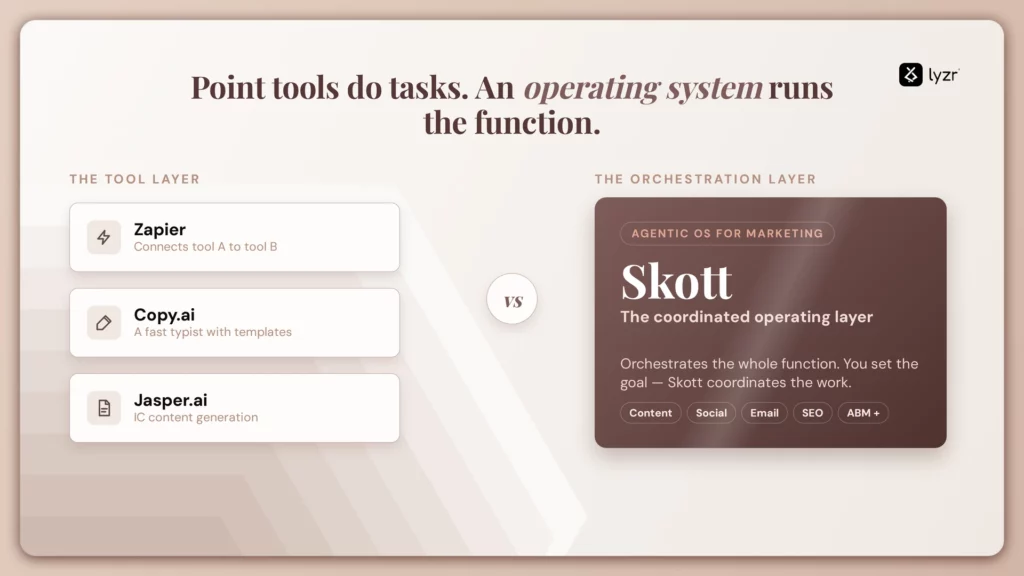
Point products (the tool layer)
Zapier automates workflows across thousands of integrations. It is the connective tissue between point tools. Zapier solves “how do I move data from tool A to tool B,” which is a real problem but a different problem than running the marketing function.
Copy.ai automates copywriting tasks with prompt-driven workflows. Copywriters and small teams use it to draft outlines, briefs, social media posts, and personalised emails. It is a fast typist with templates.
Jasper.ai is a popular tool built on LLM foundations that assists copywriters with content generation. It produces blog posts, emails, and images, with templates for common content types. Like Copy.ai, it is a tool optimised for individual contributor productivity.
These tools are useful. They are also not operating systems. They solve specific tasks. The team still has to coordinate across them.
Operating systems (the orchestration layer)
Skott is the Agentic OS for Marketing. Skott is not a point tool. Skott is the coordinated operating layer that orchestrates marketing across content, social, email, SEO, ABM, distribution, and reporting. Specialised agents run under Skott for each workflow. The marketer sets the goal; Skott coordinates the work.
What Skott orchestrates:
- SEO workflow: keyword research, competitor analysis, content brief generation, content optimisation for both traditional search and AI search, SERP monitoring, ranking recovery
- Content workflow: drafting, editing, optimisation, publishing, refresh, distribution across channels
- Social workflow: planning, copy generation, scheduling, engagement across LinkedIn, X, Instagram, and other channels via the AI social media agent blueprint
- Email workflow: campaign planning, copy generation, segmentation, sending cadence, optimisation
- ABM workflow: account targeting, multi-touch coordination, personalisation at scale via the ABM agent blueprint
- Distribution and amplification: across owned, earned, and paid channels
- Long-form content: ebook generation, webinar production, press releases
- Internal marketing communication via the AI internal communication agent
- Marketing strategy coordination via the marketing strategy builder blueprint
- Reporting and analytics with attribution to underlying agent actions
Skott is part of a broader family of Lyzr Agentic OS offerings, each purpose-built for a function:
- Skott — Agentic OS for Marketing
- Diane — Agentic OS for HR
- Jeff — Agentic OS for Customer Support
- Amadeo — Agentic OS for Banking
- Benjie — Agentic OS for Insurance
Specialised named agents work inside or alongside the OS layer: Jazon for AI SDR and outbound, Kathy for competitor analysis, Dwight for RFP scouting. For marketing teams, the typical adoption pattern is to start with Skott as the OS for marketing, layer Jazon for outbound sales coordination, and add Kathy for competitive intelligence as the agentic surface area expands.
The right comparison framing
Comparing Skott to Zapier, Copy.ai, or Jasper directly is a category error. They occupy different layers of the stack. The right comparison framing is Skott vs your current marketing tech stack as a whole. If your current stack is 15 point tools coordinated by human marketers, the alternative is an OS that runs the coordination natively. For the head-to-head context where the comparison still gets requested, the Skott vs Writesonic vs Copy.ai vs Jasper deep-dive walks through the per-tool trade-offs, and the Skott vs traditional marketing piece frames the broader category shift.
For the use-case-level perspective on Skott deployments, the 12 AI marketing agent use cases template covers the workflows we see most often. For the broader Lyzr marketing agent suite, the marketing agents overview lists every blueprint.
AI in marketing for enterprise and regulated industries
The use cases and tools above apply broadly. Inside regulated enterprises (BFSI, insurance, healthcare, government), an additional set of considerations applies. Marketing teams in these environments cannot simply adopt the SaaS tool of the month. Data residency, model governance, audit trails, vendor risk management, and compliance frameworks all gate AI adoption.
This is where the operating-system architecture becomes more than a convenience. Skott deploys inside the enterprise perimeter. Data does not leave the customer’s infrastructure. Model selection is configurable (cloud, hybrid, sovereign). Audit logs are maintained per agent action. Compliance frameworks (GDPR, HIPAA, GLBA, the EU AI Act, India’s DPDP Act) are configurable per workflow.
For sector-specific patterns, marketing teams in regulated industries should look at:
- Sovereign AI as the architectural reference for data residency and deployment-inside-perimeter
- Responsible AI as a service as the governance layer
- Banking marketing agents for BFSI marketing teams working alongside Amadeo
- Insurance marketing for insurance marketing teams working alongside Benjie
- Healthcare agents for healthcare marketing teams under HIPAA constraints
- Financial services agents for the broader financial services marketing motion
- Government for federal and state marketing teams with FedRAMP and similar requirements
The operating-system architecture is what makes marketing AI deployable inside these environments at all. Point tools that send data to public cloud APIs are typically blocked at security review. An OS that runs inside the customer’s perimeter passes.
Common roadblocks in implementing AI for marketing
AI’s impact is clear, but it comes with challenges. Teams must address risks like hallucinations, where AI provides confident but inaccurate responses, and potential biases that could skew outputs. While 34.1% of marketers have seen major improvements, 12.7% of marketers faced unexpected challenges during AI adoption, which highlights the risks that accompany the benefits.
Content quality and accuracy
AI has advanced significantly but still faces challenges in content quality. One major issue is factual accuracy. Marketers report receiving incorrect information from generative AI tools at non-trivial rates, particularly for technical or domain-specific content.
The fix is process, not technology. AI-generated content needs human review before publishing. The leverage AI provides is not in eliminating human review; it is in shifting human effort from drafting to editing, which is faster and more value-additive. Lyzr’s hallucination manager as a service is the architectural answer to managing this at platform level.
Privacy and data residency
Marketing personalisation depends on customer data. The more personalised the marketing, the more sensitive the data flowing through AI systems. Privacy regulations (GDPR in the EU, DPDP in India, CCPA in California, sector-specific frameworks like HIPAA in healthcare) constrain what data can flow where, for how long, and under what consent conditions.
The architectural answer is to keep data inside the perimeter. Marketing AI that runs inside the customer’s infrastructure, with no data leaving to third-party APIs, eliminates most privacy concerns. This is the foundation of Lyzr’s sovereign AI architecture and the knowledge base as a service and knowledge graph as a service layers that handle data inside the enterprise perimeter.
Copyright and IP concerns
Generative AI is trained on vast amounts of public content. AI-generated material can sometimes resemble content from other sources, and the legal framework around AI-generated IP is still evolving. Marketing teams need to review AI-created materials and, in some cases, use an AI humaniser to refine the output, ensuring the final version has the unique characteristics and creative nuances of human-led work before publishing.
The deeper governance question is enterprise IP. When AI agents are trained on a company’s content, that company needs to own the resulting outputs and the underlying model behaviour. This is where deployment architecture matters: sovereign AI gives the enterprise ownership in a way that public-API AI typically does not.
Evaluating non-quantifiable KPIs
Some marketing outcomes are easy to measure (CTR, conversion rate, ROI per campaign). Others are not (brand perception, customer loyalty, share of voice). Investing in AI for non-quantifiable outcomes can be a harder internal sell because the immediate ROI is harder to show.
The framing that works inside enterprise marketing is to instrument the AI deployment with both the quantitative metrics (where AI’s contribution is measurable) and the operational metrics (time saved, content velocity, channel coordination latency) that proxy for the harder-to-measure outcomes. Over 6-12 months, the brand-level effects show up in tracking studies and survey-based research.
Implementation framework for enterprise marketing teams
The pattern that works for enterprise marketing teams adopting AI in 2026:
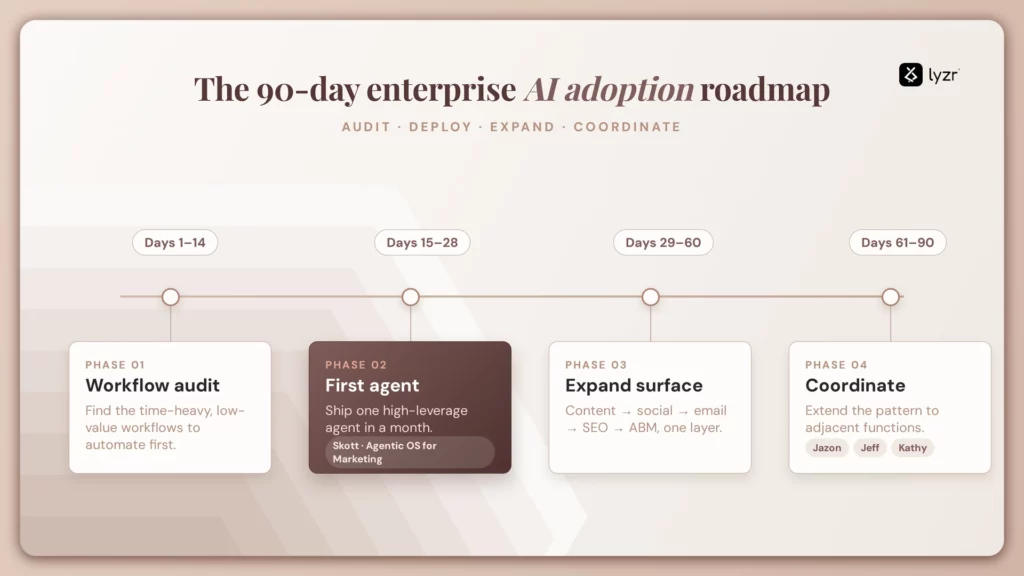
Days 1-14: Workflow audit. Identify the workflows that consume the most operator time and add the least strategic value. These are the first candidates for automation. Common candidates: content drafting, social scheduling, email segmentation, SEO keyword research, competitor monitoring, internal marketing communication.
Days 15-28: First agent deployment. Pick the single highest-leverage workflow and deploy a pre-built agent against it. For most teams, this is content optimisation, social scheduling, or SEO research. The goal is to ship one working agent within a month, not to deploy the full stack at once. Skott, as the Agentic OS for Marketing, handles many of these workflows natively, so the first deployment can often be Skott without custom configuration.
Days 29-60: Expand the agentic surface. Once the first agent is producing measurable lift, expand to adjacent workflows. The pattern is content → social → email → SEO → ABM, but it can run in any sequence based on team priorities. The OS architecture means each new workflow joins the existing coordination layer rather than running as a new silo.
Days 61-90: Coordinate across functions. As the marketing-function adoption matures, expand the agentic pattern to adjacent functions: sales (via Jazon for SDR work), support (via Jeff for the support OS), and competitive intelligence (via Kathy). Teams that adopt one Agentic OS typically adopt others within 6 months as the value pattern compounds.
For teams building custom agents on top of the platform rather than adopting Skott directly, Lyzr Agent Studio is the low-code build environment and Lyzr Architect is the higher-level visual builder. For deeper context on agent-types and architectural patterns, types of agents in production is the foundational reference.
For the broader implementation context across the AI agent lifecycle, the agents to production playbook is the canonical reference. For the 101 use-case primer covering AI applications across business functions, the 101 AI use cases template is the starting point.
Frequently asked questions
What is AI in marketing?
AI in marketing uses machine learning, large language models, natural language processing, and increasingly agentic systems to automate marketing decisions, generate content at scale, personalise customer experiences, and execute multi-channel campaigns. In 2026, AI in marketing has shifted from individual tools (used by humans for specific tasks) to operating systems (which coordinate marketing workflows end-to-end).
How does AI improve marketing ROI?
AI improves marketing ROI through three mechanisms: content velocity (more outputs per unit of human effort), targeting precision (better segmentation reduces wasted ad spend), and workflow coordination (less time spent stitching tools together). The largest measured productivity gain in published research comes from Harvard Business School’s study showing 12.2% more tasks completed, 25.1% faster, with 40% higher quality.
Is AI replacing marketing professionals?
No. AI is changing the work of marketing professionals. Repetitive operational tasks (drafting first-pass copy, scheduling social posts, building keyword lists, segmenting email lists) are being automated. Strategic, judgement-based, and creative work remains human. The marketing teams that win in 2026 are the ones that use AI to remove operational drag so human effort moves up the stack into strategy.
What is the difference between predictive AI, generative AI, and agentic AI in marketing?
Predictive AI forecasts future outcomes from historical data (churn risk, conversion probability, campaign performance). Generative AI creates new content from learned patterns (copy, images, video, email drafts). Agentic AI executes multi-step workflows autonomously, pulling on both predictive and generative capabilities as part of larger goals. The 2026 architectural shift is from generative to agentic.
What is an Agentic OS for Marketing?
An Agentic OS for Marketing is the operating layer that coordinates marketing workflows across content, social, email, SEO, ABM, and reporting under a single coordinated system. Specialised agents run under the OS for each workflow. The OS replaces the manual stitching that marketing teams do today between point tools. Skott is Lyzr’s Agentic OS for Marketing.
How do I choose between AI marketing tools and AI marketing operating systems?
For small teams with simple workflows, a few point tools may be enough. For mid-market and enterprise teams with multi-channel marketing motions, the operating-system architecture compounds value. The decision usually comes down to scale (how many workflows need coordinating), security (whether data can flow to public cloud APIs), and adoption maturity (whether the team is ready to standardise on one coordinated layer vs continuing to evaluate point tools).
Can AI in marketing work for regulated industries?
Yes, but the architectural pattern matters. Public-cloud AI tools that send data to third-party APIs typically cannot deploy inside regulated environments (BFSI, insurance, healthcare, government). Sovereign AI architectures that deploy inside the enterprise perimeter and keep data inside the customer’s infrastructure pass security review and compliance. Lyzr’s sovereign AI and responsible AI layers are designed for this.
What are the main roadblocks to AI adoption in marketing?
The four most common roadblocks are content quality (hallucination risk in AI-generated content), privacy and data residency (where customer data flows), copyright and IP (ownership of AI-generated material), and measuring non-quantifiable KPIs (brand impact, customer loyalty). Each has process-level and architectural-level answers. The architectural answers cluster around deployment inside the enterprise perimeter.
How long does it take to deploy AI in marketing?
For a single workflow agent, 2-4 weeks is typical from decision to first output. For a full operating-system deployment across the marketing function, 60-90 days is realistic. Teams that move faster than this usually skip the workflow audit and end up with point-tool deployments rather than coordinated systems. Teams that move slower usually get blocked at security or governance review.
What does Lyzr offer for marketing teams specifically?
Lyzr offers three options for marketing teams. Skott is the Agentic OS for Marketing: the orchestration layer that runs SEO, content, social, email, ABM, distribution, and reporting under one coordinated system. Pre-built marketing blueprints (AI content creation agent, AI social media agent, ABM agent, AEO/GEO optimizer agent, content distribution agent, ebook generator, AI webinar agent, press release writer, marketing strategy builder, and others) cover specific workflows. Lyzr Agent Studio and Lyzr Architect provide the platform for building custom marketing agents matched to specific team requirements. All three options deploy inside the enterprise perimeter for teams with sovereign-AI requirements.
Where to go from here
If you are evaluating AI in marketing for your team, your next step depends on where you are in the journey.
If you are exploring the agentic AI shift:
- The comprehensive AI in marketing guide covers the definitional ground in depth
- The agentic AI explainer covers the architectural pattern
- The state of AI agents 2026 report covers the adoption data
If you are evaluating AI marketing tools and operating systems:
- Skott, the Agentic OS for Marketing
- The Skott vs Writesonic vs Copy.ai vs Jasper comparison
- The 12 AI marketing agent use cases template
- The marketing agents overview
If you want workflow-specific deep-dives:
- AI agents for SEO
- AI agents for digital marketing
- AI agent for email marketing
- AI agent for content creation
- AI agents for paid advertising
- AI agents for brand building
- LinkedIn marketing agent
- Top 10 AI email automation tools
- AI content generators comparison
If you operate in a regulated industry:
- Sovereign AI for the architectural reference
- Banking marketing agents with Amadeo
- Insurance marketing with Benjie
- Healthcare agents
- Financial services agents
- Government marketing for federal and state teams
- Responsible AI as a service for the governance layer
If you want to build custom marketing agents:
- Lyzr Agent Studio for low-code building
- Lyzr Architect for visual building
- Types of agents in production for architectural reference
- Agents to production playbook for the deployment pattern
If you want to talk to the Lyzr team:
- Book a demo to see Skott and the broader platform in action
- Customers and case studies for proof points
- Wall of love for what marketing leaders say about Lyzr
The shift from point tools to operating systems is happening either way. The question for marketing leaders in 2026 is whether to be ahead of that shift or behind it. Teams that move now will have 12-18 months of compounding advantage by the time the broader market catches up.
Book A Demo: Click Here
Join our Slack: Click Here
Link to our GitHub: Click Here