There is a specific meeting that happens in large banks right now. A team of smart people sits around a table, someone pulls up a slide deck, the phrase “AI-powered” appears fifteen times, the demo shows a chatbot that can check account balances, and then everyone nods, the meeting ends, and nothing changes. Meanwhile, a competitor’s compliance team just cut their AML investigation time in half. Their loan officers are approving credit in hours instead of days. Their KYC analysts are now spending their mornings on the genuinely suspicious cases that actually need a human brain.
This is the gap that defines AI agents in banking in 2026 – not the gap between banks that have AI and banks that don’t, but the gap between banks that have deployed AI agents in workflows that matter, and banks that are still running chatbot demos and calling it transformation. This guide is for the decision-makers who intend to get to the right side of that gap. It covers what AI agents actually do inside a bank, where they deliver measurable returns, and the governance architecture that determines whether your agent survives contact with a regulator.
What Is an AI Agent in Banking?
An AI agent in banking is an autonomous software system that analyzes data, makes decisions, and executes multi-step banking workflows across systems under defined governance and human oversight. Not a chatbot. Not a rules engine. A system that understands a goal, forms a plan, works across your core banking platform, CRM, and compliance databases simultaneously, and finishes the job.
Agentic AI can plan, reason, and adapt in real time to handle more complex and multi-step workflows, such as managing portfolios, detecting fraud, and automating compliance, to improve employee and customer engagement. The definition matters because most banks have already spent money on the wrong category of technology, and getting the categories confused is expensive.
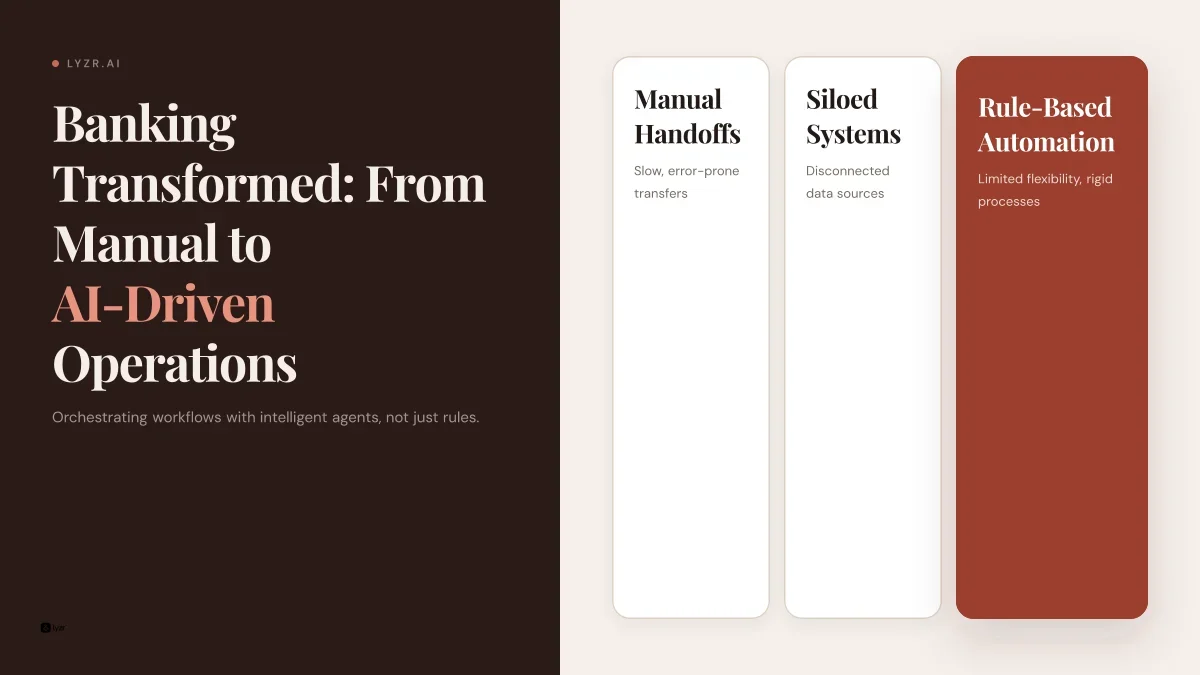
The structural difference between these three categories is what every banking executive needs to internalize before approving another AI budget line. A chatbot answers. It responds to a query based on a knowledge base or decision tree – ask it for an account balance and it retrieves it, ask it to investigate a suspicious transaction across three systems and the conversation ends where the script ends. Traditional automation follows. RPA and rule-based systems excel at repetitive, predictable tasks, but they are brittle – change the interface, add an exception, encounter an unexpected data format, and the automation breaks. It cannot adapt. It cannot reason.
An AI agent acts and accomplishes. When tasked with “investigate this flagged transaction,” it does not follow a script. It doesn’t just flag an alert as higher risk. It pulls transaction history, checks the entity against watchlists, analyzes counterparty relationships, runs the alert against your SOPs, drafts an investigation narrative, and recommends a disposition – all before a human analyst opens the case. The practical implication: you are not evaluating a model. You are evaluating an operating system. The model is one component. The orchestration layer, tool integrations, governance controls, and audit trail are the things that determine whether your deployment survives contact with a regulator.
Why Banks Are Moving to AI Agents Now
Three forces have converged in 2026 that make the timing less about innovation appetite and more about operational survival.
The compliance cost is no longer sustainable. Manual KYC, AML alert triage, and regulatory reporting consume enormous headcount at every tier of the market. Historically, compliance teams had little room to maneuver – KYC processes must adhere to strict regulatory requirements, leaving firms to choose between inflating hiring costs or accepting onboarding delays. Agentic AI changes this dynamic. With these tools, a single analyst effectively gains the output of dozens of counterparts, without the burden of time-consuming manual processes.
The regulatory environment is tightening specifically around AI governance. On April 17, 2026, the Federal Reserve, OCC, and FDIC issued revised interagency model risk management guidance, designated SR 26-2 by the Federal Reserve and captured in OCC Bulletin 2026-13, which superseded the long-standing SR 11-7. The revised guidance states that generative and agentic AI are novel and rapidly evolving and are not within its scope, and the agencies signaled plans to issue a request for information addressing banks’ use of AI. In parallel, the EU AI Act’s high-risk deadline in August 2026 and the Colorado AI Act both carry specific implications for financial services AI. Compliance is not optional, and it is not retroactive.
The competitive math is deteriorating for laggards. McKinsey highlights that first movers are set to gain a 4% return on tangible equity (ROTE) advantage – a key profitability metric – while slow movers are likely to be stuck with an uncompetitive cost base. Frontier firms leading in AI adoption achieve returns of 2.84x on their investments, compared to just 0.84x for laggards. The gap is not closing. It is widening every quarter that a bank defers deployment.
AI Agent Use Cases Across the Bank
The banks extracting real returns are not spreading thin across dozens of pilots. They are going deep on specific workflows where the before-and-after is measurable. Here is what that looks like across the three offices.
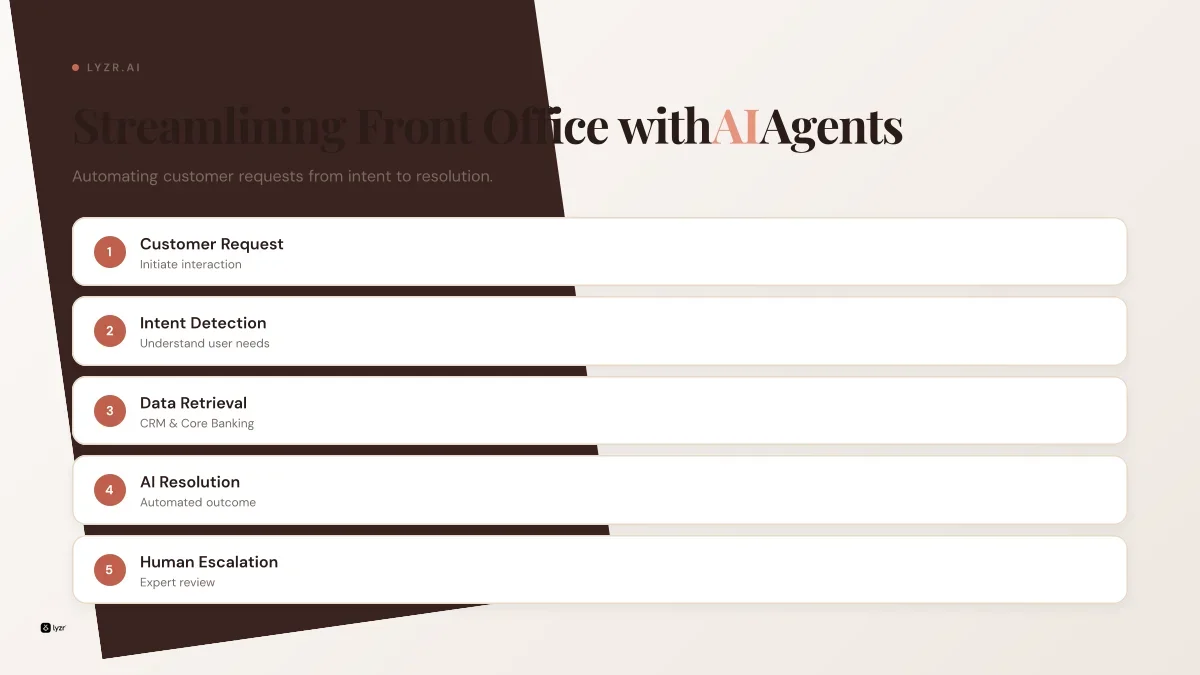
Front Office: Customer Onboarding, KYC, and Loan Origination
The manual KYC process is a study in accumulated friction – an analyst pulls documents into a queue, opens a different system to check a watchlist, another for address verification, another for PEP screening, and each step is sequential, each handoff a delay, each human touch a potential error. A large Dutch financial institution using a combination of AI innovations for its KYC and compliance processes achieved a 90% reduction in onboarding time and cut staff workload by 30%. The agent does not replace the analyst – it eliminates the data-gathering and cross-referencing that consumed most of the analyst’s time, leaving the human to focus on cases that genuinely require judgment. Similarly, AI Voice Agents automate routine customer interactions during onboarding, improving response times while allowing banking teams to focus on more complex cases.
For deeper context on how AI agents automate the entire KYC workflow from identity verification through sanctions screening, see Lyzr’s full breakdown:
AI Agents for KYC Verification: Automating Compliance with Intelligent Workflows
Loan origination is where customer patience and operational cost collide. The manual workflow – document collection, employment verification, credit bureau calls, risk scoring, underwriting review – can take days or weeks. An AI loan origination agent orchestrates the entire credit decision stack: ingesting and parsing documents, calling credit bureaus, running fraud and identity checks, computing eligibility, and routing only the genuine edge cases to underwriters. The underwriter reviews a complete, structured case file instead of a pile of raw documents. The outcome is faster decisions, more consistent underwriting, and a complete audit trail of every data point that informed the decision.
Middle Office: Fraud Detection and AML Investigation
The false positive problem in AML is not a minor inconvenience – it is a structural failure. Analysts receive hundreds of alerts per day, the vast majority are noise, but every alert must be reviewed because the regulatory requirement to review all alerts still applies. Enabling AML investigation using agentic AI saves more than two hours of human labor per case – a reduction of over 50%. Institutions piloting agentic AI in their investigation workflows are seeing up to a 60% reduction in total case investigation time without increasing headcount, and teams can handle more than double the case volume.
Agentic AI is different in one important respect: it executes the work, not just informs it. An agentic AI system doesn’t just flag an alert as higher risk – it pulls transaction history, checks the entity against watchlists, analyzes counterparty relationships, runs the alert against your SOPs, drafts an investigation narrative, and recommends a disposition. The regulatory requirement to review all alerts still applies; the agent pre-screens and prioritizes, turning an unmanageable daily queue into a tractable one. For compliance teams, this is the difference between alert fatigue and genuine risk management.
Financial institutions must stay current with thousands of regulatory changes annually across multiple jurisdictions. Agentic AI systems can continuously monitor regulatory sources, identify relevant updates, assess their impact on existing policies, and even draft implementation recommendations. This shifts compliance from periodic, manual sampling to continuous, real-time coverage – a meaningful change in both the quality and the cost of the compliance function.
Back Office: Reconciliation and Regulatory Reporting
The financial close process is where large banks quietly absorb enormous operational cost. Teams of accountants spend the first week of every month manually matching millions of transactions between internal ledgers, nostro/vostro accounts, and payment systems. Compliance reporting eats thousands of hours each quarter. Intelligent automation pulls data from across your bank, generates accurate regulatory reports automatically, and the system adapts when rules change. An AI agent for banking operations automates the matching process – even across non-standard data formats – and when it encounters a discrepancy it cannot resolve, it routes the exception to the correct team with all relevant context already assembled. No email chains. No lost context. A complete record of every matching decision, ready for audit.
Use Case Comparison by Function
AI Agent Use Cases: Impact and Deployment Complexity
| Use Case | Office | Key Metric | Complexity |
|---|---|---|---|
| KYC & Customer Onboarding | Front | 90% reduction in onboarding time | Medium |
| Loan Origination | Front | 40-60% faster credit cycle | Medium-High |
| AML Alert Investigation | Middle | 50-60% time saved per case | Medium |
| Fraud Detection | Middle | 60%+ false positive reduction | Medium |
| Regulatory Compliance Monitoring | Middle | Real-time vs. periodic review | Low-Medium |
| Financial Reconciliation | Back | Near-zero manual matching errors | Low |
| Regulatory Reporting | Back | Thousands of hours saved per quarter | Low-Medium |
The Measurable Returns: Cost, Speed, and Risk
Executives and boards do not care about the technology. They care about three numbers: cost, speed, and risk. According to McKinsey, AI could reduce certain cost categories by as much as 70% across the banking industry, with the net effect expected to be 15-20%, or $700 billion to $800 billion, due to rising AI technology costs. The cost reduction is real, but it concentrates in high-volume, repetitive, manual processes where agents replace the data-gathering that consumes human time.
On speed, the before-and-after on cycle times is not incremental. Workflows that took days now take minutes, and banks see 50 to 90% faster execution across major processes. Loan origination that took five days takes two hours. KYC that took three days takes under an hour. These are not projections – they are outcomes from banks that have moved past the pilot stage.
On risk, IDC reports that organizations achieve an average 2.3x return on agentic AI investments within 13 months. But the risk reduction is arguably more important than the ROI number. An agent that pre-screens AML alerts, maintains a complete audit trail, and escalates only genuine risks does not just save analyst time – it reduces the probability of a missed SAR filing, which is the kind of failure that ends careers and triggers regulatory action.
“The ROI unlock in financial services isn’t more AI – it’s deeper AI in the workflows that already exist.”
– Unframe, Enterprise AI ROI: 2026 Benchmarks
Why AI Agents Fail Without the Right Foundation
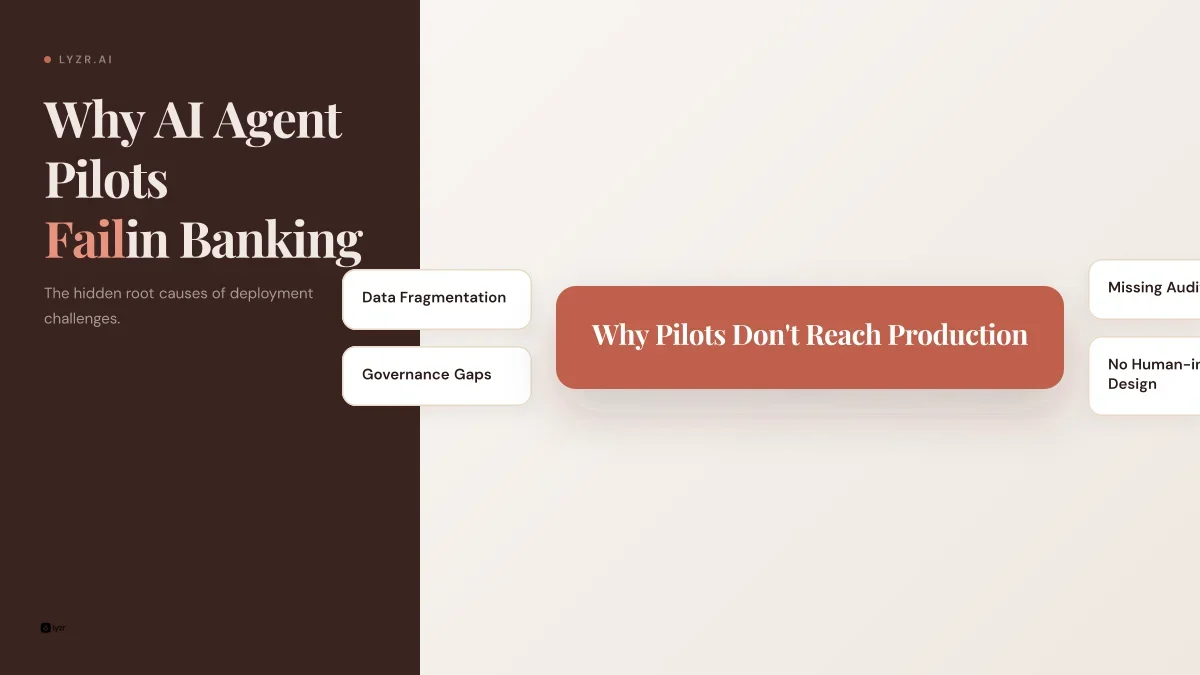
Here is the uncomfortable truth that most vendor conversations skip: the majority of AI agent pilots in banking never reach production. The failure rate is not a model problem. It is a foundation problem. Governance maturity is lagging deployment speed by a wide margin. Banks are adopting AI faster than they are governing it, creating operational, compliance, and security risks that legacy controls were never designed to manage. The gap between investment and governance is becoming a business issue, not just a technology problem.
Four specific failure modes appear consistently across failed deployments. Data fragmentation is the first: your agent is only as useful as its ability to connect to the systems it needs, and most banks have twenty or more disconnected systems. You can’t bolt AI onto fragmented systems and expect it to work – this is the number one reason transformations stall.
Governance as an afterthought is the second failure mode. The agent works in the lab, gets deployed, and six months later a regulator asks to see the decision log for a denied loan application – and there is no decision log. FINRA’s 2026 oversight report notes that the use of autonomous AI agents is rapidly evolving and may present novel regulatory and supervisory considerations, recommending that member firms consider enterprise-level supervisory processes specifically covering the development and use of AI agents.
No audit trail is the third. In a regulated bank, every decision an agent influences must be explainable to an examiner. Every action taken by an AI agent must be logged, auditable, and explainable. The evidence trail must be preserved. Human oversight must be built into the workflow by design – which is precisely what regulators expect. And fourth: human-in-the-loop designed out. Full autonomy from day one is not a sign of confidence – it is a sign the deployment was not designed for a regulated environment. High-stakes financial decisions require human approval gates, and an agent architecture that does not embed those gates is not production-ready.
For a deeper look at how enterprise AI leaders are building the governance layer that makes production deployment viable, see Lyzr’s CIO playbook:
How Banks Deploy AI Agents in Production: The Phased Approach
The banks that have moved from pilot to production follow a consistent pattern. Not big-bang deployment. Not a rip-and-replace of existing systems. A crawl-walk-run sequence that builds trust at each stage before expanding autonomy.
Phase 1 – Assist. The agent acts as a co-pilot for your employees. It gathers and synthesizes information from multiple systems but takes no action on its own. A human sees a complete, structured briefing instead of a pile of raw data. This phase proves the agent’s data access and output quality without any autonomous risk. Phase 2 – Augment. The agent executes steps within a workflow but requires human approval at defined checkpoints. It might investigate a fraud alert, build the complete case file, and recommend a disposition – but a human analyst must approve the final decision. Phase 3 – Act. Once the agent’s performance is proven and measured over time, it can be granted autonomy for specific, well-defined, lower-risk tasks. All actions logged. All exceptions routed to humans.
Deployments emphasize governed environments where every agent decision is traceable, with a human approving outputs. The phasing is not caution for its own sake – it is how you build the evidence base that satisfies your risk committee, your compliance team, and ultimately your regulator. For well-scoped use cases with pre-built integrations to core banking, CRM, and risk systems, production deployment is achievable in as little as four weeks. More complex multi-agent implementations spanning compliance, operations, and analytics simultaneously typically take eight to twelve weeks.
For teams mapping out their broader agentic transformation roadmap, Lyzr has published a practical guide to structuring the investment and the sequence:
What to Look for in a Banking AI Agent Platform
When you evaluate technology for a regulated environment, the checklist is not about features. It is about foundations. Five questions determine whether a platform is production-ready for a bank.
- Secure enterprise connectivity. Does the platform have pre-built, secure connectors to core banking systems, top banking CRM providers, market data feeds, and compliance databases? An agent that cannot connect to your existing infrastructure without a six-month integration project is not production-ready.
- A governance control plane. Is there a central place to define roles, permissions, and rules of engagement for every agent? Who can approve what actions? What happens when an agent encounters an edge case it was not designed for?
- Built-in auditability. Does the platform automatically create an immutable, human-readable log of every agent action, every data point accessed, and every decision made? “Immutable” is the key word – a log that can be edited is not an audit trail.
- Configurable human-in-the-loop. Can you define, at the workflow level, which decisions require human review? Can you adjust those thresholds as the agent’s track record develops?
- Explainability. Can the platform show you – and show a regulator – precisely why an agent made a particular recommendation, what data it used, what rules it applied, and what alternatives it considered?
Deployment infrastructure also shapes the decision. Banks choosing between cloud and on-premise deployments for AI agents will find the trade-offs have changed significantly in 2026. The full analysis of those trade-offs is here:
On-Premise AI vs Cloud AI: The 2026 Enterprise Deployment Guide
For banks deploying on specific cloud infrastructure, Lyzr has published detailed architecture guides for each major provider: IBM Cloud, Google Cloud, and Azure.
Amadeo: The Agentic OS for Banking by Lyzr
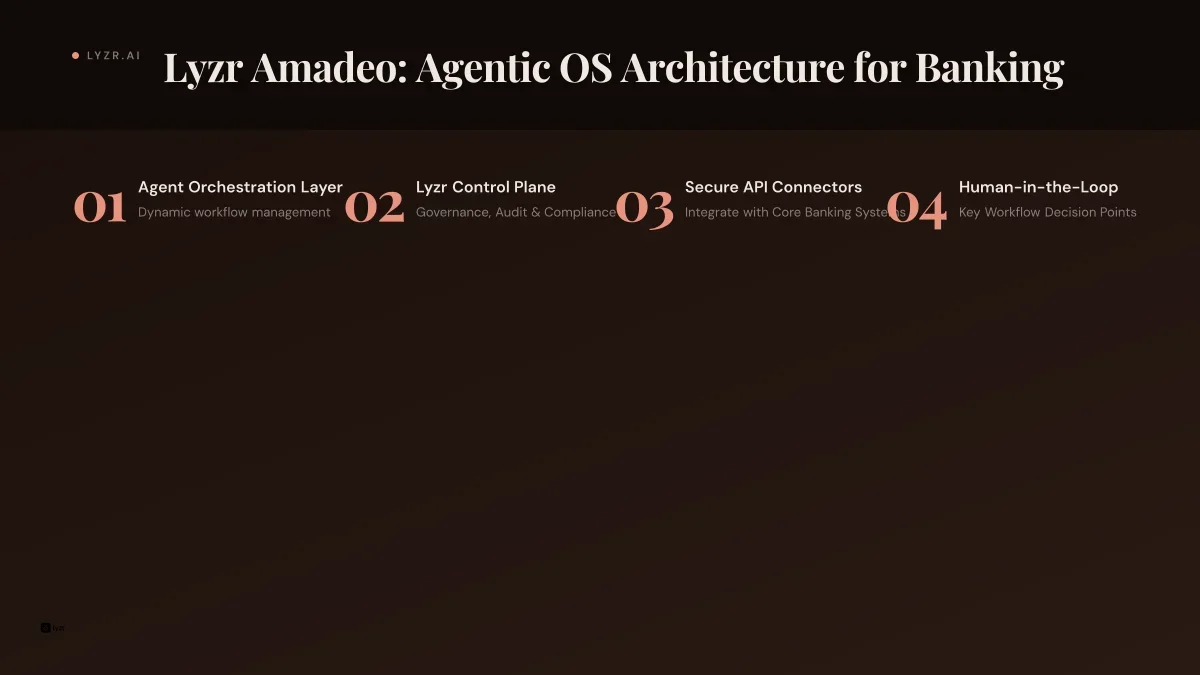
The governance problem described above is not theoretical for Lyzr. It is the specific problem that shaped how the banking platform was built. Amadeo, the Agentic OS for Banking by Lyzr, is a multi-agent AI suite built specifically for the banking industry. It automates core processes like customer onboarding, loan origination, and regulatory reporting – helping banks scale faster while staying compliant. The distinction between Amadeo and a generic LLM wrapper is architectural.
A production-grade agentic deployment in banking requires three infrastructure layers working together. Orchestration: the ability to coordinate multiple agents, manage state across multi-step workflows, and handle exceptions without human intervention at every branch point. Governance: audit trails, human-in-the-loop controls, and explainability outputs baked into every agent action – not retrofitted after deployment. Lyzr’s Hallucination Manager keeps agent responses grounded in trusted data, critical in a regulated environment where a single hallucinated regulatory citation can trigger a compliance incident. Integration: Amadeo integrates seamlessly with your CRM, compliance software, loan management tools, and customer service platforms via secure APIs – no need to rip-and-replace your current infrastructure.
The Lyzr Control Plane is the governance and audit layer that makes Amadeo viable in a regulated environment. Every agent action is logged with a timestamp. Every decision is traceable to the data that informed it. Every high-stakes action routes through a configurable human approval gate. Amadeo is trained on and aligned with NIST, FINRA, FRB, OCC, FDIC, DFS, NAIC, ATLAS, and FINOS standards.
Banks using Lyzr’s Agent Amadeo have reported up to 300% ROI, 50% faster processing times, and up to 95% time savings on manual workflows like KYC, underwriting, and regulatory documentation. To see how a mid-size bank implemented Amadeo in practice, the case study is available here:
Mid-size Bank: Lyzr Banking AI Case Study
If you are evaluating platforms, the question to ask is simple: can this platform show an examiner, on demand, exactly what the agent did, what data it used, and why it made the decision it made? If the answer is anything other than an immediate yes, you are not looking at a production-ready banking platform. For teams assessing the broader landscape of agentic platforms before committing, the 2026 enterprise buyer’s guide is a useful reference:
Best Agentic OS Platforms: Enterprise Buyer’s Guide (2026)
Frequently Asked Questions
What are AI agents in banking?
An AI agent in banking is an autonomous software system that analyzes data, makes decisions, and executes multi-step banking workflows across systems under defined governance and human oversight. Unlike a chatbot that responds to queries or RPA that follows a fixed script, an agent understands a goal, plans a sequence of actions across multiple systems, executes them, and handles exceptions – all within configurable governance guardrails.
What are the main use cases for AI agents in banking?
The highest-impact use cases in 2026 span three areas: front office (customer onboarding and KYC, loan origination, intelligent customer service), middle office (fraud detection, AML alert investigation, regulatory compliance monitoring), and back office (financial reconciliation, regulatory reporting, treasury operations). Banks seeing the best returns are starting with high-volume, auditable workflows where the before-and-after is easy to measure.
What are the measurable benefits for banks?
EY found that when used for manual, time-intensive Anti-Money Laundering investigations, agentic AI led to a 50% time reduction per investigation – a saving of two hours of human labor per case. IDC reports that organizations achieve an average 2.3x return on agentic AI investments within 13 months. The benefits concentrate in three areas: operational cost reduction, speed (days-long workflows compressed to hours or minutes), and risk management with more comprehensive, real-time compliance coverage.
Are AI agents compliant with banking regulations?
Compliance is a function of how the agent is built and governed, not a property of the underlying model. Agents deployed with immutable audit trails, configurable human-in-the-loop controls, and explainability outputs can satisfy the requirements of SR 26-2, NYDFS Part 500, DORA, and the EU AI Act’s high-risk system requirements. Governance must be designed in from the start – not bolted on after the pilot.
How do AI agents handle fraud detection and AML?
Agents act as a force multiplier for compliance analysts. A well-configured AI agent doesn’t just retrieve data; it reasons against it, applying your SOPs and escalation criteria to determine what’s relevant and why. The output is a structured investigation package, not a data dump. The regulatory requirement to review all alerts still applies; the agent makes that review tractable by pre-screening and prioritizing the queue.
Do AI agents replace bank employees?
No – they augment them. With these tools, a single analyst effectively gains the output of dozens of counterparts, without the burden of time-consuming manual processes. The pattern across every successful deployment is the same: agents handle the data-gathering, cross-referencing, and routine execution that consumes most of an analyst’s or officer’s time. The human handles judgment, exceptions, and the high-stakes decisions that require accountability.
How do banks get started with AI agents?
Start narrow. Pick a single, high-volume, auditable workflow – KYC document verification or AML alert triage are strong first candidates. Define what success looks like in measurable terms: cycle time, accuracy rate, escalation rate. Build on a platform that has governance and audit capabilities built in from day one. Prove the model in Phase 1 before granting any autonomy. The compliance teams seeing the best outcomes are the ones that defined a narrow starting scope, validated rigorously, and expanded from there. Book a demo with Lyzr to see Amadeo in action on your specific use case.
The question facing every banking decision-maker in 2026 is not whether to deploy AI agents. It is whether to build on a foundation that can survive a regulatory examination – or to discover that gap the hard way, after the pilot is already in production. The governance problem is solvable. The data fragmentation problem is solvable. The audit trail problem is solvable. But none of them are solvable if you treat them as afterthoughts. The banks that get this right will not just cut costs – they will operate differently. Faster decisions, more consistent underwriting, compliance teams focused on genuine risk rather than alert queues. The gap between those banks and the ones still running chatbot demos is widening every quarter.
Book A Demo: Click Here
Join our Slack: Click Here
Link to our GitHub: Click Here