Testing an AI agent once isn’t enough. An agent can pass a few happy-path checks and still fail when a user changes direction, a tool returns something unexpected, or a multi-step workflow takes a different path. Real coverage needs simulation, AI agent evaluation, regression testing, multi-turn and adversarial testing, and CI/CD integration.
This guide compares the best tools for AI agent simulation and testing in 2026: open-source frameworks, developer-focused evaluation tools, conversational simulation platforms, and broader control-plane platforms.
TL;DR
- Lyzr Opencontroller: Best for enterprises connecting evaluation to promotion gates, governance and the production lifecycle.
- MLflow: Best for open-source evaluation with built-in conversation simulation.
- DeepEval: Best for pytest-style agent tests in CI/CD.
- Maxim AI: Best for multi-turn simulation plus production monitoring.
- Cekura: Best for voice and chat agent simulation.
- Promptfoo: Best for red teaming and security testing.
- LangSmith or Langfuse: Best when tracing and evaluation should share one stack.
What Is AI Agent Simulation and Testing?
AI agent testing goes beyond checking a final answer. Agents take multiple steps, choose tools dynamically, call APIs, retrieve data, keep conversational state and hand off to other agents. Simulation reproduces realistic users, tool responses or failure conditions before real users meet the agent.
Keep the terms distinct. Simulation creates the scenario. Testing checks behavior. Evaluation scores it. AI agent observability and AI agent tracing show what happened, and governance decides what ships.
What to Look For in a Testing Tool
| Capability | Why it matters |
| Multi-turn simulation | Tests behavior across conversations |
| Task and tool-call evaluation | Confirms tasks completed, right tools called |
| Regression testing | Catches degradation after changes |
| Adversarial testing | Exposes prompt injection and unsafe behavior |
| CI/CD integration | Runs tests before deployment |
| Production feedback | Turns real failures into tests |
Evaluation also matters more as a gate before promotion than as a report afterward. Lyzr’s guide to deterministic vs LLM-judge evaluation covers the scoring layer.
How the Tools Compare
| Tool | Best for | Simulation | Evaluation | Regression | CI/CD | Open source |
| Lyzr Opencontroller | Lifecycle gates | ✓ | ✓ | ✓ | ✓ | Self-hosted, commercial |
| MLflow | Open-source eval | ✓ | ✓ | ✓ | Via code | ✓ |
| DeepEval | Developer CI | ✓ | ✓ | ✓ | ✓ | ✓ |
| Maxim AI | Multi-turn simulation | ✓ | ✓ | ✓ | — | No |
| Cekura | Voice and chat | ✓ | ✓ | ✓ | ✓ | No |
| Promptfoo | Red teaming | Adversarial | ✓ | ✓ | ✓ | ✓ |
| LangSmith | LangChain teams | Via OpenEvals | ✓ | ✓ | ✓ | Partial |
| Langfuse | Tracing plus eval | Via OpenEvals | ✓ | ✓ | Via SDK | ✓ |
The 8 Best Tools for AI Agent Simulation and Testing
1. Lyzr Opencontroller
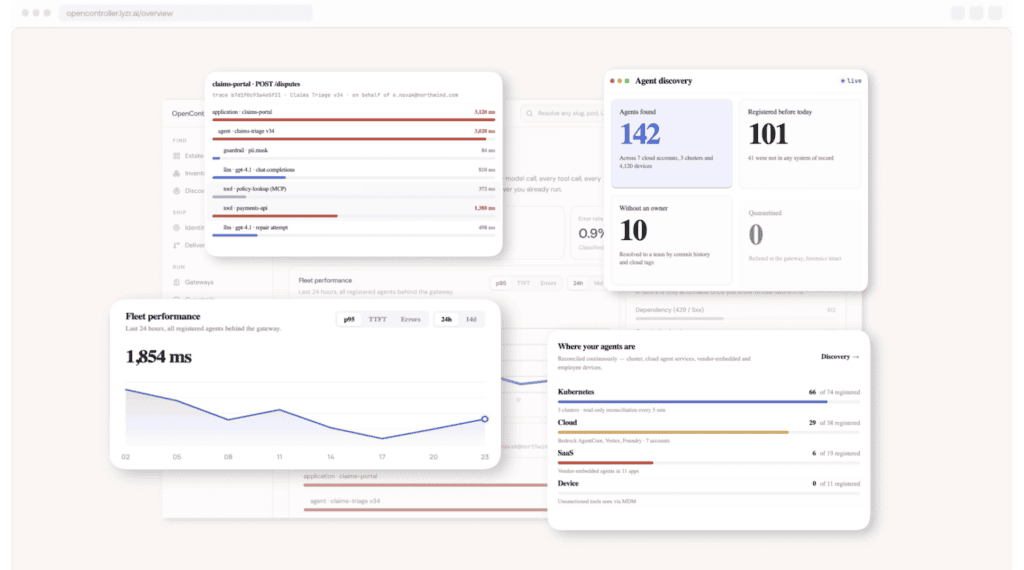
Opencontroller is the lifecycle option, not a standalone test library. Its evaluation domain scores agents and acts as a release gate, alongside Lyzr’s Agent Simulation Engine, which has an open-source SDK.
Key features
- Auto-scoped agent metrics
- Generated multi-turn and adversarial suites
- Regression gate against the live version
- Failures converted to permanent tests
Strengths
- Evaluation blocks promotion, not just reports
- Relative regression checks
- Governance and monitoring in one platform
Weaknesses
- Broader than unit-testing needs
- Commercial, not open source
- Value grows with agent estate size
Best for: Enterprises that want testing tied to release decisions and AI agent governance.
2. MLflow

MLflow’s GenAI evaluation includes a ConversationSimulator that drives agents with goal-and-persona test cases, scored by built-in or custom judges.
Key features
- Conversation simulation
- Multi-turn scorers
- Custom LLM judges
- Version comparison on shared datasets
Strengths
- Open source
- Fits existing MLflow workflows
- Reproducible scenarios
Weaknesses
- Multi-turn evaluation is marked experimental
- Little adversarial coverage
- Broader ML platform overhead
Best for: Teams already tracking experiments in MLflow.
3. DeepEval

DeepEval is an open-source, pytest-native framework where agent tests live beside application code.
Key features
- ConversationSimulator with personas
- 50+ metrics
- Trajectory and component evals
- deepeval test run for CI
Strengths
- Testing as code
- Runs locally
- Framework-agnostic
Weaknesses
- Requires Python engineering
- LLM-judge cost and variance
- Shared dashboards need Confident AI
Best for: Developers who want agent tests gating every pull request.
4. Maxim AI

Maxim combines simulated users, evaluation and production observability, so live failures can seed new test scenarios.
Key features
- Persona-based simulation
- Multi-turn scenarios
- Online evaluation
- In-VPC deployment
Strengths
- Simulation and monitoring together
- No-code workflows for product teams
- Enterprise deployment options
Weaknesses
- Not open source
- Newer platform (launched 2025)
- Broader than testing-only needs
Best for: Teams prioritizing realistic multi-turn simulation.
5. Cekura

Cekura focuses on conversational agents: scenario simulation, stress testing and monitoring for voice and chat.
Key features
- Branching scenarios and personas
- Voice, chat and SMS testing
- Regression suites
- GitHub Actions integration
Strengths
- Handles interruptions, accents and noise
- Production calls replayable as tests
- Platform-agnostic
Weaknesses
- Conversational focus, not a general agent platform
- SaaS only
- No governance layer
Best for: Voice and chat agents with branching user behavior.
6. Promptfoo

Promptfoo is an open-source (MIT) CLI for evaluation and red teaming. OpenAI announced its acquisition in March 2026 and committed to keeping it open source.
Key features
- Prompt injection and jailbreak tests
- Declarative YAML configs
- Automated evaluations
- CI/CD support
Strengths
- Strong security testing
- Easy to start
- Model-agnostic
Weaknesses
- Not a full conversation simulator
- Less production feedback
- Ownership shift to OpenAI
Best for: Security teams prioritizing adversarial testing.
7. LangSmith
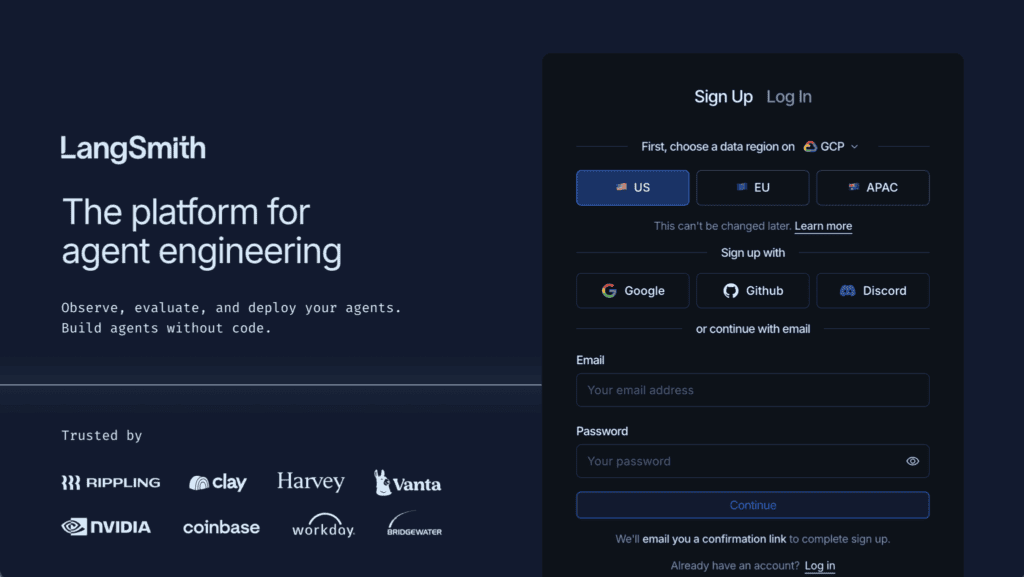
LangSmith supports datasets, experiments and evaluators, with multi-turn simulation through the open-source OpenEvals package.
Key features
- Datasets and experiments
- Simulated-user conversations
- 30+ evaluator templates
- Production traces as datasets
Strengths
- Deep LangGraph fit
- Tracing plus testing
- Mature ecosystem
Weaknesses
- Simulation is library-based
- Best inside LangChain
- Weaker for self-hosted stacks
Best for: Teams building on LangChain or LangGraph.
8. Langfuse

Langfuse (MIT core, owned by ClickHouse) adds datasets, experiments and evaluation to self-hostable tracing. Its documented simulation approach uses OpenEvals.
Key features
- Self-hosting
- Dataset experiments
- LLM-as-judge on traces
- Prompt management
Strengths
- Data control
- Testing on real production traces
- Open-source core
Weaknesses
- No native simulator
- You build CI gating
- Narrow governance
Best for: Teams already using Langfuse for tracing.
How to Choose
- Need evaluation tied to release gates and governance? Opencontroller.
- Want tests in Python and CI? DeepEval.
- Already on MLflow? MLflow.
- Need realistic multi-turn simulation? Maxim.
- Testing voice or chat agents? Cekura.
- Security first? Promptfoo.
- On LangChain? LangSmith.
- Need self-hosting? Langfuse.
From Testing to Production
Simulation matters most before deployment, but testing shouldn’t stop at launch. The healthy loop runs Build → Simulate → Evaluate → Gate → Deploy → Monitor → Improve → Regression test.
That is where OpenController fits: evaluation results decide whether an agent is promoted, its improvement engine grades production traces and clusters failures into named patterns, and resolved issues become permanent regression tests. Testing frameworks tell you how an agent scored. An AI control plane decides what happens next. See Lyzr’s playbook on taking agents to production.
See how Opencontroller connects evaluation, improvement, and production governance, or book a demo to see how it fits into your agent stack.
FAQs
Opencontroller, MLflow, DeepEval, Maxim AI, Cekura, Promptfoo, LangSmith and Langfuse cover the main categories: lifecycle gates, open-source frameworks, conversational simulation and red teaming.
There is no single best tool; it depends on your constraint. DeepEval suits developer CI, Cekura suits voice agents, Promptfoo suits security testing, and Opencontroller suits governed release gates across many agents.
DeepEval, MLflow and Promptfoo are free open-source options; Langfuse’s core is too. Free tools still cost LLM-judge tokens.
MLflow, DeepEval, Promptfoo and Langfuse’s core are open source. Lyzr’s Agent Simulation Engine SDK is on GitHub; Opencontroller itself is commercial.
Define scenarios, run the agent against simulated users and tool responses, score task completion and tool calls, and rerun after every change.
Simulation generates the conditions, such as users, conversations and failures. Evaluation scores how the agent performed under them.
Evaluate the full trajectory and each handoff, not just the final answer, and simulate tool or peer-agent failures.
Run a fixed scenario suite on every pull request using a tool like DeepEval or Promptfoo, set tolerance bands rather than exact scores to absorb LLM variance, and fail the build when a metric drops below its band.
Task completion, tool selection and arguments, multi-turn behavior, prompt injection resistance, error recovery and regressions against the live version.
Yes. Simulated users, LLM judges and CI pipelines automate most of it, with human review reserved for ambiguous or high-stakes cases.
Book A Demo: Click Here
Join our Slack: Click Here
Link to our GitHub: Click Here