AI adoption is moving faster than enterprise visibility.
Teams are deploying AI assistants, copilots, autonomous agents, and AI workflows across engineering, operations, customer support, finance, and other business functions. The result is a growing problem: How do you discover what AI is actually running across the organization?
This is where AI discovery comes in.
What is actually running across your AI stack, and how much of it can you see?
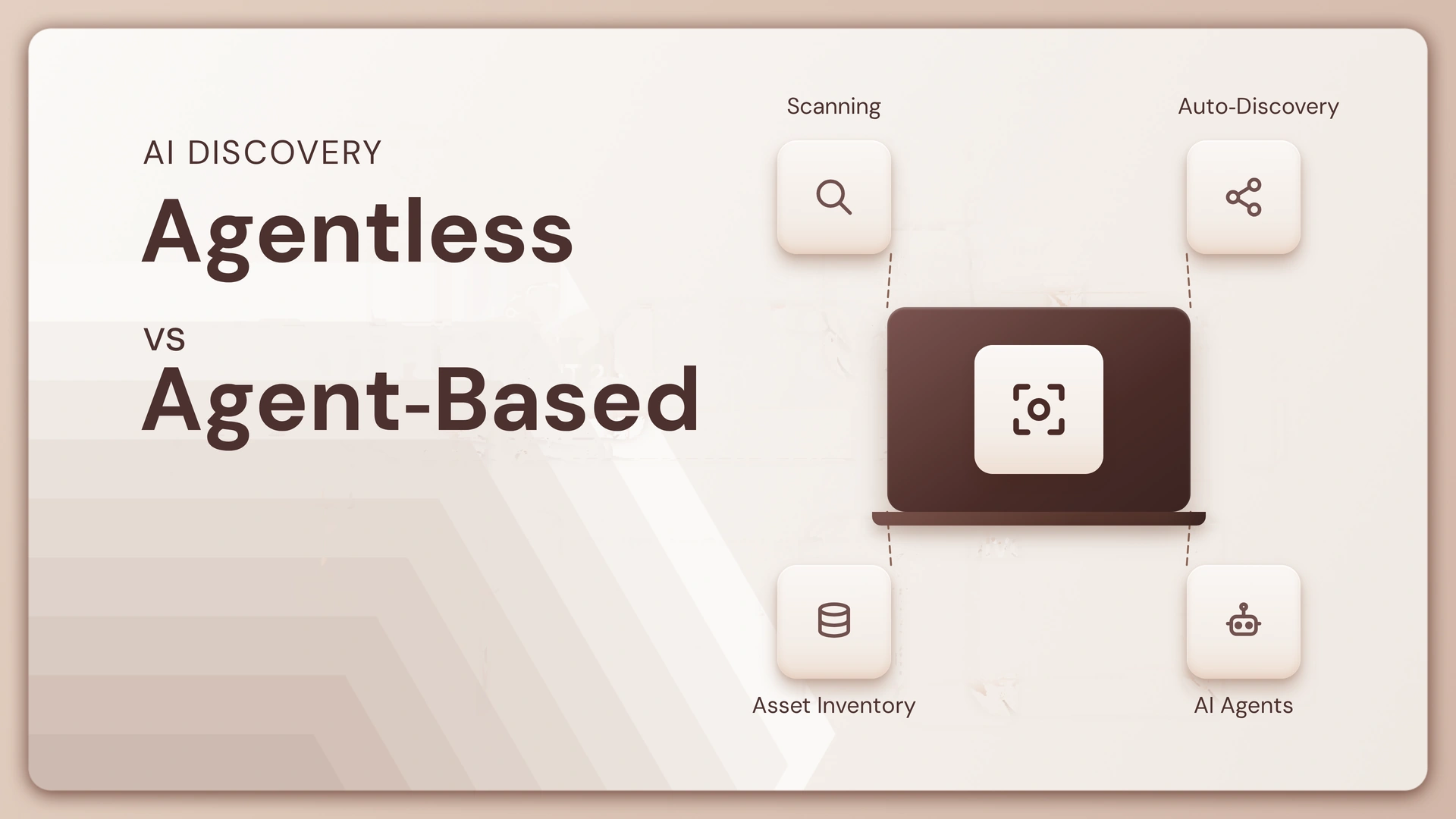
Two approaches are becoming increasingly common: agentless AI discovery and agent-based AI discovery. Both can help enterprises identify AI activity, but they work in fundamentally different ways.
Agentless discovery observes existing systems without installing software on every endpoint. Agent-based discovery uses lightweight software agents or sensors deployed within the environment to collect deeper information.
So which approach should enterprises use?
The answer is rarely one or the other. The right choice depends on how much visibility the organization needs, where AI is being deployed, and how much infrastructure it can reasonably manage.
What Is AI Discovery?
AI discovery is the process of identifying, inventorying, and understanding AI systems operating across an enterprise.
An enterprise AI discovery program may look for:
- AI agents and autonomous workflows
- AI assistants and copilots
- Large language model (LLM) usage
- AI applications and internal tools
- Models, APIs, and AI providers
- Developers or teams deploying AI
- Data sources accessed by AI systems
- Infrastructure where AI workloads run
- Usage, cost, and activity patterns
- Unapproved or unmanaged AI systems
This visibility matters because enterprises cannot govern what they cannot see.
A central inventory can help security, IT, engineering, finance, and compliance teams understand what exists, who owns it, what it can access, and where it is running.
What Is Agentless AI Discovery?
Agentless AI discovery identifies AI activity without requiring a dedicated software agent to be installed on every system being monitored.
Instead, it can use existing enterprise sources such as:
- Cloud APIs
- Identity and access management systems
- Network telemetry
- API gateways
- Logs
- SaaS integrations
- Cloud configuration data
- CI/CD systems
- Existing security and observability platforms
For example, an enterprise could analyze cloud activity and API traffic to identify applications calling AI providers without installing another monitoring component on each developer machine.
How agentless discovery works
A simplified flow looks like this:
Existing systems → Data collection → AI activity detection → Inventory → Risk and governance
The main advantage is speed. Enterprises can often begin discovery using infrastructure they already operate.
What Is Agent-Based AI Discovery?
Agent-based AI discovery uses software agents, sensors, or collectors deployed inside the environment to gather information.
These agents can run on:
- Developer endpoints
- Servers
- Virtual machines
- Kubernetes environments
- Cloud workloads
- CI/CD environments
- Application infrastructure
Because the agent operates closer to the workload, it can often collect more granular information than an external system can see.
For example, an endpoint agent might identify which developer tools are being used, which AI applications are installed, or which processes are making AI-related requests.
A typical flow looks like this:
Installed agent → Local telemetry → Central collection → AI inventory → Risk and governance
The trade-off is that deploying and maintaining those agents adds operational overhead.
Agentless vs Agent-Based AI Discovery
The biggest difference is where visibility comes from.
| Factor | Agentless Discovery | Agent-Based Discovery |
|---|---|---|
| Deployment | Uses existing systems and integrations | Requires software agents or collectors |
| Setup speed | Generally faster | Can take longer at scale |
| Endpoint coverage | Limited by available telemetry | Strong endpoint-level visibility |
| Infrastructure visibility | Strong when cloud/API integrations exist | Strong at workload level |
| Operational overhead | Lower | Higher |
| Granularity | Depends on available data | Typically deeper |
| Maintenance | Lower | Requires agent lifecycle management |
| Offline environments | Limited | Can collect locally, depending on design |
| Developer activity | May be difficult to see in detail | Can provide deeper visibility |
| Best suited for | Broad enterprise discovery | Deep workload and endpoint visibility |
Neither approach is universally better.
So, which one should you choose?
Ask yourself:
Do you need to discover AI everywhere quickly, or inspect AI activity deeply?
✓ Choose agentless for breadth.
✓ Choose agent-based for depth.
✓ Consider both when you need enterprise-wide coverage and detailed visibility.
Where Agentless Discovery Works Best
Agentless discovery is particularly useful when an enterprise wants to quickly establish a broad AI inventory.
Could you discover AI activity without installing anything new?
In many environments, the answer is yes. Existing cloud, identity, network, API, and observability data can provide a useful starting point.
✓ Faster initial coverage
✓ Lower deployment overhead
✓ Uses infrastructure you already have
1. Initial AI asset discovery
If an organization does not know how many AI applications, agents, or providers are already in use, agentless discovery can provide a fast starting point.
It can scan existing infrastructure and integrations to identify AI-related activity without waiting for agents to be installed everywhere.
2. Large and distributed environments
Global enterprises may have thousands of endpoints, multiple cloud providers, and hundreds of applications.
Deploying and maintaining another agent across that environment can be difficult.
Agentless discovery reduces the deployment burden.
3. Fast visibility with minimal infrastructure changes
Security and IT teams may not want to introduce another endpoint component simply to build an initial AI inventory.
Using existing logs, APIs, and cloud data can make discovery easier to operationalize.
Where Agent-Based Discovery Works Best
Agent-based discovery becomes more valuable when organizations need deeper visibility.
What happens when centralized telemetry isn’t enough?
That is where an agent can help. By operating closer to the endpoint or workload, it can capture activity that may otherwise remain invisible.
✓ Deeper workload visibility
✓ Better endpoint-level context
✓ More continuous monitoring
1. Developer AI usage
AI development tools can operate directly on developer machines and local environments.
An agent can provide visibility into activity that may not be obvious from centralized cloud infrastructure.
2. Workload-level monitoring
If an enterprise needs to understand what a specific process, container, or workload is doing, local telemetry can provide additional context.
3. Environments with limited centralized telemetry
Not every environment exposes sufficient logs or APIs for effective agentless discovery.
In those cases, an agent can collect information closer to the source.
4. Continuous monitoring
Agent-based systems can continuously observe activity instead of relying only on periodic scans or existing centralized data sources.
The Limitations of Each Approach
Choosing between the two requires understanding what each approach cannot easily provide.
Is more visibility always better?
Not necessarily. The best discovery architecture is the one that gives you the visibility you need without creating unnecessary operational complexity.
Agentless discovery limitations
Agentless systems depend heavily on the data available from existing infrastructure.
If an AI application leaves little centralized telemetry, it can be difficult to identify.
For example, an organization may know that a developer is using an AI coding application, but not have enough information to understand exactly how that application is being used.
Key limitation: visibility can be constrained by existing telemetry.
✓ Best when speed and broad coverage matter
✗ Less effective when important activity exists outside centralized telemetry
Agent-based discovery limitations
Agent-based systems provide deeper visibility, but deployment introduces another operational layer.
Organizations need to think about:
- Installation
- Version management
- Updates
- Resource consumption
- Compatibility
- Coverage gaps
- Agent security
- Removal and decommissioning
Key limitation: better visibility can come with higher operational complexity.
✓ Best when granular visibility matters
✗ Requires agent deployment, maintenance, and coverage management
Which Approach Should Enterprises Choose?
Agentless or agent-based—which is actually better?
For most enterprises, the answer should not be a strict agentless vs agent-based decision.
A better model is to use them at different layers.
Start agentless for breadth
Use existing infrastructure to establish a broad inventory of AI activity.
This can help answer:
- What AI systems exist?
- Which teams are using AI?
- Which providers are being accessed?
- Where are AI workloads running?
- Which systems appear unmanaged?
Add agents where depth is required
Once high-risk or high-value areas are identified, agent-based monitoring can provide deeper visibility.
For example, an enterprise could use agentless discovery across its cloud estate while deploying agents only to selected developer environments or sensitive workloads.
This creates a layered discovery strategy:
✓ Agentless discovery = broad coverage
✓ Agent-based discovery = deep visibility
✓ Combined approach = enterprise-wide AI discovery
Why choose one when each solves a different visibility problem?
A Practical Decision Framework
Still unsure which approach fits?
Start with the outcome you need rather than the technology you want to deploy.
The right architecture depends on the enterprise’s priorities.
| Enterprise Requirement | Recommended Approach |
|---|---|
| Build an initial AI inventory quickly | Agentless |
| Discover AI across multiple cloud environments | Agentless |
| Minimize deployment overhead | Agentless |
| Monitor developer AI tools | Agent-based |
| Inspect workload-level activity | Agent-based |
| Capture activity unavailable in centralized logs | Agent-based |
| Need broad coverage plus deep investigation | Hybrid |
| Operate a highly distributed AI environment | Hybrid |
A useful rule is:
Use agentless discovery to find the surface area. Use agents where you need to understand it in depth.
✓ Broad discovery first
✓ Deeper investigation where required
✓ Centralized governance across both
Why AI Discovery Is Becoming More Important
Do traditional application inventories still tell the whole story?
Traditional application inventories were designed for software that organizations intentionally purchased, deployed, and managed.
AI changes that model.
A developer can connect an application to an LLM API in minutes. A team can build an internal agent without going through the same procurement process as a traditional enterprise application. A new AI workflow can also span models, frameworks, APIs, cloud environments, and developer tools.
This creates a new category of infrastructure sprawl: AI and agent sprawl.
The challenge is no longer simply identifying applications.
Enterprises need to understand the relationships between:
Agents → Models → Data → Users → Infrastructure → Providers
Without that context, an inventory can quickly become a list of names without meaningful governance.
Beyond Discovery: From Inventory to Control
Is knowing what exists enough?
Discovery is the first step, not the end state.
Once enterprises know what AI systems exist, they need to answer harder questions:
- Who owns each agent?
- What data can it access?
- Which models does it use?
- Where is it deployed?
- Is it approved?
- What does it cost?
- What happens when it fails?
- Can access be revoked?
- Can it be moved across environments?
- Is its activity auditable?
This is where AI governance and control become important.
A mature enterprise AI architecture should move through a progression:
| Stage | Enterprise Goal |
|---|---|
| 1. Discover | Find AI systems and activity |
| 2. Inventory | Record owners, providers, environments, and dependencies |
| 3. Assess | Identify risk, access, and policy gaps |
| 4. Govern | Apply policies and controls |
| 5. Monitor | Track activity, cost, performance, and changes |
| 6. Control | Manage AI systems consistently across environments |
✓ Discovery gives enterprises visibility.
✓ Inventory gives that visibility structure.
✓ Governance turns visibility into policy.
✓ Control gives teams the ability to act on it.
Final Takeaway
So, agentless or agent-based?
Agentless and agent-based AI discovery solve different parts of the same problem.
Agentless discovery is usually the better starting point when an enterprise needs broad coverage, fast deployment, and minimal infrastructure changes.
Agent-based discovery is more useful when deeper visibility is required—particularly across developer environments, workloads, and activity that centralized systems cannot see.
For large enterprises, a hybrid approach is often the most practical:
Discover broadly without agents. Investigate deeply with agents. Govern everything from a central layer.
As AI adoption expands across models, agents, clouds, and developer environments, enterprises need more than an AI asset list. They need a reliable way to understand what is running, who owns it, what it can access, and how it is controlled.
The goal of AI discovery is not simply to find more agents.
It is to make AI visible enough to govern.
Book A Demo: Click Here
Join our Slack: Click Here
Link to our GitHub: Click Here