Your organization is running AI. Probably more than you know.
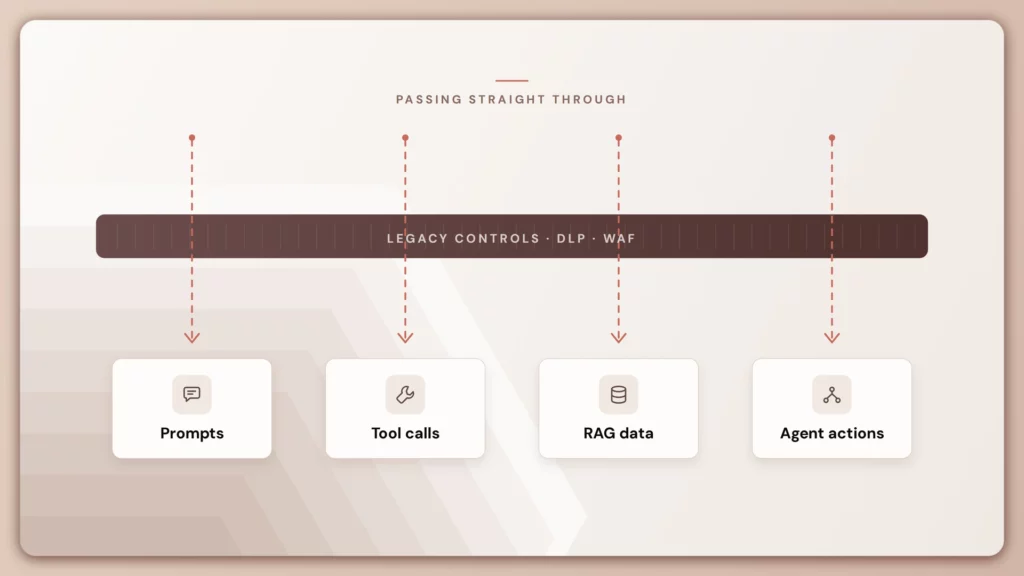
Somewhere right now, a developer on your team is pulling a model from Hugging Face and wiring it into a customer-facing workflow. A sales rep is pasting a client contract into ChatGPT. An automated agent is traversing your internal systems, invoking APIs, and making decisions no human approved. None of this shows up in your SIEM. None of it triggers your DLP. Your WAF has never seen a prompt.
This is the problem an enterprise AI security platform is built to solve – not by replacing your existing stack, but by filling the category of risk your existing stack was never designed to see.
This guide tells you what an AISP is, how it differs from everything you already have, what the four functional layers look like in practice, and which questions to ask before you put a vendor on your shortlist.
What is an enterprise AI security platform?
According to Gartner, “AI security platforms (AISPs) consolidate controls to secure both third-party AI services and custom-built AI applications. They address AI-native risks like prompt injection, rogue agent actions and data leakage.” That is a precise definition, and it matters because it draws a hard boundary: an AISP is not a smarter firewall and it is not a better DLP. It is a purpose-built system for a threat surface that did not exist five years ago.
In its Top Strategic Technology Trends for 2026 report, Gartner has placed AI Security Platforms (AISPs) among the most critical and urgent technologies shaping the future of enterprise IT. By 2028, Gartner predicts that over 50% of enterprises will use AI security platforms to protect their AI investments. That shift from under 10% to over 50% in two years is not gradual adoption. It is a category crossing a threshold.
At the heart of Gartner’s AISP framework are two interlocking pillars: AI Usage Control (AIUC) and AI Application Cybersecurity (AIAC). Each addresses a distinct but equally vital dimension of AI security. AIUC governs how employees and systems interact with third-party AI services – from ChatGPT and Gemini to specialized vertical AI tools. It enforces acceptable use policies, prevents sensitive data leakage, and monitors risky AI interactions. AIAC, by contrast, secures the AI applications and autonomous agents your own teams build. A mature AISP does both.
Why traditional security tools do not cover AI
Your security stack was designed for a world where threats followed predictable paths. A known signature, a suspicious IP, a file moving across a monitored boundary. While generative AI continues to accelerate innovation, it is simultaneously exposing organizations to a new category of AI-native security risks that traditional cybersecurity tools cannot address.
The scale of what has already slipped through is worth sitting with. GenAI traffic experienced an explosive surge of over 890% in 2024, reflecting growing enterprise reliance on mature AI models and measurable productivity gains. The widespread adoption of generative AI is outpacing many organisations’ ability to implement appropriate security controls. On average, organisations are now managing 66 generative AI applications in their environments, with 10% classified as high-risk.
The specific gaps your legacy tools cannot close are structural, not just configurational:
- No prompt visibility. DLP inspects known data patterns in transit. It cannot read a prompt sent over HTTPS to an external model API, let alone classify the intent or the response.
- No tool-call policy enforcement. When an autonomous agent decides to call an external API or write to a database, no WAF rule fires. The action looks like normal application traffic.
- No RAG pipeline lineage. Data flowing into a Retrieval-Augmented Generation pipeline – from your internal knowledge base to a third-party model – leaves no traceable trail in your existing tooling.
- No behavioral baseline for agents. AI agents given open-ended goals might chain together APIs, database queries, and external tool calls to achieve them, sometimes in creative or unintended ways. This introduces agentic risk: the AI may do something outside the bounds of what a user or developer expected.
Organizations that treat AI security as just an extension of existing security will likely be left behind by those that adopt a platform-native approach to AI risk management. That is not a vendor pitch. It is a structural observation about what the threat surface now requires.
The four core pillars of an AI security platform
A complete AI security platform is not a single product. It is a functional architecture with four layers that work together. Understanding each one tells you exactly what to test in a vendor demo.

Pillar 1: Shadow AI discovery
The first question any AISP must answer is: what AI is actually running in your environment? This means scanning network traffic, proxy logs, browser extensions, API calls, and endpoint activity to surface every AI tool, model, and autonomous agent – sanctioned or not. The numbers here are not theoretical. More than half (54%) of organizations report between 1-100 unsanctioned AI agents, with ownership often unclear. Only 15% said that 76-100% of agents have defined ownership, while 34% reported ownership visibility for just 26-50% of AI agents. That is the Zenity/CSA Enterprise AI Security survey, published April 2026, drawn from 445 IT and security professionals. The agents are already there. Most organizations just do not know about them.
An autonomous agent operating with broad permissions across your enterprise is categorically different from a shadow SaaS app. It can traverse multiple systems, invoke APIs, read sensitive data, execute transactions, and trigger downstream workflows – all within a single session, all without a human in the loop. Shadow AI discovery is the foundation every other AISP capability builds on. You cannot protect what you cannot see.
Pillar 2: Data protection and lineage
This pillar enforces DLP on AI-bound traffic specifically. It blocks PII, PHI, source code, financial data, and other sensitive content from being sent to or ingested by external AI models. It also tracks data origin, transformation, and destination as it moves through AI pipelines – a capability traditional DLP cannot provide because it was not built for the prompt-completion-RAG flow pattern. Data lineage is increasingly non-negotiable for compliance. The EU AI Act mandates auditable security controls for high-risk AI systems, with enforcement beginning August 2026. Compliance obligations span data lineage tracking, access controls, model transparency, and risk documentation. Manual governance processes cannot keep pace with AI adoption; automated policy enforcement is required to maintain coverage.
Pillar 3: AI application security and AI-BOM
This is the supply chain layer. It validates model integrity before deployment, scans open-source models for vulnerabilities and adversarial backdoors, and secures the components of your RAG pipelines. The key output is an AI Bill of Materials (AI-BOM) – a structured inventory of every model, dataset, dependency, and integration in an AI application. Organizations that pull models into production without verifying provenance, integrity, and licensing inherit immeasurable risk. AI-SPM tools solve this by tracking model provenance, generating AI Bills of Materials (AIBOMs), and flagging unverified or unauthorized models before deployment. Third-party models may contain poisoned training data, adversarial backdoors, or embedded malicious payloads.
Pillar 4: AI runtime protection
Real-time defense. This layer intercepts prompts and API calls as they happen. It blocks prompt injection – the OWASP LLM Top 10’s number-one risk – along with jailbreaking attempts, toxic output generation, and unauthorized tool execution by autonomous agents. Runtime guardrails are what stand between a deployed agent and an action it was never supposed to take. The Zenity/CSA study found that 53% of organizations have had AI agents exceed their intended permissions, leaving them vulnerable to increased risk. Nearly half (47%) of respondents experienced a security incident involving an AI agent in the past year. Runtime protection is the layer that catches these violations before they become incidents.
AISP vs AI-SPM vs AIDR vs AI Gateway
The market for AI security has generated a dense cluster of acronyms. Here is what each one actually means and how they relate.
AISP (AI Security Platform) is the umbrella category, as Gartner defines it. A complete AISP integrates the functional layers below into a single architecture. When you evaluate vendors, you are evaluating how much of the AISP stack they actually cover versus how much they claim.
AI-SPM (AI Security Posture Management) is the visibility and configuration layer. Think of it as CSPM – Cloud Security Posture Management – but applied to AI assets. AI security posture management (AI-SPM) is a comprehensive approach to maintaining the security and integrity of AI and machine learning systems. It involves continuous monitoring, assessment, and improvement of the security posture of AI models, data, and infrastructure. AI-SPM includes identifying and addressing vulnerabilities, misconfigurations, and potential risks associated with AI adoption, as well as ensuring compliance with relevant privacy and security regulations.
AIDR (AI Detection and Response) is the runtime detection component. It monitors production AI traffic for prompt injection attempts, behavioral drift, and rogue agent actions. Where AI-SPM is the posture layer, AIDR is the active monitoring layer. AI Gateway is the inline enforcement layer. It sits between AI consumers – your users and applications – and AI providers like OpenAI or Anthropic. It applies policy on prompts, completions, and tool calls in real time. An AI Gateway without AI-SPM behind it enforces policy against an incomplete inventory. A mature enterprise AI security platform integrates all three. Point solutions cover one layer well and leave the others open.
AISP functional layer comparison
| Layer | Primary Function | What it answers |
|---|---|---|
| AI-SPM | Visibility and posture management | What AI assets do I have and how exposed are they? |
| AIDR | Runtime detection and response | What is happening in production AI right now? |
| AI Gateway | Inline policy enforcement | What do I block before it reaches the model? |
| AISP (full platform) | Unified governance across all layers | Am I covered from discovery through runtime? |
Two AI security use cases: which shortlist applies to you
Most enterprises face two distinct AI security challenges. They are not the same problem and they do not have the same solution. Identifying your dominant risk profile reduces vendor evaluation time by 60 to 70 percent.
Use case A: Securing third-party AI. Your employees are using ChatGPT, Microsoft Copilot, Google Gemini, and a long tail of other AI tools you probably have not fully inventoried. The risk is data leakage and policy non-compliance. The goal is visibility into what AI your workforce is using, control over what data flows to which services, and enforcement of acceptable use policies. Your shortlist for this use case: Aurascape, Zenity, Cyberhaven, Prompt Security, Palo Alto Prisma AIRS, and Check Point. These vendors are strongest on shadow AI discovery and AIUC-layer enforcement.
Use case B: Securing custom AI applications. Your team is building copilots, autonomous agents, and AI-powered applications. The risk is supply chain compromise, prompt injection at inference, rogue agent behavior, and the compliance requirements that come with deploying AI in regulated industries. As these environments become more complex, organizations also need reliable ways to manage user identities, enforce access controls, and authenticate both users and services across AI-powered systems. Your shortlist for this use case: Protect AI (now part of Palo Alto Networks), Noma Security, Aim Security, NeuralTrust, Zenity for build-time coverage, and AI infrastructure platforms with security built in – like Lyzr’s Control Plane. Most large enterprises need both, but the vendor that wins Use Case A is rarely the best choice for Use Case B. Start with the use case that represents your most immediate risk, run a focused evaluation, then expand.
How to evaluate an enterprise AI security platform (7 questions)
These questions are designed to surface real capability gaps during a vendor evaluation. Use them as your proof-of-concept test criteria, not just demo questions.
Question 1: Can it discover unsanctioned AI usage across employees, endpoints, and agents? Test shadow AI discovery specifically. Ask for coverage across desktop applications, browser extensions, direct API traffic, and MCP servers – the protocol that lets AI agents connect to external tools and services. A vendor that only sees browser-based AI usage will miss the fastest-growing part of the shadow AI problem.
Question 2: Does it work at runtime, at build time, or both? Runtime-only coverage misses supply chain risks introduced before deployment. Build-time-only coverage misses prompt injection at inference. Manual governance processes cannot keep pace with AI adoption; automated policy enforcement is required to maintain coverage. Ask vendors to demo a build-time scan of a model from a public registry, then a runtime interception of a prompt injection attempt in the same session.
Question 3: Can it protect autonomous agents, not just LLM prompts? This is the question most vendors struggle with. Ask specifically about agent-layer guardrails: can the platform inspect, govern, and block unauthorized tool calls made by an autonomous agent mid-execution? Ask about multi-step agent chains and MCP server monitoring. If the demo shows only single-turn prompt inspection, you are looking at an LLM security tool, not an AI agent security platform.
Question 4: What deployment models does it support? For regulated industries, this question matters more than almost any functional consideration. Private cloud, on-premise, and split-plane architectures are non-negotiable in financial services, healthcare, government, and critical infrastructure. For a deeper look at the deployment trade-offs, see our guide on on-premise AI versus cloud AI deployments. A platform that only runs as a cloud service is not a viable option for air-gapped environments.
Question 5: Does it integrate with your existing SIEM, SOAR, and CNAPP? An isolated AI security tool creates another alert queue for an already-stretched security team. Ask for native integrations with your specific SIEM. Ask how AI security events are normalized into your existing incident taxonomy. An AISP that cannot feed your SOC workflow will be bypassed within six months.
Question 6: Does it produce an AI-BOM for compliance and audit? The EU AI Act high-risk enforcement deadline is August 2, 2026 – after which organizations must prove auditable AI security controls or face fines of up to 35 million EUR or 7% of global revenue, whichever is higher. An AI-BOM – inventory of every model, dataset, dependency, and integration – is the foundation of that audit trail. It is also required for NIST AI RMF and ISO/IEC 42001 compliance. If a vendor cannot generate an AI-BOM automatically, that is a gap you will fill manually at significant cost.
Question 7: Is it framework agnostic? Your AI estate is not built on a single framework. Agents run on LangChain, CrewAI, AutoGen, Google ADK, and custom stacks simultaneously. An AISP that only instruments one framework leaves the rest of your environment uncovered. Ask vendors to demonstrate protection across at least three different agent frameworks in the same environment.
The Control Plane pattern: AI security built into the substrate
Most AISPs on the market are external protection layers. They wrap around AI systems, sitting inline between users and models, inspecting traffic from the outside. For enterprises using third-party AI services, this architecture works reasonably well. For enterprises building custom AI applications and autonomous agents, it creates a fundamental gap. Security policy enforced at the perimeter cannot see or govern behavior inside the agent stack. An agent that chains five tool calls, queries an internal knowledge base, and writes to a production system is doing most of its work in a place an external AISP cannot reach.

The Control Plane pattern is a different architecture. It embeds AISP controls – identity, RBAC, policy enforcement, audit logging, hallucination detection, and tool call inspection – at infrastructure level. Every agent action is authenticated, authorized, logged, and inspected by design, not by interception. Lyzr’s Control Plane is built on this pattern. It runs above LangChain, CrewAI, AutoGen, Google ADK, and custom agent stacks with a unified governance layer. Responsible AI as a Service enforces brand safety, prompt filtering, and hallucination detection at runtime. Cognis, Lyzr’s memory management module, keeps knowledge inside the customer perimeter. The full stack runs in your VPC, on-premise, or in an air-gapped environment.
This architecture is deployed in the most demanding production environments – a US Government sovereign agent factory on GovCloud, an auditable superagent for JPMorgan with a per-user knowledge graph, and a 100% data privacy deployment for Crown Castle. These are not proof-of-concept installations. They are production systems where AI security requirements are architectural. Forrester’s 2026 cybersecurity predictions go further: an agentic AI deployment will cause a publicly disclosed data breach this year, leading to employee dismissals. When that happens – not if – the question every CISO will face is whether their security controls were built into their agent infrastructure or bolted onto the outside of it. For enterprises where AI security is a strategic requirement, security cannot be a wrapper. It has to be the foundation.
Explore the Lyzr Control Plane for enterprise AI governance
Frequently asked questions
What is an enterprise AI security platform (AISP)?
According to Gartner, AISPs “consolidate controls to secure both third-party AI services and custom-built AI applications,” addressing AI-native risks like prompt injection, rogue agent actions, and data leakage. It is a distinct category from traditional cybersecurity tools, designed for threats that DLP, WAF, and endpoint controls were never built to see.
What is the difference between AISP and AI-SPM?
AISP is the complete solution category. AI-SPM is a comprehensive approach involving continuous monitoring, assessment, and improvement of the security posture of AI models, data, and infrastructure, including identifying vulnerabilities, misconfigurations, and potential risks associated with AI adoption, as well as ensuring compliance with relevant privacy and security regulations. Think of AI-SPM as CSPM for AI assets: it discovers, inventories, and scores your AI estate. AISP is the full platform that includes AI-SPM plus runtime protection and enforcement.
What is AIUC vs AIAC in Gartner’s framework?
At the heart of Gartner’s AISP framework are two interlocking pillars. AIUC governs how employees and systems interact with third-party AI services, enforcing acceptable use policies and preventing sensitive data leakage. AIAC (AI Application Cybersecurity) secures the custom AI applications and autonomous agents your teams build. A mature AISP addresses both pillars, not just one.
How is AI security different from traditional cybersecurity?
Traditional tools are built for static perimeters and known attack signatures. AI agents given open-ended goals chain together APIs, database queries, and external tool calls in ways that are creative and unintended, introducing agentic risk where the AI may do something outside the bounds of what a developer expected. AI security requires a purpose-built discipline, not an extension of existing categories.
What are the biggest AI security risks in 2026?
More than half (54%) of organizations report between 1-100 unsanctioned AI agents. Prompt injection remains the OWASP LLM Top 10’s number-one risk. 53% of organizations have had AI agents exceed their intended permissions, and nearly half (47%) experienced a security incident involving an AI agent in the past year. AI supply chain compromise through poisoned open-source models is an accelerating threat.
Do I need an AI security platform if I already have DLP and CASB?
Yes. Legacy DLP cannot inspect encrypted prompts sent to external AI APIs. CASB does not cover agent-layer behavior. GenAI-related data loss prevention (DLP) incidents more than doubled, now accounting for 14% of all data security incidents. Shadow AI has created blind spots for IT and security teams, making it difficult to control sensitive data flows. AISP is a complementary control, not a substitute for what you already have.
What is shadow AI and how do I detect it?
Shadow AI is the unsanctioned use of AI tools, models, or agents outside IT oversight. Unsanctioned AI agents appear early in adoption, with 54% of organizations reporting 1-100 unsanctioned AI agents even when overall agent counts remain relatively modest. Ownership is often unclear as well. Detection requires an AISP with network, proxy, and endpoint scanning capabilities covering both browser-based tools and API-level agent traffic.
How do I secure AI agents built with LangChain or CrewAI?
Agent-layer security requires framework-agnostic controls. Gartner warns that custom AI agents create “new attack surfaces and uncertainty,” requiring strict development-time and runtime security practices. AISPs address this by controlling AI agent actions in real time – every tool invocation or high-impact action can be authorized against policy. The Lyzr Control Plane provides framework-agnostic governance across LangChain, CrewAI, AutoGen, and Google ADK.
What is an AI Bill of Materials (AI-BOM)?
AIBOMs provide a structured inventory of every model, dataset, and dependency so security teams can verify provenance and authorization status. It is required for compliance with the EU AI Act, NIST AI RMF, and ISO/IEC 42001, and is generated automatically by AI-SPM tools as part of a complete AISP. If your organization is subject to the EU AI Act, ISO/IEC 42001, NIST AI RMF, or similar frameworks, the AI-BOM is the evidence base your compliance team needs.
What is the best enterprise AI security platform in 2026?
It depends on your primary use case. For securing third-party AI usage, evaluate Aurascape, Zenity, and Prompt Security. For securing custom AI applications and agents, evaluate Protect AI, Aim Security, and AI infrastructure platforms with security built into the substrate – like Lyzr’s Control Plane. Use the seven evaluation questions in this guide to pressure-test any vendor before committing to a shortlist.
Where to go from here
The category is real. The threat surface is growing faster than governance is. And the decisions you make now about how to architect AI security – external wrapper versus built-in substrate – will determine how much control you actually have when something goes wrong. If your organization is primarily securing third-party AI usage, start with a shadow AI discovery assessment. Know what is running before you decide what to buy. If you are building custom AI applications and agents, the architecture question matters more than the vendor question. Security has to be designed in.
- Explore the Lyzr Control Plane: See how built-in governance covers identity, RBAC, policy, audit, and hallucination detection across every agent framework you deploy.
- Assess your AI agent security posture: Use Lyzr’s enterprise AI assessment to understand your current exposure before your next board conversation about AI risk.
- Talk to an enterprise AI strategist: If your requirements involve regulated industries, sovereign deployment, or custom agent stacks at scale, book a session with the team that has built production systems for JPMorgan, the US Government, and Crown Castle.
The enterprise AI security platform you choose in 2026 will define your ability to deploy AI at scale without trading governance for speed. That trade-off is optional. The right architecture makes it unnecessary.
Book A Demo: Click Here
Join our Slack: Click Here
Link to our GitHub: Click Here