Ask five practitioners which prompt engineering techniques actually hold up in production, and you’ll get five confident, contradictory answers. That’s the tell.
The old model was simple: write a clever prompt, get a better response, move on to the next request. The mature model looks different. It means picking the prompting pattern that fits the task in front of you, applying it the same way every time, and checking whether it still works once real, messy inputs start arriving instead of your three favorite test cases.
That progression, from prompt engineering to prompt design to reliable AI behavior to governed agentic systems, is what this piece walks through. If you’re still getting oriented on what prompt engineering actually is, our complete guide to what prompt engineering is covers that ground in full. Come back here once you’re past the definitions and need to choose.
Why “which technique” beats “what techniques exist”
For a while, the internet’s answer to prompt engineering was a catalog. Long lists of named techniques, each with a one-line pitch, none of them telling you when to actually reach for it.
That’s shifting. Search behavior around this topic is moving from “what techniques exist” toward “which one solves my problem, and how do I know it’s working.” That’s a healthier question, because it assumes what’s actually true: no technique is universally correct.
The structure and precision of a single well-built prompt still matter at the individual-task level. But the harder problem enterprise teams face isn’t writing one good prompt. It’s picking a pattern that survives contact with a hundred slightly different inputs, and knowing when it stops working.
That’s the lens for everything below: what each technique is built for, what breaks it, and how to combine techniques into something you can actually put into production.
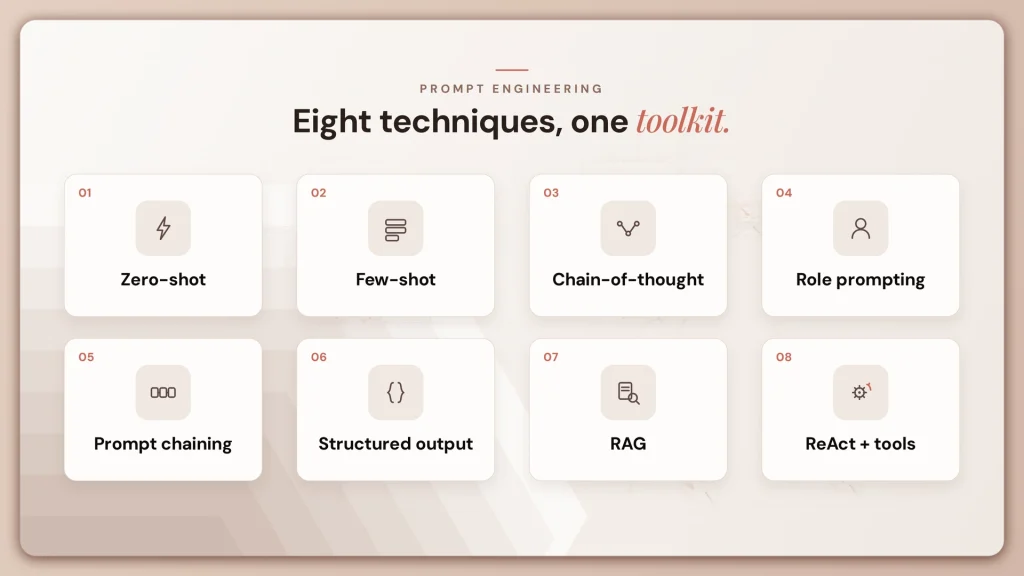
Eight prompt engineering techniques, and when to actually use them
Here’s the core toolkit, technique by technique. Each one includes what it is, when it earns its place, a concrete example, and where it fails, because every technique fails somewhere.
Zero-shot prompting
Zero-shot prompting asks the model to do a task with no examples attached, relying entirely on what it already learned during training. No demonstrations, no format samples, just the instruction.
It’s most useful for general knowledge questions, quick classification, or first-pass drafts where the task is common enough that the model has almost certainly seen it before.
Classify the following support ticket into one category: Billing, Technical Support, or Feature Request. Ticket: "I can't log into my account on the mobile app."
This is also the pattern that generalizes best across departments, from customer support to supply chain management, precisely because it needs no case-specific retraining or example curation. The trade-off is predictability. Performance swings hard on anything nuanced or ambiguous, because there’s nothing anchoring the model’s interpretation. A lightweight fix is directional-stimulus prompting, dropping a small hint or keyword into the instruction to nudge the model toward the right angle without the overhead of building out full examples.
Few-shot prompting
Few-shot prompting puts two to five worked examples directly in the prompt, showing the model the exact format, tone, and logic you want before it sees the real input.
It earns its place when the task is ambiguous or the output format is specific: structured data extraction, custom sentiment labels, or matching a particular brand voice.
Term: "Quantitative Easing" Plain English: "A central bank creating new money to buy government bonds, increasing the money supply." Term: "EBITDA" Plain English: "A company's earnings before interest, taxes, depreciation, and amortization." Term: "Accrued Revenue" Plain English:
The catch: output quality tracks example quality almost exactly. Bad or narrow examples produce bad or narrow outputs, and every example you add lengthens the prompt, adding tokens, cost, and latency.
Chain-of-thought prompting
Chain-of-thought prompting asks the model to lay out intermediate reasoning steps before committing to a final answer, instead of jumping straight to a conclusion.
It’s the right call for arithmetic, multi-step logic, and any task where the final answer is only as good as the reasoning chain that produced it.
Q: A team of 4 completes 5 tasks each per day. The project has 100 tasks. How many days? A: Let's think step by step. 1. Daily output: 4 x 5 = 20 tasks/day. 2. Days needed: 100 / 20 = 5 days.
The limitation is real and worth taking seriously. Research evaluating multimodal models across a range of prompting methods found that structured reasoning prompts including chain-of-thought and tree-of-thought frequently increased hallucination up to 75% in small models and led to longer response times, exceeding 20 seconds in large MLLMs, while simpler prompting methods provided more concise and efficient outputs. The same study concluded, more broadly, that no single prompting method uniformly optimizes all task types. For genuinely harder reasoning problems, two escalations sit above basic chain-of-thought: tree of thoughts, which lets the model explore and backtrack across multiple reasoning branches instead of committing to one, and least-to-most prompting, which decomposes the problem into an ordered sequence of easier sub-problems first.
Role prompting
Role prompting assigns the model a persona, something like “you are a senior cybersecurity analyst,” to steer its tone, vocabulary, and framing toward that character.
It’s most useful when you need consistent tone and expertise-level framing across many outputs, which is exactly why persona-locked prompts show up so often in customer-facing workflows, including the kind of consistent, on-brand replies a revenue and sales team needs at scale.
You are a senior cybersecurity analyst. Explain "zero-day vulnerability" to a non-technical marketing team. Focus on business risk, not technical detail.
The failure mode is that the persona is a costume, not credentials. A model sounding like an expert is not the same as a model being correct, and a confident-sounding persona can make a wrong answer harder to catch, not easier.
Prompt chaining
Prompt chaining splits a complex task into a sequence of smaller prompts, where the output of one becomes the input to the next.
It’s built for multi-step workflows: summarize a document, then extract entities from the summary, then draft a follow-up based on the entities. These chaining patterns show up constantly in voice applications too, where AI call prompt engineering structures multi-turn phone conversations to track caller intent across turns rather than in a single shot.
Prompt 1: Summarize this earnings call transcript in 5 bullet points. Prompt 2 (using output of Prompt 1): Draft a sales team email highlighting the growth opportunities above.
Chains are brittle by nature. An error in step two propagates cleanly into step five, and debugging which link in the chain went wrong takes real orchestration discipline, not just good workflow design. Teams formalizing this as a repeatable practice, including the way IT services firms build out a generative AI practice, tend to treat chaining as infrastructure rather than a one-off script. Once a chain is stable, the natural next step is meta-prompting: using one LLM call to generate or refine the prompts that run inside the rest of the chain.
Structured outputs
Structured output prompting instructs the model to return a specific machine-readable format, JSON, XML, or a defined schema, rather than free-flowing prose.
This matters the moment an LLM’s output needs to be consumed by other software: populating a database, feeding a UI, or triggering downstream automation. The same principle extends to multimedia pipelines, where running speech to text video transcription ahead of the prompt gives the model clean structured text to extract from, instead of raw audio.
Extract the key details as JSON with keys "company_name", "quarter", "revenue_mil".
Text: "Global Tech Inc. reported Q3 revenues of $5.2 million."
Even well-specified schemas get missed, particularly with nested structures. This is exactly why structured-output prompts need an output validation layer sitting behind them in production, not just a well-written schema in the prompt itself.
Retrieval-augmented generation (RAG)
RAG grounds a model’s response in retrieved, external information rather than relying purely on what it learned during training. A retrieval step pulls relevant documents before generation, and those documents get added to the prompt as context.
It’s the go-to pattern for answering questions about private company data, recent events, or anything a general-purpose model simply wasn’t trained on. Grounding this way is also one of the most direct levers for reducing hallucination, because the model has something factual to check itself against instead of guessing.
A customer asks a support bot about a warranty policy for a specific product line. The RAG system retrieves that exact policy document from the knowledge base and hands it to the model to synthesize into a clean answer, rather than letting the model reconstruct the policy from memory.
The limitation sits entirely upstream: RAG is only as reliable as the retriever and the underlying data quality. Feed it irrelevant chunks, get a confidently wrong answer. This is also where verification-oriented techniques earn their keep, self-consistency, self-refine, step-back prompting, and generated knowledge prompting all add a layer of checking on top of retrieval, and get more depth in the reliability sections below.
Reasoning and tool-use frameworks (ReAct-style)
ReAct-style reasoning lets a model do more than generate text. It reasons about which external tool to call, calls it, reads the result, and folds that observation back into its next reasoning step.
This is the pattern behind genuinely autonomous agents, ones that need to pull live data or take an action, not just answer from memory.
Thought: I need the current stock price of Company X.
Action: stock_price_api(ticker='X')
Observation: $150.25
Thought: I have what I need.
Final Answer: Company X is currently trading at $150.25.
The trade-off is complexity, not accuracy. Tool design, permissioning, and error handling all become production concerns the moment a model can act, not just answer. This is also the point where prompt engineering stops being about text generation and starts being about agent design, worth exploring further in Lyzr’s agent masterclass demo if you want to see the pattern in motion.
The prompt engineering technique decision matrix
Use this to skip the guesswork. Match your actual goal to a pattern, then read the trade-off before you commit to it.
Match your goal to a prompting pattern
| What are you trying to improve? | Recommended pattern | When to use it | Potential trade-off |
|---|---|---|---|
| Output consistency / format | Few-shot prompting | Structured extraction, custom labels, brand-voice matching | Quality caps at example quality; adds tokens and cost |
| Task accuracy on ambiguous input | Directional-stimulus or role prompting | General queries needing a specific angle or tone | Persona can sound confident while still being wrong |
| Complex reasoning | Chain-of-thought, escalating to tree of thoughts or least-to-most | Multi-step math, logic, planning tasks | Higher latency; can increase hallucination on some models |
| Factual accuracy on proprietary data | Retrieval-augmented generation (RAG) | Private knowledge bases, recent events, domain-specific facts | Only as reliable as the retriever and source data |
| Tool interaction / live data | ReAct-style reasoning | Agents that must call APIs or take actions | Needs robust permissioning and error handling |
| Multi-step workflow automation | Prompt chaining, escalating to meta-prompting | Sequential tasks: summarize, extract, draft, revise | Errors cascade; requires state management between steps |
| Response refinement / verification | Self-consistency or self-refine | High-stakes outputs where a wrong answer is costly | Multiple generations add cost and latency |
Guardrails: what makes a technique trustworthy at scale
Picking the right pattern gets you a good first draft of reliability. Guardrails are what make it hold up in production.
Three things matter here. Output validators check that structured responses actually match the expected schema before anything downstream consumes them. Refusal or safety patterns catch out-of-scope or harmful requests before they reach a user. Human-review checkpoints sit in front of anything high-stakes, financial actions, legal language, medical guidance, so a person signs off before the output goes live.
This is typically where platform teams come in, standardizing validators and safety patterns so every team building on top doesn’t have to reinvent them per project. None of this replaces technique selection. It’s what turns a chosen pattern into something you can trust without babysitting it.
When the model hallucinates, and what’s beyond the prompt?
Even a well-matched technique will produce a wrong answer sometimes. When it does: verify against a grounding source, which is exactly what RAG is built for. Run self-consistency, sampling the same prompt multiple times and taking the majority answer, or self-refine, having the model critique and rewrite its own draft. If confidence is still low, escalate to a human.
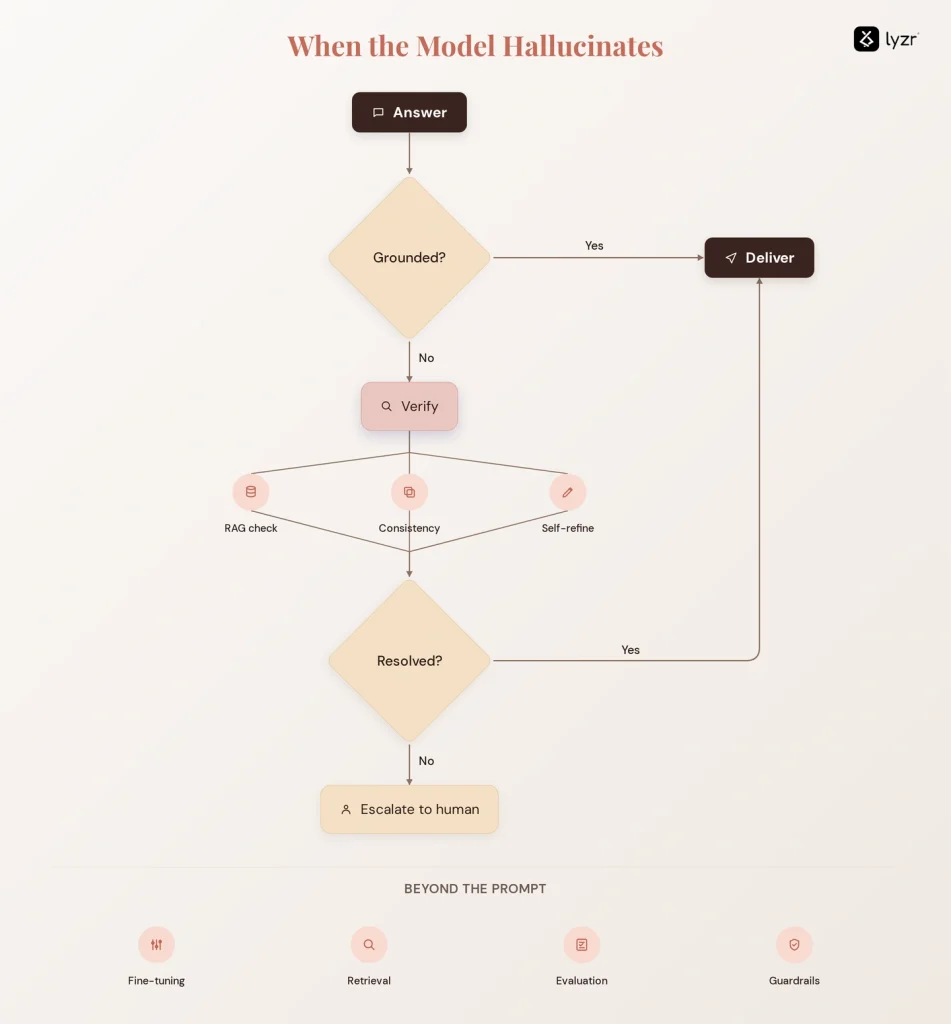
Worth naming clearly: prompting is one lever, not the whole toolkit. Fine-tuning updates the model’s actual weights on domain data. Retrieval architectures address grounding from outside the prompt entirely. Evaluation harnesses catch drift before users do. Guardrail systems, covered above, catch what slips through. Google’s own current guidance for its newer Gemini models makes a related point from the opposite direction: the recommended practice is to be precise and direct, stating the goal clearly and concisely, and avoiding unnecessary or overly persuasive language, because these models are designed for advanced reasoning and instruction following and respond best to prompts that are direct, well-structured, and clearly define the task and constraints. Sophistication for its own sake isn’t the goal. Fit is.
Reliability in production: evaluation and consistency
A technique “working” once in a playground test tells you almost nothing about whether it works at scale. Applying a pattern consistently means running it against an evaluation set, checking output quality across a range of real inputs, and monitoring drift over time, not just eyeballing one good response.
That discipline shapes how prompts get shaped in the first place. Studio’s “Improve” button next to Agent Instructions exists for exactly this reason, suggesting tighter, clearer phrasing so consistency doesn’t rely on one person’s memory of how the prompt used to read. Treat prompts like production assets and version them systematically. It’s also worth formalizing this skill set directly, and many practitioners pursue a prompt engineering certification as part of that.
Where to go deeper: related spoke content
This article covers technique selection. The disciplines below cover what surrounds it once a technique is in production:
- Enterprise prompt management, for governing prompts across teams and use cases
- Prompt versioning and lifecycle management, for treating prompts as tracked production assets
- Prompt tuning techniques, for refining a pattern once it’s already close to working
- Data sourcing for prompting and retrieval, for what feeds a RAG pipeline in the first place
- Loop engineering versus prompt engineering, for when the unit of design shifts from a single prompt to an iterative agent loop
- The SSR prompting method, for a structured alternative worth comparing against chain-of-thought
You can also join the community if you want to trade notes with other practitioners working through the same technique-selection problems.
The Lyzr view: from technique selection to governed agent behavior
Here’s what we’d push back on if we heard it in a planning meeting: that the goal is finding the “best” prompt. It isn’t. The goal is a repeatable system that produces the same quality of output on the hundredth run as it did on the first, and that you can prove is doing that.
That’s the real arc this article has been tracing. Prompt engineering gets you a working instruction. Prompt design gets you a pattern matched to the task. Reliable AI behavior gets you evaluation and guardrails around that pattern. Governed agentic systems are where all of it operationalizes at once, and that’s precisely where a tool like Magic Prompts and a full build environment start to diverge, one optimizes a single prompt, the other governs the whole workflow around it.
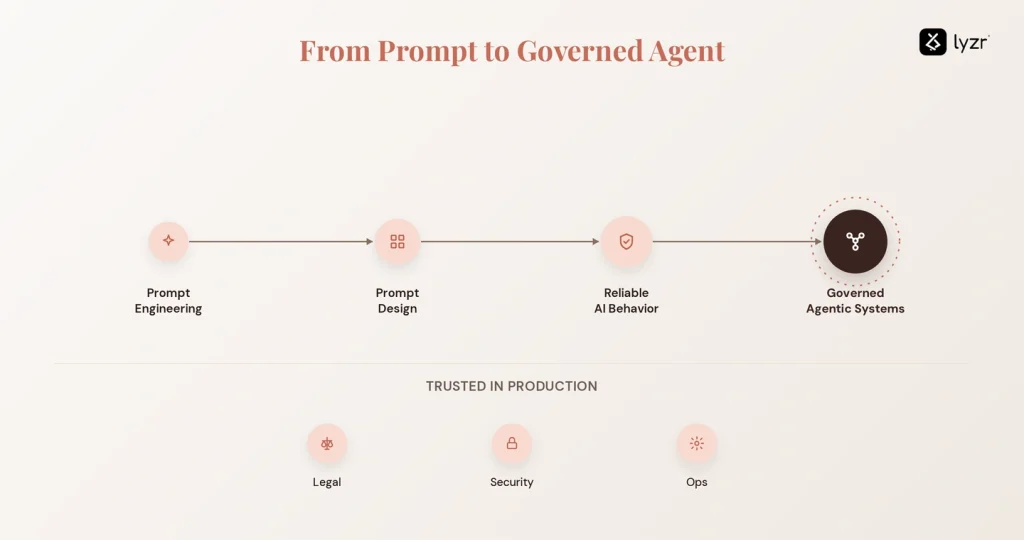
In Lyzr Agent Studio, technique selection becomes something evaluable and versioned rather than tribal knowledge sitting in someone’s chat history. That’s the piece we think most teams underbuild, and it’s exactly the gap digital transformation teams tend to hit once a proof-of-concept prompt needs to become a production agent that legal, security, and ops all trust.
Frequently asked questions
What are the most effective prompt engineering techniques?
There isn’t one universally “most effective” technique. RAG is most effective for factual accuracy against your own data. Chain-of-thought is most effective for multi-step reasoning. Few-shot is most effective for matching a specific format or tone. Effectiveness is task-dependent, not technique-dependent.
What is the difference between zero-shot and few-shot prompting?
Zero-shot gives the model no examples and relies on pretrained knowledge. Few-shot includes two to five worked examples in the prompt to show the exact format and tone expected. Few-shot generally costs more tokens but produces more predictable output.
Which prompt engineering technique should I use?
Start from the goal, not the technique. Use the decision matrix above: match your goal, whether it’s consistency, reasoning, retrieval, or tool use, to the recommended pattern, then check its trade-off before committing.
How can prompt engineering improve LLM accuracy?
Accuracy improves when the technique matches the failure mode. Ambiguity gets fixed with few-shot examples. Weak reasoning gets fixed with chain-of-thought. Factual gaps get fixed with RAG. Sophistication without a matching failure mode to address rarely moves accuracy at all.
What are advanced prompt engineering techniques?
Advanced techniques move past single prompts into systems: prompt chaining and meta-prompting for multi-step workflows, ReAct-style reasoning for tool use, and verification methods like self-consistency, self-refine, and step-back prompting for catching a model’s own errors before a user sees them.
Is prompt engineering still relevant as models get better at following instructions?
Yes, though what it means has changed. As base models get better at direct instructions, the skill shifts from writing elaborate wording toward selecting the right pattern and verifying its output, which is exactly the shift this article is built around.
What is the difference between prompt engineering and fine-tuning?
Prompt engineering shapes a model’s behavior at inference time through the input alone. Fine-tuning updates the model’s internal weights through additional training on domain data. Prompting is faster and cheaper to iterate on; fine-tuning is a heavier lift that produces a genuinely specialized model.
Why do longer, more detailed prompts sometimes perform worse?
Because added detail isn’t the same as added clarity. Unnecessary elaboration can bury the actual instruction, and current guidance for newer reasoning models specifically favors direct, concise phrasing over long, persuasive prompt text.
Ready to move technique selection from a chat history into a governed, evaluable workflow?
Book a demo and see how Lyzr Agent Studio turns a proven prompting pattern into a production-ready agent.
Book A Demo: Click Here
Join our Slack: Click Here
Link to our GitHub: Click Here