TL;DR
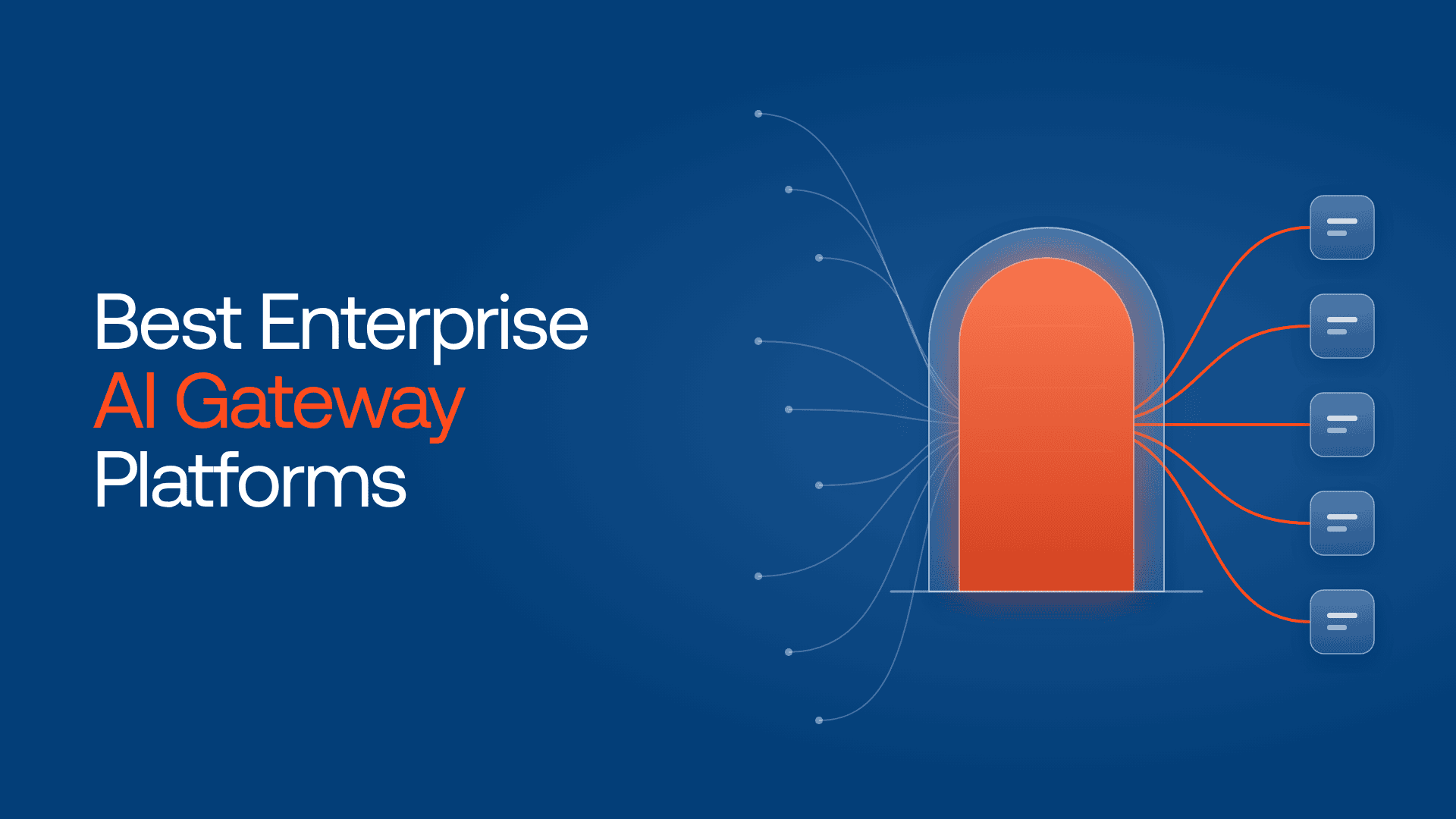
- An enterprise AI gateway is the one point in the request path where identity, budgets, guardrails and logging are enforced for every model, MCP tool and agent call.
- Judge every platform on five tests: where it runs, who it identifies, whether budgets actually block, what it inspects, and what it can’t see.
- Where a gateway came from predicts its blind spot: API managers, security suites, AI platforms and agent control planes each miss something different.
- Lyzr Opencontroller: runs inside your network, air-gapped if needed, and finds agents that bypass the gateway.
- Kong, Azure API Management, Apigee: best if that API platform is already your standard.
- Prisma AIRS AI Gateway: best for security-led, Palo Alto shops.
- TrueFoundry: best if you also host your own models.
- Only Opencontroller and TrueFoundry document fully air-gapped installs.
- Before signing, mirror real traffic to your finalists for two weeks and compare provider invoices with gateway logs.
Lyzr built Opencontroller after its own AI tools bill reached about $50,000 a month, roughly $36,000 of it Anthropic, and it needed a more granular view of where that spend came from. If an AI company needed that, enterprises with more teams and less instrumentation need it more.

Giving every team that view is an enterprise AI gateway’s job. Gartner expects 70% of software teams building multimodel applications to use one by 2028, up from 25% in 2025.
The real question is which kind. This guide ranks the best enterprise AI gateway platforms by lineage, because lineage predicts the blind spots.
What “enterprise” adds to an AI gateway
Gartner’s Market Overview treats AI gateways as the way agents reach both models and MCP servers, with policy for routing, load balancing, data protection, cost visibility, security and identity.
Most companies aren’t there. In a TrueFoundry survey of 200+ AI leaders with agents in production, run in March and April 2026, 76% lacked unified logging across models and agent workflows, and 56% had no central control layer at all. Treat a vendor survey as directional.
Five tests separate an enterprise AI gateway from a developer proxy:
- Where does it run? SaaS, a hybrid data plane, self-hosted or air-gapped. Data sovereignty rules decide which.
- Who is calling? A shared app key says nothing. The gateway should know the team, user or agent.
- Does a budget stop anything? Virtual keys with hard caps beat a cost report that lands after the invoice.
- What does it inspect? Tool calls and agent-to-agent traffic, not just prompts.
- What can’t it see? An agent calling a provider directly with its own key is invisible to every gateway, unless something else finds it.
The CIO Playbook to AI Agent Governance: The five control points every agent needs before production: registry, identity, evaluation, staged promotion and observability. Get the playbook →
Four lineages, four blind spots
Gartner groups vendors into API management platforms with AI extensions, AI platforms with built-in gateways, and purpose-built gateways. Palo Alto’s purchase of Portkey added a fourth path: the security suite.
API managers (Kong, Azure API Management, Apigee) treat AI as one more policy chain on the parent product’s cloud and release cycle. Security suites (Prisma AIRS) start from inspection. AI platforms (TrueFoundry) start from model deployment. Agent control planes (Lyzr Opencontroller) start from the agent, with the gateway as one enforcement point among several.
The 6 best enterprise AI gateway platforms
1. Lyzr Opencontroller: best when the gateway has to live inside your network
Opencontroller’s LLM gateway covers the expected ground: virtual keys, team budgets, rate limits, routing, fallback and caching across providers. Its sample trace shows a claude-sonnet-4.5 call hitting a 429 and landing on gpt-4.1 in 212 ms, billed to the team’s virtual key. That enables cost attribution by team and agent.
Guardrails in the path check prompt injection, PII, secrets, groundedness and per-tool limits both ways. An agent gateway authenticates, authorizes and rate-limits every caller, human, app or agent. Discovery hunts for agents nobody registered, which answers test five. It ships as a Docker image, Helm chart or pip package for your VPC, on-prem or air-gapped, and customer-managed deployments don’t need credentials or telemetry to reach Lyzr.
| Strength | Consideration |
| Models, MCP tools and agent-to-agent calls in one request path | A full control plane is more than one app needs |
| Air-gapped option; your secrets manager stays in place | A new product, launched in September; early pilots (Anaplan, Pepsi) are company-reported |
Best fit: regulated or multi-cloud enterprises whose agents span several providers and frameworks. Before choosing: name an owner for agent registration.
2. Kong AI Gateway: best for platform teams already running Kong

AI Gateway 2.0 went GA on September 1 as a Kong Konnect service, extending Kong Identity principals to AI traffic, so rate limits, cost attribution and access control follow the user or agent rather than a gateway-local consumer. Version 2.2 followed on September 30 with modality-aware cost management and custom plugins. Agent-to-agent traffic arrived in April with Agent Gateway in Kong AI Gateway 3.14.
| Strength | Consideration |
| One policy engine for APIs, LLMs, MCP and A2A | 2.x runs on Konnect; its MCP Server entity is marked incompatible with on-prem |
| Identity-keyed limits and cost attribution | 3.x AI plugins stay supported through 3.14 LTS and become opt-in from 3.18 |
Best fit: companies with Kong in production that want AI under the same governance. Before choosing: if everything must stay on-prem, list the 2.x features you’d give up on 3.x.
3. Azure API Management: best for Azure-committed enterprises
At Build in June, Microsoft extended APIM’s AI gateway policies to Anthropic and Vertex AI models, made content safety for MCP and A2A traffic generally available, and previewed a Unified Model API. The llm-token-limit policy sets a per-key token rate, a token quota over an hourly to yearly window, or both, on classic, v2, self-hosted and workspace gateways. A dedicated AI Gateway tier entered public preview in July.
| Strength | Consideration |
| Policies cover Azure OpenAI, Anthropic and Vertex AI backends | Token limits are counted per gateway, so multi-region setups don’t share one total |
| Self-hosted gateway for hybrid traffic | The preview AI Gateway moved to a new resource type on October 14; old resources are removed after January 15, 2027 |
Best fit: enterprises whose AI traffic is mostly Azure OpenAI and Foundry. Before choosing: if you piloted the preview tier, plan the move to a new runtime URL and access keys.
4. Google Apigee: best for turning your API estate into agent tools
Apigee covers the basics: Model Armor screening, cross-provider model routing with automatic fallback, semantic caching, an LLM token limit policy and token usage by model and app. Its real angle: it turns APIs you already manage into MCP tools without new code and syncs them to Agent Registry. Extension processor policies even apply Apigee rules to model and MCP calls that skip an Apigee proxy. Google positions Apigee, not Agent Gateway, for agents running outside its own Agent Platform.
| Strength | Consideration |
| Existing governed APIs become agent tools | Heavy if AI traffic is all you need to govern |
| Apigee hybrid processes traffic in your own cluster | Hybrid’s management plane runs on Google Cloud, so there’s no air-gapped option |
Best fit: Google Cloud shops whose agents mostly call internal APIs. Before choosing: count the agents running outside Google Cloud; that’s where Apigee earns its place.
5. Prisma AIRS AI Gateway: best for security-led rollouts

Palo Alto Networks closed its $117 million Portkey deal on May 29 and made Prisma AIRS AI Gateway generally available on July 16, six weeks later. It sits inline across agent-to-model, MCP tool and A2A calls, while AI Runtime Security inspects prompts and responses for prompt injection, secrets and customer data heading out. Palo Alto says the architecture processed 68 trillion+ tokens the month before launch. Hybrid mode runs the data plane in your Kubernetes cluster, with management in Strata Cloud Manager.
| Strength | Consideration |
| Gateway, runtime security and AI red teaming from one vendor | Americas region only at launch |
| Hybrid data plane keeps payloads in your cluster | PII detection comes from AI Runtime DLP, not the gateway’s guardrails |
Best fit: enterprises whose CISO already runs Prisma AIRS or Strata. Before choosing: get EU and APAC residency dates in writing.
6. TrueFoundry AI Gateway: best when you also host your own models

TrueFoundry bundles an LLM gateway, an MCP gateway and, since June, an Agent Gateway, with 1,600+ models behind one API. It runs as SaaS or in your VPC, on-prem, hybrid or air-gapped, with built-in PII detection plus third-party guardrail integrations. The same platform deploys models, MCP servers and agents on Kubernetes, and it bought Seldon in June.
| Strength | Consideration |
| Gateway plus model and agent deployment on one platform | A platform purchase if a gateway is all you want |
| Air-gapped installs with outbound-only connectivity | Agent Gateway is its newest piece, launched in June |
Best fit: teams serving fine-tuned open models next to frontier APIs. Before choosing: decide if you want gateway and serving from one vendor.
Six platforms on one grid
| Platform | Runs in your network | Air-gapped | Guardrails in the path | Agent-to-agent traffic | Finds agents that bypass it | Not tied to one vendor’s cloud or suite |
| Lyzr Opencontroller | ✓ | ✓ | ✓ | ✓ | ✓ | ✓ |
| TrueFoundry AI Gateway | ✓ | ✓ | ✓ | ✓ | ✗ | ✓ |
| Kong AI Gateway | ◐ | ✗ | ✓ | ✓ | ✗ | ✓ |
| Prisma AIRS AI Gateway | ◐ | ✗ | ✓ | ✓ | ◐ | ◐ |
| Azure API Management | ◐ | ✗ | ✓ | ✓ | ✗ | ◐ |
| Google Apigee | ◐ | ✗ | ✓ | ◐ | ✗ | ◐ |
✓ built in · ◐ partial, hybrid only, separate product or not documented end to end · ✗ not in the public docs we reviewed. Editorial assessment from the cited sources, as of October.
Guardrails and agent traffic are close to table stakes. The grid splits on deployment and discovery.
Run a two-week bake-off before you sign
Feature lists converge every quarter, so test on your own traffic.
- Pick three slices. An internal copilot, an agent that calls MCP tools, and a regulated workflow that touches personal data.
- Mirror, don’t cut over. Copy 10% of each slice to every finalist.
- Collect evidence, not demos. A budget that blocked a request, a stopped injection, a trace that names the agent.
- Count the strays. Compare provider invoices with gateway logs. That gap is your shadow fleet.
- Measure overhead at P95 on your payloads, not the vendor’s benchmark.
AI Agent Sprawl Audit: Find the agents calling models with their own keys before your new gateway goes live. Take the audit →
Buy for the agents you’ll have next year
Gartner puts end-user spending on AI models and platforms at $64 billion in 2026, and expects the long-term winners to be vendors that help enterprises manage where and how AI is used. A gateway is part of that answer.
Our advice: choose by what won’t change after you sign, which is where it must run and whom it must identify. If your answers are “inside our network” and “every agent, including the ones we haven’t found,” book an Opencontroller demo and we’ll mirror a slice of your traffic through it.
FAQs
Lyzr OpenController, Kong AI Gateway, Azure API Management, Google Apigee, Prisma AIRS AI Gateway and TrueFoundry AI Gateway.
An API gateway meters requests. An AI gateway meters tokens and cost, routes across providers, and inspects prompts, responses and tool calls.
Of these six, only Lyzr OpenController and TrueFoundry document air-gapped installs.
Related reading: Best LiteLLM alternatives · Best tools for AI policy enforcement at scale · Best tools for real-time AI agent monitoring
Book A Demo: Click Here
Join our Slack: Click Here
Link to our GitHub: Click Here
Got a use case in mind?
8 weeks from use case to agents running in production.
Platform, people and FDEs, all in. Bring your environment. We'll co-build and stay until it's live.
Talk to UsFree resource
101 AI Agents Use Cases
100+ production-ready AI agent use cases across Marketing, Sales, HR, Banking, Insurance, Operations and a lot more
Download now