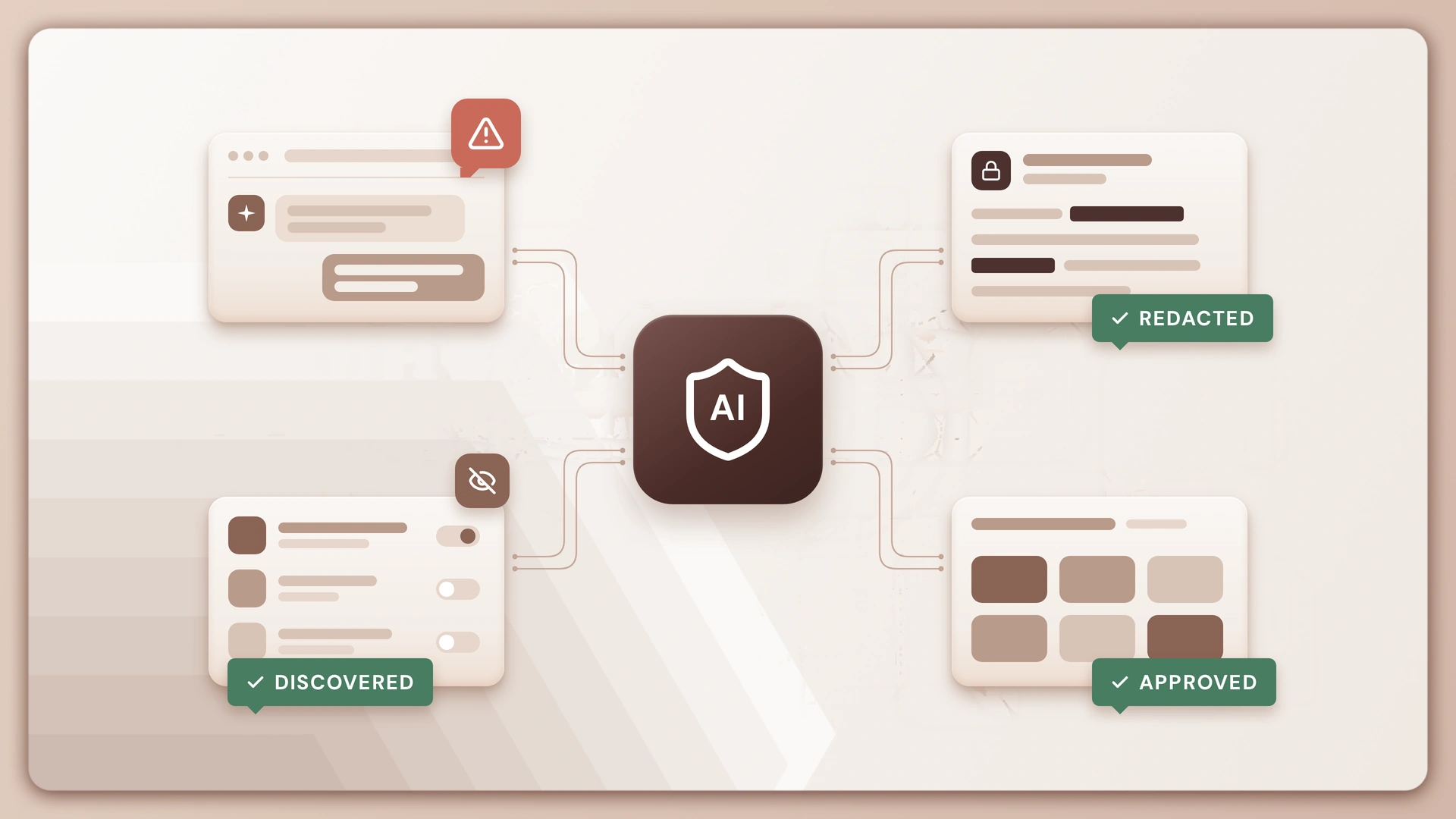
Shadow AI is no longer just an employee opening ChatGPT without telling IT.
Employees are using coding agents with personal API keys. Teams are connecting MCP servers to AI applications. Developers are running local models. AI features are appearing inside SaaS applications that security teams already approved.
That changes what Shadow AI prevention needs to cover.
A tool that only tells you which AI websites employees visit can give you visibility. A DLP platform can help prevent sensitive data from reaching those applications. An AI gateway can enforce policies on traffic.
But enterprises managing hundreds or thousands of AI agents have another problem:
Knowing what exists is not the same as controlling it.
This guide compares the leading tools across AI discovery, data protection, policy enforcement, agent governance, access control, and cross-environment visibility.
Best for: CTOs, CISOs, Heads of AI, security teams, and AI platform leaders evaluating Shadow AI prevention tools.
Not for: Teams looking for a basic introduction to Shadow AI. This is a buyer’s comparison for teams already evaluating products.
What should a Shadow AI prevention tool actually do?
Before comparing products, separate Shadow AI prevention into the jobs the platform needs to perform.
| Capability | What it should answer |
| Discovery | What AI tools, applications, agents, and models are being used? |
| Identity | Who is using them, and is the account sanctioned? |
| Data protection | What information is being sent to AI systems? |
| Policy enforcement | Can risky AI usage be blocked or restricted? |
| Agent governance | Which agents exist, who owns them, and where are they running? |
| Access control | Which users, agents, models, and tools can interact with each other? |
| Auditability | Can security teams trace AI activity back to an owner or policy? |
Best Shadow AI Prevention Tools Compared

1. Lyzr OpenController

Best for: Enterprise AI agent governance and control
Lyzr OpenController approaches Shadow AI from the perspective of AI agent sprawl.
As enterprises move from individual copilots to multi-step agents, the problem changes. AI systems can be built across different teams, frameworks, clouds, models, and runtimes. Some have clear owners. Others become difficult to trace once they move into production.
OpenController provides a control layer across that agent estate.
What OpenController is useful for
- Centralized visibility across AI agents
- Agent ownership and governance
- Access control
- Cross-cloud and cross-framework governance
- Agent activity and cost visibility
- Policy enforcement
- Controlling agents without replacing existing infrastructure
The distinction is important:
OpenController is not another cloud runtime, model provider, framework, CI/CD system, or identity provider.
It sits above the existing stack as a governance and control layer.
Why this matters for Shadow AI?
A security team can discover that an employee is using an unapproved AI application.
But an enterprise can also have a different problem: “We have hundreds of AI agents. Which ones are approved, who owns
them, what can they access, and which ones can still run?”
That is where agent governance becomes part of Shadow AI prevention.
Consider OpenController if…
- Your organization is moving from copilots to production agents.
- Agents are spread across multiple clouds or frameworks.
- Ownership becomes difficult to track.
- You need a consolidated view of agent activity and cost.
- Security needs controls at the agent layer rather than only the
employee or browser layer.
2. Microsoft Purview

Best for: Data security and AI governance in Microsoft-heavy environments
Microsoft Purview approaches Shadow AI through Microsoft’s broader security, compliance, and data governance ecosystem.
Its Shadow AI guidance focuses on discovering AI applications, identifying unsanctioned usage, blocking risky applications, and protecting sensitive data sent to AI applications.
What it is useful for
- AI application discovery
- AI interaction monitoring
- DLP
- Compliance workflows
- Microsoft security integrations
- Controls around sanctioned and unsanctioned AI usage
Consider Microsoft Purview if…
Your enterprise already relies heavily on Microsoft 365, Defender, Entra, and Purview and wants AI governance to fit into that existing security architecture.
The consideration for a broader AI estate is whether additional controls are needed for agents, models, and runtimes outside the Microsoft ecosystem.
3. Netskope AI Command Center

Best for: AI visibility, security, and enforcement across network and endpoint environments
Netskope has expanded its Shadow AI capabilities beyond simply identifying AI websites.
Its AI Command Center brings together visibility into AI applications, AI interactions, MCP servers, and associated risks.
Its endpoint AI discovery capabilities also cover locally installed AI agents, local LLMs, MCP servers, browser extensions, and IDE extensions.
What it is useful for
- AI application discovery
- Shadow AI detection
- Local AI and agent discovery
- MCP visibility
- DLP
- AI guardrails
- Access policies
- AI traffic enforcement
Consider Netskope if…
Your Shadow AI problem spans users, applications, endpoints, AI traffic, and MCP and you already have a broader Netskope security deployment.
4. Nudge Security
Best for: SaaS and AI discovery
Nudge Security takes a discovery-first approach to Shadow AI.
The focus is on identifying SaaS and AI applications through signals such as identity activity, OAuth connections, email metadata, and browser activity.
This is useful because AI functionality is increasingly appearing inside SaaS applications that may already be approved by IT.
What it is useful for
- Discovering unsanctioned AI applications
- Finding AI applications connected through OAuth
- Identifying AI embedded inside SaaS
- Mapping applications to users
- SaaS and AI lifecycle governance
Consider Nudge Security if…
Your primary question is: “What AI applications have employees connected to the
organization?”
5. Nightfall AI

Best for: Preventing sensitive data exposure through AI
Nightfall AI approaches Shadow AI primarily as a data protection problem.
The question isn’t simply whether someone is using an unapproved AI tool.
It is: What sensitive information is entering that AI tool?
That matters because completely blocking AI isn’t realistic for many enterprises. Employees may have legitimate reasons to use generative AI without being allowed to paste source code, customer information, credentials, financial information, or other sensitive content into any model.
What it is useful for
- Detecting sensitive information
- DLP around AI usage
- Protecting sensitive prompts and content
- Applying policies to AI-related data flows
Consider Nightfall if…
Your biggest Shadow AI concern is data leakage rather than AI inventory or agent lifecycle management.
6. Cyberhaven

Best for: Data lineage and understanding where sensitive information moves
Cyberhaven takes a data-centric approach to Shadow AI.
Instead of focusing only on which AI application is being used, the platform is designed around understanding how sensitive data moves.
That makes it relevant when security teams need to answer questions such as:
- What sensitive data entered an AI prompt?
- Where did that data originate?
- Which user or application handled it?
- Where did the information go afterward?
- What policies should apply to that movement?
Consider Cyberhaven if…
Your Shadow AI program is closely tied to data lineage, insider risk, and understanding the movement of sensitive information.
Shadow AI prevention isn’t one problem
This is where many enterprise comparisons become misleading.
A company could deploy a DLP platform and still have thousands of unmanaged AI agents.
It could discover every AI application and still have no control over which agents can access production systems.
It could block ChatGPT and still have developers running local models, coding agents, MCP servers, or AI features inside approved SaaS applications.
So the better question isn’t:
“Which tool detects Shadow AI?”
It is:
“Where does our Shadow AI problem actually exist?”
If your main problem is… Look for…
- Employees using unapproved AI AI and SaaS discovery websites
- Personal vs. enterprise AI accounts Identity and application controls
- Sensitive data entering AI prompts DLP and prompt inspection
- AI traffic leaving the enterprise AI gateway / SWG
- Local AI tools and coding agents Endpoint discovery
- MCP servers and AI integrations MCP discovery and access control
- Hundreds of unmanaged AI agents Agent inventory and governance
- Agents spread across clouds and Cross-stack control plane frameworks
- Lack of ownership Agent identity and ownership mapping
The biggest buying mistake: confusing discovery with prevention

Finding an AI application is useful. But discovery alone doesn’t prevent anything.
The same applies to an inventory of AI agents.
If a security dashboard tells you that 400 agents exist but gives you no mechanism to establish ownership, restrict access, govern deployment, or enforce policy, you’ve gained visibility without necessarily gaining control.
A useful evaluation should therefore separate:
Discover → Understand → Govern → Enforce
1. Discover
Find the AI applications, models, agents, MCP servers, and integrations already in use.
2. Understand
Determine who owns them, what data they access, what models they use, and where they run.
3. Govern
Define which AI systems are approved, what they can access, and what policies apply.
4. Enforce
Actually prevent unauthorized actions rather than relying on alerts after the fact.
How to choose a Shadow AI prevention tool
If you’re evaluating vendors, ask these questions during the demo.
- Can it see AI beyond the browser?
A browser-only approach can miss:
- Desktop AI applications
- Coding assistants
- Local models
- MCP servers
- IDE extensions
- AI agents
Your inventory should reflect how AI is actually being used inside engineering and business teams.
- Can it distinguish sanctioned from unsanctioned use?
“Employee uses ChatGPT” isn’t enough information.
You need to know whether the employee is using:
- A company-approved account
- A personal account
- An approved use case
- An unapproved model
- An unmanaged integration
- Can it see what the AI is doing?
For data security, that can mean inspecting prompts, uploads, responses, and other interactions.
For agents, it means understanding which tools and systems the agent can access and what actions it is allowed to take.
- Can it enforce policy?
A dashboard is useful.
A control mechanism is different.
Look for actual actions such as:
Allow → Restrict → Block → Revoke → Isolate → Audit
rather than visibility alone.
- Can it scale beyond one AI stack?
This becomes especially important as enterprises move from individual copilots to multi-agent systems.
Your environment may include:
LangGraph + CrewAI + custom agents + multiple LLM providers + AWS + Azure + GCP + local models + MCP.
A governance layer that only works inside one ecosystem can quickly become another silo.
The real shift: from Shadow AI discovery to AI estate control
The first phase of enterprise AI governance was about asking: “Which AI tools are our employees using?”
The next phase is broader: “What AI exists inside our organization, who owns it, what can it
access, and who has the authority to control it?”
That includes applications, models, agents, MCP servers, integrations, and the infrastructure around them.
For enterprises still dealing primarily with unauthorized AI applications, tools such as Microsoft Purview, Netskope, Nudge Security, Nightfall, and Cyberhaven address different parts of the discovery and data-protection problem.
For organizations dealing with agent sprawl across multiple clouds, frameworks, models, and runtimes, the requirement starts to look different.
You need a control layer for the AI estate itself.
Where Lyzr OpenController fits?
Lyzr OpenController gives enterprises a governance layer for AI agents without requiring them to replace the infrastructure, models, frameworks, or cloud environments they already use.
The shift is simple:
Shadow AI prevention used to mean finding the tools employees weren’t
supposed to use. Now it also means knowing which AI agents exist, who owns them, what
they can access, and whether they should be allowed to act.
When Shadow AI becomes Shadow Agents, discovery is only the first step. Control becomes the bigger problem.
FAQ
- What is Shadow AI prevention?
Shadow AI prevention refers to the processes and technologies enterprises use to discover, monitor, govern, and restrict unauthorized or risky use of AI applications, models, agents, and integrations.
- Is DLP enough to prevent Shadow AI?
Not necessarily.
DLP can help prevent sensitive information from entering AI applications, but it does not automatically provide an inventory of every AI system or govern the lifecycle and permissions of production agents.
- What is the difference between Shadow AI and AI agent sprawl?
Shadow AI generally refers to AI tools or services being used without the organization’s knowledge or approval.
AI agent sprawl is a related problem in which the organization accumulates large numbers of agents across teams, frameworks, clouds, and runtimes, making ownership, access, and governance difficult to manage.
- Should enterprises use more than one Shadow AI security tool?
Potentially.
Different tools operate at different layers. A company may use one platform for SaaS and AI discovery, another for DLP, and an agent governance layer for production AI systems.
The important part is understanding which layer each tool controls instead of assuming every product provides the same type of coverage.
Bottom line
Shadow AI prevention is moving beyond “find the AI tools employees are using.”
Enterprise AI now spans SaaS applications, APIs, local models, coding assistants, MCP servers, and autonomous agents.
That means the buying question is becoming:
Can we see the AI estate, understand who owns it, control what it can access, and enforce policy as it acts?
For application and data-level Shadow AI, discovery and DLP tools can cover important parts of that problem.
For organizations scaling a large, multi-framework agent estate, agent governance becomes another critical layer.
And that is where a platform such as Lyzr OpenController fits.
Book A Demo: Click Here
Join our Slack: Click Here
Link to our GitHub: Click Here