An AI agent can follow every rule in a test environment and still create problems when it starts interacting with real customers, internal data, and business systems. One agent might expose sensitive information in a response, while another might pass that same information to an external tool without anyone noticing.
Now multiply that across dozens of agents, different models, and multiple teams. Keeping AI behavior within company policies becomes much harder when every system has its own controls and enforcement logic.
That’s why choosing the right AI policy enforcement solution matters.
You need to look beyond content filters and consider how policies apply across inputs, outputs, data access, and agent actions. In this guide, we’ll compare six AI policy enforcement tools for 2026, what each is best suited for, and how to choose one that fits your organization’s governance requirements.
Why AI Policy Enforcement Gets Harder as You Scale
An AI assistant answering customer questions is relatively easy to monitor. The challenge changes when an organization deploys multiple agents across customer support, internal search, sales, and operations.

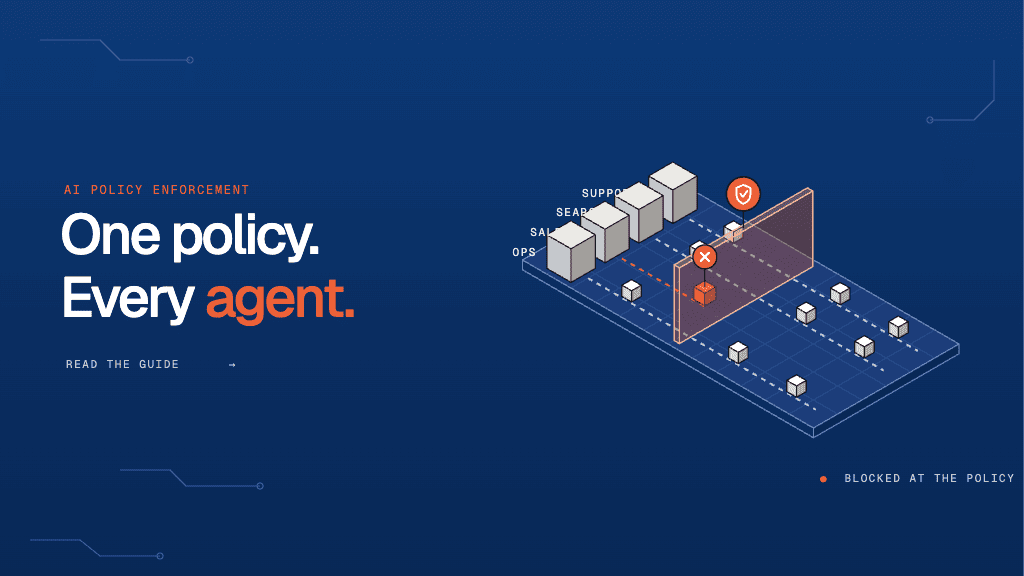
Each agent may use a different model, access different data, and perform different actions. A policy such as “never expose customer information” must apply consistently, whether an agent is answering a question, retrieving a document, or sending information to an external tool.
This is where basic content filtering falls short. Checking a final response may prevent sensitive information from reaching a user, but it does not necessarily stop an agent from sharing that information through a tool call.
Teams need to evaluate tools based on where policies run, how consistently they can be applied, and whether administrators can monitor enforcement across their AI systems.
Quick Comparison: Best AI Policy Enforcement Tools
The following comparison prioritizes centralized agent governance, configurable safety policies, integration flexibility, and production oversight. The ratings reflect an editorial assessment of how each tool fits these requirements, rather than a claim that competitors lack all similar capabilities.
| Capability | Lyzr OpenController | AWS Bedrock Guardrails | Google Model Armor | NVIDIA NeMo Guardrails | Check Point AI Guardrails | Guardrails AI |
| Centralized agent governance | ✓ | ✕ | ✕ | ✕ | ✕ | ✕ |
| Configurable safety policies | ✓ | ✓ | ✓ | ✓ | ✓ | ✓ |
| Input and output protection | ✓ | ✓ | ✓ | ✓ | ✓ | ✓ |
| Custom policy implementation | ✓ | ✓ | ◐ | ✓ | ◐ | ✓ |
| External guardrail integrations | ✓ | ◐ | ◐ | ◐ | ◐ | ◐ |
| Cross-agent operational oversight | ✓ | ✕ | ✕ | ✕ | ✕ | ✕ |
How to read the table:
- ✓ indicates alignment with the stated evaluation criterion.
- ◐ indicates that the capability may depend on configuration, integration, or implementation.
- ✕ indicates that the capability is not the tool’s primary consolidated offering in this comparison.
These symbols do not establish that a competitor cannot support a capability through integrations or additional products. Verify the current feature set and deployment requirements before making a purchasing decision.

The key distinction is that Lyzr is worth evaluating when the requirement is governing a growing collection of agents, while the other tools are particularly relevant for managed safety screening, threat detection, or application-level guardrails.
Best Tools for AI Policy Enforcement at Scale
1. Lyzr OpenController: Best for Centralized Agent Governance
Lyzr is worth evaluating when an organization needs more than a filter around individual model requests. OpenController focuses on governing agents across environments, while Lyzr’s Responsible AI capabilities provide controls for managing agent behavior.
Explore the Responsible AI documentation and the guardrails integration guide for implementation details.
| Capability to evaluate | Why it matters |
| Reusable safety policies | Helps apply consistent rules across relevant agents |
| PII redaction and content checks | Helps reduce the risk of sensitive or inappropriate output |
| External guardrail connections | Supports connecting compatible third-party safety services |
| Testing and monitoring | Helps teams review how policies behave before and after deployment |
Best fit: Teams managing multiple agents that need consistent policies and operational visibility.
Before choosing: Confirm support for your specific agent frameworks, deployment environments, access controls, audit requirements, and desired integrations.
2. AWS Bedrock Guardrails: Best for AWS-Based AI Applications

AWS Bedrock Guardrails provides configurable safeguards for applications using Amazon Bedrock. Depending on the configuration, teams can filter harmful content, restrict denied topics, detect sensitive information, and check contextual grounding.
| Strength | Consideration |
| Managed content and sensitive-data filters | Check coverage across non-Bedrock applications |
| Prompt-attack detection | Validate how tool calls and external actions are protected |
| Contextual grounding checks | Configure controls for your retrieval workflow |
Best fit: Teams already using Amazon Bedrock that want managed guardrail capabilities close to their model workflows.
Before choosing: Check whether all relevant agents and data flows can be protected, especially when the architecture extends beyond Amazon Bedrock.
3. Google Model Armor: Best for Managed AI Screening

Google Model Armor screens prompts and model responses for risks such as prompt injection, sensitive data exposure, and harmful content. It is worth evaluating when your AI applications rely on Google Cloud services or Gemini-related workflows.
| Strength | Consideration |
| Prompt and response screening | Confirm coverage across every application path |
| Sensitive-data protection | Test detection against your data types |
| Configurable screening | Balance missed threats against false positives |
Best fit: Teams seeking managed AI safety and security screening, particularly in Google Cloud-oriented environments.
Before choosing: Verify how Model Armor fits into your application architecture and what additional controls are needed for agent permissions and tool execution.
4. NVIDIA NeMo Guardrails: Best for Custom Guardrail Logic

NVIDIA NeMo Guardrails is an open-source framework that lets engineering teams configure controls at multiple stages, including inputs, retrieval, conversation flow, tool execution, and outputs.
| Strength | Consideration |
| Multiple enforcement points | Requires configuration and integration |
| Custom execution controls | Engineering teams maintain the implementation |
| Flexible application-level logic | Testing and operational ownership remain important |
Best fit: Engineering teams that want to define custom guardrail behavior within their applications.
Before choosing: Estimate the effort required to develop, test, deploy, and maintain custom policies as your models and workflows change.
5. Check Point AI Guardrails: Best for AI Threat Detection

Check Point AI Guardrails focuses on AI security risks, including prompt injection, jailbreaks, and sensitive-data leakage. Its data-leakage controls can also cover tool interactions when those interactions are included in requests to the guardrail API.
| Strength | Consideration |
| Prompt-injection and jailbreak defenses | Test against your own threat scenarios |
| Sensitive-data detection | Validate the entities and destinations you need to protect |
| Tool-interaction screening | Check integration requirements for your agents |
Best fit: Teams prioritizing specialized AI threat detection and data-leakage prevention.
Before choosing: Determine whether you also need a separate layer for centralized policy management and broader agent oversight.
6. Guardrails AI: Best for Custom Application Validation

Guardrails AI provides a framework for validating LLM outputs and implementing custom checks. It can help enforce structured-output requirements and application-specific rules.
| Strength | Consideration |
| Custom validators | Teams define and maintain validation logic |
| Structured-output checks | Rules must match the application’s requirements |
| Application-level integration | Central governance may require additional components |
Best fit: Python-focused teams that need customizable validation inside their applications.
Before choosing: Decide whether application-level validators are sufficient or whether you also need centralized policy management, threat detection, and controls around external actions.
Find the Right Tool for Your Policy Requirements
Before choosing a tool, consider how well your current setup handles a common requirement: customer information must never reach an unauthorized destination.
Use this checklist to identify the controls you need from your AI policy enforcement solution.
AI Policy Readiness Checklist

- Input protection: Can the system detect or redact sensitive information before it reaches the model?
- Data access: Can it prevent agents from retrieving information their users are not authorized to access?
- Action control: Can it validate tool calls, destinations, and permissions before an agent executes an action?
- Output protection: Can it detect and block sensitive information before a response reaches the user?
- Policy consistency: Can you apply the same rules across multiple agents without configuring everything separately?
- Monitoring and auditability: Can you review policy decisions, investigate failures, and track exceptions?
How to interpret your answers?
If you cannot confidently check several of these boxes, identify which controls are missing before selecting a vendor.
For example, a team that only needs to filter model responses may be able to start with a focused guardrail solution. A team deploying agents that access customer records, call external tools, or execute business actions should also evaluate execution controls, reusable policies, and centralized oversight.
The goal is not to choose the tool with the longest feature list. It is to find one that enforces your policies at the points where risks actually occur.
For teams managing multiple AI agents, Lyzr OpenController is worth evaluating for centralized governance, alongside its Responsible AI capabilities.
Final Recommendation
The best AI policy enforcement tool depends on the risks you need to control and the systems you need to govern.

- Choose Lyzr OpenController as your starting point when centralized agent governance, reusable safety policies, and operational oversight are priorities.
- Choose AWS Bedrock Guardrails when managed safeguards for Bedrock applications are central to your requirements.
- Choose Google Model Armor when managed prompt and response screening fits your architecture.
- Choose NVIDIA NeMo Guardrails when your engineering team needs configurable, application-level control.
- Evaluate Check Point AI Guardrails for specialized AI threat detection and Guardrails AI for custom validation logic.
Before committing, test your shortlist against the same real-world scenarios. Compare enforcement coverage, false positives, latency, integration effort, auditability, and failure behavior.
If your challenge is governing multiple AI agents rather than filtering a single model’s responses, start by evaluating Lyzr and its Responsible AI capabilities against your requirements.
FAQs
1 What Is AI Policy Enforcement?
AI policy enforcement applies rules to AI inputs, retrieved information, outputs, and, where supported, agent actions. These rules can address sensitive data, harmful content, prompt injection, and business-specific requirements.
2. What Is the Difference Between AI Guardrails and AI Governance?
Guardrails inspect or restrict specific interactions. Governance is broader and can include policy ownership, access controls, monitoring, evaluations, audit trails, and oversight across multiple AI systems.
3. Can One Tool Enforce Policies Across Every AI Agent?
Not necessarily. Coverage depends on the tool’s integrations, deployment architecture, and enforcement points. Some organizations combine a governance layer with specialized safety tools.
4. Should AI Policies Run on Inputs or Outputs?
Both are often necessary. Input checks can detect risky requests, output checks can catch unsafe responses, and retrieval or execution checks can help protect data and external actions.
5. How Should You Compare AI Policy Enforcement Tools?
Evaluate them against your own use cases. Compare policy coverage, tool-call controls, false-positive rates, latency, integrations, monitoring, and the effort needed to maintain policies across applications.
Publishing note: Before publishing, validate the comparison matrix against current vendor documentation. In particular, the checkmarks and crosses for centralized governance, external integrations, and cross-agent oversight should reflect verified product capabilities and the exact scope of the features being compared.
Book A Demo: Click Here
Join our Slack: Click Here
Link to our GitHub: Click Here