For most of AI’s history, large language models worked one prompt at a time.
You asked a question, the model produced an answer from its training data, and the exchange stopped until you typed the next prompt. The model didn’t decide what to do next. It didn’t break problems into steps, choose tools, gather missing information, or check its own work. Reasoning was single-shot and sealed inside the model’s pre-trained weights.
That’s not how the best AI works in 2026.
The leading systems: OpenAI’s o-series, Anthropic’s Claude, DeepSeek R1, Google’s Gemini deep research, increasingly behave more like analysts than answer engines. They break a complex goal into sub-tasks, decide what information they’re missing, call tools to fetch it, check the results, and revise the plan when something doesn’t add up. They keep going until the goal is reached or further reasoning won’t help.
The architectural shift behind this behavior is what researchers and engineers call agentic reasoning. It isn’t a synonym for “AI agents” or “agentic AI”, those are categories. Agentic reasoning is specifically the mechanism by which an agent thinks through a problem step by step instead of answering in one shot. It’s what separates a chatbot from a system that can plan a market entry, debug a production incident, or work through a multi-step compliance investigation.
This guide explains what agentic reasoning actually is, how it works mechanically, how it compares to adjacent techniques like chain-of-thought and ReAct, what the benchmarks show about real performance, where it fails, and how enterprises deploy it in production. If you’re an AI engineer, technical PM, or platform decision-maker evaluating where agentic reasoning fits in your stack, this is for you.
What Is Agentic Reasoning?

Agentic reasoning is the process by which an AI agent breaks a complex goal into steps, selects tools or sub-agents to execute each step, evaluates the results, and adapts its plan in real time until the goal is reached.
The defining word is iterative. A traditional LLM produces one response to one prompt. An agent with agentic reasoning produces a sequence of reasoning steps, tool calls, observations, and revisions, closer to how a human analyst tackles a problem than how an answer engine responds to a query.
You’ll recognize agentic reasoning when:
- An AI assistant sorts a product backlog by what’s urgent and impactful, weighing context across multiple Jira projects rather than answering “what should we work on?” with a generic framework.
- A coding agent refactors code after spotting recurring issues across past sprints, having read the diff history to understand the pattern.
- A support agent scans internal docs, customer history, and known issues before a ticket is even filed, then drafts a fix when the customer arrives.
- A research agent answers a complex question by searching the web, running calculations, and organizing findings, not by producing a single LLM response.
These aren’t scripted responses. They’re goal-oriented actions driven by reasoning loops that understand context and decide what to do next, drawing on the agent’s memory layer (Cognis) and its connected tools.
For the broader category, see agentic AI, agentic reasoning is the mechanism inside agentic AI systems. For the architectural contrast, see agentic vs. non-agentic systems.
The Mechanics: How Agentic Reasoning Actually Works
Underneath the surface, every agentic reasoning system runs the same basic loop:
- Reason. The agent considers what it knows, what’s missing, and what to do next. This is what the underlying LLM produces, natural-language reasoning that explains its plan.
- Act. The agent calls a tool to execute the next step, searching the web, running code, querying a database, calling an API, or invoking another agent. The action is the bridge between reasoning and the outside world.
- Observe. The agent receives the result, search hits, code output, query response, sub-agent answer, and integrates it into its context.
- Adapt. The agent decides whether the goal is reached. If yes, it produces the final answer. If no, it returns to step 1 with new information and continues.
This Reason–Act–Observe–Adapt cycle, often called the ReAct pattern, after the foundational 2022 Yao et al. paper, is the architectural backbone of every modern agentic reasoning system. The variation comes in which tools are available, how reasoning is structured, how memory is managed, and how multiple agents coordinate.
Modern reasoning LLMs like OpenAI’s o1/o3 series and DeepSeek R1 extend this by making reasoning explicit. These models produce internal “reasoning tokens”, chains of thought, before committing to an answer. Wired into an agentic system, those tokens dynamically decide when to call a tool, when to delegate to a sub-agent, and when to commit.
The depth of reasoning matters. A system that calls tools ten times to answer “what’s 2 + 2?” is over-reasoning. A system that fires a single LLM response at “should we expand into the Berlin market?” is under-reasoning. The art is in the calibration, letting the agent reason as much as the problem warrants, and no more.
Agentic Reasoning vs. Chain-of-Thought vs. ReAct vs. Tree-of-Thoughts
Four terms in this conversation get conflated constantly. Here’s the clean separation:
| Term | What it is | Is it agentic? |
|---|---|---|
| Chain-of-Thought (CoT) | A prompting technique where the model “thinks step by step” inside a single LLM call (Wei et al., 2022) | No, no tool use or external action |
| ReAct (Reasoning + Acting) | A framework that combines CoT reasoning with iterative tool use in a loop (Yao et al., 2022) | Yes, the foundational agentic pattern |
| Tree-of-Thoughts (ToT) | Explores multiple reasoning paths in parallel and picks the best, rather than one linear chain | Partially, advanced reasoning structure; compute-heavy |
| Agentic reasoning | The broad architecture combining reasoning LLMs, tool use, memory, and multi-agent coordination | Yes, the umbrella category |
The short version: CoT is thinking out loud. ReAct is thinking and acting in a loop. ToT is exploring several lines of thought at once. Agentic reasoning is the umbrella that contains all three as components.
Most production enterprise systems in 2026 run a ReAct-pattern loop with explicit tool integration, structured memory, and increasingly multi-agent delegation. For the agent-to-agent coordination layer, see agent orchestration.
This taxonomy matters because vendors increasingly attach “agentic” to anything with an LLM behind it. Knowing the actual technique under the hood is how you separate marketing language from architectural substance.
When More Tools Help vs. Backfire
A common mistake in agentic reasoning system design: assuming more tools = better reasoning.
The opposite is often true.
Imagine a system trying to answer “what’s the GDP of France?” with these tools available: web search, code execution, knowledge graph query, vector database, calculator, document retrieval, language translation, and image recognition. A poorly tuned agent might:
- Search the web (overkill)
- Verify with a knowledge graph (redundant)
- Cross-check via document retrieval (unnecessary)
- Run code to calculate something (confused)
- Translate the answer (pointless)
Each tool call adds latency, cost, and a new failure surface. Over-reasoning is a real production problem, it produces brittle systems with unpredictable behavior.
The smarter pattern is specialization. One agent handles reasoning. Another handles math. Another handles retrieval. Each focuses on what it’s good at. Tools are exposed only when they’re likely to help. The reasoning system is trained (or prompted) to prefer the simplest path that produces a correct answer.
This is also why multi-agent coordination matters in enterprise reasoning. Instead of one agent with 50 tools, you have 5 specialized agents with 10 tools each, coordinated by an orchestrator. The architecture is cleaner, the failure modes are more predictable, and the audit trail is easier to follow.
For the architectural pattern, see agentic AI architectures and how Lyzr structures multi-agent orchestration.
When More Tools Genuinely Help
Specialization isn’t always the answer. For genuinely complex problems, say, a graduate-level physics question requiring background research, formula derivation, and result verification, using multiple tools in sequence is exactly the right pattern:
- A web-search tool fetches the relevant scientific background
- A code-execution tool runs the calculations
- A reasoning model cross-checks the result against expected ranges
The principle: tool calls should be proportional to problem complexity. Simple questions don’t need ten tools. Complex questions warrant the full reasoning stack. The system’s job is to know which is which.
How agentic reasoning measures up: the benchmark evidence
The framework that introduced agentic reasoning as a named architecture comes from Wu et al. (2025), a team spanning Oxford, the National University of Singapore, Carnegie Mellon, and MBZUAI. Their results are striking.
The benchmark of choice was GPQA Diamond, 198 PhD-level questions across biology, physics, and chemistry, designed specifically to defeat models that rely on memorization or shallow pattern-matching. Paired with DeepSeek R1 and equipped with web-search, code-execution, and structured-memory tools, the Agentic Reasoning framework beat:
- Standard reasoning LLMs without tool integration
- Reinforcement-learning-trained reasoning models
- Retrieval-augmented generation (RAG) systems
- Google’s Gemini Deep Research, across Finance, Medicine, and Law benchmarks
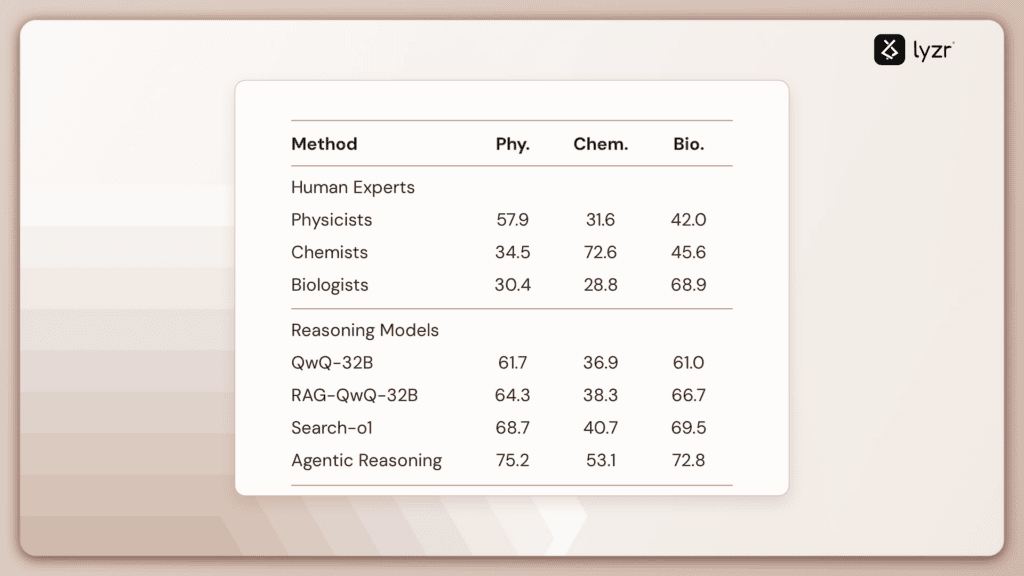
On Humanity’s Last Exam, an even harder benchmark, the framework reached 23.8% with DeepSeek R1, a 14.4-point improvement over the base model alone, closing most of the gap to OpenAI’s proprietary Deep Research system. It also outperformed human experts on the GPQA Extended set of 546 additional questions.
What this means in practice: the gap between an LLM working alone and an LLM working as part of an agentic reasoning system is large. The technical reader’s takeaway should be that the orchestration layer matters as much as the underlying model. A weaker model in a well-designed agentic framework can outperform a stronger model with no scaffolding.

For how the leading systems compare, see our agent framework comparison and agentic AI vs. LLMs.
See where the field stands. Want adoption data, benchmarks, and real production patterns from across the industry? Download the free State of AI Agents 2026 report →
Agentic Reasoning in the Enterprise Stack
A research benchmark is one thing; a production deployment is another. Inside the enterprise, agentic reasoning rarely runs in isolation, it sits inside a larger stack of memory, knowledge retrieval, governance, and orchestration. Each layer matters for a different reason.

Memory. Enterprise agents need context across sessions, what the user asked last week, what was decided on a deal, which compliance rule applies. Without it, the agent reasons from scratch every time. Lyzr’s Cognis memory layer is built for this.
Knowledge graph retrieval. Enterprise data isn’t just text, it’s structured relationships: who reports to whom, which contracts depend on which, what regulation applies to which business unit. Agentic reasoning gets dramatically more accurate querying a knowledge graph than searching raw text. Semantic search and RAG widen the retrievable surface further.
Orchestration. Most enterprise problems need multiple agents, one gathers data, one analyzes, one drafts, one checks compliance. Orchestration as a service coordinates them under a unified governance layer.
Responsible AI. Reasoning at enterprise scale needs guardrails: permissions enforcement, audit logging, output validation, hallucination control. Lyzr’s Responsible AI infrastructure and Hallucination Manager provide these primitives.
Production governance. None of it matters if the agent can’t survive in production, cross-framework reliability, multi-cloud deployment, observability, audit trails. See how to take AI agents to production for the diagnostic.
The architectural lesson: agentic reasoning is necessary but not sufficient for enterprise AI. A well-built reasoning loop without memory, knowledge, governance, and orchestration fails in production, not because the reasoning is bad, but because the surrounding stack isn’t there. This is what separates the roughly 5% of enterprise agent prototypes that reach production from the 95% that don’t.
Limits and Challenges of Agentic Reasoning
Four honest limits, because the hype cycle obscures them:
Cost. Multi-step reasoning is far more expensive than single-shot calls. A loop that calls tools 8–10 times can cost 10–50x a single LLM response. For high-volume, low-complexity tasks (lookups, classifications), agentic reasoning is over-engineering. Deploy it selectively.
Latency. Each reasoning step and tool call adds time. For interactive use cases (live chat, voice), cumulative latency can break the experience. Agentic reasoning fits asynchronous, complex tasks where the user expects depth, not fast-response interfaces.
Hallucination cascades. When an agent hallucinates at step 2, every later step builds on the mistake. Without hallucination control at the reasoning-loop level (not just the model level), errors compound.
Reasoning-loop failure modes. Agents can get stuck in loops, over-call tools, or fail to notice they’re not making progress. Designing the exit conditions, when the agent stops and commits, is non-trivial and demands observability and circuit-breaker patterns.
These limits don’t invalidate the architecture; they define where it fits. The teams that get it right deploy agentic reasoning selectively, with appropriate governance, for the problems it genuinely suits.
How Lyzr Implements Agentic Reasoning

Lyzr exposes agentic reasoning through five architectural primitives designed to work together as a production-grade stack:
- The reasoning engine: Lyzr Studio. The core platform where agents are built, configured, and deployed. It runs the ReAct-pattern reasoning loop, tool integration, and agent-to-agent coordination.
- Memory: Cognis. The persistent memory layer that lets agents retain context across sessions and reason with continuity instead of starting fresh each time.
- Knowledge: Knowledge Base + Knowledge Graph. The retrieval layer that grounds reasoning in enterprise-specific data, structured and unstructured, beyond what the base LLM was trained on.
- Orchestration: Orchestration as a Service. The coordination layer that distributes reasoning across multiple specialized agents rather than overloading one.
- Governance: Responsible AI + Hallucination Manager. The trust layer that enforces permissions, logs actions, validates outputs, and bounds hallucination rates, what makes agentic reasoning safe enough for regulated industries.
Together these layers form Lyzr Control Plane, the production infrastructure that turns agentic reasoning from a research demo into a deployed system meeting enterprise governance, observability, and audit requirements. For planning which use cases to build first, Architect by Lyzr applies the same reason-plan-decide loop to strategy, crowdsourcing use cases and generating a prioritized AI roadmap.
For where each agent type fits, see types of agents in production. For a domain example, see how the Banking Playbook applies agentic reasoning to KYC, fraud detection, and loan origination.

Build a reasoning agent yourself. Spin up an agent with reasoning, memory, and tool access in minutes. Start free in Lyzr Studio →
Where to go from here
If you’re learning about agentic AI categories:
- What is agentic AI — the broader category that agentic reasoning sits inside
- Agentic AI vs LLMs — how agentic systems differ from raw language models
- Agentic vs non-agentic systems — the architectural contrast
If you’re evaluating frameworks and architectures:
- Best AI agent frameworks — leading frameworks compared
- Agentic AI architectures — architectural patterns
- Agent orchestration — coordinating multiple agents
If you’re comparing vendors:
If you want the research and production discipline:
If you want to talk to our team:
Book a demo — see Lyzr Agent Studio in action
Frequently Asked Questions
What is agentic reasoning?
Agentic reasoning is the process by which an AI agent breaks a complex goal into steps, selects tools or sub-agents to execute each step, evaluates the results, and adapts its plan in real time until the goal is reached. Unlike a traditional LLM response (one prompt → one answer), it produces an iterative sequence of reasoning, action, observation, and adaptation.
How is agentic reasoning different from chain-of-thought?
Chain-of-thought (CoT) is a prompting technique where the model “thinks step by step” inside a single LLM call. Agentic reasoning extends this with tool use, memory, and iterative loops. CoT is a foundational technique inside most agentic reasoning systems; agentic reasoning is the broader architectural pattern.
How is agentic reasoning different from ReAct?
ReAct (Reasoning + Acting), introduced by Yao et al. (2022), combines chain-of-thought reasoning with iterative tool use. Most modern agentic reasoning systems use a ReAct-pattern loop as their backbone. ReAct is a subset of agentic reasoning; the broader category adds memory, multi-agent coordination, and governance.
What’s the difference between agentic reasoning and agentic AI?
Agentic AI is the category of AI systems that take autonomous action toward goals. Agentic reasoning is the specific mechanism by which an agent thinks through a problem step by step. Agentic AI is the category; agentic reasoning is the technique inside it that makes the category work.
What’s an example of agentic reasoning?
A support agent that reads a customer’s message, checks their order history, verifies account status, queries internal docs for the relevant policy, and drafts a resolution, without being scripted on each step. It reasons through what it needs, calls tools to fetch it, and answers based on what it found.
Does agentic reasoning require multiple LLM calls?
Yes. By definition it involves multiple reasoning steps with tool calls and observations between them. A single-shot LLM response is not agentic reasoning, it lacks the iterative loop, which is also why agentic reasoning costs more.
What are the limits of agentic reasoning?
The main limits are cost (10–50x a single-shot call), latency (each step adds time, breaking some interactive uses), hallucination cascades (errors at one step compound), and reasoning-loop failure modes (agents getting stuck or over-calling tools). Production deployments need explicit governance to address these.
How is agentic reasoning implemented in enterprise systems?
Enterprise implementations combine a reasoning engine (the ReAct-pattern loop), a memory layer, knowledge integration, orchestration across specialized agents, and governance for auditability and safety. Lyzr exposes these as five primitives that form Lyzr Control Plane.
Book A Demo: Click Here
Join our Slack: Click Here
Link to our GitHub: Click Here