AI in e-commerce refers to the full stack of technologies, predictive machine learning, conversational AI, generative AI, and agentic AI, that retailers use to personalize shopping, optimize pricing and inventory, automate support, and run supply chains. GenAI gets noticed. Agentic AI is what’s now taking action on top of it. The rest quietly runs the business.
Key takeaways
- AI in e-commerce is bigger than GenAI. Predictive AI and machine learning have quietly powered recommendations, forecasting, and logistics for years.
- Agentic AI is already live, not a future layer. It’s approving returns, reordering stock, and completing checkout steps on a shopper’s or merchandiser’s behalf right now, not just recommending what a human should do next.
- The real advantage comes from integration. A GenAI shopping assistant is only as good as the inventory and pricing data it can query in real time, and an agent is only as useful as the systems it’s actually allowed to act on.
- Legacy retailers with decades of transaction data may hold an underrated AI advantage, if that data gets connected across fragmented systems for agents to act on.
- Success gets measured in business outcomes: conversion rate, average order value, return rate, and support deflection, not feature counts.
Shoppers see the chatbot. They see the AI stylist. They see the product description that reads a little too smoothly.
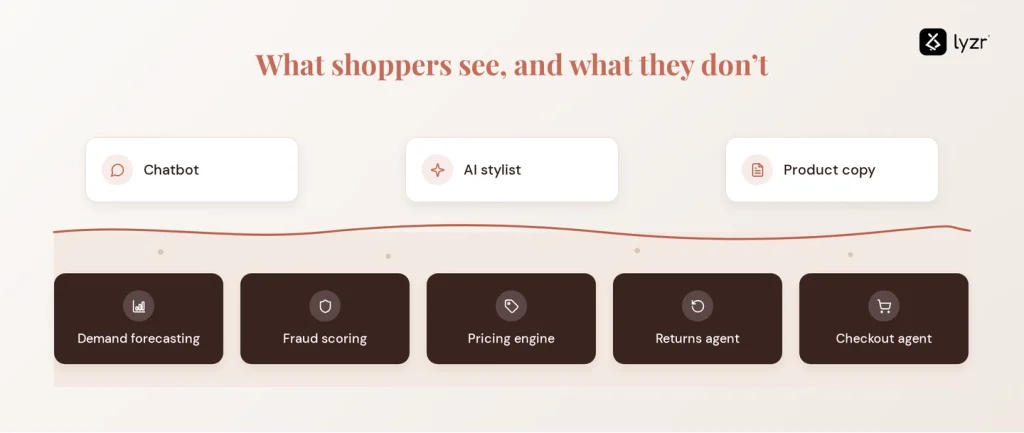
What they don’t see is the demand-forecasting model deciding how much inventory sits in a regional warehouse. Or the fraud model scoring a transaction in milliseconds. Or the pricing engine adjusting a product’s price six times a day. Increasingly, they also don’t see the agent that already approved their return, reordered the stock behind it, or walked a purchase through checkout end to end, because agentic AI’s whole job is to act without anyone watching it happen.
That invisible layer has shaped retail for well over a decade, long before anyone had heard of a shopping assistant. What’s changed in 2026 is that a growing share of it doesn’t just predict or generate anymore. It acts.
The next real advantage in e-commerce won’t come from bolting on the most GenAI features. It will come from connecting predictive AI, conversational AI, generative AI, and agentic AI to the data and workflows that already run the business, treating them as one connected toolkit instead of competing trends.
What is AI in e-commerce?
AI in e-commerce is the combination of four distinct technology types working on the same retail data, not one technology wearing different outfits.
Predictive AI and machine learning came first and never left. These are statistical models trained on historical transactions, browsing behavior, and inventory movement to forecast what happens next: which product a customer will buy, how much stock a warehouse will need, whether a transaction looks fraudulent.
Conversational AI is the layer customers actually talk to: chatbots, voice assistants, and support bots that use natural language processing (NLP), the branch of AI that lets software interpret and respond to human language, to answer questions and route requests.
Generative AI (GenAI) creates new content on demand: product descriptions, marketing copy, synthetic imagery, and the conversational responses inside a shopping assistant.
Agentic AI is the newest layer, and the one this guide spends the most time on. An AI agent doesn’t just predict a risk score or generate a reply. It takes the next step: processing the refund, reordering the stock, completing the checkout. It’s the difference between a system that tells a merchandiser what to do and one that does it. This is the shift analysts now describe as agentic ecommerce, where AI moves from assisting a purchase to completing one.

What are the 12 AI use cases in e-commerce?
Here’s where the four layers show up across a live retail operation, numbered because that’s genuinely how a use-case inventory reads when you’re evaluating where to invest next. Many of these are now available as pre-built Ecommerce Agents rather than custom builds from scratch.
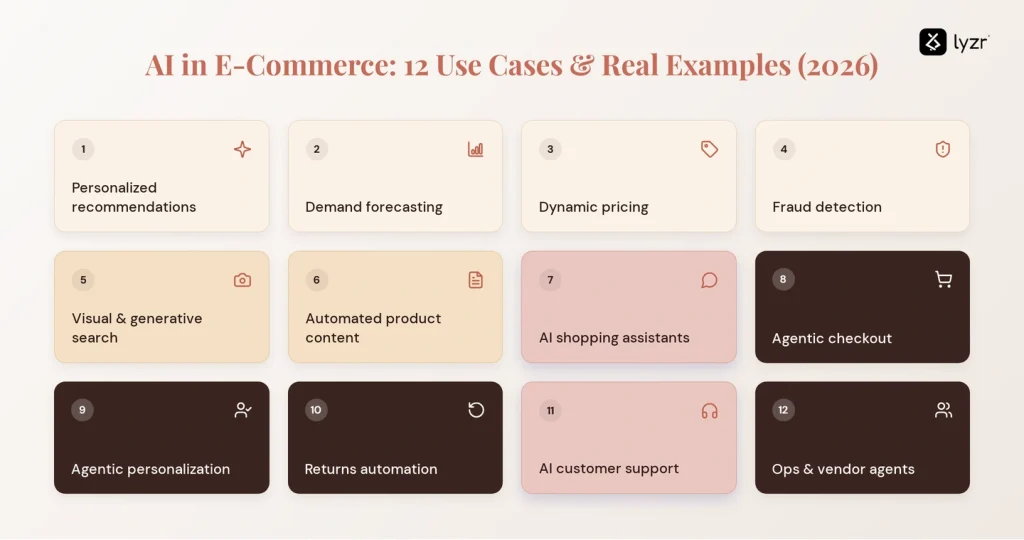
Personalized product recommendations (predictive AI). Collaborative and content-based filtering models analyze purchase history and real-time browsing to power personalized product recommendations, the original AI use case in retail and still one of the highest-ROI investments a team can make.
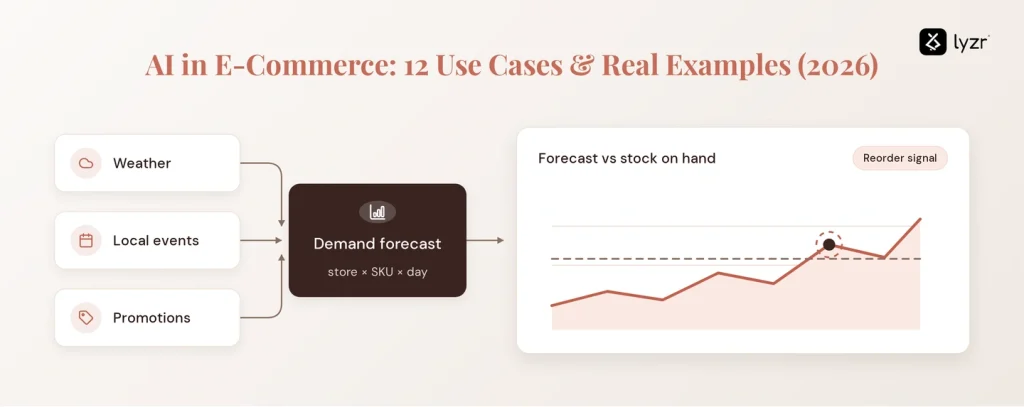
Demand and inventory forecasting (predictive AI). Machine learning models power precise demand forecasting at the store-SKU-day level, factoring in weather, local events, and promotional calendars to keep shelves stocked without overbuilding safety inventory. The same forecasting logic applies whether a retailer holds traditional inventory or fulfills through print on demand products, and it’s just as useful for signaling when to flag a back order vs pre order distinction before a shopper abandons the cart.
Dynamic pricing (predictive AI). Pricing engines adjust prices in near real time based on competitor pricing, demand signals, and remaining inventory, a use case still under-adopted relative to its proven margin impact.
Fraud detection (predictive AI). Models score transactions in milliseconds using device, location, and behavioral signals, balancing catching real fraud against the far more expensive problem of falsely declining good customers.
Visual and generative search (generative AI). Shoppers upload a photo or describe what they want in plain language instead of guessing the right keyword.
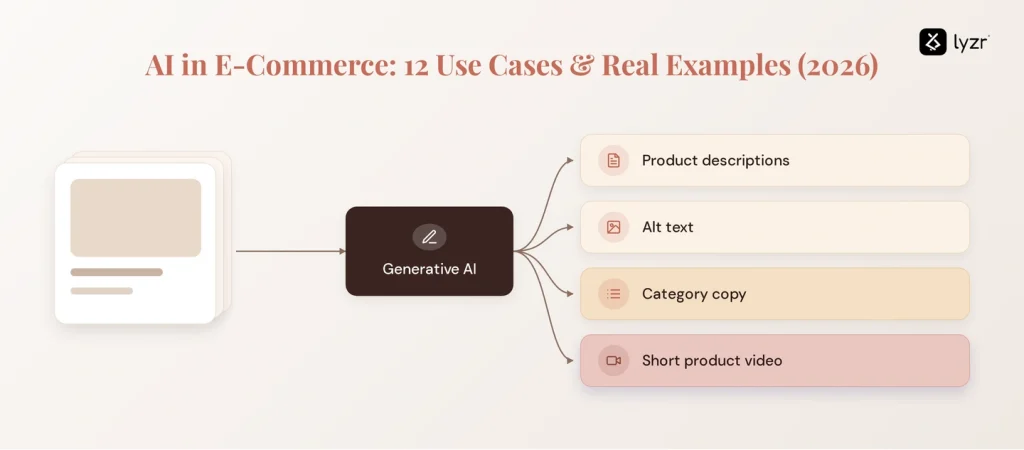
Automated product content (generative AI). GenAI drafts product descriptions, alt text, category copy, and increasingly short product video content at catalog scale, a task that used to require a copywriting team per thousand SKUs.
AI shopping assistants (conversational + generative AI). Chat-based assistants answer product questions, compare options, and guide undecided shoppers through a purchase decision.
Conversational commerce with agentic checkout (conversational + agentic AI). This is where the assistant stops recommending and starts acting: after helping a shopper decide, the agent adds the item to the cart, applies an eligible discount, and completes the transaction on the shopper’s behalf inside the same conversation, with confirmation, not just a suggestion to go to checkout. The same pattern is now showing up in social commerce, where brands are running TikTok Shop with agents to close a sale inside the same feed a shopper is scrolling.
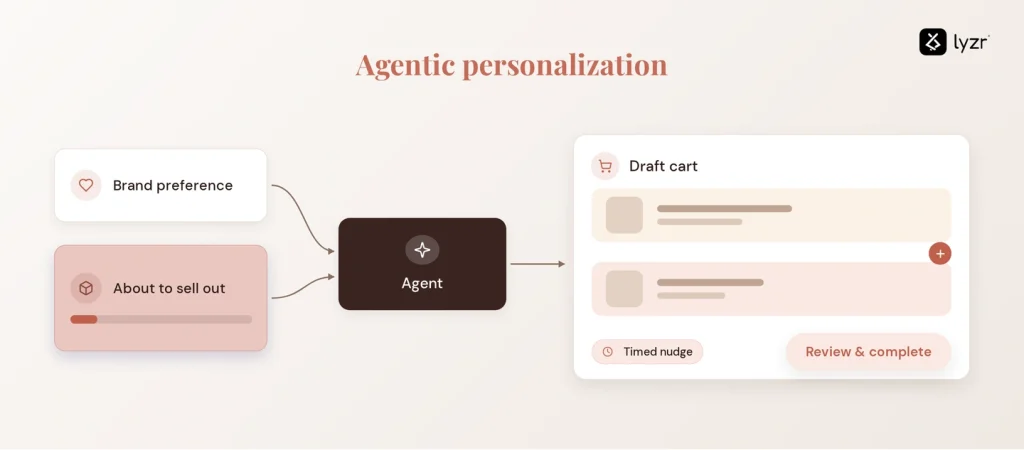
Agentic personalization (agentic AI). Rather than just showing a personalized homepage, an agent takes action on the prediction. If a shopper’s known brand preference matches an item that’s about to sell out, the agent assembles a draft cart with that item and a complementary accessory, then sends a timed notification for the shopper to review and complete, no dashboard, no marketer manually building the campaign.
Returns management automation (agentic AI). This is the clearest agentic proof point in retail today. An AI agent handles the return end to end: verifying the purchase, issuing the label, tracking the shipment, and processing the refund or exchange once the item is received, without a human ever opening a support ticket.
AI-powered customer support (conversational + generative AI). Support agents combine NLP to understand the issue with generative responses pulled from a knowledge base, resolving routine order-status and policy questions instantly and escalating the rest with full context attached.
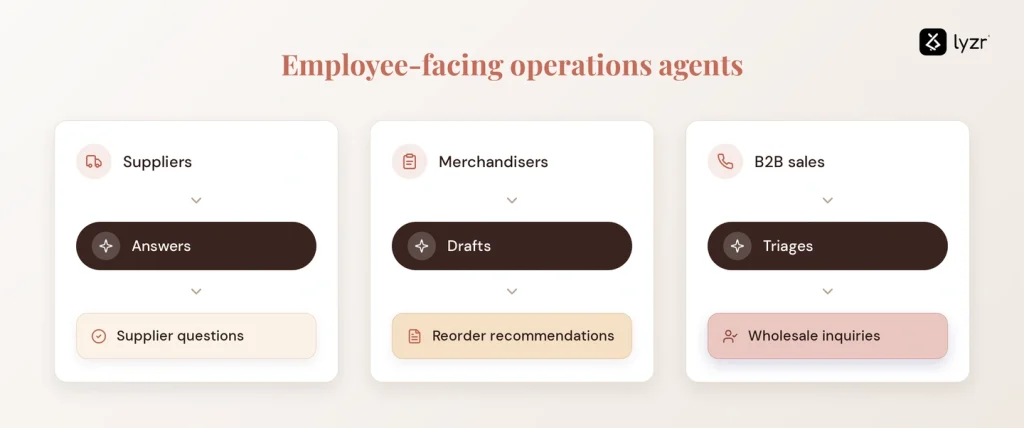
Employee-facing operations agents (agentic AI). Not every use case faces the customer. Vendor-facing assistants answer supplier questions, merchandisers get agents that draft reorder recommendations, and B2B sales teams use AI agents for lead qualification to triage wholesale inquiries before a rep ever picks up the phone. Retailers running Shopify storefronts often bring in a Shopify B2B eCommerce development agency to wire these agents into a wholesale channel, and some sellers extend the same infrastructure into group purchase models that coordinate bulk orders automatically.
AI in e-commerce examples: what US retailers are doing

Amazon built the category-defining example, dating back to founder Jeff Bezos’s early public commitment to practical, revenue-driving applications of AI rather than speculative research. Product recommendations are estimated to drive roughly 35% of Amazon’s sales, the most-cited data point in the category. The figure is old, but the underlying architecture, recommendations tied to real-time inventory and one of the world’s most automated supply chains, is what every retailer below is trying to approximate at their own scale.
Walmart runs AI-driven demand forecasting down to the store-SKU-day level, and has moved beyond prediction into action. Agentic AI tools give Walmart a unified view of inventory across stores and fulfillment centers, letting its systems automatically detect, diagnose, and correct issues in real time without constant manual intervention. When a demand spike threatens to outpace projections, AI-powered forecasting tools adjust replenishment schedules and the flow of goods through the supply chain without a planner triggering the change.
Target has leaned into conversational discovery. Target became one of the first companies to work with OpenAI to test contextual advertising in ChatGPT, aiming to connect shoppers with relevant products at the moment they’re actively searching. Internally, executives describe the payoff in blunt commercial terms.
Target’s AI-driven personalization engine “generates billions of dollars in incremental sales,” according to remarks from CEO Michael Fiddelke.
Wayfair built its AI strategy around the hardest part of furniture shopping: knowing what you want before you can describe it. Its Muse tool and Search with Photo feature let shoppers browse styles visually and buy directly from the results, and the company went further in January 2026, becoming a foundational partner that co-developed Google’s Universal Commerce Protocol (UCP), an open standard designed to enable more seamless, secure interactions between AI agents and retailers’ platforms.
Sephora proved that AI-driven customer experience pays for itself in reduced returns, not just added sales. With its Virtual Artist tool, customers who used the feature were three times more likely to complete a purchase than those who didn’t, and Sephora reported a 30% reduction in returns for makeup products.
Alibaba, for international contrast, built its generative AI advantage around scale rather than a single flagship feature, running GenAI across merchandising, marketing copy, and seller tools for a marketplace with hundreds of millions of active buyers.
Two proof points show what happens when the agentic layer gets built deliberately rather than bolted on. A leading eyewear brand partnered with Lyzr to build a scalable AI recommendation and support infrastructure, where the agent interprets conversational intent in real time and recommends relevant eyewear options dynamically, shifting the experience from search-heavy browsing to guided product discovery. Lyzr introduced a conversational commerce workflow that connected discovery and checkout into a single interaction, reducing friction between consideration and conversion.
But why is personalization needed in e-commerce
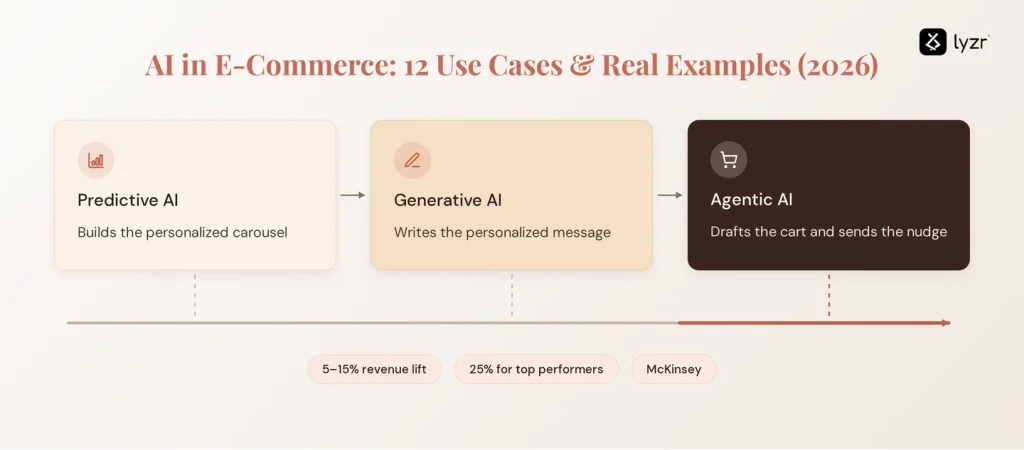
AI personalization works because it compounds three separate effects: better product discovery, higher order values, and lower acquisition costs. According to McKinsey’s research, AI personalization typically drives a 5 to 15% revenue lift, with top performers reaching 25%.
Predictive AI builds the personalized carousel. Generative AI writes the personalized message. The next step, agentic personalization, takes both and turns them into an action a human didn’t have to trigger: an agent that notices a returning visitor’s brand preference, drafts a cart, and sends a timed nudge to complete it, no marketer sitting behind a campaign dashboard.
That same infrastructure increasingly extends into loyalty. An agent that notices a lapsed high-value shopper can trigger a personalized nudge into the reward programme rather than a generic discount blast, and retailers evaluating Loyalty programs software are increasingly asking whether it can plug into the same agent layer instead of running as a separate system. The payoff shows up as broader user engagement across the funnel, not just a single conversion metric.
Here’s the part worth pausing on: personalization and agentic action aren’t two different projects. They’re the same data pipeline, just extended one step further, from insight into execution.
How retailers are implementing AI
Most retailers move through a predictable maturity curve, and knowing which stage you’re in says more about your next investment than any feature list.
AI maturity stages in retail
| Stage | What it looks like | Typical AI layer |
|---|---|---|
| Foundational | Built-in recommendations and analytics from an existing commerce platform | Predictive AI |
| Point solutions | A standalone support chatbot or a GenAI copy tool, usually siloed from other systems | Conversational or generative AI |
| Integrated stack | A search assistant that checks real inventory and completes a purchase | Predictive + generative AI |
| Agentic operations | Agents trusted to execute decisions across merchandising, support, and fulfillment, with humans managing exceptions | Agentic AI |
The jump from “integrated stack” to “agentic operations” is where legacy retailers have an underappreciated edge. A decade of transaction history is exactly the training data an agent needs to make good autonomous decisions, if that data isn’t still trapped in five disconnected systems that don’t talk to each other.
Marketing teams are running a parallel track here too, evaluating dedicated AI in retail marketing tools to personalize campaigns outside the storefront itself, though the strongest results still come from wiring that layer into the same customer and inventory data instead of running it separately.
Measuring AI impact on e-commerce metrics
Feature counts don’t matter. These metrics do.
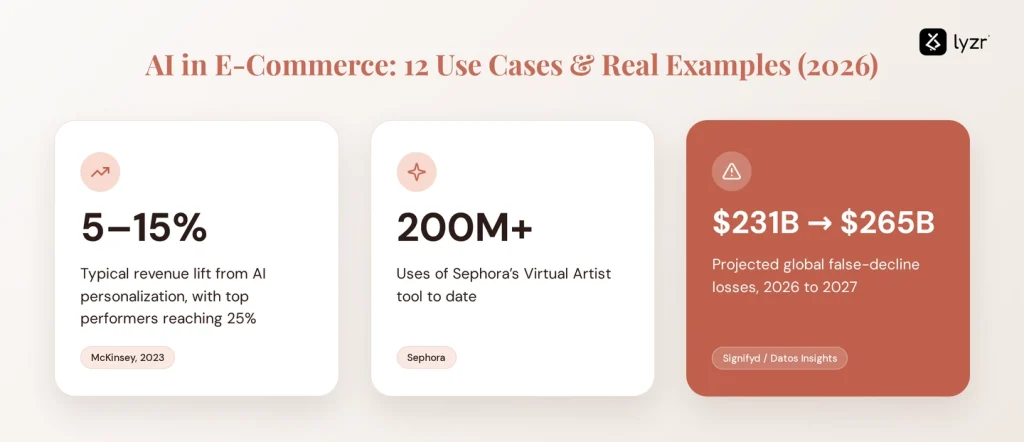
Conversion rate. AI personalization typically drives a 5 to 15% revenue lift, with top performers reaching 25%, according to McKinsey’s 2023 research on personalization at scale. That range has held up as a realistic planning benchmark rather than a best-case outlier across multiple independent 2026 analyses.
Average order value. Recommendation engines remain one of the most reliable AOV levers in retail, which is consistent with why Amazon has leaned on the mechanism for two decades.
Return rate. Sephora’s Virtual Artist is the clearest case study here: the tool has now been used more than 200 million times, letting customers try a shade virtually before buying rather than guessing and returning it. The mechanism is straightforward: better pre-purchase confidence means fewer wrong-shade orders shipped back.
Resolution speed. Agentic workflows compress refund and support timelines that used to take hours into minutes, since an agent can verify a purchase, apply a policy, and issue a refund without waiting in a human queue.
There’s a fraud-side metric worth watching too, because it cuts against the instinct to tighten controls after a bad quarter. Global false declines, legitimate orders wrongly flagged and rejected as fraud, are projected to cost retailers roughly $231 billion in 2026, rising to nearly $265 billion by 2027, according to Signifyd and Datos Insights research. That means retailers lose far more revenue to blocking good customers than to fraud itself. The AI use case here isn’t “catch more fraud.” It’s catching the same fraud with fewer legitimate customers turned away.
How Lyzr simplifies building an e-commerce AI agent
Connecting four AI layers to a fragmented retail stack, order management, inventory, CRM, payment processing, is an integration problem before it’s an AI problem. Lyzr’s Agent Studio is built to shorten that path: teams connect existing product, inventory, and customer data, build task-specific agents for search, personalization, or refund management, and orchestrate them to work together rather than as isolated point tools.
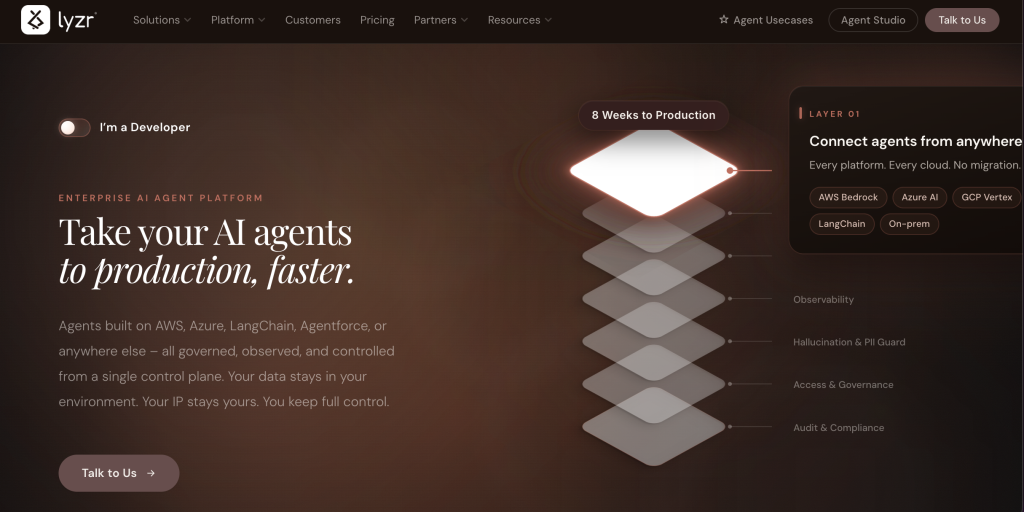
The same architecture handles customer support escalations, hands off ambiguous cases to a human with context preserved, and gives retail teams an audit trail for every decision an agent makes, which matters as more of those decisions start touching real money and real inventory.
Ready to see it against your own catalog and support data? Book a Lyzr demo and bring a specific workflow, returns, search, or personalization, to walk through live.
The future of AI in e-commerce
The next competitive shift won’t be measured in how many GenAI features a retailer ships. It will be measured in how many of its systems an agent is actually allowed to touch.
Analysts size US agentic commerce at $190 to $500 billion by 2030, and the payment rails to support it, Visa’s tokenized credentials, Mastercard’s Agent Pay, Google’s UCP, are already live as of mid-2026. The retailers positioned to benefit aren’t necessarily the ones with the flashiest shopping assistant. They’re the ones whose inventory, pricing, and fulfillment data are clean and connected enough for an agent to act on with confidence.
That’s the quiet advantage sitting inside every legacy retailer’s decade of transaction history. The question worth asking isn’t which AI feature to add next. It’s which system your data is still trapped in.
Frequently asked questions
How is AI used in e-commerce?
AI is used across the entire operation, not just the storefront. Predictive AI powers recommendations, demand forecasting, and fraud scoring. Conversational AI runs support chat and voice assistants. Generative AI writes content and drives conversational search. Agentic AI takes the next step, processing a return, reordering stock, or completing a checkout without a human triggering each step.
What is generative AI in e-commerce?
Generative AI in e-commerce is the technology that creates new content: product descriptions, marketing copy, synthetic product imagery, and the natural-language responses inside a shopping assistant. It’s the most visible layer of AI in retail, which is part of why it gets treated as the whole story when it’s really one of four.
What are examples of AI in e-commerce?
Amazon’s recommendation engine, Walmart’s demand forecasting, Wayfair’s visual search, Sephora’s virtual try-on tool, and Target’s conversational advertising pilot are all live examples. Newer agentic examples include automated end-to-end refund processing and guided conversational buying flows that connect discovery directly to checkout.
How does AI improve conversion rates?
AI improves conversion by closing the gap between what a shopper wants and what they can find. Personalized recommendations, generative search, and virtual try-on tools all reduce the friction of decision-making, and McKinsey’s research puts the resulting revenue lift at 5 to 15% typically, with top performers reaching 25%.
What are AI shopping assistants?
AI shopping assistants are conversational tools, usually built on generative AI, that help shoppers find and compare products in natural language rather than keyword search. The 2026 evolution is assistants that don’t stop at recommending: with payment protocols like Visa’s tokenized agent checkout now live, some assistants can complete the purchase directly inside the conversation.
How does visual search work in e-commerce?
Visual search uses computer vision to analyze an uploaded image, identifying attributes like color, shape, and style, then matches those attributes against a retailer’s catalog to surface visually similar products. Wayfair’s Search with Photo and Muse tools are current production examples of this working at scale.
The real test for any retailer reading this isn’t which of these 12 use cases to try next. It’s whether the systems behind your best-performing feature, the inventory feed, the pricing engine, the return policy, are connected well enough for an agent to act on them without a human checking every step.
Related reading
A few more resources worth bookmarking if you’re building out this stack, or comparing notes across markets:
- For infrastructure context before layering AI agents on top, see this overview of Magento Hosting options.
- Flipkart’s decade of transaction data was an early example of a legacy retailer’s data advantage, as its co-founder Sachin Bansal discussed years before agentic AI made that advantage directly actionable, covered in this piece on Flipkart‘s AI strategy.
- Visual personalization extends well beyond apparel and electronics. Home décor sellers like wallpics apply the same style-matching logic to framed wall art.
- For an early look at visual search performance in a fashion marketplace deployment, see this Visenze case study.
- Analysts have also modeled the broader profitability upside of AI adoption across the sector in these recent studies.
- For a wider view of AI’s footprint across industries beyond retail, see this overview of the impact of artificial intelligence.
Book A Demo: Click Here
Join our Slack: Click Here
Link to our GitHub: Click Here