TL;DR: Procurement automation is software-driven handling of routine procurement work: requisitions, approvals, purchase orders, and invoice matching, executed through configured rules instead of manual routing.
Four stages automate cleanly: intake, approval, PO creation, and invoice processing. The three benefits that matter to a CPO: shorter cycle times, fewer manual errors, and tighter spend control.
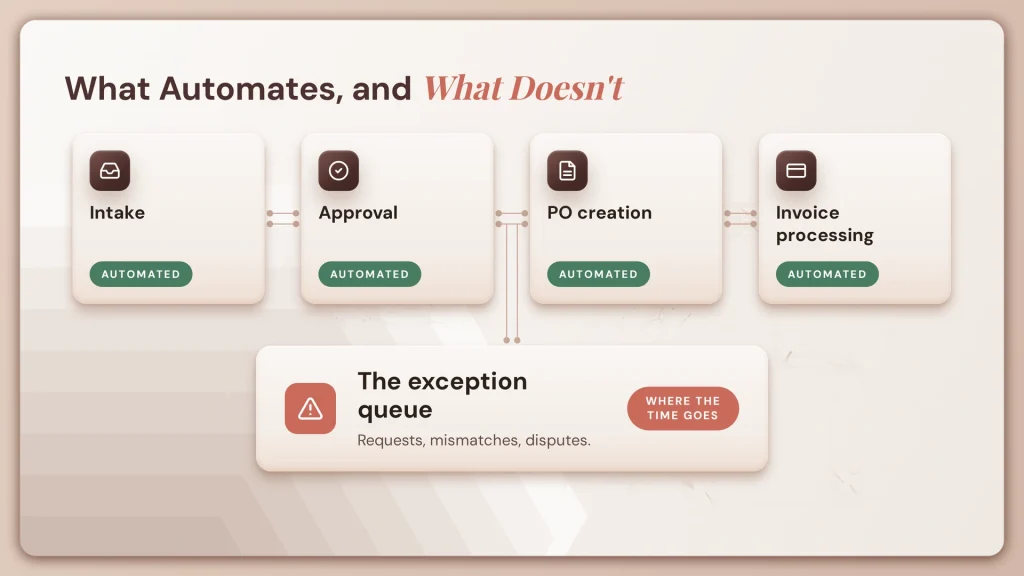
The real test isn’t the automated path. It’s what happens to the exception queue, the requests, mismatches, and disputes that rules can’t resolve, because that’s where most procurement teams still spend their time.
Procurement automation gets sold as a speed story. Faster requisitions, faster approvals, faster payment. Speed is real, but it’s not the point that matters to a CPO signing off on a transformation budget.
The point is control. A manual procurement process is a process nobody can fully see. Approvals sit in inboxes. Contract terms live in someone’s memory. When an auditor asks for a decision trail, someone reconstructs it from email threads. Procurement automation replaces that reconstruction with a record that already exists, built the moment the transaction happened.
According to Gartner’s supply chain research, by 2026, virtual assistants and chatbots will be used by 20% of businesses to handle internal and vendor interactions. That’s a modest number, and it’s the right one to notice: this is a category in the middle of its adoption curve, not at the end of it. Most of what follows in this piece assumes you’re evaluating automation from that position, not retrofitting a system that’s already mature.
Why procurement automation became structural, not optional
Procurement automation became structural because manual procurement created operational risk that compounded with scale. A single buyer’s supplier knowledge, pricing history, and workaround habits used to live entirely in their head. When they left, that knowledge left with them. When a request needed urgent sign-off, it waited for whoever happened to check email.
None of that is a speed problem. It’s a continuity problem.
Automation replaces informal process ownership with a system of record. Every request, approval, and PO exists in a structured, queryable format from the moment it’s created. Policy gets enforced at the point of transaction instead of discovered during a quarterly audit. That shift, from after-the-fact correction to embedded enforcement, is what makes procurement automation a governance function as much as an efficiency one.
In a volatile spend environment, that discipline is the actual return on investment. It’s not “we processed invoices faster.” It’s “we can prove, for every dollar spent last quarter, exactly who approved it and why.”
What procurement automation actually means in practice
Procurement automation is the application of rule-based logic across the procure-to-pay cycle, so a computer executes a predefined workflow instead of a person routing it manually. That single shift, rules instead of judgment for repeatable decisions, is what produces consistency, auditability, and control where manual handling produced variance.
Core components
A centralized data model that gives every request, PO, and invoice a single source of truth. Configurable workflow engines that encode approval logic and routing rules. Integration with the ERP systems that already run the business.
The clearest way to see what this looks like stage by stage:
The procurement cycle, stage by stage

| Stage | What gets automated | What still needs a human |
|---|---|---|
| Intake / requisition | Guided forms, catalog matching, budget pre-check | Non-standard or novel category requests |
| Approval routing | Threshold-based routing, delegation, escalation timers | Policy exceptions, contested approvals |
| Sourcing / RFP | Template generation, distribution, response collation | Award decisions, negotiation strategy |
| PO creation | PO generation, ERP posting, supplier transmission | Amendments and cancellations with contract impact |
| Receipt / GRN | Three-way match within tolerance | Quantity and quality disputes |
| Invoice processing | Extraction, matching, tolerance checks, payment scheduling | Mismatches outside tolerance, disputed line items |
| Supplier management | Onboarding data collection, document expiry tracking, scorecards | Risk decisions, relationship escalation |
That right-hand column is the one worth sitting with. It’s the same list you’ll come back to when this article gets to the automation-versus-intelligence boundary, because those “still needs a human” cells are exactly where an exception queue forms.
Intake management: where the process either holds or breaks
Procurement automation starts by structuring how a need gets expressed. Instead of an email or a hallway request, employees submit through a guided form or a catalog, so the request arrives already coded, categorized, and checked against budget before a buyer sees it.
For standard purchases, this can be nearly touchless: a catalog selection, an automatic budget check, an automatic approval below threshold, and a PO. A purchase requisition agent can run this whole path without a buyer’s involvement.
The failure mode is coverage, not design. When an employee needs something that isn’t in the catalog, they default to email, and the manual process the automation was supposed to remove quietly reconstitutes itself outside the system’s visibility. The measure of a good intake deployment isn’t how fast the catalog path runs. It’s how small the off-catalog volume stays.
What automated intake delivers
- Spend visibility: All requests are captured and categorized from inception.
- Policy compliance: Users are guided to preferred suppliers and contracts.
- Buyer efficiency: Buyers are freed from processing routine, low-value requests.
Approval workflows that scale without turning into a bottleneck
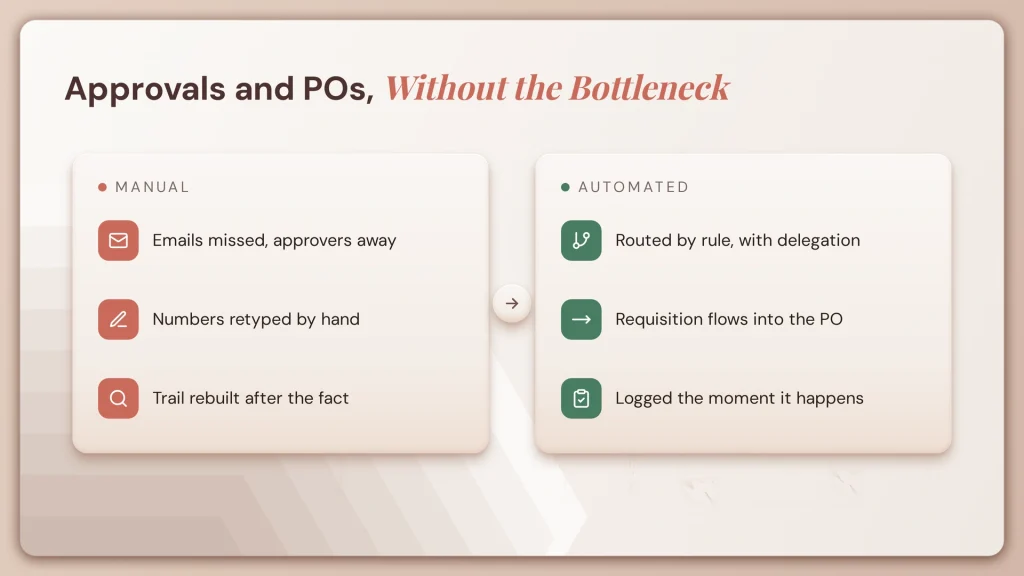
Manual approval routing fails predictably: emails get missed, approvers go out of office, multi-signature requests stall with no clear owner. Procurement workflow automation replaces that with rules that route by spend category, department, and value, with delegation for absences and escalation timers for anything stalled too long.
Every step gets logged automatically, which means the approval chain is auditable by default instead of reconstructed after the fact. For routing logic with several conditional branches, an approval workflow agent handles the branching without a human deciding, case by case, who signs off next.
Purchase order execution without manual intervention
A manually created PO carries risk in every field: the wrong supplier entity, a transposed quantity, a price list that’s a version out of date. Each of those errors becomes a downstream invoice dispute weeks later, at a much higher cost to fix than it would have been to prevent.
Automation removes the transcription step entirely. The approved requisition data flows directly into the PO, which posts to the ERP and transmits to the supplier without anyone retyping a number. A PO creation agent handles that generation and transmission, leaving the exceptions, amendments, and cancellations with contract impact, for a human to review.
Invoice processing at volume
Three-way matching, invoice against PO against goods receipt, is a cornerstone financial control, and it’s also the single biggest bottleneck in most AP teams. AP automation uses extraction and matching logic to close that loop without a person touching every line item. When invoice, PO, and receipt align within configured tolerance, the invoice clears for payment untouched. An invoice receipt triage agent can handle the initial sort and extraction, and a cash application agent can carry the matched invoice through to payment allocation.
Tolerance configuration is the part that gets glossed over. An organization reporting a 95% straight-through match rate with wide price and quantity tolerances hasn’t eliminated risk, it’s agreed to absorb more of it before an exception fires. Tighter tolerances improve control and increase the exception count. The number that actually describes process health isn’t the straight-through rate. It’s the exception rate, and what happens to those exceptions once they’re flagged.
What automated invoicing delivers
- AP efficiency: Staff can focus on investigating exceptions rather than matching clean invoices.
- Reduced payment errors: Automation prevents duplicate payments and payments for incorrect amounts.
- Early payment discounts: Faster processing allows the organization to capture discounts.
Compliance becomes embedded, not enforced after the fact
Procurement compliance isn’t a once-a-quarter audit event, it’s a continuous state: preferred suppliers, contracted rates, current insurance certificates, valid tax forms. Automation moves enforcement to the point of transaction instead of the point of audit. The system can block a PO from a non-approved vendor or flag pricing that deviates from contract terms before the purchase happens, not three months later.
A supplier risk assessment agent can hold that risk picture current in real time, and an AP fraud risk reduction agent can flag payment patterns that look like duplicate or fraudulent activity before a check goes out.
Reporting that reflects execution, not estimation
Fragmented, manual procurement makes reporting a guessing exercise: spend analysis runs on lagging data, cycle time gets estimated from memory. A single structured system removes the guesswork. How long is the average approval cycle actually taking? Which category is generating the most off-contract spend? A spend intelligence agent or a price benchmarking agent can answer those questions from live transaction data rather than a quarterly spreadsheet reconciliation.
Procurement automation examples
Four patterns show up repeatedly across procurement teams that have automated the predictable path.
Tail-spend requisition handling. A team where senior buyers spend disproportionate time on low-value, high-volume requests moves to catalog-first intake with policy-based auto-approval below a set threshold. The operational change: buyer time shifts from processing transactions to category strategy and negotiation, work a rules engine can’t do.
Three-way invoice match at scale. An AP team reconciling thousands of monthly documents by hand deploys automated extraction and tolerance-based matching, drawn from patterns detailed in Lyzr’s 100 use cases for CFOs template. The change: review shifts from every invoice to exceptions only, and the exception rate becomes the metric that actually matters.
Supplier onboarding and document currency. A compliance team tracking insurance certificates and tax forms across hundreds of vendors automates collection and expiry tracking with a supplier onboarding agent. The change: compliance status becomes a continuously known state instead of a finding surfaced during a periodic audit.
Contract renewal visibility. Auto-renewing agreements pass their notice window unreviewed because no one is tracking the date. A renewal alert agent ties alerts to contract metadata at 90, 60, and 30 days out. The change: renewal becomes an active decision instead of a default outcome.
Procurement automation software: how the category is structured

Procurement automation software isn’t one thing, it’s four distinct categories, and mismatching your team to the wrong one is the most common evaluation mistake. This is category orientation, not a vendor ranking, because the ranking that matters is the one specific to your ERP, your data quality, and your exception volume.
Source-to-pay suites cover the full cycle, sourcing through payment, on one platform. Deep functionality, long implementation timelines, high switching cost once you’re in. Fits large enterprises standardizing globally.
Point solutions focus on one stage, intake-to-procure, contract lifecycle, or AP automation specifically. Faster to deploy, but they require integration work to talk to everything around them. Fits a team with one specific, identifiable bottleneck.
Workflow platforms are general-purpose automation tools configured for procurement use cases. Flexible and lower cost, but the configuration burden sits with your team. Fits organizations with process maturity but a limited software budget.
Agentic layers sit above the systems you already run rather than replacing them, and they’re built specifically to handle the exception paths that rules-based automation routes to a human. Fits teams that have already automated the predictable path and are now looking at where the manual work actually concentrated. Lyzr’s Dwight, an AI RFP agent, is an example of this layer applied to sourcing specifically.
Whichever category you’re evaluating, the questions that actually determine fit are the same: ERP integration depth, master data quality requirements, the exception-handling model, configurability without vendor involvement, and audit trail completeness. A tool that scores well on functionality and poorly on the last two will cost you more in year two than it saved in year one.
Automation versus intelligence: understanding the boundary
Automation and intelligence solve different problems, and conflating them is where most procurement transformation budgets get spent on the wrong layer.
Rules-based automation vs. agentic intelligence
| Dimension | Rules-based automation | Agentic intelligence |
|---|---|---|
| Logic source | Predefined rules and thresholds | Reasoning over context and precedent |
| Best suited for | High-volume, repeatable transactions | Non-standard, ambiguous cases |
| Change management | Requires rule updates for new scenarios | Adapts within governed boundaries |
| Output | Deterministic, predictable | Context-dependent, explainable |
| Handles novel inputs | No, routes to a human by default | Yes, within defined guardrails |
| Cost of adding a new case | A new rule, and a maintenance liability | No structural change required |
Every team that automates intake and approvals arrives at the same place eventually: the predictable path runs clean, and the manual work that’s left concentrates in exceptions. A non-standard requisition. Supplier data that doesn’t match the master record. A contract clause that deviates from template. An invoice mismatch outside tolerance. A sourcing event with no incumbent to benchmark against.
The instinct is to write another rule for each one. That grows the rule set without shrinking the queue, because exceptions are, definitionally, the cases nobody wrote a rule for. Rule sets also age badly: undocumented, unowned by anyone specific, and increasingly risky to touch.

An agentic layer solves a different problem than automation does. It doesn’t execute a known path faster, it reasons about inputs that don’t match any known path: reading a contract’s non-standard clause and flagging what deviates, using clause analysis to reconcile supplier records that disagree across systems, or assembling the context an approver actually needs for a contested request. According to Gartner, 90% of all B2B purchases will be handled by AI agents within three years, channeling more than $15 trillion in spending through automated exchanges, a scale that only makes sense if the layer above rules-based automation is doing real reasoning, not just faster routing.
None of this replaces automation. Automation should still handle everything predictable, because it’s cheaper, faster, and more auditable than reasoning over cases that don’t need reasoning. The agentic layer earns its place only on the residual, the queue automation can’t touch. Teams that skip straight to agents without automating the predictable path first tend to build something expensive that’s also unreliable, because they’re asking reasoning to do work that rules would have done more cheaply.
This is the layer Lyzr’s procurement solutions are built for: sitting above the systems already in place rather than replacing them, with the governance a function this auditable demands, decision traces on every action, policy-bound behavior, and human-approval gates on anything carrying financial commitment. Teams starting from an existing automation base can scope this with the 90-day pilot for procurement agent deployment, or explore the broader pattern in AI agents in procurement.
What strong procurement automation looks like in large enterprises
At enterprise scale, strong procurement automation isn’t a bigger version of a small team’s setup, it’s a different architecture entirely. Multiple business units, multiple ERPs, and regional compliance requirements mean the workflow engine has to support configuration variance without becoming unmanageable. The organizations that get this right treat automation as infrastructure with a named owner, not a project that ships and gets left alone. Rules get reviewed on a schedule. Exception volume gets tracked as a KPI, not an afterthought. The goal isn’t zero manual touches, it’s manual touches concentrated exactly where judgment is actually needed.
Governing automation at scale
Governance for procurement automation covers who can change a rule, how changes get tested before deployment, and how the audit trail gets preserved for the retention period compliance requires. That’s the baseline for the rules layer.
The agentic layer needs its own governance boundary, and in procurement that boundary is usually financial commitment. Reading a contract, analyzing supplier data, and recommending an approval path can run autonomously. Committing spend, approving a payment, or signing off on a contract term should not, without a human in the loop. Every agent decision needs to log what triggered it, what data it used, and what it recommended, so an auditor asking “why did this happen” gets an answer instead of a reconstruction effort.
This matters because McKinsey highlights that organizations deploying AI-driven analytics in procurement can unlock around 20% savings potential and significantly accelerate processes such as supplier selection, but only when the underlying data supports it, which means the governance conversation and the data-quality conversation are really the same conversation. Lyzr’s Control Plane is built to make that decision log queryable on demand, and Responsible AI controls define the approval gates before deployment, not after an incident.
How procurement automation evolves over time
Most procurement teams move through the same four stages, whether they name them or not. Stage one automates the transactional core: intake, approval, and PO creation. Stage two extends into invoicing and matching, where the volume and the error cost are both highest. Stage three adds real-time reporting, replacing quarterly estimates with live spend visibility. Stage four introduces intelligence, specifically where variability is high and rules have stopped shrinking the exception queue no matter how many get added. Teams that try to skip to stage four before stage one is solid end up automating chaos instead of removing it. Related patterns for scaling this beyond procurement live in agentic workflows and enterprise workflow automation.
Frequently asked questions
What is procurement automation?
Procurement automation is software that handles procurement tasks like requisitions, approvals, purchase orders, and invoice matching through configured rules, reducing manual effort and enforcing policy consistently across every transaction.
What are the 7 stages of procurement?
Identifying need, sourcing suppliers, requesting quotes or proposals, negotiating and contracting, raising the purchase order, receiving goods and matching invoices, and managing supplier performance.
What are the four types of automation?
Fixed, programmable, flexible, and intelligent automation. Most procurement deployments today run on programmable or flexible logic, with intelligent automation reserved for exception handling.
Which AI is best for procurement?
It depends on the task. Document-heavy work like contract review and invoice extraction suits language models, spend forecasting suits predictive models, and exception handling suits agentic systems that reason across context.
Which software is used for procurement?
Source-to-pay suites, point solutions for a single stage like contract lifecycle or AP automation, general workflow platforms configured for procurement, and agentic layers that sit above existing systems.
What are the 5 pillars of procurement?
Commonly cited as value, quality, supplier relationships, risk management, and compliance, though the exact definitions vary somewhat across professional bodies like CIPS.
What is L1 and L2 automation?
L1 handles simple, single-step, rule-driven tasks. L2 handles multi-step processes with conditional branching. Neither reasons about inputs that fall outside its configured logic.
What are the top procurement automation tools?
In procurement specifically, the category matters more than any ranking. Evaluate by ERP integration depth, exception-handling model, and configurability rather than by a vendor’s list position.
Is AI a type of automation?
They overlap but aren’t the same thing. Automation executes predefined logic, AI infers from patterns, and agentic AI reasons about inputs that no predefined logic actually covers.
What are the 5 P’s in procurement?
Typically product, price, place, promotion, and people, adapted from the marketing framework, though some models substitute process or performance for one of those.
What are the types of procurement?
Direct, indirect, goods, services, and increasingly digital or software procurement, which carries distinct approval and security-review requirements of its own.
What skills are needed for procurement?
Category analysis, negotiation, contract literacy, supplier risk assessment, and increasingly data and systems fluency, as more of the transactional work moves to automation.
Wrapping up
Procurement automation isn’t a speed upgrade you bolt onto an existing process. It’s a decision about where control lives, in a person’s inbox or in a system that can prove what happened and why.
The teams that get real value from it are the ones that automate the predictable path fully, watch where the exception queue concentrates, and only then decide whether that residual work justifies an intelligence layer on top. Skip the first step and the second one becomes guesswork. For a structured path through that sequence, Lyzr’s strategic procurement automation playbook walks through the implementation order in more depth.
If your exception queue hasn’t shrunk despite adding more rules to it, that’s not a rule-writing problem. It’s worth a conversation about what’s actually sitting in that queue.
Book a demo to walk through it.
Book A Demo: Click Here
Join our Slack: Click Here
Link to our GitHub: Click Here