A support agent is mid-conversation when its primary model starts timing out. The fallback chain fires exactly as designed, where a backup provider picks up the request, the response comes back in under two seconds, and nobody outside the on-call channel notices.
Except the backup model formats its structured output slightly differently, and the parser downstream was never tested against that shape. Ticket after ticket comes back malformed. No alert fires, because as far as the system can tell, every one of those requests succeeded.
Key takeaways
- LLM failover is the automated process of detecting that a primary model or provider can’t serve a request, then rerouting that request to a predefined backup.
- Provider outages and rate limits are routine, not rare: three major AI platforms went down the same morning in September 2026, and one independent monitor has logged over 400 Anthropic incidents since January 2025.
- Four mechanisms do the actual rerouting: health checks, fallback chains, circuit breakers, and hedged requests, each answering a different piece of “when do we reroute, and to where.”
- A request that succeeds after failover isn’t the same as one that succeeds correctly. A different model can change output format, quality, and cost without throwing an error.
- Deciding the fallback order and failback condition is a design choice made once. Making sure every agent follows it during a live incident is a runtime enforcement problem.
What is LLM failover?
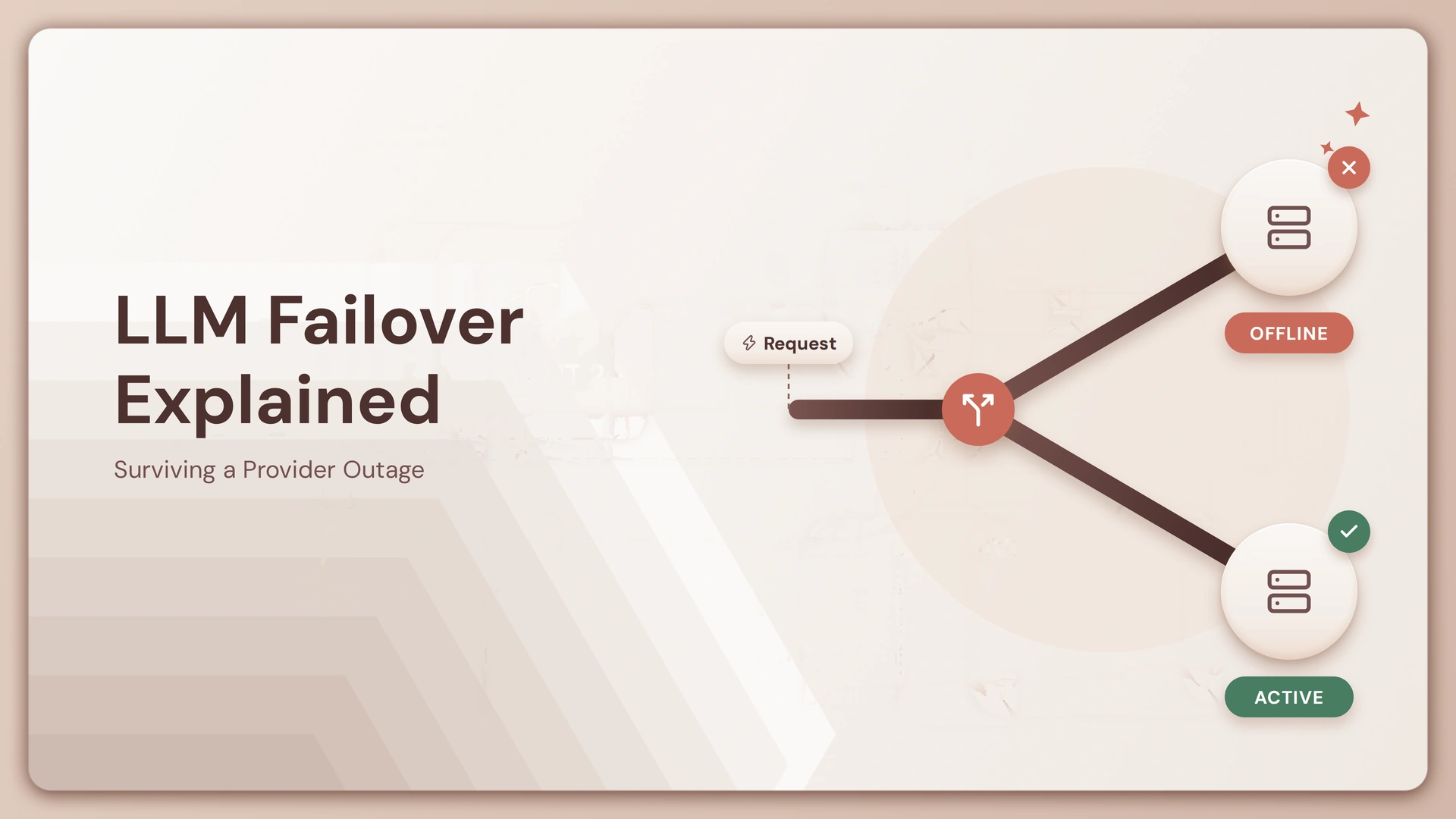
LLM failover, explained simply, is the automated process of detecting that a primary model or provider can’t serve a request and rerouting that request to a predefined backup, ideally before anyone downstream notices. It’s worth separating from two things people lump in with it. Load balancing spreads normal, healthy traffic across providers to manage cost or latency; it isn’t a response to failure. A plain retry just asks the same provider again, which does nothing if that provider is the one that’s actually down.
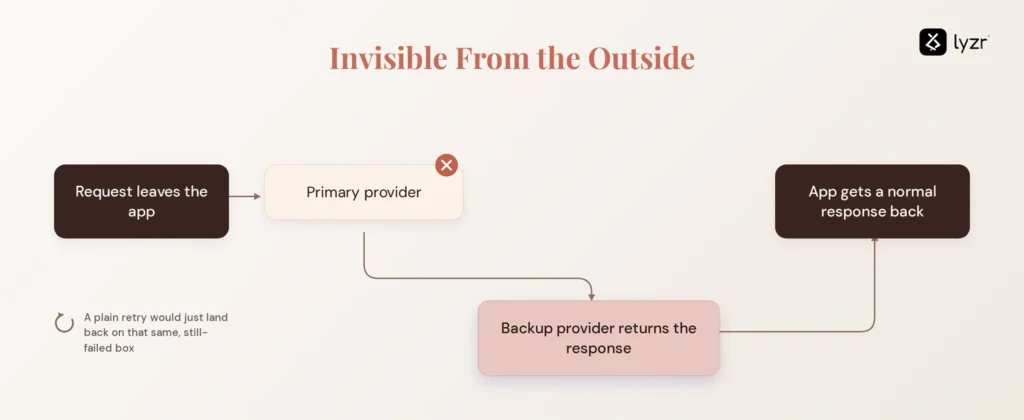
Failover is the third case, and the one this article is about: something has already gone wrong, and instead of hoping the same provider recovers, the request goes to a specific backup that’s ready to take it.
Why LLM failover is necessary
The case for failover isn’t a hypothetical one. On September 3, 2026, ChatGPT, Claude, and Grok all reported outages within the same morning, an event Axios covered directly, noting that individual AI outages happen regularly, but three major platforms going down together was unusual. Separately, the independent monitor StatusGator has logged more than 420 Anthropic outages since January 2025, a reminder that “the provider had downtime” is closer to a weekly occurrence than a rare postmortem line.
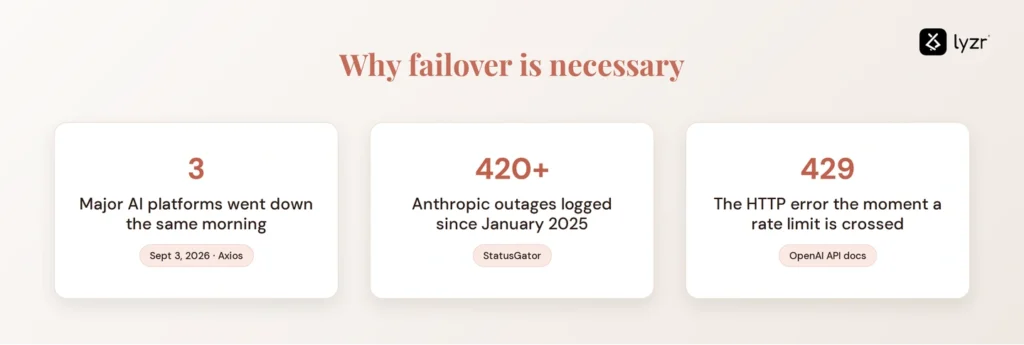
Rate limiting is the same problem in a different disguise: the provider hasn’t gone down, but it still can’t serve the request right now. It’s the quieter half of that problem, and it hits healthy accounts too. OpenAI’s own API documentation measures limits in requests and tokens per minute, and returns an HTTP 429 the moment either is crossed, sometimes because request volume simply accelerated too fast, not because the raw quota was exceeded.
Put the two together: an LLM-dependent product will eventually hit a primary provider that’s down or throttling it, and “that shouldn’t happen” is not a plan.
How LLM failover actually works
Four mechanisms cover most of what production failover setups are actually built from, and they typically work together rather than standing in for one another.
Health checks and failure detection decide what counts as “down” in the first place. A fixed timeout alone is a weak signal, since a slow response and a hung connection look identical for the first several seconds. Most setups combine a timeout threshold with error-rate tracking, a rising share of 5xx or 429 responses, before calling a provider unhealthy.
Fallback chains are an ordered list of backups to try once the primary is marked unhealthy. The obvious way to order that list is by cost, cheapest first. The often better way is by how closely a backup’s output matches what the primary was tuned to produce, since a cheap backup that breaks the workflow costs more than it saves.
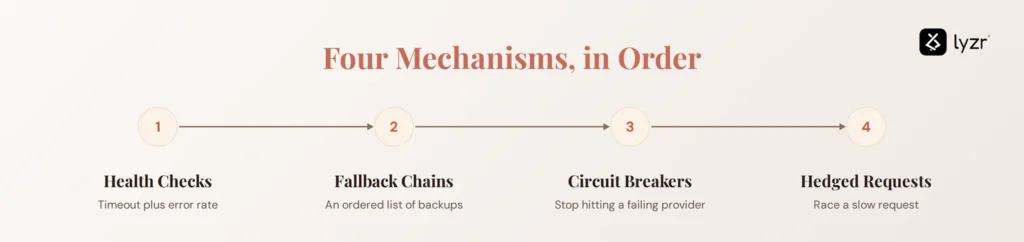
Circuit breakers stop sending traffic to a provider that’s already failing, instead of letting every new request retry against it and pile latency on top of an outage already in progress. Microsoft’s Azure Architecture Center documents the pattern as a way to let a failing dependency recover instead of getting hit with a wall of retries the moment it comes back up.
Hedged requests handle a provider that’s slow rather than fully down: fire a duplicate request to a backup after a short delay, and use whichever answer comes back first. The technique predates LLMs, coming from Google’s 2013 “The Tail at Scale” paper, which found that hedging after a 10-millisecond delay cut 99.9th-percentile latency on a distributed lookup from 1,800 milliseconds to 74, while adding only 2% more requests. Applied to LLM calls, a small amount of extra spend buys real protection against the slow tail, not just the fully-down case.
What each pattern actually protects against
| Pattern | What it catches | What it doesn’t | Trade-off |
| Health checks | A provider that’s genuinely down or erroring | A provider that’s up but returning bad or degraded output | False positives if thresholds are too tight |
| Fallback chains | Total unavailability of the primary | Behavioral differences in the backup’s output | Ordering choice: cost vs. output fidelity |
| Circuit breakers | Retry storms worsening an active outage | The original failure itself | A brief window of hard failures while the breaker is open |
| Hedged requests | Slow responses (tail latency) before they become timeouts | Outright provider downtime | Extra cost and load from duplicate requests |
Getting a request to succeed after failover is the easy half of this problem. What happens after it succeeds is the part that actually decides whether the workflow held up.
The part most guides skip
Three things change quietly the moment a fallback actually fires, and none of them show up as an error.
Behavioral drift: A backup model can format, reason, or refuse differently than the primary, even answering the exact same prompt, which is how a fallback returns a technically valid response that a downstream parser or a user still finds wrong.
Schema and API differences: Providers don’t share one request or response contract. Field names, streaming formats, and function-calling conventions differ enough that a fallback often needs a normalization layer just to keep application code from branching on which provider answered.
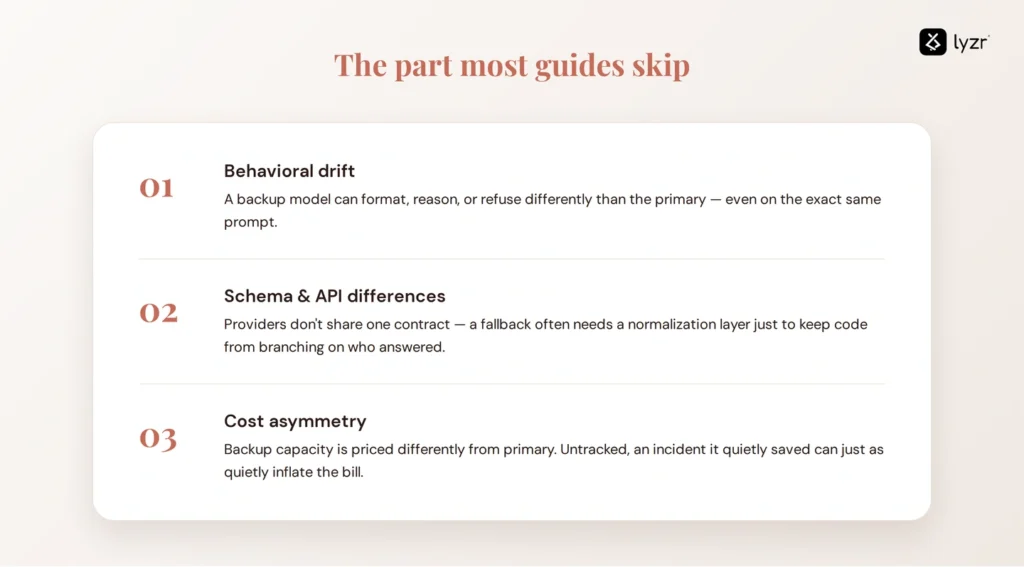
Cost asymmetry: Backup capacity is often priced differently than primary capacity, sometimes higher for a premium fallback, sometimes lower for a smaller model kept in reserve. A failover that quietly saves an incident can just as quietly inflate a monthly bill if nothing tracks which requests ran on the backup, and for how long.
None of this is an argument against building failover. It’s an argument against treating “the response came back” as proof the system worked.
Designing a failover strategy that actually holds up
The four mechanisms above are the easy part to buy or build. What actually determines whether a failover strategy holds up during a real incident is a handful of decisions most teams never write down, because nothing forces them to until the day it matters.
Define what “down” means for your specific application, not in general. A chatbot’s tolerance for a slow answer isn’t a batch pipeline’s, and a threshold copied from a generic monitoring template will either trigger too often or too late. This should be a number your team agrees on, not something the tooling decides by default.
Order the fallback chain by what the workflow needs preserved, not by sticker price alone. Cheapest-first is the easiest rule to write and often the wrong one, since a backup that quietly breaks a downstream parser or changes the tone of a customer-facing response costs more in cleanup than the money it saved during the incident.
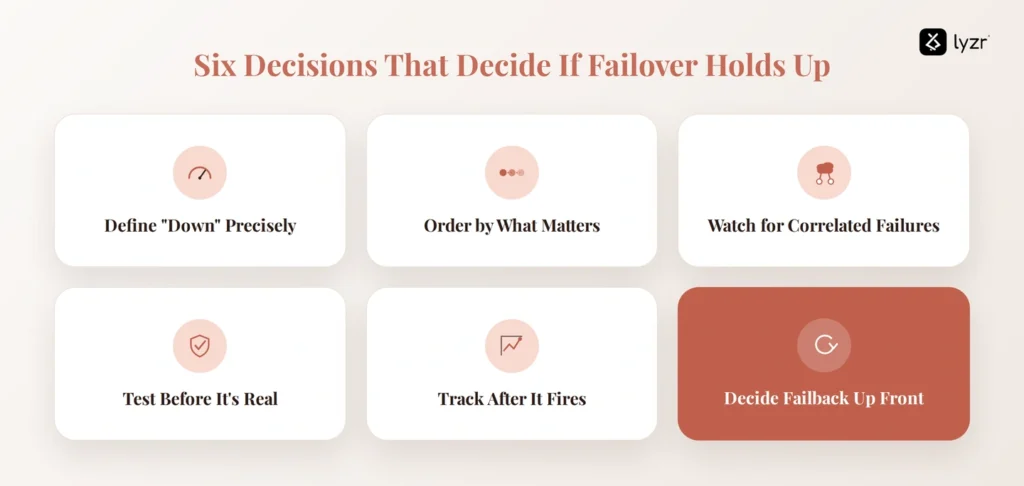
Watch for correlated failures, not just single-provider ones. Some reporting on the September 3, 2026 outage pointed to shared cloud infrastructure as a contributing factor across more than one AI provider that morning. Whether or not that specific link holds up, the general risk is real: a primary and a backup running on the same underlying cloud aren’t as independent as they look on a vendor list.
Test the failover path before a real outage forces you to. Infrastructure teams have run scheduled failure drills for years for exactly this reason: the first time a fallback chain executes for real shouldn’t be during a live incident, when nobody has time to notice it’s misconfigured.
Track what happens after failover fires, not just whether it fired. Cost, latency, and output drift on the backup path are easy to lose track of once the incident is over. A strategy without this visibility can look like it’s working for weeks while it quietly degrades quality or racks up cost nobody’s watching.
Decide the failback condition up front. Set the specific signal, typically a sustained return to healthy error rates and latency, that moves traffic back to the primary, rather than deciding it in the moment. Staying on a backup by default quietly locks in its cost and its behavior indefinitely, and nobody ever schedules time to revisit a decision that was never actually made.
For teams working through the broader question of what it takes to get an agent production-ready, not just its failover path, Lyzr’s playbook on taking agents to production covers that ground in more depth.
How Lyzr Opencontroller handles failover at runtime
Everything above is a design decision a team makes once, during planning. Making sure every agent actually follows it, on every call, during the one week a provider has an incident, is a separate problem: enforcement, not design.
Lyzr Opencontroller is built for that second half. Find automatically discovers agents, models, tools, and workflows across an AI estate, so an undocumented fallback path doesn’t stay invisible until it fails. Ship evaluates an agent’s configuration before it reaches production, the natural checkpoint where a failover plan built into that configuration would actually get checked, rather than assumed. Run monitors agents, applications, APIs, and infrastructure in real time from one control plane, and enforces policy directly in the request path, refusing a call that falls outside it rather than logging the violation afterward. Improve turns the usage, performance, cost, and security signals Run collects, including near-misses during a provider’s bad hour, into the next round of policy.
Opencontroller enforces whatever failover policy a team has already designed. It isn’t itself an LLM gateway or a model provider. To see how that enforcement holds up against a real agent estate, book a demo.
FAQ
It’s the automated process of detecting that a primary LLM provider or model can’t serve a request, because it’s down, erroring, or rate-limited, and rerouting that request to a predefined backup before it reaches the user as a failure.
Load balancing distributes healthy, normal traffic across providers for cost or latency reasons. Failover responds to a provider that has already failed or hit a limit, and routes around it.
Outages come from the provider’s own infrastructure: timeouts, server errors, capacity issues. Rate limits are a deliberate throttle that fires once a healthy account’s request or token volume crosses a threshold, sometimes just from accelerating too quickly rather than exceeding the raw quota.
No. A backup model can format, reason, or refuse differently even when answering the same prompt, which is why a successful failover and a correct one aren’t automatically the same thing.
By setting the condition in advance, typically a sustained return to healthy error rates and latency, rather than reacting in the moment. This avoids staying on a backup’s cost and behavior by default.
Book A Demo: Click Here
Join our Slack: Click Here
Link to our GitHub: Click Here