Your support agent ships a new version on a Tuesday. By Thursday, someone notices it approved twelve refunds that should have gone to human review first. The fix here looks obvious: roll back to the previous build. Except the refunds already went out, and the ledger reflects them. Reverting the code did nothing to what the agent did while running the bad version.
That gap, undoing a deployment versus undoing what it did, is the whole rollback problem for enterprise agents.
Key takeaways
- Agent rollback is two jobs: reverting a bad version and undoing the real-world actions the agent already took because of it. Most teams only build for the first one.
- Traditional rollback assumes reverting code clears the problem. Agents leave side effects, payments, messages, writes, that a redeploy can’t touch, since those changes live outside the code.
- Four mechanisms handle the second job: idempotent tool calls, compensating actions, append-only logs, and pinned versioning, each covering a different piece.
- None of these decide when to trigger a rollback. That’s a separate layer built on canary rollouts, dry-run checks, and circuit breakers.
- Gartner ties this gap to real risk, citing inadequate risk controls among the reasons agentic AI projects get canceled.
- Lyzr OpenController builds these in by default, instead of leaving each team to assemble them alone.
What are AI agent rollback patterns?
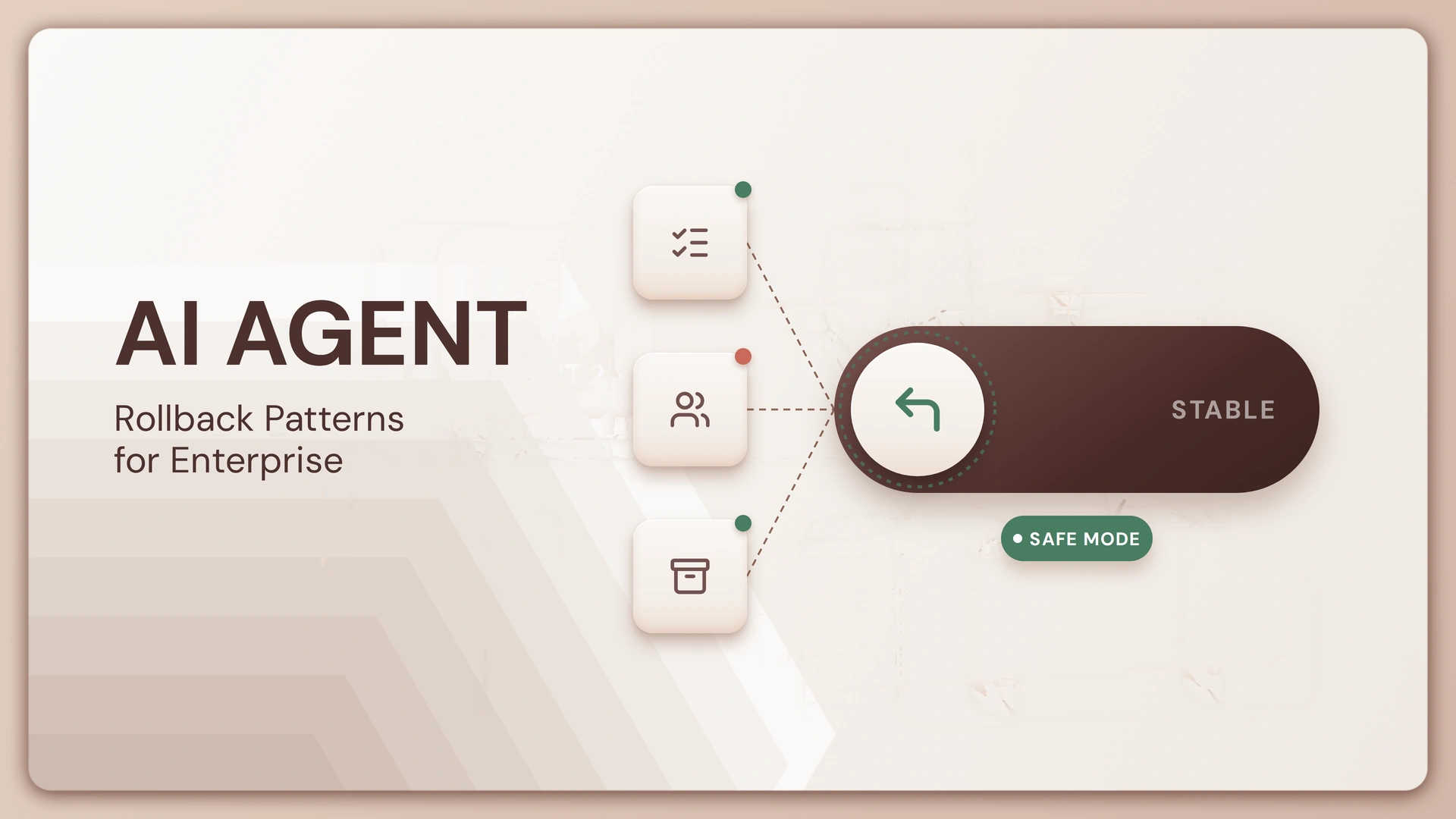
AI agent rollback patterns are the architectural techniques enterprises use to undo two things at once when an agent misbehaves: the version responsible, and the real-world actions it already took under that version. A pattern that only handles the first half, swapping back to an older prompt or model, is version control wearing a rollback costume. It stops the bleeding going forward, but does nothing about the refund that already went out.
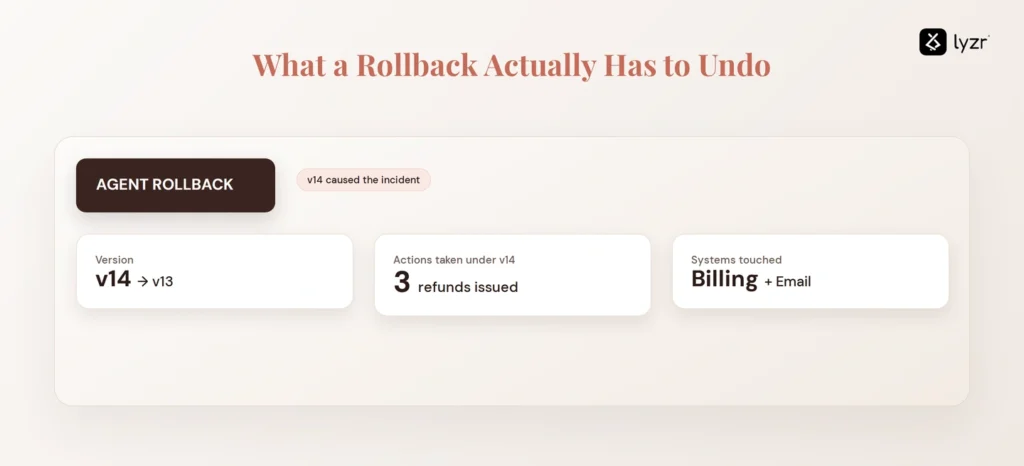
This is important as an agent reasons over context and acts through tools that reach into real systems, so rollback has to reach into those same systems too.
Why rolling back an AI agent is different
Rolling back a web application usually means reverting to the last known-good build. It works because the previous version was typically stateless or contained enough that reverting the code gets close to reverting the outcome.
That breaks for agents on two fronts. First, agents act through tools that write to external systems, a CRM, a payment processor, or someone else’s inbox, and those writes stay in place even after the code reverts; undoing the version doesn’t undo what already happened downstream. Second, agents are non-deterministic: even if you pin the exact same prompt, model, and tools back to their old configuration, the agent can still behave differently on the next run, because its output depends on the specific input it gets in that moment, not only on how it’s configured.
Gartner has already put a number on what this costs. In a June 2025 forecast, the firm predicted over 40% of agentic AI projects will be canceled by the end of 2027, citing escalating costs, unclear business value, and inadequate risk controls. Inadequate risk controls, plainly, means discovering after the fact that there was no way to undo what an agent had already done.
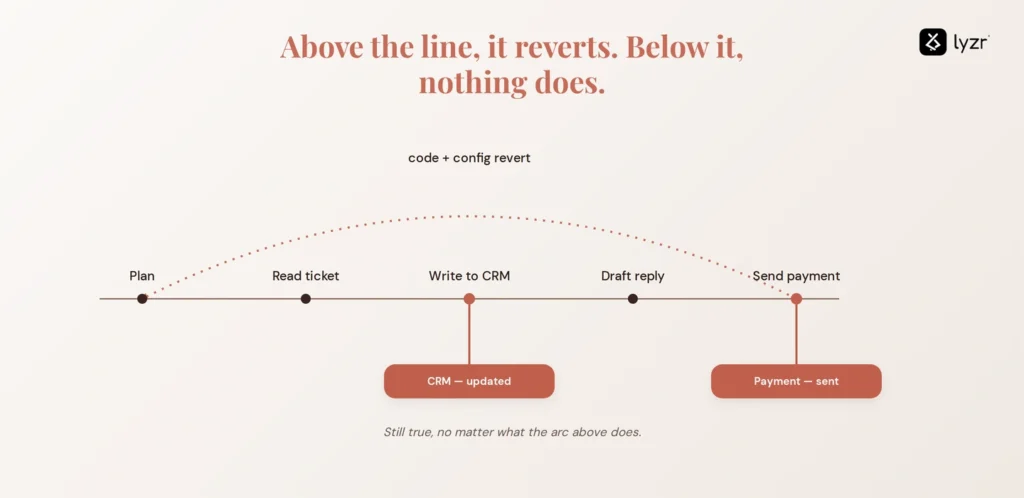
Most teams that believe they’ve solved agent rollback have only solved half of it. They can restore a prompt or pin a model, but finding and reversing what happened under the version that was live before is the part they usually can’t do.
Core AI agent rollback patterns for enterprise applications
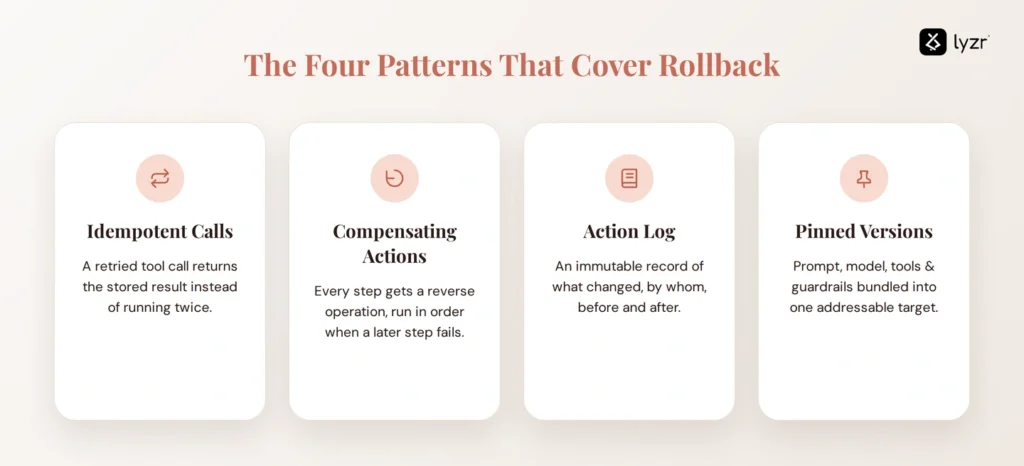
Four patterns cover most of what enterprises actually build, and they tend to show up together rather than one at a time. None of them is new on its own; what’s new is applying them specifically to agent tool calls instead of conventional application code, since an agent’s “code path” is really a sequence of external actions rather than a single function running in isolation.
Idempotent tool calls
Every tool call carries a unique key, so a retried action, from a network hiccup, a crash, or the agent simply trying again after a timeout, returns the stored result instead of executing a second time. Stripe documents idempotency keys for exactly this reason: repeating a request after a connection error shouldn’t risk creating a second object or performing the same update twice. Applied to an agent, this is what stops a single flaky retry from becoming a duplicate refund, a second calendar invite, or two identical emails landing in the same inbox minutes apart.
Compensating actions (the saga pattern)
Every state-changing tool call gets a registered reverse operation sitting alongside it: cancel the reservation, reverse the ledger entry, delete the draft, revoke the access grant. Microsoft’s Azure Architecture Center documents the saga pattern as a way to keep data consistent across a multi-step transaction by undoing completed steps in order when a later one fails, rather than relying on one all-or-nothing lock across every service involved. Picture an onboarding agent that creates an account, provisions a license, then sends a welcome email; if provisioning fails, a saga unwinds the account creation too, instead of leaving a half-onboarded user for someone to notice days later.
Append-only action logs
An immutable log records who or what acted, on which system, and the exact value before and after, every time, with no entry ever edited after the fact. This is the raw material any rollback decision gets made from: without it, a compensating action has nothing precise to point at, and a security team investigating an incident is left reconstructing what an agent did from memory instead of a record built for the purpose.
Pinned versioning and immutable snapshots
An agent’s prompt, model, tool permissions, and guardrails get bundled into one version-controlled object, so a rollback has an exact, addressable target instead of a vague “go back to how it was.” Lyzr has written about this gap separately: most teams version an agent’s code but not its runtime configuration, which is exactly the part that changes most often and is hardest to reconstruct once it’s gone.
What each pattern protects against, and where it falls short
| Pattern | What it undoes | What it doesn’t cover |
| Idempotent tool calls | Duplicate execution from retries | An action that was correct to run once but shouldn’t have run at all |
| Compensating actions | A partially completed multi-step task | An action with no valid reverse (a message already read) |
| Append-only action logs | Nothing alone; it’s the record other patterns act on | Reversal itself, a log proves what happened |
| Pinned versioning & snapshots | Uncertainty over which configuration was live at a given moment | Anything the agent already did under that configuration |
Nothing in that table is complete by itself, which is why enterprises tend to reach for these four together rather than pick a favorite. Idempotency stops new damage from repetition, compensating actions undo what can actually be undone, logs supply the evidence both need to act on, and versioning tells you which configuration to blame and which one to return to. Treat any single one as “rollback, solved” and the gap it doesn’t cover is usually what surprises a team, often during an incident review rather than a calm afternoon.
Operationalizing rollback: deciding when to pull the trigger
The mechanisms above don’t answer when a rollback actually gets triggered. Canary rollouts route a small slice of traffic to a new version, with gates that auto-revert once error rates or drift cross a threshold. Dry-run previews force a high-risk action, a large refund, or a bulk message to generate an explicit difference before it executes. Circuit breakers cap how many tool calls an agent can make in a loop and suspend it when something looks wrong, rather than waiting for a scheduled review.
These decide when the patterns above fire. A compensating action that only runs after someone notices the damage weeks later is far less useful than one triggered the moment a canary gate catches the drift.
Choosing the right combination for your stack
Not every agent needs every pattern. Customer-facing and financial workflows need compensating actions and idempotent tool calls first, since a duplicated or irreversible action costs the most there. Regulated workflows need the append-only log regardless, since an auditor asks for the record whether or not anything went wrong. Agents that ship frequently, which are most of them, need pinned snapshots paired with canary gates, as the risk isn’t one bad action; it’s a bad version running unnoticed for days.
Lyzr’s playbook on taking agents to production covers this readiness question in more depth, for anyone whose real question is less “which pattern” and more “are we ready to ship this at all.”
How Lyzr OpenController operationalizes agent rollback
These patterns are what a platform team would otherwise design and maintain by hand. Lyzr OpenController is built to give them by default.
Find discovers every agent, model, and tool across an estate, including the ones nobody registered. Ship governs a change before it reaches production, capturing the configuration as an immutable snapshot at promotion. Run enforces policy in the request path itself, since, as OpenController’s own documentation puts it, “a dashboard can’t stop an agent, a policy document can’t stop an agent, an alert can’t stop an agent, control has to happen in the path.” Improve feed incident signals back into what gets reviewed next.
On rollback specifically, OpenController maintains immutable versions with what it calls “rollback as a pointer move” rather than a manual rebuild, with every identity attributable and every decision traceable.
To see it against a live agent estate rather than a slide, book a demo.
FAQ
Techniques enterprises use to undo both a bad agent version and the real-world actions it already took, using idempotent tool calls, compensating actions, append-only logs, and pinned versioning.
Rolling back code restores the previous prompt or model. Rolling back actions reverses what the agent did while running the bad version, a write, a payment, a message. Most teams have solved the first, not the second.
Every state-changing tool call gets a matching reverse operation registered alongside it, so a multi-step task can be unwound one step at a time if something later fails.
The mechanism can be, but the trigger shouldn’t always be hands-off. Canary gates and circuit breakers can auto-revert on clear signals; a judgment call, like an unusual but not obviously wrong refund, still needs a human.
Not many labeled that way, but checkpoint-and-restore code in agent orchestration frameworks and saga-pattern libraries built for microservices cover the same ground.
It limits a new version to a small share of traffic and pairs it with automated gates that revert once error rates or drift pass a threshold. It’s the trigger; versioning and compensating actions are what it invokes.
Book A Demo: Click Here
Join our Slack: Click Here
Link to our GitHub: Click Here