Let’s talk about something that doesn’t get nearly enough credit in the machine learning world: batch inference.
If you’ve spent any time around ML engineering, you’ve probably heard endless chatter about real-time inference, the low-latency, split-second predictions that power recommendation feeds, fraud detection, and chatbots. I
t’s flashy. It’s what demos are made of. But there’s a quieter, less glamorous workhorse doing a huge chunk of the actual heavy lifting in production ML systems, and it’s called batch inference.
So let’s break down what it actually is, why it matters, and when you should reach for it instead of its real-time cousin.
What Is Batch Inference, Really?
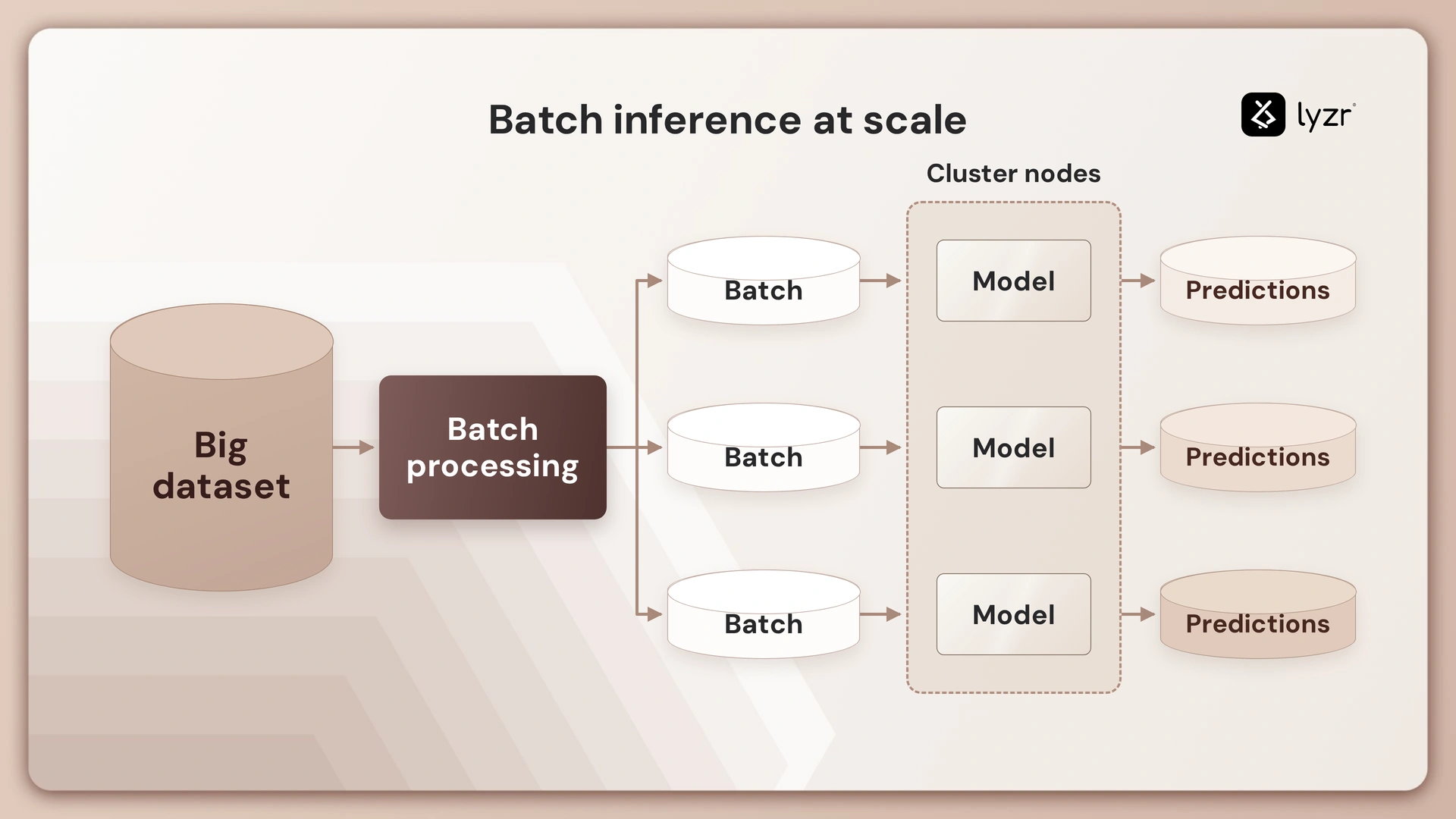
At its core, batch inference means running a trained model on a large set of inputs all at once, rather than responding to requests one at a time as they arrive.
Instead of your model sitting around waiting for a single user to hit “submit,” you feed it a big pile of data, maybe a million rows, maybe a hundred million, and let it chew through everything in one coordinated run.
Think of it like the difference between a barista making one coffee at a time for each customer walking in, versus a factory that brews ten thousand cups overnight for the morning rush. Both approaches make coffee. But the constraints, the tools, and the mindset are completely different.
In practice, batch inference shows up in things like: scoring every customer in your database for churn risk once a week, generating personalized email content for your entire subscriber list before a campaign launches, running nightly product recommendation updates for an e-commerce catalog, or classifying a backlog of millions of images or documents.
Why It Deserves More Attention
Batch inference is unglamorous because it doesn’t need to be fast in the way real-time systems do. There’s no user impatiently waiting on the other end. And that lack of urgency is actually its superpower.
It’s dramatically cheaper. Because you’re not paying for an always-on, low-latency serving endpoint, you can use cheaper compute, take advantage of spot instances, and run jobs during off-peak hours. Providers like AWS, Google Cloud, and Azure all have separate, discounted batch pricing tiers precisely because batch jobs are more flexible about when and how they run.
It’s more efficient by design. Batch jobs let you maximize throughput. You can pack your GPU or CPU with much larger batch sizes since you’re not worried about the added latency of waiting to fill a batch, there’s no user tapping their foot. This often means better hardware utilization and higher tokens- or predictions-per-second than a real-time system could ever achieve.
It simplifies your infrastructure. No need for auto-scaling policies tuned to handle sudden traffic spikes, no need for a always-warm model server burning money 24/7. You spin up compute, run the job, and spin it down.
It plays nicely with existing data pipelines. Most companies already have batch ETL jobs running nightly or weekly. Batch inference slots naturally into that same rhythm — pull data, transform it, score it, push it downstream.
When Batch Inference Makes Sense (And When It Doesn’t)
The deciding factor really comes down to one question: does the prediction need to happen the instant the data shows up, or can it wait?
If you’re building a system where a user expects an answer in under a second, think search autocomplete, live fraud checks during a transaction, or a chat assistant — batch inference isn’t your friend. You need real-time serving.
But if predictions can be pre-computed and cached, batch is almost always the smarter, cheaper, more scalable choice. Nightly churn scores, weekly demand forecasts, monthly document classification for compliance review, bulk content moderation on an existing dataset — all of these are perfect batch use cases.
There’s also a hybrid pattern worth knowing: pre-compute predictions in batch, then serve them instantly from a fast lookup store like Redis or DynamoDB. This gives you the cost efficiency of batch processing with the responsiveness of real-time serving. A lot of large-scale recommendation systems actually work exactly this way, the “real-time” feel you experience as a user is often the product of a batch job that ran hours earlier.
The Rise of Batch APIs for LLMs
Batch inference has taken on new relevance with large language models. Running an LLM over millions of prompts one-by-one through a standard API can get expensive fast, and most of those use cases, bulk summarization, dataset labeling, content generation at scale — don’t need instant responses anyway.
That’s why major LLM providers now offer dedicated batch APIs, often at a meaningful discount compared to standard real-time pricing, with results delivered within a defined turnaround window rather than instantly. If you’re processing large volumes of text and don’t need sub-second responses, checking whether your provider offers a batch tier is one of the easiest wins available.
Batch vs. Real-Time: A Side-by-Side Look
Sometimes the clearest way to understand something is to see it stacked up against the alternative.
| Batch Inference | Real-Time Inference | |
| Latency | Minutes to hours (or longer) | Milliseconds to seconds |
| Cost | Lower — flexible, off-peak, spot-friendly compute | Higher — always-on endpoints |
| Throughput | Very high, optimized for volume | Optimized for individual requests |
| Infrastructure | Simple, ephemeral jobs | Requires auto-scaling, load balancing, uptime SLAs |
| Best for | Large-scale scoring, reports, pre-computation | User-facing, interactive experiences |
| Failure handling | Retry the whole job or a chunk of it | Must degrade gracefully in the moment |
Neither approach is “better” in some universal sense — they’re built to solve different problems. A lot of mature ML platforms end up running both side by side, using each where it fits best.
How Batch Inference Actually Works Under the Hood
It’s worth pulling back the curtain a bit on what a batch inference pipeline typically looks like in practice, because the mechanics explain a lot of the benefits.
1. Data collection and staging. Input data is gathered from a data warehouse, data lake, or object storage (think S3, GCS, or a BigQuery table) and organized into a format the model can consume — usually something like Parquet, CSV, or JSON Lines.
2. Job scheduling. A workflow orchestrator (Airflow, Dagster, Prefect, or a cloud-native scheduler) kicks off the batch job on a set cadence — nightly, weekly, or triggered by an upstream event like “new data landed.”
3. Compute provisioning. Instead of a permanently running server, compute resources spin up specifically for the job. This might mean a cluster of GPU instances for a deep learning model, or a fleet of CPU workers for a simpler classical ML model. Because the job is finite, teams can lean on cheaper, interruptible compute like spot instances.
4. Parallelized scoring. The input data gets sharded across workers, and each worker runs inference on its slice. Frameworks like Apache Spark, Ray, or cloud-native batch services (AWS Batch Transform, Google Vertex AI Batch Prediction, Azure Batch Endpoints) handle the distribution and coordination automatically.
5. Output storage. Predictions get written back to a database, data warehouse, or file store — ready to be picked up by a dashboard, a downstream pipeline, or a serving layer.
6. Teardown. Once the job finishes, the compute spins back down. You’re not paying for anything sitting idle.
That last step is easy to overlook, but it’s a huge part of why batch inference is so cost-effective. You only pay for compute while work is actually happening.
Common Pitfalls (and How to Avoid Them)
Batch inference sounds simple in theory — pass data through a model, save results — but there are a handful of ways teams trip themselves up.
Staleness creeping in unnoticed. Because batch predictions are pre-computed, there’s always a gap between when the prediction was made and when it’s actually used. If your batch job runs nightly but user behavior shifts hourly, you could be serving outdated recommendations without realizing it. The fix is usually to explicitly define an acceptable “freshness window” for your use case and monitor for violations.
Silent partial failures. In a real-time system, a failed request usually surfaces immediately. In a batch job processing ten million rows, a few thousand silently failing rows can slip through unnoticed unless you build in row-level error tracking and reconciliation checks (did the number of outputs match the number of inputs?).
Schema drift. Batch jobs often run against upstream tables that evolve over time. A renamed column or a new null value pattern can quietly break a pipeline or, worse, produce bad predictions without erroring out at all. Schema validation at the start of the pipeline is cheap insurance.
Treating batch size as an afterthought. The size of each batch you feed into the model at once (not to be confused with the overall job size) has a real effect on throughput and hardware utilization. Too small, and you waste compute on overhead; too large, and you risk memory errors. This is usually worth tuning empirically for your specific hardware and model.
Skipping monitoring because “it’s not real-time.” Some teams treat batch jobs as fire-and-forget because there’s no user directly depending on split-second uptime. But a batch job that quietly fails for three days can be just as damaging as a real-time outage — it just takes longer to notice. Track job success rates, output row counts, and prediction distributions over time just like you would for a live service.
Tooling Worth Knowing
If you’re setting up batch inference for the first time, you don’t need to reinvent the wheel. A few tools show up again and again across the industry:
- Cloud-native batch prediction services — AWS SageMaker Batch Transform, Google Vertex AI Batch Prediction, and Azure Machine Learning batch endpoints all handle provisioning, scaling, and teardown for you.
- Distributed compute frameworks — Apache Spark (especially with MLlib or Spark UDFs wrapping a model) and Ray are popular for teams that need fine-grained control over parallelization.
- Workflow orchestrators — Airflow, Dagster, and Prefect are the usual suspects for scheduling and chaining batch inference into a broader pipeline.
- LLM-specific batch APIs — Most major LLM providers now offer a dedicated batch endpoint with discounted pricing and a defined turnaround window, ideal for bulk summarization, labeling, or content generation tasks that don’t need instant answers.
The Practical Takeaway
Batch inference isn’t exciting. It doesn’t get keynote demos or flashy product launches. But if you’re running ML in production and you’re not asking “does this actually need to happen in real time?” before defaulting to a live serving endpoint, you might be leaving serious cost savings and efficiency gains on the table.
The next time you’re architecting a prediction pipeline, start with a simple gut check: can this wait an hour, a day, a week? If the answer is yes, batch inference deserves a serious look. Start small — pick one use case where freshness genuinely doesn’t matter, move it to a scheduled batch job, and measure the cost difference. More often than not, the savings will make the case for themselves.
It’s the quiet, efficient engine running behind the scenes of more production ML systems than most people realize — and understanding when to reach for it is one of the more underrated skills an ML engineer can have.
Book A Demo: Click Here
Join our Slack: Click Here
Link to our GitHub: Click Here