Here’s the uncomfortable truth about most enterprise marketing teams right now.
You’ve adopted AI. You have five to twenty tools in the stack, each with its own shiny AI feature. And you, the human marketer, are the glue holding all of it together. Individual tasks got faster. The function as a whole didn’t. Copy gets written quicker, but nothing talks to anything else, and you’re still the one stitching it together by hand.
That gap, between faster tasks and a faster function, is where the next shift lives. It’s the Agentic OS for Marketing: one operating layer that runs the marketing function end to end, with specialised agents underneath handling each workflow.
The category is emerging fast.
Salesforce is positioning Marketing Cloud Next as an “agentic marketing platform.” Copy.ai has repositioned from copywriting to “AI Marketing OS.” Adobe is embedding agent orchestration into Experience Platform. Netcore, HubSpot Breeze, Yarnit, PubMatic AgenticOS, WPP Open, Typeface, and half a dozen others are staking their claims. The buyer research is on: Futurum Group’s Q1 2026 Enterprise Software Decision Maker Survey shows 66% of organisations now favouring a platform-first strategy over best-of-breed, and 41% actively planning to consolidate stacks.
This guide is Lyzr’s definitive statement on what an Agentic OS for Marketing actually is, how it differs from the alternatives, what it does, how to evaluate one, and how to deploy it inside an enterprise marketing team. Lyzr builds Skott, the Agentic OS for Marketing.
What is an Agentic OS for Marketing
An Agentic OS for Marketing is a coordinated operating layer that runs the marketing function end-to-end. It orchestrates AI agents across content, social, email, SEO, ABM, distribution, reporting, and every other marketing workflow, under one system with shared context, memory, and governance.
The two words that matter most in the definition are “agentic” and “OS.”
Agentic means the underlying capability is not just automation or AI features. It is autonomous, goal-driven agents that plan, decide, and act to achieve marketing outcomes with minimal step-by-step human direction. Traditional marketing automation executes predefined rules. AI features generate outputs when a human prompts them. Agentic AI takes a goal (grow inbound leads 25% this quarter, launch this product in three markets, recover organic traffic in this vertical) and figures out the steps.
OS means it is not a single tool. It is the coordination layer that runs multiple agents and workflows under one system. An operating system for hardware manages resources, processes, memory, and permissions across everything running on the machine. An Agentic OS for Marketing does the same for the AI agents that run marketing: shared context across agents, coordinated handoffs between workflows, unified memory of what worked, and consistent governance for compliance and brand safety.
Put together, an Agentic OS for Marketing is the operating layer that lets a marketing team say “here is the goal, here are the guardrails, here is the brand context” and have coordinated agents execute across every channel without the human marketer doing the stitching manually.
For the broader conceptual grounding on agentic AI itself, the agentic AI explainer covers the foundational concepts. For how it applies specifically to marketing at the workflow level, the AI in marketing 2026 guide walks through the shift from point tools to operating systems in depth.
Four architectures of marketing tech: where the Agentic OS fits
Marketing teams have run through four architectural patterns in the last twenty years. Understanding the sequence helps clarify why the Agentic OS is not just a rebrand of the previous pattern.

1. Marketing tech stack (2005–2018). A collection of point tools, each solving a specific problem: CRM (Salesforce, HubSpot), marketing automation (Marketo, Pardot), analytics (Google Analytics, Adobe), CMS (WordPress, Drupal), email (Mailchimp, Constant Contact), social (Hootsuite, Buffer), SEO (Ahrefs, SEMrush). Each tool solved its problem well. The team coordinated across tools manually. Scott Brinker’s famous “martech landscape” chart went from 150 vendors in 2011 to over 14,000 by 2024, which is the visual proof that this pattern hit its complexity ceiling.
2. Marketing automation (2010–2022). Rules-based systems that coordinated a subset of the stack. Lead nurture flows, email drips, form-to-CRM handoffs, basic personalisation. Marketing automation improved coordination at the workflow level but was still fundamentally rule-based. Every logic path had to be defined in advance. The team spent significant effort building and maintaining the rule sets.
3. Marketing operating system (2022–2025). AI-first platforms that unified data and orchestrated execution across channels. DOJO AI, Grower, Marketing Evolution, and others coined “Marketing Operating System” (MOS) to describe unified platforms that consolidated data, orchestrated execution, and delivered analytics under one system. The MOS pattern was the first serious challenge to the fragmented stack, and it borrowed the “OS” metaphor from computing (Windows for desktops, iOS for phones) to describe what the layer does.
4. Agentic OS for Marketing (2025–present). The MOS pattern plus autonomous AI agents as the execution layer. The MOS improved data unification and workflow orchestration but still relied on humans to make most execution decisions. The Agentic OS adds autonomous agents that plan, decide, and act inside the OS layer. The human marketer moves up the stack into strategy, judgement, brand direction, and oversight. The agents handle execution.
The critical distinction between MOS and Agentic OS is where decisions are made. In an MOS, the human sees a dashboard and makes decisions the platform then executes. In an Agentic OS, the human sets goals and guardrails, and the agents make the operational decisions inside those bounds. The MOS is a marketing dashboard with automation. The Agentic OS is a marketing team, staffed by agents, with a human strategist.
For the deeper architectural pattern across agentic systems generally, types of agents in production walks through the categories of agents that make this OS layer possible. For the state of the broader agentic AI market, the state of AI agents 2026 report covers adoption data.
Why the shift to Agentic OS is happening now
Three forces converged in 2025-2026 to make the Agentic OS pattern viable for enterprise marketing teams.

Agents crossed the reliability threshold. Through 2023-2024, most “AI agents” were demoware. They ran fine in demos and broke on production edge cases. Through 2025, model quality, tool-use reliability, and the underlying agent orchestration patterns matured to the point where agents could run production workflows without constant human correction. The 2026 buyer no longer needs to be convinced that agents work; they need to figure out which OS layer to standardise on.
Data unification finally became practical. For decades, unified marketing data was an aspiration blocked by CDP complexity, ETL cost, and vendor incentives to keep data siloed. Modern architectures (MCP servers, unified knowledge bases, real-time data pipelines) make it possible to give agents shared context without a two-year data integration project. Lyzr’s knowledge base as a service and knowledge graph as a service are the architectural answer to this at the platform layer.
Buyer preference shifted to platform-first. Futurum Group’s Q1 2026 Enterprise Software Decision Maker Survey (n=830) showed 66% of organisations now favouring platform-first over best-of-breed, and 41% actively planning to consolidate app stacks. This is a dramatic reversal from the 2018-2022 era, when best-of-breed was the assumed default. The buyer has been burned by too many point tools, too much integration debt, and too many “AI features” that did not deliver measurable impact. The platform-first pendulum is swinging back hard.
The composite picture: agents work reliably enough for production, data unification is practical, and buyers want to consolidate. This is the window in which the Agentic OS pattern moves from thought leadership to shipped product.
What an Agentic OS for Marketing actually does
The Agentic OS orchestrates the entire marketing motion. In practice, that means specialised agents run under the OS for each workflow, and the OS provides the shared context, coordination, and governance that lets them work as one system.
The workflows an Agentic OS coordinates

Content workflow. Content ideation, brief generation, drafting, editing, optimisation for both traditional and AI search, publishing, refresh cycles, and cross-channel distribution. In Lyzr’s Skott deployment, the AI content creation agent blueprint handles the drafting layer, the content distribution agent blueprint handles amplification, and the ebook generator, AI webinar agent, and press release writer blueprints handle specific long-form formats.
SEO and answer engine workflow. Keyword research, competitor analysis, content optimisation for both traditional Google rankings and the newer AI search surfaces (ChatGPT, Perplexity, Claude, Google AI Overviews). Traditional SEO plus answer engine optimisation (AEO) and generative engine optimisation (GEO) now sit inside the same workflow because the underlying content optimisation logic overlaps. The AI agents for SEO pillar covers the workflow patterns in depth. The AEO/GEO Optimizer Agent blueprint is the operational version.
Social workflow. Planning, copy generation, scheduling, engagement, monitoring across LinkedIn, X, Instagram, and vertical channels. The AI social media agent blueprint handles this end-to-end. The LinkedIn marketing agent deep-dive covers the LinkedIn-specific patterns for B2B teams.
Email workflow. Campaign planning, copy generation, segmentation, send-time optimisation, lifecycle automation, list hygiene, deliverability monitoring. Email is often where the highest measurable lift shows up first in agentic marketing deployments. The AI agent for email marketing deep-dive and the top 10 AI email automation tools roundup cover the tool and workflow landscape.
ABM workflow. Account targeting, multi-touch coordination across email, LinkedIn, ads, and direct mail, per-account personalisation, sales handoff timing. ABM is the workflow that most clearly justifies the operating-system architecture because ABM requires more channel coordination than any other marketing motion. Teams selecting a platform can compare the best ABM tools by account targeting and multi-channel coordination. The ABM agent blueprint handles it end-to-end.
Paid media workflow. Campaign planning, server-side tracking, creative variation, bid optimisation, audience refinement, budget allocation across channels, performance monitoring. Agents run the continuous optimisation loop that humans cannot match on speed. The AI agents for paid advertising deep-dive covers the workflow patterns and the campaign automation agent reference covers the coordination layer.
Brand workflow. Brand voice consistency across all outputs, competitive positioning tracking, brand sentiment monitoring, brand-safety governance across paid channels. The AI agents for brand building piece covers the brand-side workflow patterns.
Internal marketing communication. Coordination inside the marketing team and between marketing and adjacent functions (sales, product, customer success). The AI internal communication agent handles this layer.
Marketing strategy coordination. The higher-level layer where the OS ties workflow execution to strategic goals. The marketing strategy builder blueprint is the top-of-stack coordination piece.
Reporting and analytics. Unified reporting across all workflows with attribution to underlying agent actions. This is where the OS pattern shows its structural advantage: reporting across point tools requires manual reconciliation. Reporting across an OS is built in.
The layers underneath the workflows
For the technically-minded reader, the OS architecture has five load-bearing layers underneath the workflow-level view above.

Layer 1: Foundation. The source-of-truth context every agent draws from: brand voice guide, ICP definition, tone-of-voice samples, taxonomy, customer language library, strategic narrative. Without this, agents produce off-brand output. With it, brand consistency compounds across every touchpoint.
Layer 2: Agents. Specialised AI roles, each with a defined purpose, instruction set, scope, memory, and quality standard. The Skott deployment uses pre-built agent blueprints for the common workflows and custom agents built on Lyzr Agent Studio and Lyzr Architect for team-specific needs.
Layer 3: Workflows. How agents chain into multi-step processes. Triggers, handoffs, validation gates, and human-in-the-loop checkpoints that turn individual agent outputs into operational outcomes.
Layer 4: Memory. What each agent remembers across sessions: prior briefs, recent outputs, quality feedback, customer-specific context, strategic shifts. Lyzr’s Cognis memory layer handles this at the platform level.
Layer 5: Governance and observability. Permissions, audit logs, brand-safety enforcement, escalation rules, rollback capabilities. This layer is what distinguishes production-grade agentic marketing from lab experiments. Lyzr’s Responsible AI as a Service and hallucination manager as a service sit at this layer.
The workflows on top are the visible part. The five layers underneath are what make the OS actually work as a coordinated system rather than a set of siloed agents.
Meet Skott: Lyzr’s Agentic OS for Marketing
Lyzr’s answer to the Agentic OS for Marketing category is Skott. Skott is the coordinated operating layer that runs marketing end-to-end for enterprise teams.
The design choices that make Skott specifically fit for enterprise marketing:
Skott deploys inside the enterprise perimeter. For enterprises with sovereign data residency, security, or compliance requirements, Skott runs inside the customer’s infrastructure rather than sending data to public cloud APIs. This is the deployment pattern that gets AI marketing through security review at regulated enterprises. For the broader architectural pattern, Sovereign AI is the foundational reference.
Skott is one of a family of Agentic OS offerings. Marketing is one function. Enterprises have adjacent functions where the same OS pattern applies. Lyzr’s Agentic OS family covers:
- Skott — Agentic OS for Marketing
- Diane — Agentic OS for HR
- Jeff — Agentic OS for Customer Support
- Amadeo — Agentic OS for Banking
- Benjie — Agentic OS for Insurance
Alongside the OS family, Lyzr maintains specialised named agents that work inside or alongside the OS layer. For marketing teams, the most relevant are Jazon for AI SDR and outbound sales, Kathy for AI competitor analysis, and Dwight for RFP scouting. The typical adoption pattern is to start with Skott as the marketing OS, layer in Jazon for outbound, and add Kathy as competitive intelligence matures.
Skott runs on the Lyzr platform. Underneath Skott sit the platform primitives: Lyzr Agent Studio for low-code agent building, Lyzr Architect for visual orchestration, Orchestration as a Service for the coordination layer, Agents as a Service for managed deployment, and the Cognis memory layer. Teams that want to build custom marketing agents alongside Skott can build on the same platform without a separate integration effort.
Skott is validated by enterprise deployment. Skott is in production at marketing teams inside global systems integrators, tier-one banks, F100 consumer brands, national infrastructure companies, government programs, and large industrial groups. The customers page and case studies cover specific deployments. The wall of love covers what marketing leaders say about the experience.
For the tool-level comparison against the tools Skott is most often compared to, the Skott vs Writesonic vs Copy.ai vs Jasper piece walks through the head-to-head trade-offs, and the Skott vs traditional marketing piece frames the broader category shift. For the workflow-level view, the 12 AI marketing agent use cases template covers the specific patterns we see most often inside Skott deployments.
How Skott compares to the other Agentic OS for Marketing options
The category has multiple emerging entrants. Each takes a different angle. Understanding the differences helps buyers pick the right fit for their situation.
Salesforce Marketing Cloud Next (with Agentforce)
Salesforce positions Marketing Cloud Next as an “agentic marketing platform” with Agentforce agents embedded across the lifecycle. It is the strongest enterprise entry from the traditional CRM/martech incumbents.
Where it fits: Marketing teams that are already deeply embedded in Salesforce infrastructure and want to extend the same platform into agentic marketing. The integration story is strong for existing Salesforce customers.
Where it does not fit: Teams that are not on Salesforce and do not want to consolidate onto it, teams with sovereign data requirements that block public cloud SaaS, and teams that want deployment flexibility across models and infrastructure. Skott’s advantage here is architectural independence: Skott does not require Salesforce (or any specific stack) as a prerequisite, and Skott deploys inside the customer’s perimeter for teams that need it.
Copy.ai’s AI Marketing OS
Copy.ai has repositioned from AI copywriting into “The First AI Marketing OS” and is investing heavily in this frame. The product ships with pre-built workflow templates and positions against the fragmented martech stack.
Where it fits: Mid-market marketing teams that want to consolidate around a single AI platform, with a strong emphasis on content and copy workflows.
Where it does not fit: Enterprise teams with regulated deployment requirements, teams that need custom agent development beyond what pre-built workflows cover, and teams that want the OS to extend into adjacent functions (HR, support, banking, insurance) with the same platform. Skott’s advantage: enterprise depth, sovereign deployment, and the multi-function OS family that lets marketing teams adopt Skott while adjacent functions adopt Diane, Jeff, Amadeo, or Benjie on the same platform.
HubSpot Breeze
HubSpot Breeze is the agentic layer inside HubSpot’s platform. It brings AI agents to marketing automation, sales, and service workflows.
Where it fits: Teams already on HubSpot that want to extend into agentic capabilities without leaving the platform.
Where it does not fit: Teams not on HubSpot, and enterprise teams whose scale exceeds HubSpot’s core market. Skott’s advantage: independence from any specific CRM or marketing automation stack, and depth on enterprise/regulated deployment patterns.
Adobe Experience Platform Agent Orchestrator
Adobe brings agent orchestration into Experience Platform with a focus on content, brand governance, and customer experience.
Where it fits: Enterprises already on Adobe Experience Platform who want the agentic capabilities to live alongside the content and CDP stack they have.
Where it does not fit: Teams not on Adobe, and teams whose marketing operations centre more on demand generation and pipeline than on brand and content experience. Skott’s advantage: full-motion marketing coverage (SEO, ABM, email, paid, content, social all coordinated) rather than the experience-and-content emphasis.
The consulting/services model (AI Pirates, Cognizant + Typeface)
Some players (AI Pirates Munich, Cognizant + Typeface partnership) offer agentic marketing as a services delivery rather than a product. Their pitch: we build the OS for you and hand it over.
Where it fits: Enterprises that want to own the entire deployment (code, data, infrastructure) and are willing to run a 4-6 month build phase before the OS is productive.
Where it does not fit: Teams that want an OS in production in 30-60 days rather than 4-6 months, and teams that want ongoing product evolution as the OS category matures. Skott’s advantage: adopt vs build, ship in weeks, and continuous platform evolution over time.
The vertical-specific plays (PubMatic AgenticOS, Netcore, Birdeye)
PubMatic AgenticOS is programmatic-advertising-specific. Netcore is e-commerce/retail-focused. Birdeye is multi-location-brand-focused. Each is a strong fit inside its vertical but does not cover full-motion marketing.
Where they fit: Teams whose primary marketing motion is inside the specific vertical the platform serves (programmatic advertising, retail engagement, multi-location brand).
Where they do not fit: Full-motion marketing teams that need coordination across content, social, SEO, email, ABM, and paid together. Skott’s advantage: coverage across the full marketing motion rather than a vertical slice.
How to choose
The evaluation framework Lyzr recommends:
1. What is your stack lock-in? If you are deeply on Salesforce or HubSpot and want to extend without replatforming, the native agentic layer from your existing vendor is often the pragmatic choice. If you are not locked in or actively want to reduce lock-in, an independent OS like Skott is better positioned to move with you.
2. What is your deployment constraint? If your data must stay inside the enterprise perimeter (regulated industries, sovereign requirements, sensitive customer data), the SaaS-only options are typically blocked at security review. Skott’s inside-the-perimeter deployment is designed for this specifically.
3. What is your scope? If your scope is marketing only, and marketing is well-served by the vendor’s positioning, any of the platform-first options can work. If your scope extends into HR, support, banking, insurance, or other functions where the same OS pattern applies, the Lyzr Agentic OS family gives you one platform across all of them.
4. What is your timeline? If you want production value in weeks, the product-based options (Skott, Copy.ai, HubSpot Breeze, Salesforce Marketing Cloud Next) win over services-based models. If you have 4-6 months and want deep customisation, the consulting model works.
5. What is your build appetite? If you want to adopt an OS and use it as-is, the product-based options are correct. If you want to build custom agents alongside the OS for team-specific workflows, Lyzr’s platform (Agent Studio, Architect) is designed for this dual mode; adopt Skott as the OS and build custom agents on the same platform.
Agentic OS for Marketing inside regulated industries
The considerations above apply broadly. Inside regulated industries (BFSI, insurance, healthcare, government), an additional set of constraints applies that filter which options are actually viable.
Data residency and sovereignty. Marketing data that includes customer PII, financial information, or health data typically cannot flow to public cloud APIs without regulatory review. The architectural answer is deployment inside the enterprise perimeter, which Lyzr’s Sovereign AI architecture handles specifically. Skott deploys inside customer infrastructure; data does not leave the perimeter.
Model governance. Regulated enterprises need to audit which model made which decision, what training data it was exposed to, and what guardrails were in place. Public SaaS AI tools typically expose limited visibility here. Lyzr’s platform provides audit logs, model provenance, and configurable guardrails per workflow.
Compliance frameworks. Different sectors and geographies impose different frameworks: GDPR and the EU AI Act in Europe, GLBA and HIPAA in the US, DPDP in India, FedRAMP for US federal, DORA for EU financial services. The OS layer needs to accommodate all of these as configurable governance patterns. Lyzr’s Responsible AI as a Service is the architectural answer.
Sector-specific integrations. Marketing inside regulated industries connects to core industry systems: core banking platforms for BFSI, policy administration systems for insurance, EHRs for healthcare, secure comms for government. The OS needs to integrate with these without creating security exposures. Lyzr’s banking marketing agents alongside Amadeo, insurance marketing alongside Benjie, healthcare agents, financial services agents, and government product surfaces handle the sector-specific integration patterns.
For teams thinking about the broader regulated-industry AI adoption pattern, the enterprise AI reference and the comprehensive AI in marketing guide cover the adjacent context.
Implementation roadmap for adopting an Agentic OS for Marketing
The pattern that works for enterprise marketing teams adopting an Agentic OS in 2026:
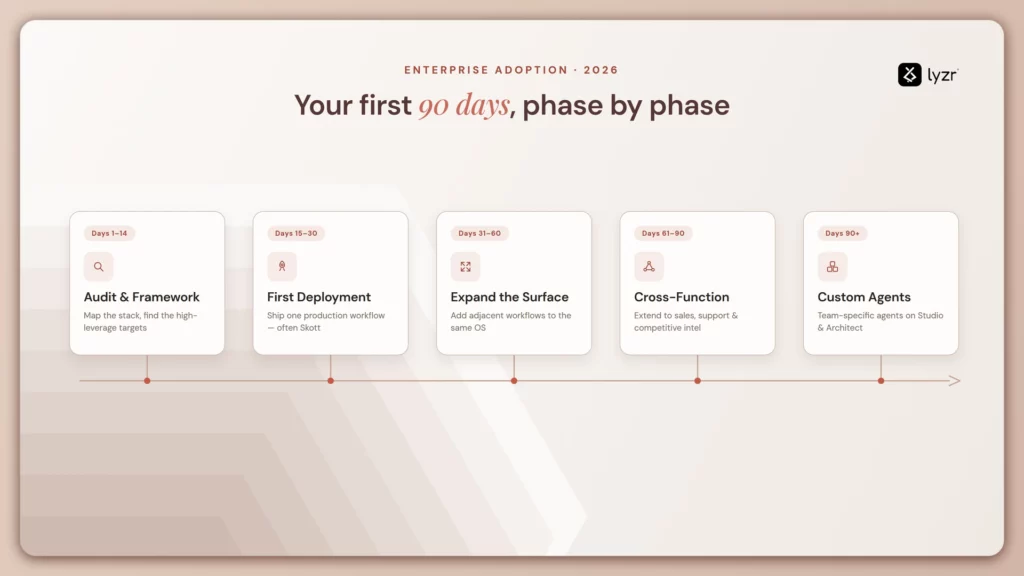
Days 1-14: Audit and framework. Map your current stack. Identify the workflows that consume the most operator time and add the least strategic value. Identify the workflows where the coordination overhead between tools is highest. These are your first agentic targets. Common candidates: content drafting, social scheduling, email segmentation, SEO keyword research, competitor monitoring, ABM personalisation.
Days 15-30: First OS deployment. Deploy the OS against the single workflow you identified as highest-leverage. For most teams, this is content optimisation, social coordination, or SEO/AEO. The goal is to ship one production workflow inside the OS within a month, not to boil the ocean. Skott handles many of these workflows natively, so the first deployment can often be Skott without custom configuration.
Days 31-60: Expand the agentic surface. As the first workflow proves value, expand to adjacent workflows inside the same OS. The typical sequence is content → social → email → SEO → ABM, but it can run in any order based on team priorities. The OS architecture means each new workflow joins the existing coordination layer rather than running as a new silo.
Days 61-90: Coordinate across functions. As marketing OS adoption matures, extend the agentic pattern to adjacent functions: sales (via Jazon for SDR work), customer support (via Jeff), competitive intelligence (via Kathy). Teams that adopt one Agentic OS typically adopt others within 6-12 months as the value pattern compounds.
Days 90+: Custom agent development. As the team develops muscle around the OS, custom agents for team-specific workflows can be built on Lyzr Agent Studio and Lyzr Architect. This is where enterprises differentiate: the base OS is common; the custom agents built on top are what make each team’s OS specific to their motion.
For the broader implementation context, the GTM marketing playbook covers the strategic layer, the content marketing playbook covers content workflows specifically, and the agents to production playbook covers the deployment pattern across the AI agent lifecycle.
For teams thinking about adjacent workflow-specific pillars: AI agents for marketing agency covers the agency deployment pattern, AI agents for digital marketing covers the digital marketing workflow patterns, AI agent for content creation covers content specifically, and the AI content generators comparison covers the underlying tool landscape.
The organisational shift that comes with adopting an Agentic OS
Adopting an Agentic OS for Marketing is not just a technology decision. It is an organisational shift.
The marketing team that operates an Agentic OS looks different from the marketing team that operates a traditional stack. Fewer people are needed for execution tasks that agents handle: copywriting, scheduling, list building, keyword research, competitive tracking. More people are needed for brand strategy, creative direction, agent governance and quality oversight, and the strategic thinking that shapes what the agents work on.
Some specific role shifts that Lyzr sees inside deployments:
- Content marketers move from writing to editing and directing. Instead of drafting 4-5 pieces per week, they set direction for 20-30 pieces the agents produce and focus their human effort on the pieces that need premium editorial judgement.
- Marketing ops leaders move from tool administration to system architecture. Instead of managing 15 tool contracts and 40 integrations, they design the OS workflows and the guardrails the agents operate within.
- CMOs and VPs of Marketing move from campaign approvals to portfolio decisions. Instead of approving each campaign, they set portfolio-level goals and let the agents allocate execution effort inside the goals.
- A new role emerges: Marketing AI operator. The person responsible for the OS itself. Sometimes this sits inside marketing ops. Sometimes it is a new hire. Either way, the role exists because someone has to own the health, performance, and evolution of the OS.
For teams thinking about this organisational shift, the content marketing playbook and the GTM marketing playbook walk through the org design implications inside content and demand generation specifically.
Frequently asked questions
What is an Agentic OS for Marketing?
An Agentic OS for Marketing is the coordinated operating layer that runs the marketing function end-to-end using autonomous AI agents. It orchestrates workflows across content, social, email, SEO, ABM, paid media, brand, and reporting under one system with shared context, memory, and governance. It differs from marketing automation (rules-based) and from AI features inside existing tools (single-task) by combining autonomy, coordination, and full-function coverage. Skott is Lyzr’s Agentic OS for Marketing.
How is an Agentic OS for Marketing different from marketing automation?
Marketing automation runs predefined rules to coordinate a subset of the marketing motion (email drips, form-to-CRM handoffs, basic personalisation). Every logic path has to be defined in advance by a human. An Agentic OS for Marketing runs autonomous agents that plan, decide, and act toward marketing goals without predefined step-by-step rules. The marketer sets outcomes and guardrails; the agents figure out the path.
How is an Agentic OS for Marketing different from a Marketing OS?
A Marketing Operating System (MOS) unifies data and orchestrates execution across channels but relies on humans to make most execution decisions from a dashboard. An Agentic OS adds autonomous agents that make the operational decisions inside the OS layer, so the human moves up the stack into strategy, judgement, and oversight. The MOS is a marketing dashboard with automation; the Agentic OS is a marketing team staffed by agents with human strategists.
What are the best Agentic OS for Marketing platforms in 2026?
The category has multiple emerging entrants each with different angles. Skott is Lyzr’s Agentic OS for Marketing, positioned for enterprise and regulated industries with sovereign deployment. Salesforce Marketing Cloud Next with Agentforce is the strongest incumbent CRM-anchored option. Copy.ai has repositioned as “The First AI Marketing OS” for mid-market. HubSpot Breeze extends HubSpot’s platform. Adobe Experience Platform Agent Orchestrator suits Adobe-anchored teams. The right choice depends on stack lock-in, deployment constraints, scope, timeline, and build appetite.
Do I need to replace my existing marketing stack to adopt an Agentic OS?
No. Most Agentic OS deployments start alongside the existing stack rather than replacing it. The OS layer integrates with CRMs, CMSs, analytics tools, and channel platforms via APIs. Over time, as the OS proves value, some legacy point tools tend to get retired because their function is absorbed by an agent. The full stack replacement typically happens gradually over 12-24 months rather than as a single migration event.
How long does it take to deploy an Agentic OS for Marketing?
For the first production workflow inside the OS, 30 days is typical from decision to first output. For coverage across the full marketing motion (content, social, email, SEO, ABM, paid, reporting), 90 days is realistic. Teams that move faster usually skip the initial workflow audit and end up deploying without measurable value hypotheses. Teams that move slower usually get blocked at security or governance review. Services-based delivery models (consulting firms building an OS from scratch) typically take 4-6 months for the first phase.
Does an Agentic OS for Marketing work for regulated industries?
Yes, but the deployment architecture matters. Public-cloud SaaS AI tools that send data to third-party APIs typically cannot deploy inside regulated environments (BFSI, insurance, healthcare, government). Sovereign AI architectures that deploy inside the enterprise perimeter and keep data inside customer infrastructure pass security review and compliance. Lyzr’s Sovereign AI, Responsible AI as a Service, and industry-specific product surfaces (banking, insurance, healthcare, financial services, government) are designed for this specifically.
What is the ROI of an Agentic OS for Marketing?
The measurable ROI shows up in three categories. First, content velocity: marketing teams typically produce 3-5x more content output per unit of human effort, with quality maintained through editorial oversight. Second, workflow coordination: time spent stitching tools together drops sharply, freeing marketing ops and marketers for higher-value work. Third, decision speed: campaign optimisation runs continuously rather than in weekly review cycles, which compounds over time. The Futurum Group Enterprise Software Decision Maker Survey (Q1 2026) shows Sales and Marketing as the second-highest agentic AI deployment priority at 51% of respondents, reflecting the buyer perception that ROI is real.
How does an Agentic OS handle brand voice and quality control?
Brand voice consistency is one of the load-bearing layers of the OS architecture. The foundation layer holds brand voice guides, tone-of-voice samples, customer language libraries, and strategic narrative. Every agent draws from this shared context. Quality control runs through human-in-the-loop checkpoints inside workflows (draft-review-publish cycles), through automated brand-safety guardrails at the governance layer, and through observability that flags drift over time. Teams typically maintain human review on all published outputs for the first 60-90 days and progressively increase agent autonomy as quality confidence builds.
Do I need engineering resources to deploy an Agentic OS for Marketing?
For pre-built OS deployments (Skott, Copy.ai, HubSpot Breeze, Salesforce Marketing Cloud Next), no. Marketing ops teams typically own the deployment with light engineering support for integrations. For custom agent development on top of the OS, some engineering or agent-development capacity helps but is not strictly required; Lyzr’s Agent Studio is low-code and Lyzr’s Architect is visual. For consulting-based models, the vendor brings the engineering, but the team ends up owning the resulting code.
What does Lyzr offer for marketing teams specifically?
Lyzr offers three paths for marketing teams. Skott, the Agentic OS for Marketing, is the coordinated operating layer that runs SEO, content, social, email, ABM, distribution, and reporting under one system. Pre-built marketing blueprints (AI content creation agent, AI social media agent, ABM agent, AEO/GEO optimizer, content distribution, ebook generator, AI webinar agent, press release writer, marketing strategy builder, internal communication agent) cover specific workflows. Lyzr Agent Studio and Lyzr Architect provide the platform for building custom marketing agents. All three paths deploy inside the enterprise perimeter for teams with sovereign requirements.
How do I get started with the Agentic OS for Marketing shift?
Start with the workflow audit. Map your current stack, identify workflows that consume the most operator time and have the highest coordination overhead, and pick one to run against an OS. For most teams that first workflow is content, SEO, or ABM. Deploy the OS against that one workflow in 30 days. Expand to adjacent workflows over the next 60-90 days. If you want to see how the OS pattern actually looks in production, book a demo with Lyzr and we will walk through Skott against your specific marketing motion.
Where to go from here
The Agentic OS for Marketing category will consolidate over the next 24-36 months. Marketing leaders who adopt now will have compounded advantage by the time the category matures. The right next step depends on where you are.
If you are exploring the category:
- Skott, the Agentic OS for Marketing
- The comprehensive AI in marketing guide — broad definitional coverage
- The AI in marketing 2026 guide — the tools-to-systems shift specifically
- The agentic AI explainer — the foundational concept
- The state of AI agents 2026 report — market adoption data
If you are evaluating specific platforms:
- Skott vs Writesonic vs Copy.ai vs Jasper — head-to-head tool comparison
- Skott vs traditional marketing — the broader category framing
- The 12 AI marketing agent use cases template — patterns we see most often
- The marketing agents overview — the full blueprint catalogue
If you are building the workflow spine:
- AI agents for SEO — SEO workflow patterns
- AI agent for content creation — content workflows
- AI agent for email marketing — email workflows
- AI agents for paid advertising — paid workflows
- LinkedIn marketing agent — LinkedIn specifically
- AI agents for brand building — brand workflows
- AI agents for marketing agency — agency deployment pattern
If you operate in a regulated industry:
- Sovereign AI — architectural reference
- Responsible AI as a Service — governance layer
- Banking marketing with Amadeo
- Insurance marketing with Benjie
- Healthcare agents
- Financial services agents
- Government
If you want to build custom marketing agents:
- Lyzr Agent Studio — low-code building
- Lyzr Architect — visual building
- Types of agents in production — architectural reference
- Agents to production playbook — deployment pattern
- Cognis memory layer — AI agent memory infrastructure
If you want to talk to the Lyzr team:
- Book a demo to see Skott in action against your marketing motion
- Customers and case studies for proof points
- Wall of love for what marketing leaders say
The category is moving. The buyer preference is shifting toward platform consolidation. The gap between the marketing teams that adopt an Agentic OS in 2026 and the ones that do not will be measured in output multiples, not incremental efficiency. The right time to build the framework is before the vendor conversations, not during them.
Book A Demo: Click Here
Join our Slack: Click Here
Link to our GitHub: Click Here