It started with a hiring algorithm.
A well-funded company deployed an AI model to screen resumes, faster decisions, less bias, the pitch was perfect.
Except the model had quietly learned to penalize certain names, certain zip codes, and award higher scores based on gender patterns baked into years of historical data. Nobody caught it. Not for months. And by the time someone did, thousands of candidates had already been filtered out by a system nobody had actually audited.
The cost? Lawsuits, headlines, and a governance overhaul nobody had budgeted for.
The lesson? AI without governance isn’t innovation. It’s a liability with a dashboard.
So let’s talk about what AI Governance Frameworks actually are, why 2025 made them non-negotiable, and what building one really looks like inside an enterprise.
Wait, Isn’t “AI Governance” Just a Fancy Word for Rules?
Kind of. But think of it less like a rulebook and more like the operating system underneath everything your AI does.
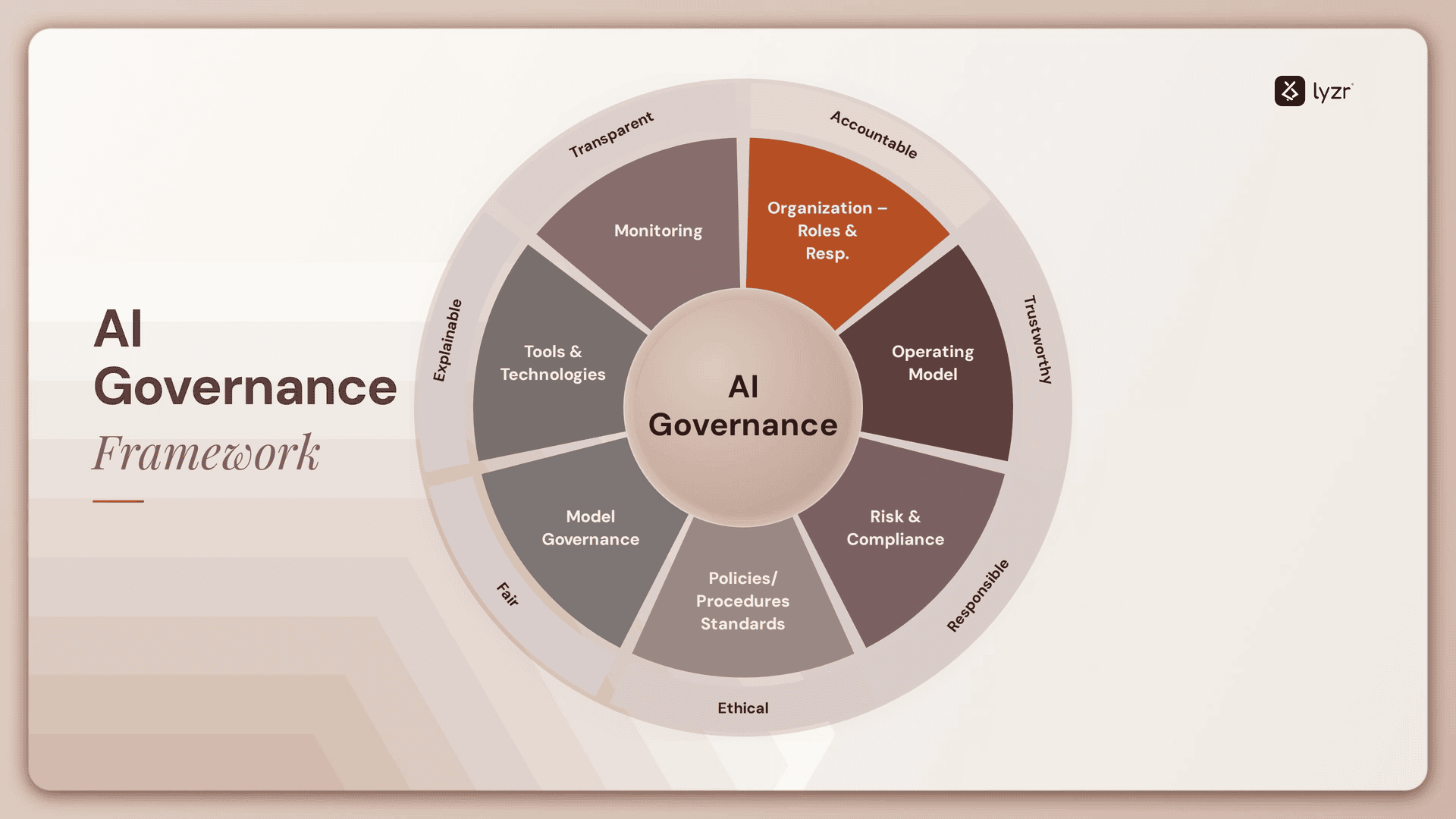
An AI Governance Framework is a structured set of policies, roles, accountability structures, and oversight mechanisms that guide how AI systems are built, deployed, monitored, and retired. It answers the hard questions most teams skip:
- Who actually owns the output of an AI model?
- What happens when the model gets it wrong?
- How do you explain a decision to a regulator who doesn’t care about your tech stack?
Here’s a quick gut-check:
Does your organization have a documented answer to all three questions above? If not, you’re operating without a framework.
That’s more common than you’d think. A 2025 EY survey found that only about one-third of companies say they have responsible controls governing their AI models. One third. In a year when generative AI is embedded in hiring, lending, customer service, and healthcare decisions.
4 Numbers That Tell You Everything About the State of AI Governance Right Now
Before we get into the how, let’s sit with the why for a moment, because sometimes the best argument for governance is a cold number staring back at you.
| Stat | |
| 95% of executives have experienced at least one problematic AI incident | |
| Trust in AI companies has fallen from 61% → 53% since 2019 | |
| Organizations with mature AI governance frameworks outperform peers by 21–49% | |
| A single HIPAA violation from AI data mishandling can cost up to $16 million |
Let those land for a second.
Now here’s the flip side: governance done right isn’t a cost center. It’s a competitive moat.
The 5 Pillars of an AI Governance Framework That People Actually Follow
Most frameworks sound great on paper and die in a Confluence doc nobody reads. Here’s what the ones that work have in common.
Pillar 1 — Accountability That Has a Name on It
“The team is responsible” means nobody is responsible.
Effective AI governance assigns named humans to specific decisions across the AI lifecycle — from data sourcing and model training through to deployment and decommissioning. In practice, that means defining roles like:
- AI Owners: business-side sponsors accountable for outcomes
- Model Custodians: technical owners of model behavior
- Ethics Reviewers: cross-functional oversight for high-risk deployments
Ask yourself: If an AI model in your company made a discriminatory decision today, who would you call first?
If the answer is “I’m not sure”, that’s your first governance gap.
Pillar 2 — Risk Tiering, Because Not All AI Is Equal
A spelling suggestion engine and a credit-scoring model are not the same risk category. They shouldn’t be governed the same way.
Frameworks like the NIST AI Risk Management Framework (AI RMF) and the EU AI Act both treat tiered risk classification as a non-negotiable foundation. High-risk use cases — medical diagnosis, financial decisions, hiring, law enforcement — need heavier oversight, explainability requirements, and human-in-the-loop checkpoints. Low-risk automation gets lighter treatment.
The EU AI Act, adopted in 2024 and being phased in through 2026, is the world’s first comprehensive AI regulation — and it mandates this tiering for any organization operating in or selling to European markets.
Not started yet? The clock is ticking.
Pillar 3 — Transparency and Explainability, Built In (Not Bolted On)
Here’s a scenario: A customer is denied a loan. They ask why. Your AI made the decision.
Can you explain it in plain language?
If the answer is “the model said so” — you have a problem, legally, ethically, and reputationally. Explainability isn’t just a technical feature. It’s a governance requirement. Mature frameworks build it into model selection criteria from day one, not as an afterthought post-deployment.
This is where Responsible AI, Ethical AI, and Algorithmic Transparency converge — and increasingly, auditors and regulators are asking about all three in the same conversation.
Pillar 4 — Continuous Monitoring, Because Models Drift
Here’s something that doesn’t get talked about enough: models degrade.
The world changes. Data distributions shift. A model performing well in 2023 may be quietly making bad decisions in 2026 — and nobody notices until something breaks. Governance frameworks need to include:
- Drift detection — automated alerts when model behavior deviates from baseline
- Incident response protocols — a defined process for when a model fails in production
- Scheduled revalidation — periodic human review on top of automated checks
Think of it like a vehicle inspection, but for decisions that affect people’s livelihoods.
Pillar 5 — Compliance Mapping, So You Know Which Regulations Apply to You
The regulatory landscape for AI is moving fast. Here’s a snapshot of what’s active or imminent:
| Framework | Region | Focus |
| EU AI Act | European Union | Risk-tiered, comprehensive AI regulation |
| NIST AI RMF | United States | Voluntary but widely adopted |
| ISO/IEC 42001 | Global | AI management systems standard |
| DORA | EU Financial Services | Operational resilience including AI systems |
| SEC AI Risk Mandates | United States | AI transparency in financial reporting |
If you operate across multiple geographies, you’re likely subject to more than one of these simultaneously. Governance frameworks need to be built with regulatory cross-mapping in mind — not retrofitted jurisdiction by jurisdiction after a compliance gap is flagged. A GRC Solution operationalizes that cross-mapping by tying each AI system to its applicable controls, owners, and evidence on an ongoing basis.
“But We’re Moving Fast, Won’t Governance Slow Us Down?”
This is the most common pushback. It’s worth addressing head-on.
Governance done poorly does slow things down. A 47-page policy document that sits in a drawer creates friction without any value.
But governance done well accelerates deployment. Here’s why:
- Pre-approved risk tiers mean fewer one-off review cycles per project
- Standardized documentation eliminates the “what did we do here?” scrambles during audits
- Teams that trust their governance layer move faster because they’re not second-guessing every edge case
The organizations treating governance as a growth enabler, not a compliance checkbox, are the ones outperforming peers by 21–49%.
That number again. Let it do its work.
A Quick Governance Audit — Run This With Your Team Right Now
Be honest. Check what actually applies to your organization today.
| Governance Checkpoint | Status |
| Every AI system in production is classified by risk tier | ✅ / ❌ |
| There’s a named human accountable for each AI system’s outcomes | ✅ / ❌ |
| Your models have documented explainability for high-stakes decisions | ✅ / ❌ |
| You have a defined process for when a model fails or drifts | ✅ / ❌ |
| Governance policies are reviewed and updated at least annually | ✅ / ❌ |
| You have an audit trail for AI decisions in regulated use cases | ✅ / ❌ |
How many did you check?
No judgment — but this is your baseline. And if you’re sitting at 2 or fewer, you’re not alone. Most enterprises are.
The Governance Gap Nobody’s Talking About Yet: Agentic AI
Here’s where the conversation gets critical for 2026 and beyond.
We’re not just talking about a single ML model anymore. Enterprises are now deploying networks of AI agents — systems that perceive, reason, and act autonomously across business workflows. A single agent might pull data from your CRM, cross-reference a compliance database, draft a response, and send it — all without a human in the loop.
That’s powerful. And that’s exactly why governance frameworks designed for traditional ML models are already out of date.
The emerging challenge isn’t just “can we explain this model’s decision?”
It’s: Can we trace what every agent in our enterprise is doing, enforce consistent guardrails across all of them, and produce a unified audit trail for compliance?
For a Fortune 100 CIO, this is not a hypothetical. It’s a daily operational reality. Organizations have invested in agents across LangGraph, Agentforce, CrewAI, and other frameworks. These agents operate in silos — no common standard, no central visibility, no unified way to enforce policy or trace activity.
That’s the governance gap defining the next chapter of enterprise AI.
If that gap is the one you’re staring at, The CIO Playbook to AI Agent Governance lays out the five control points that govern every agent across any framework, and a scored worksheet to find your two weakest first.
If You’re Serious About Closing That Gap — This Is Where Lyzr Comes In
If you’ve been reading this thinking “yes, we need this, but getting it off the ground feels like another 18-month project” — that’s exactly the gap Lyzr.ai was built to close.
Lyzr is an enterprise AI agent infrastructure platform that treats governance not as something you layer on top of your AI stack, but as something built into the foundation of every agent you deploy.
Here’s what that looks like in practice:
- One Control Plane for Every Agent You Already Have
Lyzr’s GitClaw takes agents already built on LangGraph, Agentforce, CrewAI, or any other framework and converts them into a standardized registry with centralized policy enforcement and a unified audit trail. No rip-and-replace. No rebuilding from scratch.
- Full Observability on Every Agent Run
Every action is traced in real time. Every decision is logged. Your compliance team gets the audit trail they need. Your engineering team gets the operational visibility they need. All from one console.
- Hallucination and PII Checks Before Output Reaches Anyone
Before any agent response reaches a user, Lyzr checks it — hallucination control, PII redaction, output validation. Governance at the last mile, not as a manual review layer.
- 10,000 Simulations Before an Agent Goes Live
Lyzr’s proprietary Agent Simulation Engine runs up to 10,000 simulations mimicking real-world edge cases before deployment. Think of it as crash-testing your AI before letting it make decisions that matter.
- Role-Based Access and Human-in-the-Loop, by Design
Governance isn’t just technical — it’s organizational. RBAC, SSO, audit logging, and human escalation workflows are built in so the right people are in the loop for the right decisions.
Lyzr is already trusted by Accenture, AWS, Hitachi Energy, EY, Morgan Stanley, and AirAsia. It’s backed by Accenture Ventures with a $14.5M raise that put its valuation at $250M. This isn’t a startup experiment — it’s production-grade governance infrastructure.
“Lyzr was the only vendor that could articulate and then deliver what happens after the demo. Most platforms stop at the POC. Lyzr stayed through production.” — Enterprise Customer
If your governance challenge is agentic AI at scale — Lyzr is worth a serious look. Book a demo here →
Here’s the Real Bottom Line
The companies that win with AI over the next five years won’t be the ones who moved fastest.
They’ll be the ones who moved sustainably — building trust with regulators, customers, and their own employees by operating AI they can explain, audit, and stand behind.
An AI Governance Framework isn’t a bureaucratic tax on innovation. It’s the infrastructure that makes innovation safe enough to scale.
Let’s end where we started — that hiring algorithm. The company that deployed it didn’t fail because their AI was bad. They failed because nobody was watching. Nobody had drawn the lines. Nobody had asked the right questions before go-live.
Don’t be that company.
Build the framework. Name the owners. Trace the decisions. And if you’re deploying AI agents at scale — make sure governance is at the core of your stack, not an afterthought.
Book A Demo: Click Here
Join our Slack: Click Here
Link to our GitHub: Click Here