TL;DR
- Data sovereignty is about which jurisdiction’s laws govern your data, not just where a server happens to sit.
- It is distinct from data residency (physical storage location) and data localization (a legal requirement to keep data in-country).
- Regulations like GDPR, sector laws, and cross-border transfer rules make data sovereignty a compliance issue, not just an IT one.
- Cloud computing complicates sovereignty because storage, processing, and access can each sit in different jurisdictions.
- AI adds a new layer: prompts, context, and model outputs can move through infrastructure you don’t control, which is where sovereign AI becomes relevant.
- Organisations can approach this with a practical framework: map, understand, evaluate, control, monitor, extend.
A hospital in Manchester signs a contract with a US-headquartered cloud provider. The data center is in Dublin. The support team troubleshooting an outage is in Bangalore. The backup replica lives in Frankfurt.
Ask that hospital’s compliance officer where the patient data “is,” and the honest answer is: it depends which layer you’re asking about, and which government you’re asking on behalf of.
This is the situation most organisations are now in, whether they’ve mapped it out or not. Cloud platforms, SaaS tools, and AI systems move data across borders as a matter of routine operation, often without anyone in the business noticing it happened. That movement raises a question that has nothing to do with server racks and everything to do with law: which country’s rules actually apply to this information, and who has the legal right to demand access to it?
That question is data sovereignty. It’s a distinct concept from where data physically sits, and confusing the two is one of the most common, and most costly, mistakes compliance teams make.
Data sovereignty is the principle that data is governed by the laws and regulations of the jurisdiction where it is stored, processed, or generated. It determines how organisations can collect, store, access, transfer, and protect data while meeting applicable legal and regulatory requirements.
This article walks through what that means in practice, how it differs from data residency and data localization, why it matters across regulated industries, and how it extends into cloud computing and AI.
What is data sovereignty?
Data sovereignty is the idea that data falls under the legal authority of a specific jurisdiction, and that authority determines how the data can be handled.
Data sovereignty is the legal principle that digital information is subject to the laws, regulations, and governance frameworks of the country or region where it is physically stored or processed.
But that’s only the starting point. The harder, more useful version of the definition looks at who actually holds legal power over the data, not just where it happens to sit at rest.
Three things determine that legal picture:
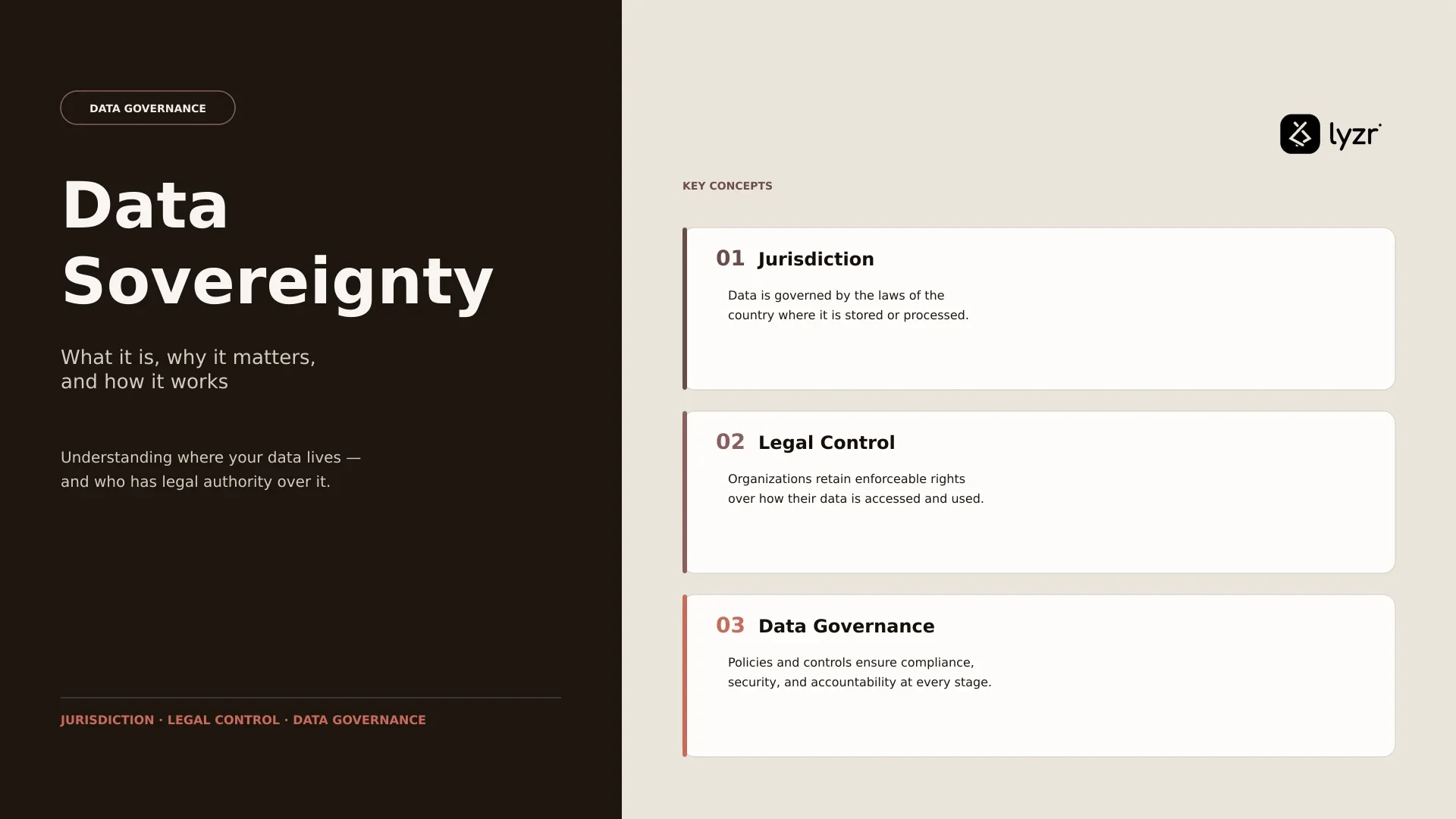
- Jurisdiction. Which country’s or region’s laws apply to this data, based on where it’s stored, where it’s processed, and the legal domicile of the organisation handling it.
- Legal authority and access. A government’s ability to compel a company to hand over data, through a warrant, subpoena, or national security order, is a sovereignty issue even if the data never physically moves.
- Governance and control. The policies, contracts, and technical controls an organisation puts in place to manage data according to whichever legal framework applies to it.
Beyond location and law, sovereignty involves who has the authority to access, modify, delete, or transfer data, including both the data owner and government authorities.
Here’s why physical location alone doesn’t settle the question.
A European company using a U.S. cloud provider might achieve data residency by storing data in European data centers, but data sovereignty questions arise if U.S. authorities can legally compel the provider to access that data.
The server is in Europe. The legal exposure isn’t. That gap between “where it sits” and “whose laws reach it” is the entire reason data sovereignty exists as a separate concept from storage location, and it’s the source of most of the confusion organisations run into when they start asking these questions.
Data sovereignty vs data residency vs data localization
These three terms get used interchangeably in vendor marketing and compliance conversations alike, which causes real problems. They answer different questions, and an organisation can satisfy one without satisfying the other two.
Data sovereignty vs data residency vs data localization: a comparison
| Concept | What it answers | Nature of the concept |
|---|---|---|
| Data sovereignty | Which laws and jurisdiction govern the data, and who has legal authority to access or compel it? | Legal principle |
| Data residency | Where is the data physically stored at rest, often for performance or business reasons? | Location choice |
| Data localization | Does a specific law require certain data to remain within a jurisdiction’s borders? | Legal mandate |
Data residency is a location choice.
Data residency refers to the physical or geographical location where data is stored and processed, often driven by performance, latency, or regional business requirements, but without the strict legal implications of sovereignty.
A company can pick a data residency location for entirely practical reasons and still be exposed to foreign legal reach, as the European-company-plus-US-cloud-provider example above shows.
Data localization is a legal mandate, not a preference.
While data sovereignty emphasizes a country’s legal authority over data within its borders, data localization specifically refers to the practice of requiring data to be physically stored and processed within a specific country or geographic region.
Russia, China, and India have all passed localization requirements for specific categories of data, particularly financial and government-related records. When a localization law exists, residency stops being optional and becomes a compliance requirement.
Data sovereignty sits above both. It’s the question of legal control, and it’s what determines whether residency and localization choices actually deliver the protection organisations think they do. You can have data residency in a trusted jurisdiction and still lack sovereignty if a foreign parent company, foreign-owned cloud provider, or cross-border legal instrument can reach that data anyway. That’s the gap that catches most compliance teams off guard, and it’s why treating these three terms as synonyms is a planning risk, not just a semantic one.
Why does data sovereignty matter?
Regulatory compliance. Different jurisdictions impose different, sometimes conflicting, data protection obligations.
The European Union’s General Data Protection Regulation (GDPR) laws were the first set of data privacy regulations aimed at protecting individual citizens’ privacy rights across international borders, and its extraterritorial scope and strict rules on data transfers forced organizations to rethink their data processing and storage practices.
Sector-specific rules add another layer: healthcare data, financial records, and government information each carry their own obligations on top of general privacy law.
Data privacy and protection. Sovereignty determines which legal protections actually travel with a piece of personal data.
Some paradigms seek to make sure that the legal protections guaranteed to data generated in a jurisdiction will follow the data even if it is processed or stored in another jurisdiction.
Without a clear sovereignty position, an organisation can’t reliably answer whether a customer’s data is actually protected once it leaves its country of origin.
National security. For governments and critical infrastructure operators, sovereignty isn’t a compliance nicety, it’s an operational requirement.
For many countries, the issue of data sovereignty is presented as an issue of national security, with concerns over being able to protect citizens’ personal data.
Risk management. Third-party and cloud relationships create legal ambiguity that pure contracts don’t always resolve. Foreign ownership or foreign incorporation of a service provider can expose data to legal instruments like the US CLOUD Act, regardless of where the servers physically sit, which is exactly the kind of exposure a sovereignty assessment is designed to catch before a contract is signed rather than after a regulator asks about it.
Operational control. Knowing where data moves and who can touch it isn’t just a defensive measure. It’s the foundation that makes audits, incident response, and vendor management workable instead of guesswork.
None of these reasons require an organisation to be a bank or a government agency. They apply anywhere sensitive data crosses a border, which today is almost everywhere.
Who needs to care about data sovereignty?
Some sectors face this question with more legal weight than others, but the underlying exposure is broadly the same shape wherever regulated or sensitive data is involved.
Government and public sector organisations hold citizen data and, often, information tied to national security, making sovereignty a statutory requirement rather than a best practice.
Financial services firms handle transaction records, account data, and identity information subject to overlapping national and sector regulation, often across multiple countries at once.
Healthcare organisations manage patient records where jurisdiction determines which privacy protections apply and who can legally request access to that information.
Defence and critical infrastructure operators treat data sovereignty as inseparable from national security, since foreign access to operational data can be a strategic vulnerability.
Multinational enterprises operate across jurisdictions with genuinely conflicting rules, where a transfer that’s routine in one country can be a violation in another.
Regulated enterprises more broadly, insurers, legal firms, telecoms, and any organisation handling large volumes of sensitive personal or financial data, increasingly face sovereignty questions from regulators, auditors, and customers alike. Many of these organisations lean on dedicated compliance teams to translate sovereignty requirements into day-to-day controls. In the UK specifically, public-sector procurement and financial services oversight have both sharpened their focus on where data sits and who can reach it, but this is a pattern showing up across the EU, the Gulf, and Asia-Pacific in parallel, not a UK-only concern.
Data sovereignty and cloud computing
Cloud computing is where sovereignty stops being a theoretical legal question and becomes a daily operational one. A single workload can involve data stored in one region, processed in another, backed up in a third, and administered by support staff in a fourth.
Many organizations use their cloud infrastructure to store data in one region, process it in another, and replicate it to multiple locations to improve performance, all of which makes data sovereignty more challenging.
A few factors decide whether that arrangement is actually sovereign, or just looks tidy on paper:
- Provider infrastructure and legal domicile. Where a provider’s data centers sit matters less than where the provider itself is legally headquartered, because that determines which government can compel it to act.
- Processing versus storage location. Data can be stored in a compliant region while being processed, temporarily or persistently, somewhere else entirely. Storage location guarantees rarely cover processing location by default.
- Encryption and key management. Who holds the encryption keys decides who can actually read the data, independent of where it’s stored. If the cloud provider holds the keys, it can be legally compelled to decrypt data even when the customer never intended that access to be possible.
- Legal jurisdiction of the vendor relationship. A provider incorporated in a country with broad extraterritorial data-access laws can create exposure even when every server involved sits in a “safe” region.
This is the exact set of problems that gave rise to sovereign cloud as a distinct infrastructure category: cloud environments purpose-built to give stronger, verifiable guarantees on where data lives, who can process it, and who can access it. Data sovereignty is the legal principle; sovereign cloud is one architectural answer to it.
What Is Sovereign Cloud? The Enterprise Guide to Data Sovereignty

Data sovereignty and AI
AI systems don’t just store data, they move it constantly, and in ways that are harder to trace than a database read or write.
A prompt sent to a model, a document retrieved for context, a conversation logged for quality review, a third-party API call made mid-inference: each of these is a data event, and each one can cross a jurisdictional line without anyone explicitly deciding it should.
Training data, prompts, embeddings, model artifacts, inference outputs, logs and telemetry all need to remain within whatever jurisdictional or organizational boundary an organisation actually requires.
Most AI deployments were never architected with that requirement in mind.
That leaves organisations facing a question sovereignty planning didn’t used to have to answer: where does the data go when an AI system processes it, and who ultimately controls that environment?
Answering that question well, at the infrastructure, model, and governance level rather than just the storage level, is what the concept of sovereign AI is built to address. Where data sovereignty asks which laws govern the data, sovereign AI asks the same question about the entire stack that touches that data once an AI system starts using it: the model, the compute, the logs, and the operational controls around all of it.
How organisations can approach data sovereignty
None of this is solved with a single policy document. It’s an ongoing practice, and it tends to follow a consistent sequence regardless of industry.
Data sovereignty checklist
- Map where data is stored, identify physical locations and the jurisdictions they fall under, including backups and disaster recovery sites.
- Map where data is processed, storage location and processing location are rarely the same thing, and both carry legal weight.
- Understand applicable regulations, jurisdiction-specific and sector-specific rules both apply, often simultaneously.
- Evaluate third-party providers, their infrastructure, their legal domicile, and who on their side can access your data.
- Strengthen access and encryption controls, particularly key management, since key custody often decides real-world access more than location does.
- Monitor cross-border data movement, not as a one-time audit, but as an ongoing visibility requirement.
- Extend sovereignty considerations to AI, workloads, model context, retrieved data, and logs all deserve the same scrutiny as a database.

This sequence is deliberately ordered. Skipping straight to “evaluate providers” without first mapping where data actually lives and moves is how organisations end up with contracts that sound reassuring and don’t hold up under a real audit.
Challenges and limitations
Data sovereignty is a moving target, and a few structural realities make it genuinely difficult rather than just administratively tedious.
Interconnected systems move data in ways that resist mapping. APIs, integrations, and SaaS tools pass data between systems constantly, often across borders, in ways that aren’t always visible to the teams responsible for governance.
Cloud environments obscure both physical and legal control.
Data stored in cloud computing services may be under the jurisdiction of more than one country’s laws, and different legal requirements regarding data security, privacy, and breach notification could occur depending on where the data is being hosted or who is controlling it.
Regulations differ by jurisdiction, and they change. A transfer mechanism that’s compliant today can become invalid after a single court ruling.
Following the Schrems II decision, organisations must assess whether the destination country’s laws could affect the protection of transferred data.
That single legal decision forced a wholesale rework of how companies justified EU-to-US data transfers, and similar shifts can happen again.
Third-party providers add dependencies you don’t fully control. Even with strong contracts, an organisation is trusting a vendor’s infrastructure decisions, personnel access policies, and legal posture, none of which the organisation can unilaterally change.
Sovereignty is not the same as security or privacy. Meeting sovereignty requirements doesn’t automatically mean data is encrypted properly, access is well managed, or breach risk is low. It’s a legal and jurisdictional framework, not a security control in itself.
And the distinction that trips up the most organisations: keeping everything inside one country’s borders isn’t the same as achieving full sovereignty. If a foreign-owned provider operates that in-country infrastructure, or if a foreign government has a legal mechanism to compel access regardless of physical location, geographic containment alone hasn’t solved the underlying problem.
Data sovereignty and sovereign AI
Data sovereignty is the foundational layer in a broader hierarchy: data sovereignty leads into infrastructure and cloud sovereignty, which in turn leads into sovereign AI. Each layer inherits the requirements of the one beneath it and adds its own.
Sovereign AI is not a single architecture, but rather a spectrum of control based on organizational or national needs.
It extends sovereignty thinking beyond the data itself, to the models processing it, the infrastructure running those models, the people operating that infrastructure, and the governance wrapped around the whole system.
Understanding data sovereignty well is what makes that next conversation, about sovereign AI, actually productive instead of theoretical.
Where this leads for organisations moving AI into production
Data sovereignty becomes harder to treat as a one-time compliance exercise once AI workloads move from pilot to production. It stops being only a question of where data resides, and starts being a question of how AI systems are deployed, governed, monitored, and controlled on an ongoing basis, because AI systems generate new data (logs, embeddings, outputs) continuously rather than storing a fixed dataset once.
Lyzr’s work with regulated enterprises and government organisations centres on exactly this shift: building agent infrastructure where data sovereignty isn’t bolted onto a contract after deployment, but is part of the architecture from the start. For organisations that have mapped their sovereignty position and are now asking what that means for AI specifically, the comparison of sovereign AI platforms is the logical next read.
Top 5 Sovereign AI Platforms in 2026: A Buyer’s Comparison
Frequently asked questions
What is data sovereignty?
Data sovereignty is the principle that data is governed by the laws of the jurisdiction where it is stored, processed, or generated. It determines who has legal authority over the data, including the right to access, request, or compel disclosure of it, regardless of where the underlying infrastructure physically sits.
Why is data sovereignty important?
Data sovereignty is important because it determines which legal protections and obligations apply to an organisation’s data, including regulatory compliance, privacy rights, and government access rules. Without a clear sovereignty position, organisations can’t reliably assess legal risk when data moves across cloud providers, vendors, or borders.
What is the difference between data sovereignty and data residency?
Data sovereignty concerns which jurisdiction’s laws govern the data and who can legally access it. Data residency is simply the physical location where data is stored, often chosen for performance or business reasons. An organisation can have data residency in one country while still facing sovereignty exposure from a foreign-owned provider.
What is the difference between data sovereignty and data localization?
Data localization is a specific legal requirement mandating that certain data physically remain within a country’s borders. Data sovereignty is the broader legal principle governing which jurisdiction’s laws apply to the data overall. Localization is one regulatory tool governments use to enforce sovereignty; sovereignty is the underlying concept.
What are the challenges of data sovereignty?
The main challenges include tracking data as it moves through interconnected cloud systems, keeping up with regulations that vary by jurisdiction and change over time, managing dependency on third-party providers, and understanding that sovereignty compliance does not by itself guarantee data security or privacy protection.
How does data sovereignty apply to cloud computing?
Cloud computing complicates data sovereignty because storage, processing, backup, and administrative access can each occur in different jurisdictions for a single workload. Organisations need visibility into provider infrastructure, legal domicile, encryption and key management, and processing locations, not just where data is stored at rest.
How does data sovereignty affect AI?
AI systems introduce new sovereignty considerations because prompts, retrieved context, model outputs, and logs can move through infrastructure and third-party services across multiple jurisdictions. This raises the question of where data goes when an AI system processes it and who controls that environment, which is the starting point for sovereign AI.
Final thought
Most organisations can answer “where is our data stored” with reasonable confidence. Far fewer can answer “whose laws actually govern it, and who can compel access to it” with the same certainty, and that second question is the one regulators, auditors, and courts actually care about.
That gap is worth sitting with for a moment, particularly for any team currently evaluating a cloud provider or AI vendor on data residency guarantees alone. Residency is a location. Sovereignty is a legal condition. Confusing the two doesn’t just create a compliance risk, it creates a false sense that the risk has already been handled.
The organisations getting this right treat data sovereignty as an ongoing practice, not a checkbox in a vendor RFP, and they extend that same discipline to their AI systems as those systems move from pilot into production. If your team has mapped where its data lives but hasn’t yet asked where that data goes when an AI agent processes it, that’s the next question worth answering.
Book A Demo: Click Here
Join our Slack: Click Here
Link to our GitHub: Click Here