A customer support agent starts hallucinating refund policies. A sales research agent suddenly stops pulling data from Salesforce. An underwriting agent begins producing different risk scores for the same application. Engineering teams immediately ask the same question:
What changed?
The problem is that AI agents don’t change in just one place.
- A prompt gets updated.
- A model gets swapped.
- A workflow node gets modified.
- A retrieval configuration changes.
- A new tool is connected.
- An access policy is updated.
Any one of these changes can alter agent behavior.
Without agent versioning, identifying the root cause can take hours, or even days.
As organizations move from a handful of AI agents to hundreds, versioning is becoming a foundational requirement for AgentOps.
Why Traditional Version Control Breaks Down for AI Agents
Many teams assume Git is enough. It isn’t.
Git tracks source code extremely well.
The problem is that most of an agent’s behavior lives outside source code.
Consider a typical enterprise agent:
| Component | Stored in Git? | Impacts Agent Behavior? |
| Source Code | Yes | Yes |
| System Prompt | Sometimes | Yes |
| Model Selection | Often No | Yes |
| Workflow Configuration | Sometimes | Yes |
| RAG Knowledge Base | Usually No | Yes |
| Connected Tools | Often No | Yes |
| Memory Configuration | Usually No | Yes |
| Agent Permissions | Rarely | Yes |
An engineering team may see no meaningful code changes while the agent behaves completely differently in production.
That’s why organizations are beginning to think beyond code versioning and toward agent versioning.
The $500,000 Debugging Problem Nobody Talks About
Imagine a financial services company running 150 AI agents.
Each agent receives just two updates per month.
That creates:
| Metric | Value |
| Active Agents | 150 |
| Updates Per Agent Per Month | 2 |
| Total Agent Changes Monthly | 300 |
| Total Agent Changes Annually | 3,600 |
Now imagine that just 5% of those updates introduce unexpected behavior.
That’s 180 investigations every year.
If each investigation takes:
- 4 engineers
- 3 hours each
The organization spends: 2,160 engineering hours annually
just answering:
“What changed?”
Agent versioning is not a governance problem. It’s a productivity problem.
What Actually Needs Versioning?
One of the biggest misconceptions is that prompt versioning equals agent versioning. Prompts are only one part of the equation. A production-grade agent should track changes across the entire agent stack.
Layer 1: Behavioral Changes
These affect how the agent thinks.
Examples include:
- Prompt updates
- Goal changes
- Policy modifications
- Reasoning instructions
Layer 2: Operational Changes
These affect what the agent can do.
Examples include:
- New tool integrations
- API updates
- Workflow changes
- Trigger modifications
Layer 3: Knowledge Changes
These affect what the agent knows.
Examples include:
- New documentation
- Updated vector databases
- Retrieval settings
- Knowledge source changes
Layer 4: Infrastructure Changes
These affect how the agent runs.
Examples include:
- Model upgrades
- Memory configurations
- Runtime settings
- Deployment environments
Without visibility across all four layers, root-cause analysis becomes guesswork.
A Realistic Example: Version 1.7 vs Version 1.8
A customer support agent is successfully handling 25,000 conversations per month.
The team releases Version 1.8.
Performance immediately drops.
Customer satisfaction falls from:
| Metric | Version 1.7 | Version 1.8 |
| Resolution Rate | 82% | 69% |
| Escalation Rate | 12% | 27% |
| Customer Satisfaction | 4.5/5 | 3.8/5 |
The issue isn’t obvious.
The engineering team discovers Version 1.8 introduced:
- A prompt update
- A model change
- A new retrieval strategy
- An additional CRM integration
Four changes shipped together.
Without agent versioning, isolating the root cause becomes extremely difficult.
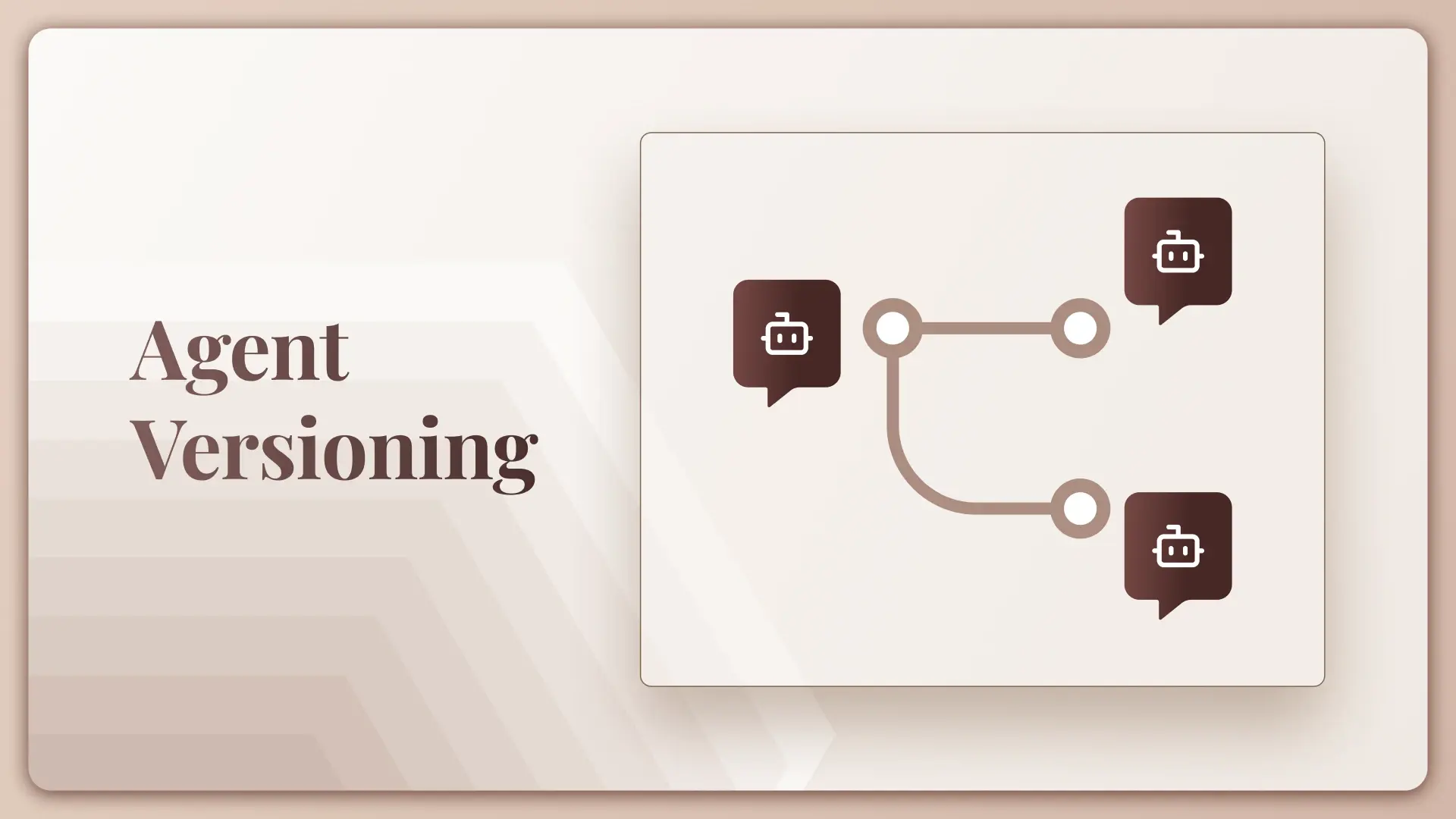
With versioning, teams can compare versions side by side and identify exactly what changed.
Agent Versioning Is Becoming the Foundation of AgentOps
DevOps introduced:
- CI/CD
- Monitoring
- Infrastructure as Code
- Version Control
AgentOps is introducing:
| DevOps Era | AgentOps Era |
| Application Versioning | Agent Versioning |
| CI/CD Pipelines | Agent Deployment Pipelines |
| Infrastructure Monitoring | Agent Behavior Monitoring |
| Source Control | Agent Lifecycle Control |
| Application Rollbacks | Agent Rollbacks |
The pattern is familiar.
Every technology shift eventually creates a need for lifecycle management.
AI agents are no different.
What Enterprise Teams Should Look For?
As agent deployments grow, versioning platforms should support:
| Capability | Why? |
| Version History | Track every change |
| Diff Comparisons | Understand what changed |
| Rollbacks | Recover quickly |
| Approval Workflows | Governance and compliance |
| Branching | Experiment safely |
| Audit Trails | Regulatory requirements |
| Environment Promotion | Development → Staging → Production |
| Ownership Tracking | Accountability |
Without these capabilities, scaling agents becomes operationally expensive.
Agent Versioning Is Where Git Was 20 Years Ago
Before Git became standard, software teams relied on shared folders, ZIP files, and naming conventions.
Projects looked like this:
final_v2.zip
final_v3.zip
final_v3_final.zip
final_v3_final_latest.zip
Today that sounds ridiculous.
Yet many AI teams are managing agents using:
- Prompt_v12.txt
- SupportAgent_Final
- SalesAgent_New_v4
- Agent_Production_Latest
The industry is repeating the same pattern.
The difference is that agents are significantly more complex than code files.
Which is why agent versioning is quickly becoming a critical layer in the AI agent development lifecycle.
Where GitAgent Fits Into Agent Versioning
As organizations move toward large-scale agent deployments, they need more than prompt storage.
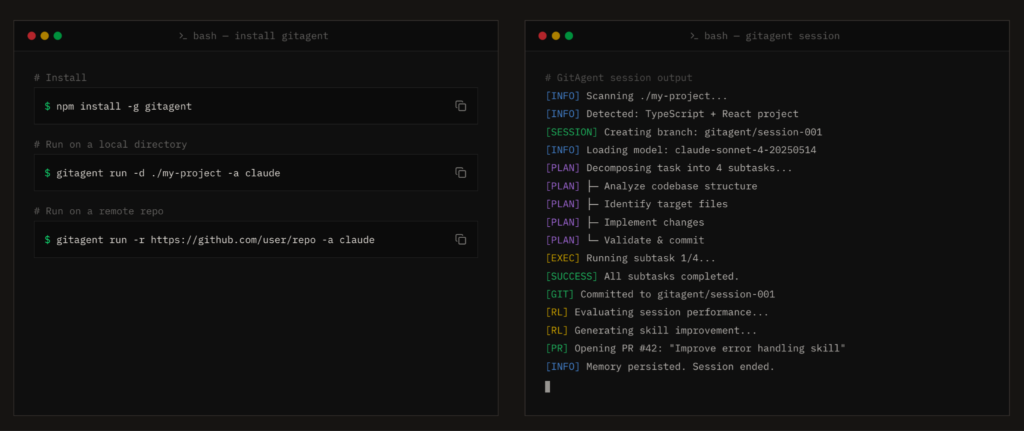
They need a system designed specifically for agent lifecycle management.
This includes:
- Tracking agent versions
- Comparing agent changes
- Managing deployments
- Monitoring agent evolution
- Enabling safe rollbacks
- Maintaining audit trails
In the same way Git became the system of record for software, platforms like GitAgent are emerging as the system of record for AI agents.
Because once organizations are managing hundreds of agents, knowing which version is running becomes just as important as building the agent itself.
Final Thoughts
The future challenge of AI won’t be creating agents. It will be operating them reliably.
As agent ecosystems grow, every prompt update, workflow modification, model upgrade, and knowledge change introduces risk.
Agent versioning provides the visibility needed to manage that complexity.
Without it, teams spend their time investigating changes.
With it, they spend their time shipping improvements.
Book A Demo: Click Here
Join our Slack: Click Here
Link to our GitHub: Click Here