TL;DR
- Sales enablement is shifting from “give reps better content” to “give reps an execution layer that acts inside their workflow.”
- The core components (content, training, coaching, technology) haven’t changed. What’s changed is who does the surfacing: the rep, a tool, or an agent.
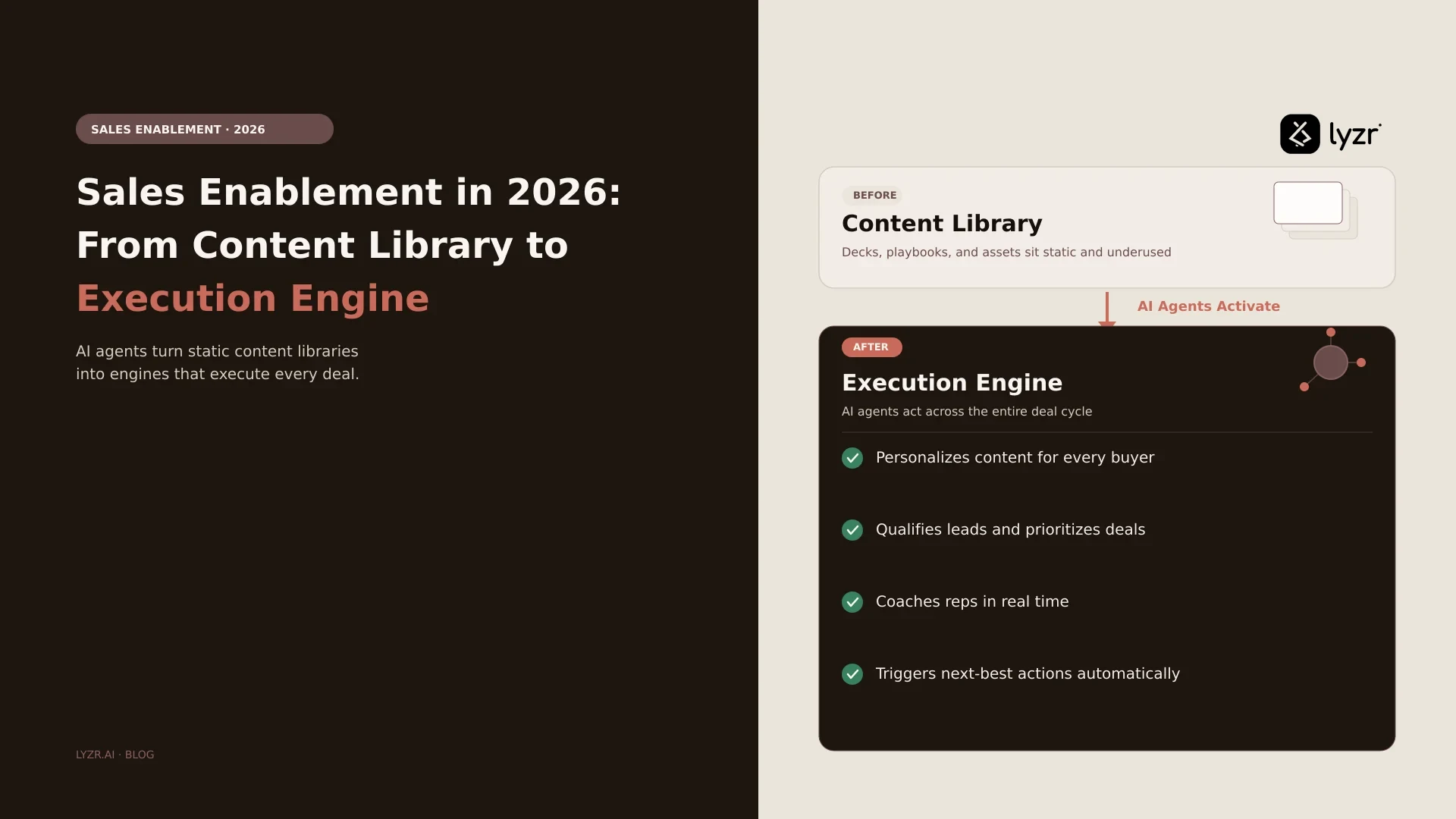
- Agentic sales enablement means AI agents proactively recommend and execute next-best actions inside the CRM, not just retrieve documents.
- Governance (audit trails, human oversight, controlled deployment) is the part almost nobody covering this topic addresses, and it’s the part that decides whether agentic enablement survives contact with a compliance review.
- The future isn’t better AI tools. It’s intelligent, governed assistance embedded directly into where sales decisions actually get made.
Every sales enablement definition on the internet says roughly the same thing, and that’s not an accident. It’s because the discipline has genuinely converged on a shared set of components: content, training, coaching, technology. What hasn’t converged is what happens next, a question this piece and the broader conversation on the Lyzr blog both keep returning to.
For a decade, enablement meant building a library and hoping reps used it. That model has a structural flaw: it puts the burden of retrieval on the seller, mid-deal, under time pressure.
This piece covers the definition fast, because you already know most of it. Then it goes where most sales enablement content doesn’t: what happens when enablement stops being something reps search for, and becomes something that runs inside their workflow, with governance attached.
What is sales enablement?
Sales enablement is the strategic, cross-functional process of equipping a sales team with the content, training, coaching, and technology it needs to engage buyers and close deals consistently. It sits between marketing, sales, product, and customer success, and it exists because none of those functions alone can give a rep everything they need at the exact moment a deal requires it.
That’s the textbook version, and it’s accurate as far as it goes. What it misses is the mechanism. Sales enablement doesn’t just supply resources. When it’s working, it’s a shared responsibility for sales enablement between marketing and sales, not a service one team performs for another.
Why sales enablement matters
Poor sales and marketing alignment is expensive, not abstractly, but in a specific, widely cited way.
Research frequently cited across the industry estimates that misalignment between sales and marketing costs businesses more than $1 trillion each year in the U.S. alone.
That number matters because it isn’t a productivity story, it’s a coordination story. Reps without consistent messaging, current content, or a shared definition of a qualified lead don’t just work slower. They actively work against each other.
Enablement is the function built to close that gap. Done well, it shortens ramp time, raises win rates, and gives leadership a consistent way to drive effective sales strategies and cross-team communication instead of relying on tribal knowledge that lives in one rep’s head.
The core components of sales enablement
Strip away the branding and every mature program is built on four things working together, not in isolation.
- Content and messaging. Case studies, battlecards, and decks mapped to a specific deal stage, not a general audience.
- Training and skill development. Onboarding and ongoing certification, ideally validated with something more durable than a quiz. Some teams use certification badges on LinkedIn here, though badges alone measure completion, not competence. Real skill development still needs practice and feedback.
- Coaching, tied to real deals. Feedback on live calls and actual pipeline, not hypothetical scenarios.
- Technology and process. The CRM, the content system, and increasingly, the sales enablement platforms that sit on top of both and decide what surfaces when.
The mistake most programs make is treating these as four separate workstreams owned by four separate people. They only compound when they’re connected to the same sales process data.

Sales enablement across the buyer journey
Enablement isn’t a single event. It changes shape at every stage of the deal.
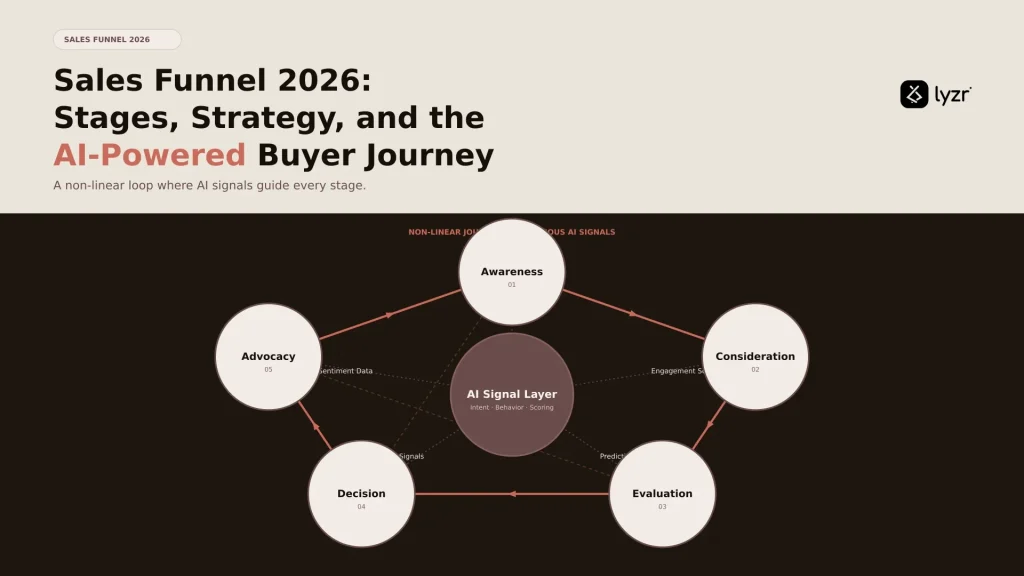
Early on, in awareness, reps need broad, credible material and a clear view of who’s engaging with it. A lead management software layer earns its keep here, showing which content is landing and where a prospect has gone cold.
In consideration, especially in B2B cycles where buying committees can run past ten stakeholders, reps need comparison material, ROI cases, and objection handling specific to the persona in the room.
At decision, the content changes again: pricing, security documentation, contracts, implementation timelines. Getting the wrong asset to a legal reviewer at this stage doesn’t just slow the deal, it can restart the review.
Common challenges
Most enablement programs don’t fail on strategy. They fail on friction.
Low adoption is the most common symptom: reps skip the portal because searching it costs more time than it saves. Content chaos follows close behind, where outdated decks stay in circulation because nobody owns deprecating them. And leadership consistently struggles to connect enablement activity, like content views or training completions, to actual revenue outcomes, which makes the function an easy budget target in a downturn.
How AI is changing sales enablement?
AI’s first wave inside enablement was additive, not architectural. It made existing workflows faster without changing who initiates the work.
Conversation intelligence tools transcribe calls and flag keywords. A tool that offers valuable call analytics turns raw recordings into structured coaching data instead of a rep’s memory of how a call went. And AI roleplay software lets new hires rehearse objection handling against a realistic simulation before they ever risk a live deal, a genuine improvement over static training modules. Some teams now run AI-powered sales roleplay as a standing part of onboarding rather than a one-time bootcamp exercise.
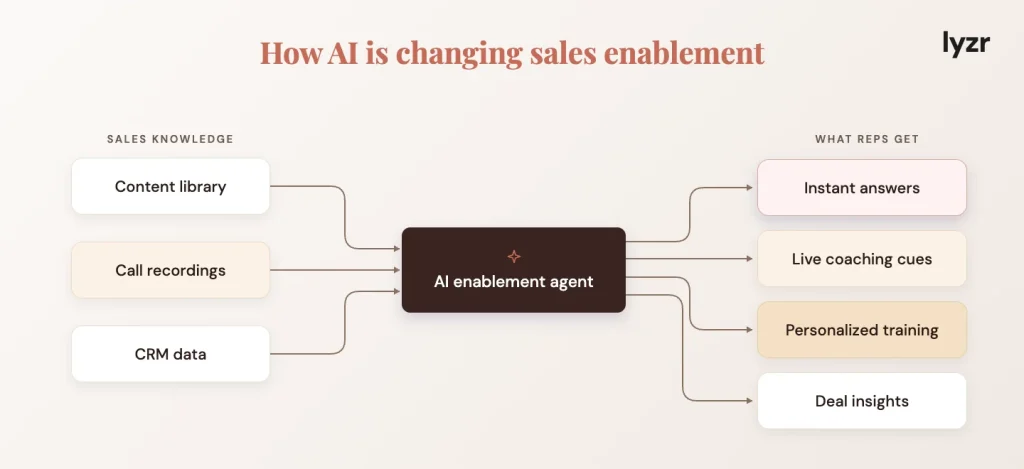
These tools help. But they still wait to be used. A rep has to open the tool, ask the question, and interpret the answer. That’s the ceiling of AI-assisted enablement, and it’s where most of the current market stops.
From AI tools to agentic sales enablement
The next step isn’t a better tool. It’s a shift in who initiates the action.
Traditional vs AI-assisted vs agentic enablement
| Stage | Who acts | What happens |
|---|---|---|
| Traditional enablement | The rep | Rep leaves the CRM, searches a portal, finds and attaches a document manually. |
| AI-assisted enablement | The rep, with suggestions | An AI-powered search surfaces likely-relevant content. The rep still chooses and attaches it. |
| Agentic enablement | The agent, with rep approval | An agent detects the deal has moved to “proposal,” drafts the follow-up, attaches the right case study for that industry, and surfaces a battlecard, ready for one-click approval. |
That third row is the actual definition of agentic sales enablement: an agent operating inside the seller’s workflow that proactively surfaces knowledge, personalizes guidance, and recommends the next action, rather than waiting to be asked.
This is also the point where AI stops being a feature and starts being a system. Purpose-built agents already work this way in adjacent functions. Skott, the Agentic OS for marketing by Lyzr, operates content workflows end to end rather than generating a draft and stopping. On the sales side, Jazon, Lyzr’s AI SDR, automates prospect research and outreach sequencing, the same proactive logic applied earlier in the funnel. For a closer look at how AI SDR approaches differ in practice, see Jazon vs Alice.
How to measure sales enablement success?
Measurement is where most programs quietly lose credibility, usually by reporting activity instead of outcomes.
Leading and lagging indicators for sales enablement
| Category | Leading indicator (behavior) | Lagging indicator (business outcome) |
|---|---|---|
| Productivity | Rep usage rate of key content | Time to first deal, new hire ramp |
| Performance | CRM data quality and completeness | Quota attainment rate |
| Efficiency | Time spent on non-selling tasks | Deal cycle length |
| Effectiveness | Content engagement per deal stage | Win rate, deal size |
Getting this right takes more than dashboards. It takes data analysis that connects enablement activity to a specific won or lost deal, not just an aggregate trend line that leadership can’t act on.
Best practices for building a modern sales enablement strategy
A workable rollout sequence, in order:
- Write the charter first. Define who enablement serves and how success gets measured before buying any tool.
- Map content to the buyer journey, not to internal org charts. Audit what exists and kill what’s outdated.
- Put the platform inside the CRM. A CRM system with real workflow automation removes the extra tab reps otherwise ignore.
- Coach on trends, not single calls. Scale coaching across the full team, not one call per manager per month.
- Communicate constantly and visibly. Some teams push leaderboards and wins to shared screens using free digital signage templates so momentum stays visible without another Slack channel.
- Account for every GTM motion. If part of your pipeline runs through a sales outsourcing company or a partner ecosystem, enablement has to reach them too. Ecosystem intelligence tools like Crossbeam show where partner overlap creates warm paths into accounts; teams building partner-led motions can contact Crossbeam directly to scope it.
- Build governance in from day one, not after the first agent makes a mistake in front of a customer.
The future of sales enablement
A relatively small number of vendors globally are building genuinely agentic systems today, according to Gartner’s ongoing market coverage of agentic AI, which means most of what’s marketed as “agentic enablement” is still workflow automation with a new label. The distinction that actually matters isn’t whether an agent can draft an email. It’s whether an enterprise can trust that agent to act, prove what it did, and shut it off cleanly if it doesn’t.
That’s the layer Lyzr builds for.
The Lyzr Control Plane brings structure to how agents move from code to production, where every deployment follows a defined path, every change is tracked, and every agent is evaluated, approved, and identity-mapped before it goes live. Paired with Lyzr Studio for building the agents themselves, that’s the difference between an agent that drafts a good email and one an enterprise can actually deploy against live pipeline.
The future of sales enablement isn’t better content, and it isn’t a smarter AI tool bolted onto the existing library. It’s intelligent, governed assistance embedded directly into the workflows where sales decisions and actions actually happen, accountable the same way a human rep would be, and auditable in a way a content portal never needed to be.
Go deeper: Agent orchestration 101 for how multi-agent systems coordinate handoffs, and best agentic OS platforms for how to evaluate the governance layer before you buy one.
Frequently asked questions
What exactly is sales enablement?
Sales enablement is the ongoing process of equipping sales teams with the content, training, coaching, and technology needed to engage buyers and close deals consistently. It’s cross-functional by design, drawing on marketing, sales, and product.
What are the three pillars of sales enablement?
Most frameworks converge on content, training, and technology as the three foundational pillars, with coaching and analytics often added as a fourth and fifth layer depending on the model.
What is the 30-60-90 rule in sales?
It’s an onboarding framework that sets specific goals for a new rep’s first 30, 60, and 90 days, typically moving from learning and shadowing to independent pipeline generation and closed deals.
Is sales enablement a good job?
Yes. It sits at the intersection of sales, marketing, and RevOps, and it’s one of the few functions with direct visibility into what’s actually moving revenue, which makes it a strong path toward RevOps or sales leadership.
What are the five pillars of sales enablement?
Some frameworks expand the three core pillars into five: strategy, content, training, technology, and analytics, adding measurement and executive alignment as distinct disciplines rather than side effects.
What are examples of sales enablement?
Common examples include competitor battlecards, structured new-hire onboarding, live-deal coaching, ROI calculators for the consideration stage, and a governed content system that updates automatically as messaging changes.
What is another name for sales enablement?
It’s sometimes called sales readiness, sales effectiveness, or revenue enablement, particularly at companies where the function has expanded beyond sales to cover the full go-to-market team.
What skills are needed for sales enablement?
A sales enablement specialist typically needs a working understanding of the sales process, project management discipline, instructional design for training content, and enough data fluency to connect activity to pipeline outcomes.
Most of what’s in this article, you could have found in a dozen other places, and that’s by design; the definition isn’t the differentiated part. The differentiated part is deciding whether your enablement stack stays a library reps search, or becomes an execution layer that acts, with someone accountable for what it does. If you’re weighing that question against your own stack, book a demo and walk through what governed agentic enablement looks like running on Lyzr Studio, deployed and monitored through the Lyzr Control Plane.
Book A Demo: Click Here
Join our Slack: Click Here
Link to our GitHub: Click Here