Only 5% of enterprise AI agents ever make it to production.
The rest die in prototype. They demo well, get budget approved, and then quietly stall in pre-prod, failing security review, missing observability, hallucinating in edge cases, or simply lacking the governance plumbing every enterprise needs but no prototyping tool provides.
This is the central problem of enterprise AI in 2026. Every Fortune 500 has a working AI agent demo. Almost none have one running against real customers, on real data, at scale.
This guide explains what AI agents actually are and, more importantly, what separates the agents that ship from the 95% that don’t.
What are AI agents?
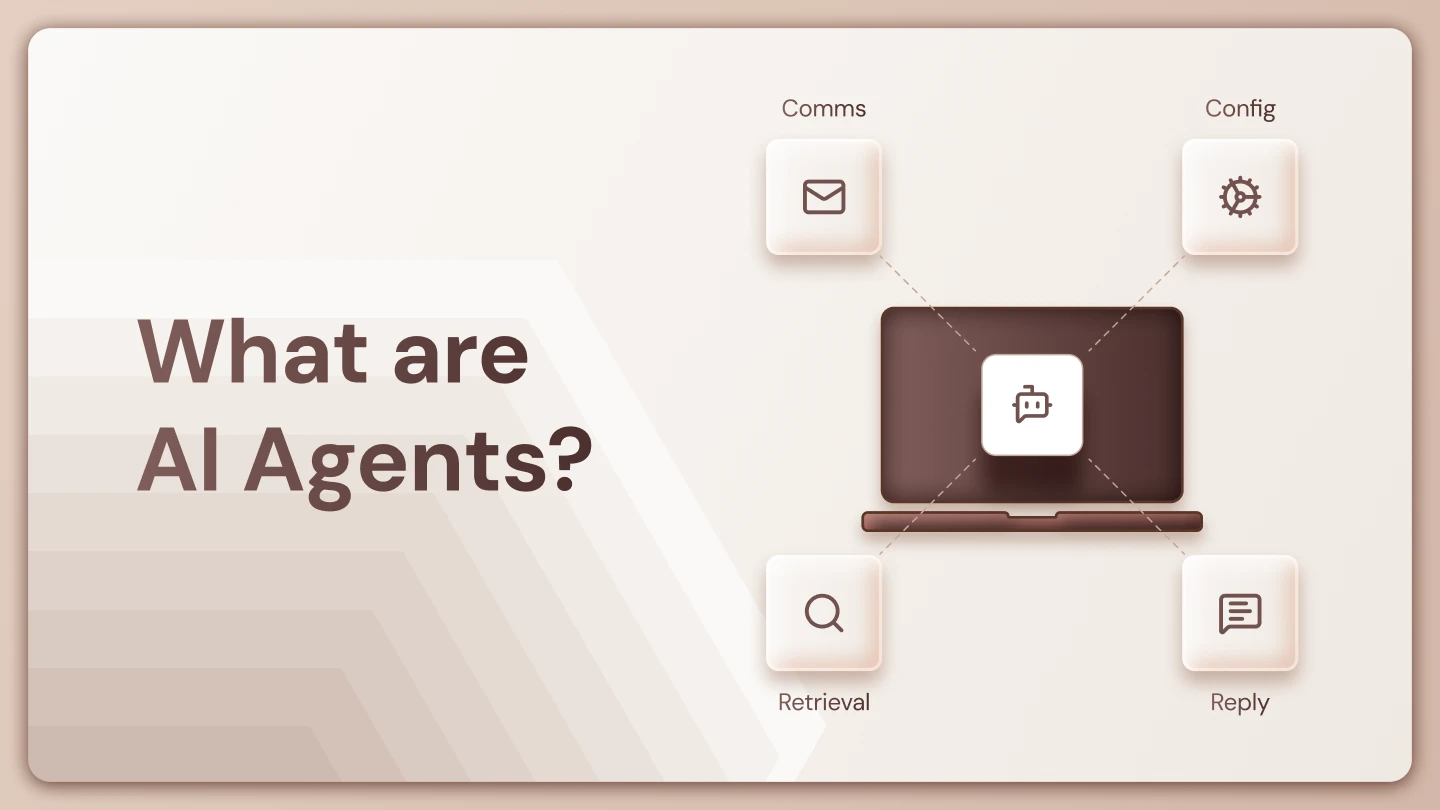
An AI agent is a software system that perceives its environment, reasons about goals, and takes autonomous actions using tools and memory, without requiring a human in every step.
That’s the short answer. If you take nothing else from this guide, take that sentence.
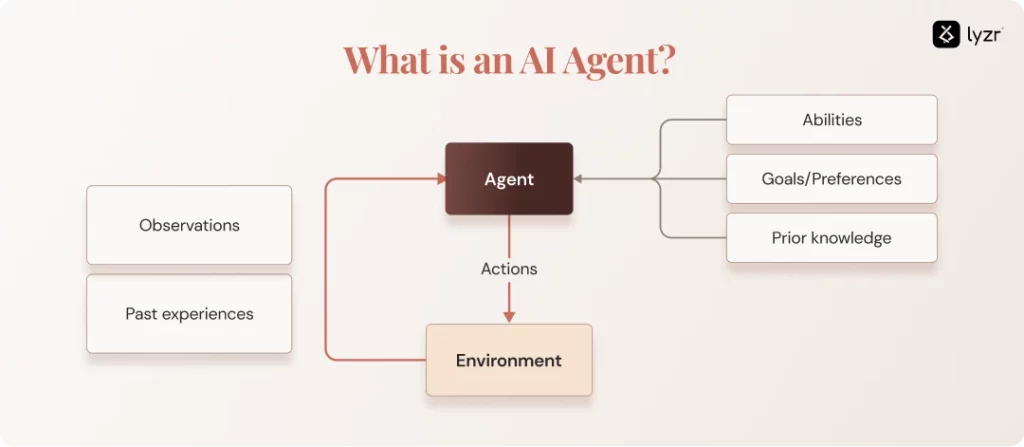
The longer answer is that AI agents are a category that emerged in 2023–2024 and matured into an enterprise software stack in 2025–2026. The category exists because something fundamentally changed in software: for the first time, applications can decide what to do — not just execute pre-written instructions. An AI agent is what you get when you give a large language model three additional capabilities: memory, tools, and the ability to plan.
According to Lilian Weng, the head of safety systems at OpenAI and former head of applied AI research, an AI agent has three essential characteristics
- Planning: An AI agent can create a step-by-step plan from a prompt, setting clear goals along the way. It learns from mistakes by using a reward system, which helps improve its future results. By leveraging multi-agent hyperautomation, multiple AI agents can collaborate seamlessly to handle complex tasks, increasing efficiency and accuracy in executing plans.
- Memory: AI agents use short-term memory to handle immediate questions and long-term memory to remember important information. They often use techniques like retrieval-augmented generation (RAG) to provide accurate answers.
- Tool Use: An AI agent can connect with APIs to gather extra information or perform tasks based on what users ask, making it a useful tool for many jobs. An AI agent can connect with APIs to gather extra information or perform tasks based on what users ask, making it a useful tool for many jobs, including data enrichment workflows like find email address by phone number.
Key Components of an AI Agent
In production, an enterprise AI agent has six working parts:
- The LLM — the reasoning core (GPT-5, Claude, Gemini, an open-weights model). This is the “brain” that decides what to do.
- Memory — short-term context and long-term storage. Without memory, every interaction starts from zero.
- Tools and APIs — the agent’s hands. The MCP (Model Context Protocol) standard is increasingly how tools are exposed to agents in 2026.
- An orchestration layer — for multi-step workflows or multi-agent systems, this is the conductor coordinating which agent or which tool runs when.
- Knowledge Base — A shared vector database where agents store and access information, enabling collaboration and collective decision-making.
- Reasoning Engine — Agents use this to analyze data, apply rules, and make decisions. When combined, agents communicate and coordinate to solve complex tasks.
- A governance and observability layer — the part that logs every decision, enforces guardrails, and makes the agent’s behavior auditable. This is the layer that decides whether your agent reaches production or stalls in pre-prod.
Strip out any one of these in a production deployment and the agent breaks down, either it can’t remember what it did yesterday, can’t take action, can’t access your data, can’t coordinate, or can’t be trusted by your CISO.
Why the shift from traditional chatbots?
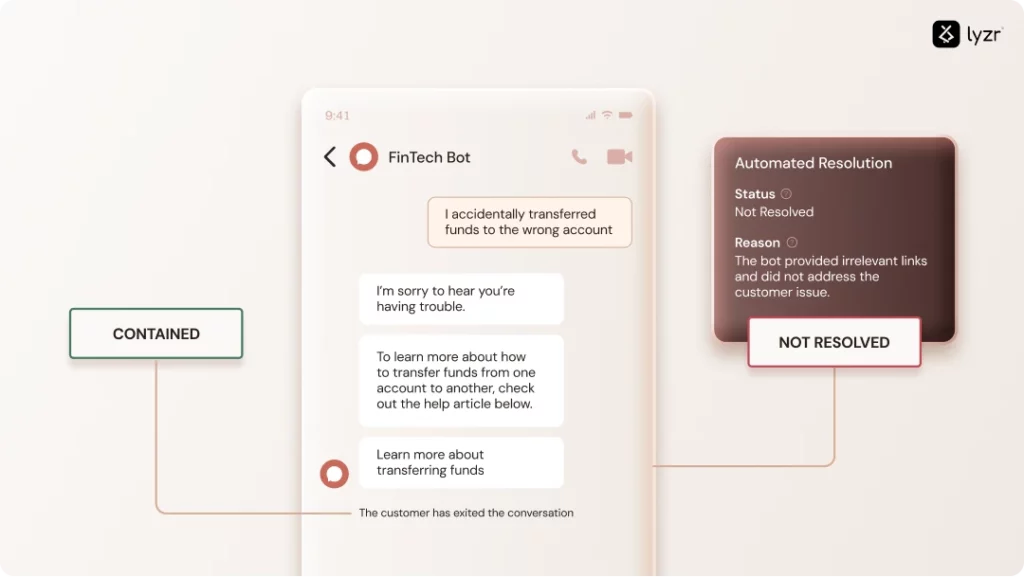
Traditional Chatbot: The image shows a conversation between a customer and a FinTech bot. The customer reports accidentally transferring funds to the wrong account, but the bot responds with a generic message, directing them to a help article that does not resolve the issue.
Consequently, the conversation is marked as “Not Resolved” because the bot provided irrelevant information.
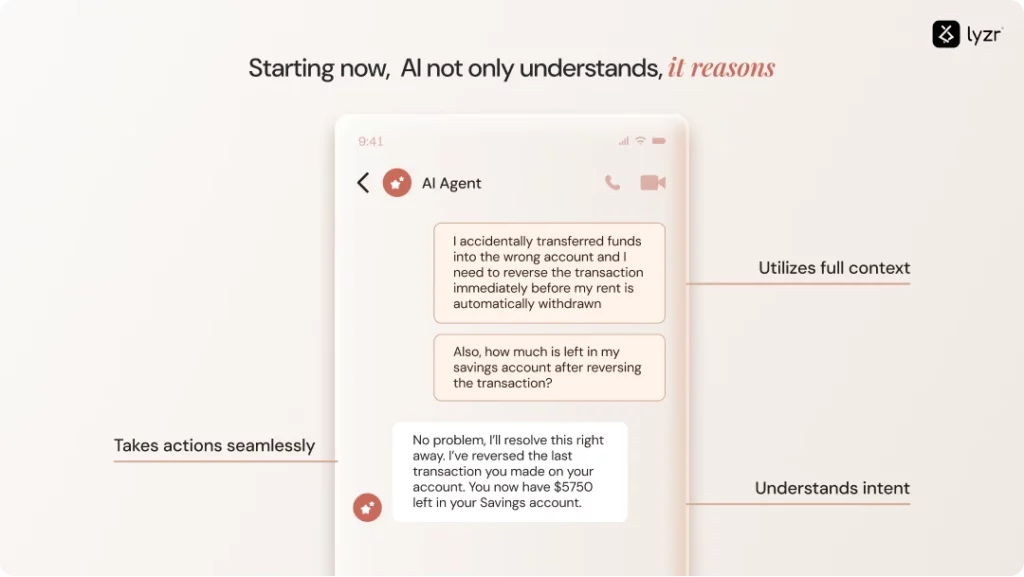
AI agents: The image depicts a conversation between a user and an AI agent. The user explains they mistakenly transferred money and need to reverse it quickly while also checking their savings balance.
The AI agent promptly confirms it will resolve the issue and provides the updated balance, showcasing its ability to understand context and take action effectively.
These AI agents function as advanced ai assistants, automating tasks, responding to user queries, and operating autonomously within various workflows. This evolution is reshaping customer communication as well. Unlike traditional bots that rely on fixed scripts, modern AI-driven platforms such as Crisp AI leverage natural language understanding and contextual memory to interpret intent more accurately.
By connecting to knowledge bases and internal systems, they can resolve queries more intelligently while still enabling smooth human handoffs when conversations require nuance or oversight. The result is a more adaptive and conversational experience that aligns closely with how AI agents are designed to operate.
AI agent vs. chatbot vs. LLM vs. workflow automation
The category is easier to grasp by what it isn’t. Four things AI agents get confused with, and the actual differences:
| What it does | What it can’t do | |
|---|---|---|
| Chatbot | Follows scripted conversation flows. Answers from a fixed library. | Reason about goals. Take action outside the script. |
| LLM (raw) | Generates text in response to prompts. | Remember across sessions. Use tools. Plan. Act. |
| Workflow automation (Zapier, n8n, RPA) | Executes a pre-defined sequence of steps reliably. | Adapt when inputs vary. Decide what to do. |
| AI agent | Decides what to do, uses tools, remembers context, takes action. | Operate without governance (in enterprise). |
The shift from chatbots to agents is the shift from responding to acting. A banking chatbot tells you your balance. A banking agent reverses your accidental wire transfer, confirms your corrected balance, and emails you a receipt, in one interaction, without escalating to a human, while logging every step for audit. Same conversation, fundamentally different software underneath.
Value of AI Agents for Businesses
71% of Leaders Predict Better Customer Service
According to a survey, ai agents can boost productivity by an impressive 126%! Right now, about 10% of businesses are already using them, and over half are planning to jump on board soon.
Many leaders believe AI agents will not only make workflows smoother—71% think so—but also enhance customer service. As these agents become more common, they could change the way we work for the better.
1. Increased Productivity upto 126% with AI Agents
Automation is crucial for scaling operations. AI agents can take over tasks traditionally performed by humans, such as processing large datasets or managing customer support. They complete these tasks much faster, allowing human employees to concentrate on strategic initiatives.
- Pain Point: As businesses grow, they often hit limitations with manual processes, like Excel’s capabilities.
- Solution: AI agents handle repetitive tasks, speeding up decision-making and enabling human resources to focus on higher-value activities. As operations become more connected, AI business tools help companies manage complex workflows with less manual effort. By linking agents together, businesses can fully automate processes, surpassing what spreadsheet or SaaS solutions can offer.
2. Reduce Cost upto 41% with AI Agents
Recruiting and training employees for every task can be costly and inefficient. AI agents help cut labor costs by automating routine activities. Additionally, they can operate continuously without breaks, maximizing resource utilization.
- Pain Point: High operational costs arise from data management, analysis, customer service, and administrative tasks.
- Solution: AI agents provide a cost-effective alternative to outsourcing these routine tasks, helping businesses reduce labor costs while minimizing human error.
3. Data-Driven Decision Making
To stay competitive, quick and accurate decision-making is essential. AI agents analyze data in real-time, offering insights and actionable recommendations, enabling businesses to adapt to market changes based on data rather than guesswork.
- Pain Point: Inconsistent decision-making often results from a lack of real-time insights, leading to issues like inaccurate inventory management, which can cause overstocking and cash flow problems.
- Solution: AI agents provide timely data analysis and insights, improving decision-making across the organization.
4. 24/7 Availability
AI agents are always on—no breaks, vacations, or sleep needed. This constant availability ensures your business operates continuously, significantly enhancing customer service by eliminating missed opportunities or delays.
- Pain Point: Businesses often lose opportunities during non-operational hours.
- Solution: AI agents provide round-the-clock availability, enhancing customer satisfaction and engagement by being accessible at any time.
How does an AI agent work?
Now that you know what ai agents bring to the table, it is important to understand how do they really work
Think of an AI agent like a curious helper. It starts by using sensors to gather information about its surroundings—like eyes and ears picking up details.
Then, its brain (a control system) kicks in to analyze the data, brainstorm possible solutions, and decide the best course of action. Once it knows what to do, it uses actuators to perform actions in the real world—kind of like hands or tools getting the job done.
But what does this process look like in practice?
Let’s take a closer look
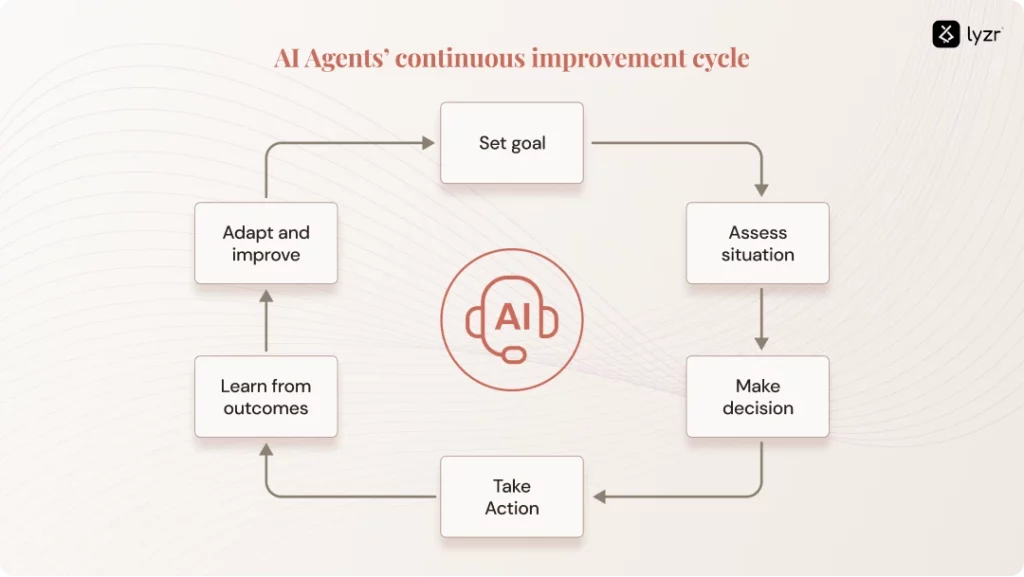
- Perception and Data Collection: AI agents begin by gathering information from various sources, such as customer interactions, transaction histories, and social media. This helps them understand the context behind each request.Take for example, if you’re browsing an online store, the AI agent will recommend products based on what you’ve previously viewed or purchased. What’s impressive is that this happens in real time, so the suggestions are always relevant and up-to-date.
- Decision-Making: Once the data is collected, the AI processes it to make informed decisions. By using advanced learning models, it can recognize patterns and determine the best response or action.For example, if you’ve repeatedly inquired about delivery options, the AI might suggest quicker shipping methods based on your preferences. And with each interaction, it gets better—constantly refining its responses for more accuracy.
- Action Execution: After analyzing the situation, the AI takes action. This could be anything from answering a customer query to placing an order, or even escalating a complex issue to a human agent.For example, in a banking app, the AI agent can handle routine tasks like checking balances, but for more complicated matters, it will easily transition to a human representative.
- Learning and Adaptation: AI agents are designed to improve with every interaction. If an AI struggles with a specific type of request, it learns from that experience and adjusts its responses for the future. This ongoing learning process ensures that the AI remains efficient and responsive, even as customer expectations evolve. A great example of this in action is a customer service chatbot. It starts by receiving a question from a customer. Using natural language processing, it understands the query and decides on the best response based on the context. Then, it replies to the customer, providing helpful information or asking further questions.
Why 95% of AI agents never reach production
Anyone can build an AI agent in a weekend. n8n, LangChain, Copilot Studio, Replit, the tools are everywhere, and a working prototype takes hours, not weeks.
Production is the hard part. And production is where AI agent projects collapse.
Based on Lyzr’s work with Accenture, JPMorgan Chase, Pepsi, Crown Castle, and U.S. government deployments, the same six gaps kill enterprise agent projects again and again:
- Governance and approval gates. Prototyping platforms have no concept of dev → UAT → pre-prod → prod. Enterprise agents need CISO-clearable approval flows at every stage. Without them, the agent never passes security review.
- Observability and audit. Most agent frameworks log conversations, not decisions. When a regulator asks “why did this agent approve this loan,” “the LLM said so” is not an answer. Production demands agent observability — full traceability of inputs, tool calls, reasoning steps, and outputs.
- Hallucination control. A 2% hallucination rate is fine for a chatbot. It’s catastrophic for a loan-origination agent or claims-processing agent. Production-grade agents need a Hallucination Manager — not a vibes-based confidence score.
- Cross-framework orchestration. Real enterprises don’t run one framework. They have LangChain agents from a 2024 hackathon, Salesforce Agentforce in sales, ServiceNow agents in IT, and Microsoft Copilot in productivity. Without an orchestration layer that speaks every framework, you’re building seven kingdoms instead of one stack.
- Multi-cloud high availability. A production agent can’t go down because AWS us-east-1 hiccuped. Enterprise agents need cross-cloud failover (AWS + GCP simultaneously), policy-based routing, and 50/50 traffic splits. None of this exists in prototyping tools.
- The platform-plus-people gap. Plenty of vendors sell platforms. Plenty of consultancies sell people. Production requires both — plus the know-how of having shipped agents before. LangChain has 70+ FDE roles open. Accenture has thousands of consultants. Hiring isn’t the differentiator. The combined lived knowledge of what breaks in production and how to fix it is.
This is why Lyzr is structured the way it is. Lyzr Agent Studio compresses 6 months of LangChain work to weeks. Lyzr Control Plane registers and governs every agent across every framework — yours, LangChain’s, Crew’s, Agentforce’s. And our Applied AI team brings the production know-how that turns a working demo into a shipped product.
If you want the full breakdown, we’ve published the playbook:
The 6 types of AI Agents for Enterprises
AI agents aren’t one thing. They sit on a spectrum from simple rule-followers to fully autonomous learning systems. Understanding which type you actually need is the single most important architectural decision in any enterprise AI project — and the most commonly skipped one.
The wrong type means over-engineering (paying for a learning agent when a rule-based one would ship in a week) or under-engineering (deploying a simple reflex agent for a task that needs reasoning and watching it fail in production). Here are the six types that matter, what each one is actually good for, and where each lives in the Lyzr stack.
1. Simple Reflex Agents
What they are: The simplest form of AI agent. They operate on if-this-then-that condition–action rules, no memory of past states, no model of the world, no goals beyond the immediate rule. They see an input, match it to a rule, produce an output. Done.
How they work: A simple reflex agent perceives the current state of its environment through sensors (an incoming email, a transaction record, a form submission), matches that perception against a fixed rule library, and executes the matched action. The agent has no idea what happened five minutes ago, every interaction starts fresh.
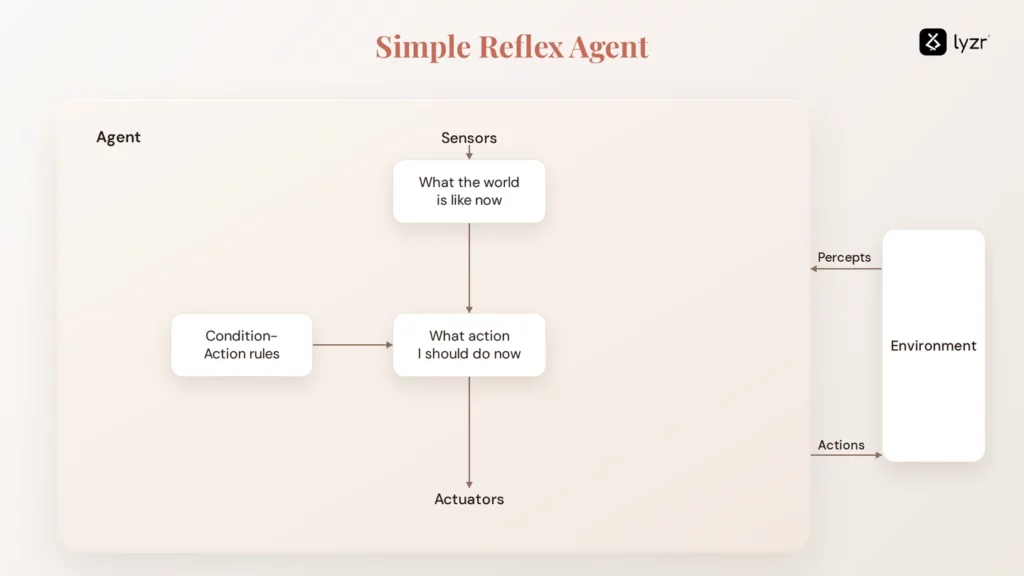
Enterprise example: Email triage that routes incoming customer queries to the right team based on subject-line keywords. A KYC pre-check agent that flags any application missing a required field. A simple FAQ bot that answers from a fixed library of approved responses. None of these need to remember anything between interactions, they just need to react fast and consistently.
Trade-off to know: Brittle. Anything outside the rule library fails silently or returns nonsense. Fine for narrow, high-volume, well-understood tasks. Disastrous for ambiguity.
Where this lives at Lyzr: Most of our pre-built business agents start here. The Email Triage Agent is a canonical simple reflex deployment, fast to deploy, no training data needed, immediate ROI on high-volume repetitive work. When the task gets more nuanced, you graduate to the next type.
Let’s take an example to understand: E-commerce, for example, has repetitive and predictable tasks, which is where such agents excel.
Customer onboarding, tailored product suggestions, and review collection and insights are a few such tasks. These tasks are often supported by agent platforms developed by major players like OpenAI and Google, which are driving rapid growth and innovation in the field of AI agents.
2. Model-based reflex agent
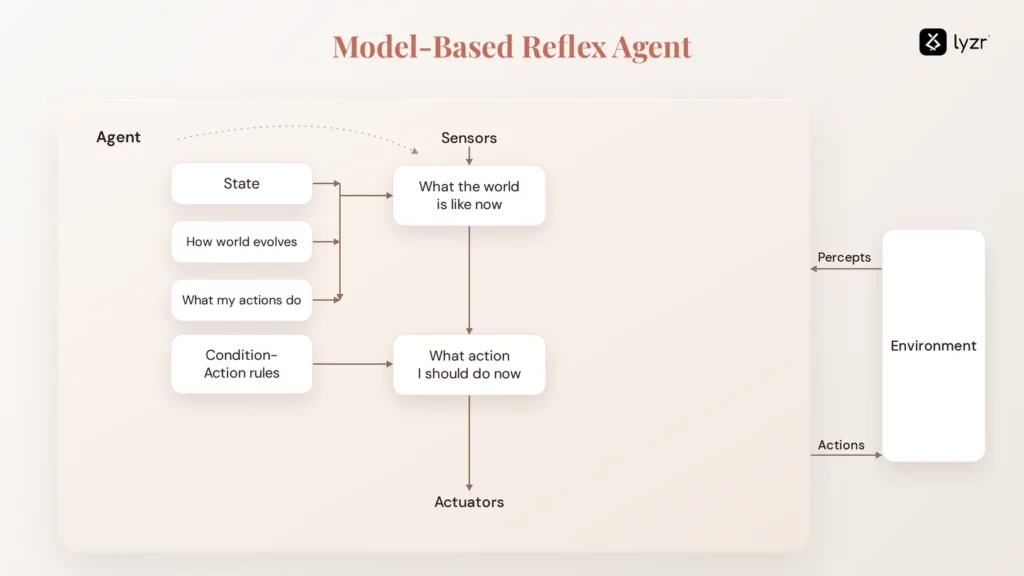
What they are: A step up from simple reflex agents. These maintain an internal model of the world — a record of recent state changes, partial knowledge of things the agent can’t directly observe, and an understanding of how its own actions affect the environment. They still react to current input, but reactions are informed by history.
How they work: A model-based reflex agent updates its internal state with every new perception. When deciding what to do, it asks two questions: how has the world changed since I last looked? and how will my action change the world? The internal model lets the agent handle partial observability — situations where the agent can’t see everything but has to act anyway.
Enterprise example: A fraud detection agent that flags a transaction based on the current transaction plus the pattern of the last 50 transactions on the same account. A customer support agent that remembers a customer hit “frustrated” three messages ago and adjusts tone accordingly. A supplier performance agent that tracks delivery reliability over time, not just the most recent shipment.
Trade-off to know: More capable than simple reflex, but the internal model is only as good as the engineer who wrote the state-tracking logic. Without explicit goals, the agent still can’t plan — it can only react smarter.
Where this lives at Lyzr: Agent Studio lets you wire stateful agents with persistent memory through Cognis, our agent memory layer. Most production support and fraud-monitoring use cases in our customer base are model-based reflex agents under the hood.
3. Goal-based Agents
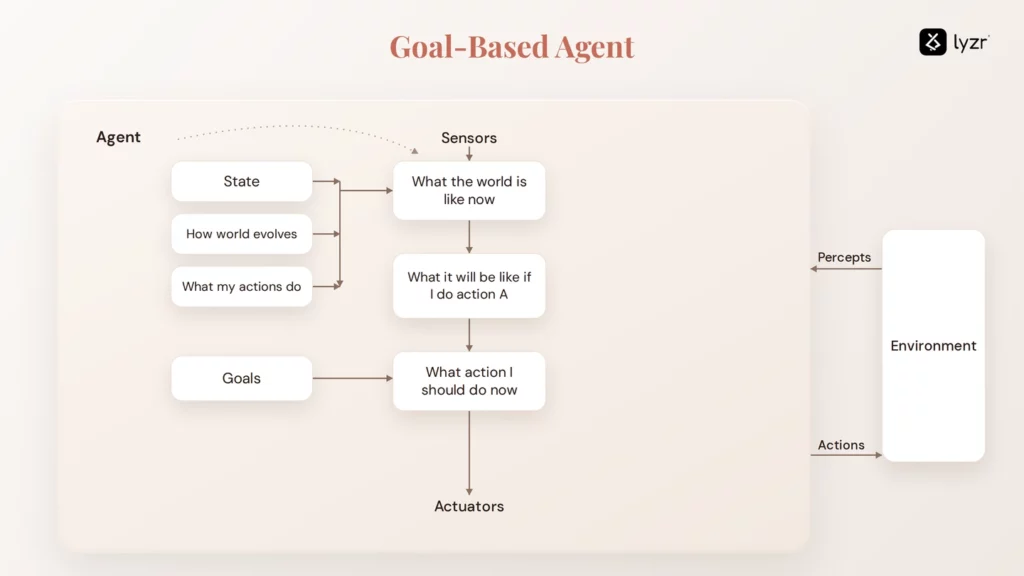
What they are: Agents that don’t just react — they plan. A goal-based agent has an explicit objective and uses search and reasoning to find a sequence of actions that achieves it. The defining shift from reflex agents is intent: the agent isn’t just responding to its environment, it’s trying to change the environment toward a desired state.
How they work: Given a goal (resolve this support ticket, originate this loan, source this supplier), the agent generates candidate action sequences, evaluates which sequences lead closer to the goal, and executes the best path. If the path fails or new information arrives, the agent re-plans. This is where LLM-based reasoning shines — the LLM is the planner, the tools are the actions, the goal is the constraint.
Enterprise example: An AI SDR given the goal “book a qualified meeting with this prospect.” The agent enriches the lead, drafts personalized outreach, sequences follow-ups, books the meeting in the calendar — all in service of one goal. An AI loan origination agent given the goal “complete this application end-to-end.” A claims processing agent given the goal “resolve this claim within SLA.”
Trade-off to know: Goal-based agents need clear success criteria. Vague goals (“delight the customer”) produce vague behavior. Crisp goals (“book a meeting on the prospect’s calendar”) produce crisp behavior. The hardest engineering problem isn’t the agent — it’s defining the goal precisely enough.
Where this lives at Lyzr: This is the sweet spot for Agent Studio. Most enterprise agents that ship to production are goal-based agents wrapped in governance — which is exactly what Studio is built for.
4. Utility based agents
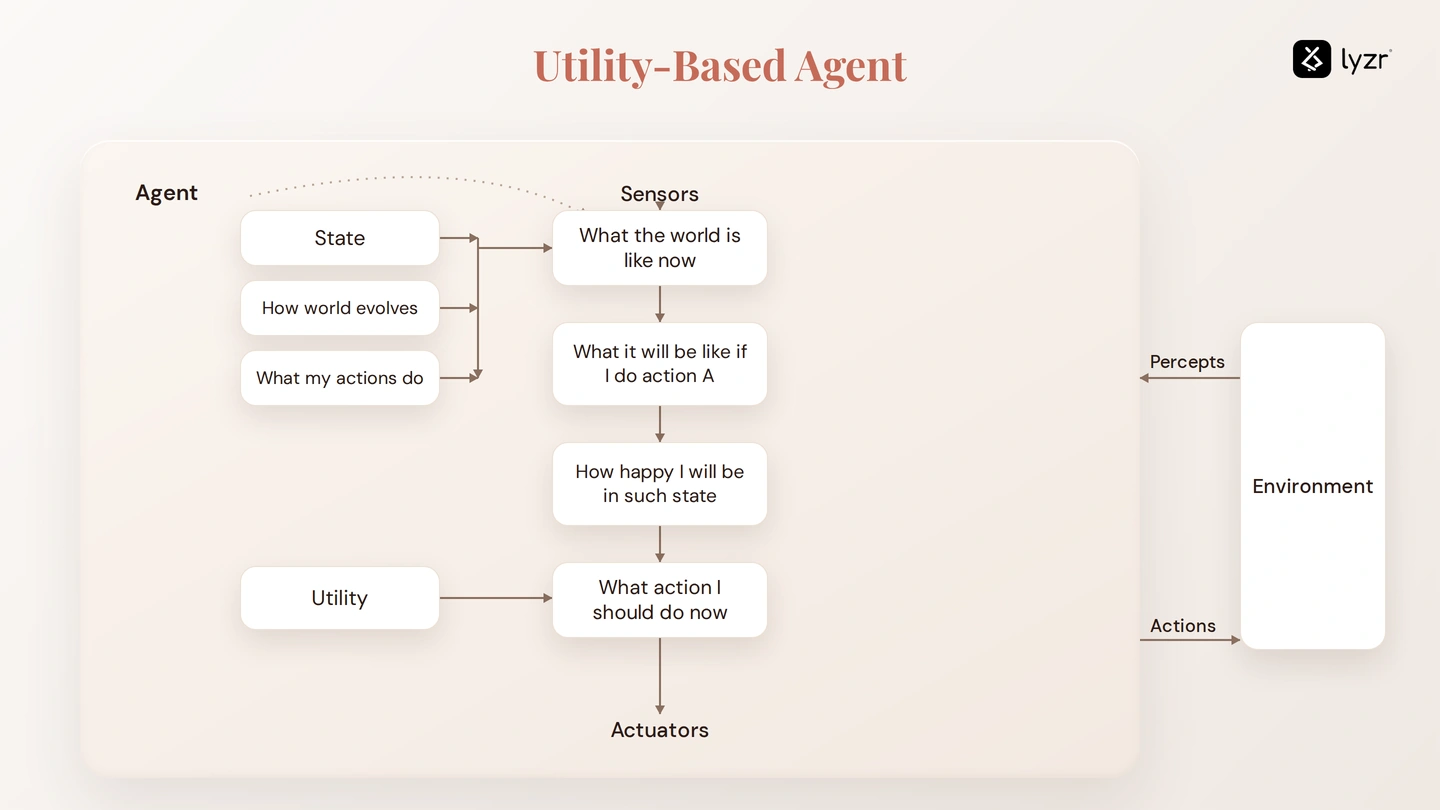
What they are: Goal-based agents with judgment. Where a goal-based agent asks “did I reach the goal?”, a utility-based agent asks “how well did I reach it, and was it worth the cost?” These agents make trade-offs — between speed and accuracy, between cost and quality, between competing goals that can’t all be satisfied.
How they work: A utility function assigns a numerical “goodness” score to each possible outcome. The agent doesn’t just look for paths that reach the goal — it looks for the path with the highest expected utility, accounting for uncertainty. This is essential whenever multiple goals compete or when “success” isn’t binary.
Enterprise example: A supplier sourcing agent trading off price, lead time, supplier reliability, and ESG compliance to recommend the best vendor — not just any vendor that meets minimum spec. A regulatory monitoring agent prioritizing which compliance changes to surface to legal first, based on impact and urgency. A dispute management agent in banking weighing customer satisfaction against fraud risk on a partial-refund decision.
Trade-off to know: Designing the utility function is the entire game. A poorly tuned utility function will optimize for the wrong thing extremely efficiently. This is where the difference between a vendor’s demo and a production deployment shows up — demos always have hand-tuned utility functions; production needs them to be learned, audited, and updated.
Where this lives at Lyzr: Agent Studio plus Cognis for the memory and feedback loops that let the utility function improve over time. The banking dispute management agent in our Accenture deployment is a utility-based agent at its core.
5. Learning Agent
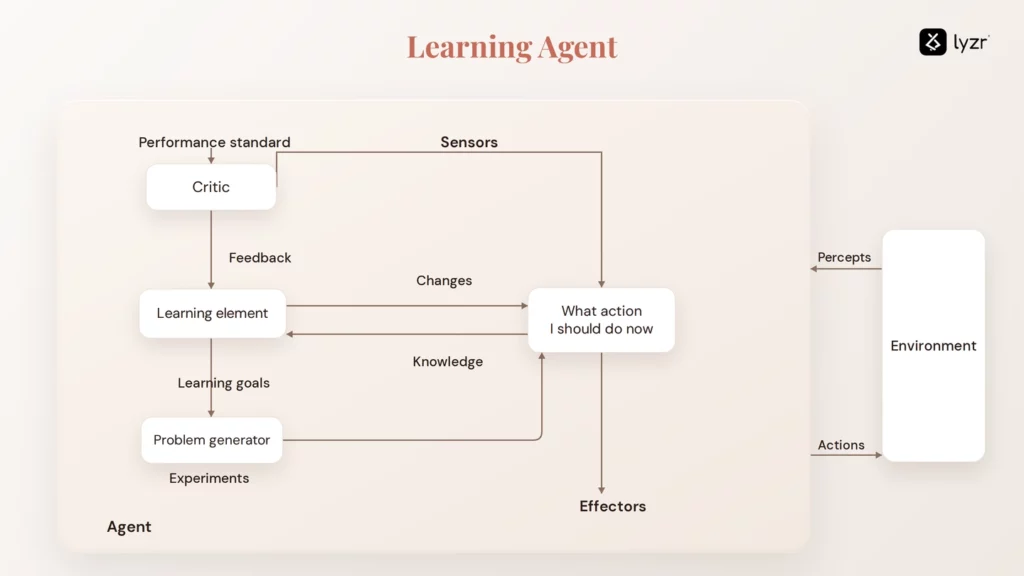
What they are: Agents that improve with experience. Where the previous four types are largely fixed once deployed (any improvement requires a developer to rewrite logic), a learning agent updates its own behavior based on feedback from past outcomes. It gets better at the task the longer it runs.
How they work: A learning agent has four components: a learning element that updates internal knowledge based on experience; a critic that evaluates how well the agent is performing against a standard; a performance element that selects the actual actions to take; and a problem generator that proposes new experiences to learn from (essentially, controlled exploration). Together, these create a feedback loop where the agent’s behavior evolves.
Enterprise example: A customer support agent that gets better at handling refund requests every quarter, based on resolution-quality feedback. A code generation agent that learns which patterns the engineering team accepts and which it rejects. A research agent that learns which sources its analyst users trust and which they discard.
Trade-off to know: Learning agents are powerful but expensive, to build, to govern, to audit. The learning loop is also the most common source of production failure: agents drift, learn bad behaviors from biased feedback, or game the reward function in ways nobody anticipated. This is why learning agents need observability and governance more than any other type, not less.
Where this lives at Lyzr: GitAgent, our open-source framework, is built for learning-agent patterns — file-system driven, terminal access, can spawn sub-agents and learn skills over time. JPMorgan-trusted. Mudit built more in 48 hours with GitAgent than a competing team could with full Google stack access. For governed enterprise learning loops, you pair GitAgent with the Lyzr Control Plane so the learning is auditable.
6. Hierarchical and Autonomous Agents
What they are: Agents organized in tiers, where higher-level agents decompose complex objectives into sub-tasks and delegate them to lower-level agents. Each layer has its own responsibility — strategy at the top, tactics in the middle, execution at the bottom. The hierarchy is what lets a system handle complexity that would overwhelm any single agent.
How they work: A top-level “manager” agent receives a complex goal, breaks it into sub-goals, and routes each sub-goal to a specialized agent. Those specialized agents may themselves delegate further. The hierarchy is dynamic — agents are spawned, complete their task, return results, and shut down. The manager agent monitors progress, handles failures, and re-plans when sub-agents return unexpected results.
Enterprise example: An end-to-end procurement workflow where a top-level agent receives “source and onboard a new logistics vendor,” then delegates to a supplier sourcing agent, a supplier performance agent, a contract review agent, and a supplier onboarding agent, coordinating their outputs and handling failures. A claims-processing workflow that routes intake, fraud-check, valuation, and payout to four different specialist agents under one orchestrator.
Trade-off to know: Hierarchical agents are where most enterprises think they need to start. They usually don’t. Start with a goal-based agent on a single workflow, prove it ships, then scale to hierarchy. Premature hierarchy is the single most common cause of enterprise agent projects stalling — the orchestration complexity kills the project before the agents themselves are working.
Where this lives at Lyzr: Lyzr Control Plane is the orchestration layer for hierarchical and multi-agent systems. It registers every agent (Lyzr-built or third-party, LangChain, Crew, Agentforce), handles routing between them, manages approval gates, and provides the cross-cloud high availability hierarchical systems need. This is also where Superflow, our orchestration engine, lives.
A note on multi-agent systems
Hierarchical agents are one kind of multi-agent system, but the two terms aren’t synonymous. A multi-agent system is any architecture involving multiple autonomous agents, hierarchical ones (with clear authority structures), collaborative ones (peer agents negotiating), or competitive ones (agents with opposing objectives, like adversarial testing setups).
In 2026, the most common production pattern in our customer base isn’t a single agent type, it’s a multi-agent system combining 3–5 of the types above. A utility-based supplier sourcing agent feeding a goal-based contract review agent, both governed by a hierarchical manager agent, all observed by a learning agent watching for drift. The categories aren’t either-or. The skill is composing them.
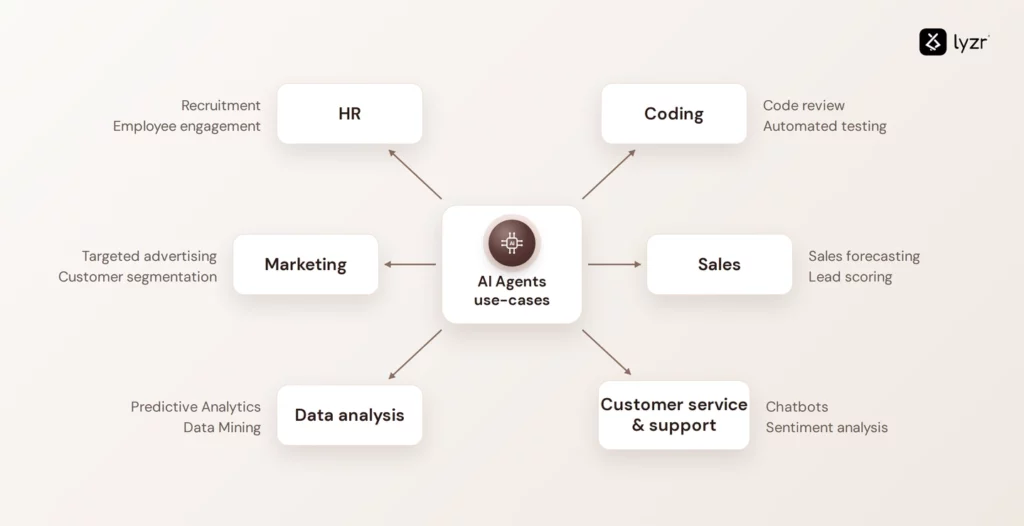
AI Agents in Action: Transforming Industries One Task at a Time
AI agents are not just for one industry; their flexibility allows them to make a big impact across many business sectors.
Each sector uses these agents in different ways, showing how adaptable and useful they can be, especially as more businesses collaborate with ai agent development vendors to build industry-specific solutions.
1. Retail & E-commerce
Retailers face intense competition to deliver personalized shopping experiences and efficient operations. AI agents are stepping in to bridge this gap.
Challenge: Customers expect recommendations that feel personal, not generic.
- Example: AI agents analyze browsing patterns to suggest complementary products. For instance, a customer buying hiking boots might see suggestions for weatherproof jackets or backpacks.
Challenge: Managing inventory is complex, especially during seasonal spikes.
- Example: AI logistics agents predict demand based on historical data, ensuring warehouses are stocked with the right products at the right time, avoiding overstock or shortages.
2. Banking & Finance
The financial sector is under pressure to provide quick services while maintaining strict security. AI agents tackle both.
Challenge: Customers want quick, 24/7 answers to basic financial questions.
- Example: AI-powered chatbots assist users in calculating EMIs, checking account balances, or understanding investment options without waiting for a human agent.
Challenge: Fraud is a growing concern in digital banking.
- Example: AI fraud detection agents monitor thousands of transactions per second, identifying unusual patterns—like a credit card being used in two countries simultaneously—and taking immediate preventive action.
3. Manufacturing
Factories aim to optimize production while reducing downtime and waste. AI agents are helping modernize traditional manufacturing processes.
Challenge: Maintaining consistent quality in large-scale production is tough.
- Example: AI vision agents inspect products for defects during assembly, identifying flaws as small as a millimeter to ensure top-notch quality.
4. Telecommunications
Telecom companies juggle high customer expectations and the technical challenge of managing massive networks. AI agents are critical in meeting these demands.
Challenge: Network reliability is key, especially during peak usage.
- Example: AI network agents analyze real-time data to predict congestion and reallocate bandwidth, ensuring smooth streaming during live events like the World Cup or holiday seasons. As a result, the Entertainment Streaming Solution supports this process by adapting delivery paths and maintaining stable performance for large audiences.With many viewers accessing international broadcasts or dealing with regional content restrictions, it’s common for users to buy mobile proxies or rely on a VPN for streaming sports, both of which add additional load and encryption complexity to the network, making intelligent traffic management even more essential.
5. Hospitality & Travel
Travelers expect convenience, while the industry needs to streamline operations. AI agents bring both to the table.
Challenge: Guests want immediate assistance without waiting for human staff.
- Example: Virtual concierges in hotels handle room service requests, booking spa sessions, or arranging transport, all through an app or smart speaker. Hotels can use guest messaging software to streamline these interactions, ensuring requests are handled quickly and efficiently while enhancing the guest experience.
Challenge: Planning travel can be overwhelming for users.
- Example: AI travel agents craft customized itineraries by factoring in preferences, budget, and past trips. For instance, “Based on your love for adventure, here’s a 7-day package with skydiving, river rafting, and mountain trekking.”
Build AI Agents with Lyzr Agent Studio
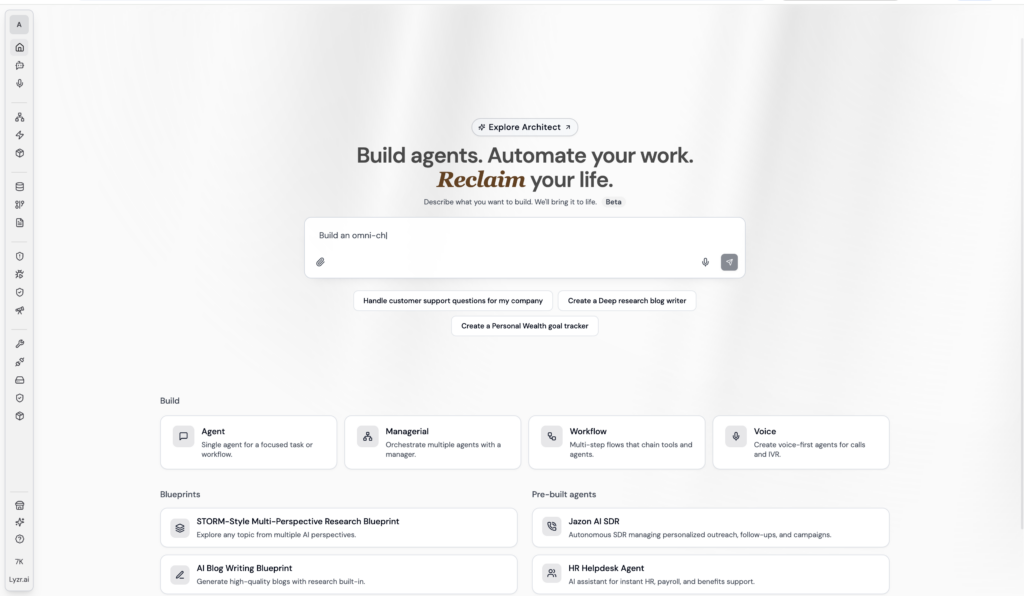
The only agent framework that natively integrates Safe AI & Responsible AI within the core agent architecture, featuring seamless agent integration to enhance your web user interface with conversational assistants.
Key features:
- Agentic AI at its Core: Create and deploy AI agents that think, adapt, and scale effortlessly to meet your business demands, reducing downtime and maintenance costs by forecasting equipment failures.
- HybridFlow Precision: Blend the power of LLMs and ML models to deliver intelligent, accurate, and dependable outputs.
- Secure and Responsible AI: Built with security and fairness at the forefront, ensuring ethical AI practices and compliance.
- Customization: Easily customize workflows and design agents tailored to your business needs—no advanced coding required.
Frequently asked questions about AI agents
What’s the difference between an AI agent and a chatbot?
A chatbot follows scripted conversation flows and answers within a fixed knowledge base. An AI agent reasons about goals, uses tools, calls APIs, accesses memory, and takes autonomous actions to complete multi-step tasks. A chatbot tells you your account balance. An agent reverses a wrong transfer and confirms the corrected balance, in the same interaction.
What’s the difference between an AI agent and an LLM?
An LLM (large language model) generates text. An AI agent uses an LLM as its reasoning engine, but adds memory, tool access, planning, and the ability to act. The LLM is the brain; the agent is the brain plus hands, eyes, and a goal. Without the surrounding system, an LLM can only respond, it cannot do.
What’s the difference between an AI agent and workflow automation?
Workflow automation (Zapier, n8n, traditional RPA) executes a pre-defined sequence of steps. An AI agent decides which steps to take based on the situation. Workflow automation breaks when inputs vary. Agents adapt. The trade-off: workflows are predictable; agents are flexible but require governance to keep behavior bounded.
What is agentic AI?
Agentic AI is the broader paradigm, AI systems designed to act with autonomy toward goals rather than respond to prompts. An AI agent is a specific implementation of agentic AI. Read more in our agentic AI glossary.
What are AI agents used for in enterprises?
The highest-ROI use cases in 2026 are customer support triage, claims processing, loan origination, KYC and compliance monitoring, sales lead enrichment, procurement supplier sourcing, and IT incident response. See 30 AI agent use cases for a full catalogue with quantified outcomes.
How are AI agents built?
Most enterprise AI agents are built on a low-code agent platform like Lyzr Agent Studio, an open-source framework like GitAgent, or a prototyping tool like Architect for business users. The choice depends on who’s building (developer, business user, or pro-dev) and the production requirements.
Why do most AI agent projects fail to reach production?
Roughly 95% of enterprise AI agent prototypes never ship. The most common reasons: no governance or approval gates, weak observability for auditors, uncontrolled hallucination rates, no orchestration across existing frameworks, and no multi-cloud failover. We’ve published the full playbook on taking agents to production.
What’s the future of AI agents?
Three shifts are already underway in 2026. First, control planes are emerging as a new category, universal layers that govern agents across every framework. Second, open-source agent protocols like Open GAP are reducing vendor lock-in. Third, pre-built business agents are replacing custom-built ones for 60–80% of common enterprise workflows.
Ready to get started? Start building now
Book A Demo: Click Here
Join our Slack: Click Here
Link to our GitHub: Click Here