TL;DR
- An AI SDR agent researches prospects, runs outreach, qualifies replies, and books meetings with little or no human intervention.
- Jazon, Salesforce Agentforce SDR, Artisan, 11x, Amplemarket, AiSDR, Qualified, and Regie.ai lead the 2026 market, each built for a different buyer.
- Autonomy runs on a spectrum: fully autonomous, human-in-the-loop, or blended. Most enterprise teams land on blended.
- Seven questions (channels, CRM, autonomy, compliance, deployment, model support, pricing) narrow a shortlist fast.
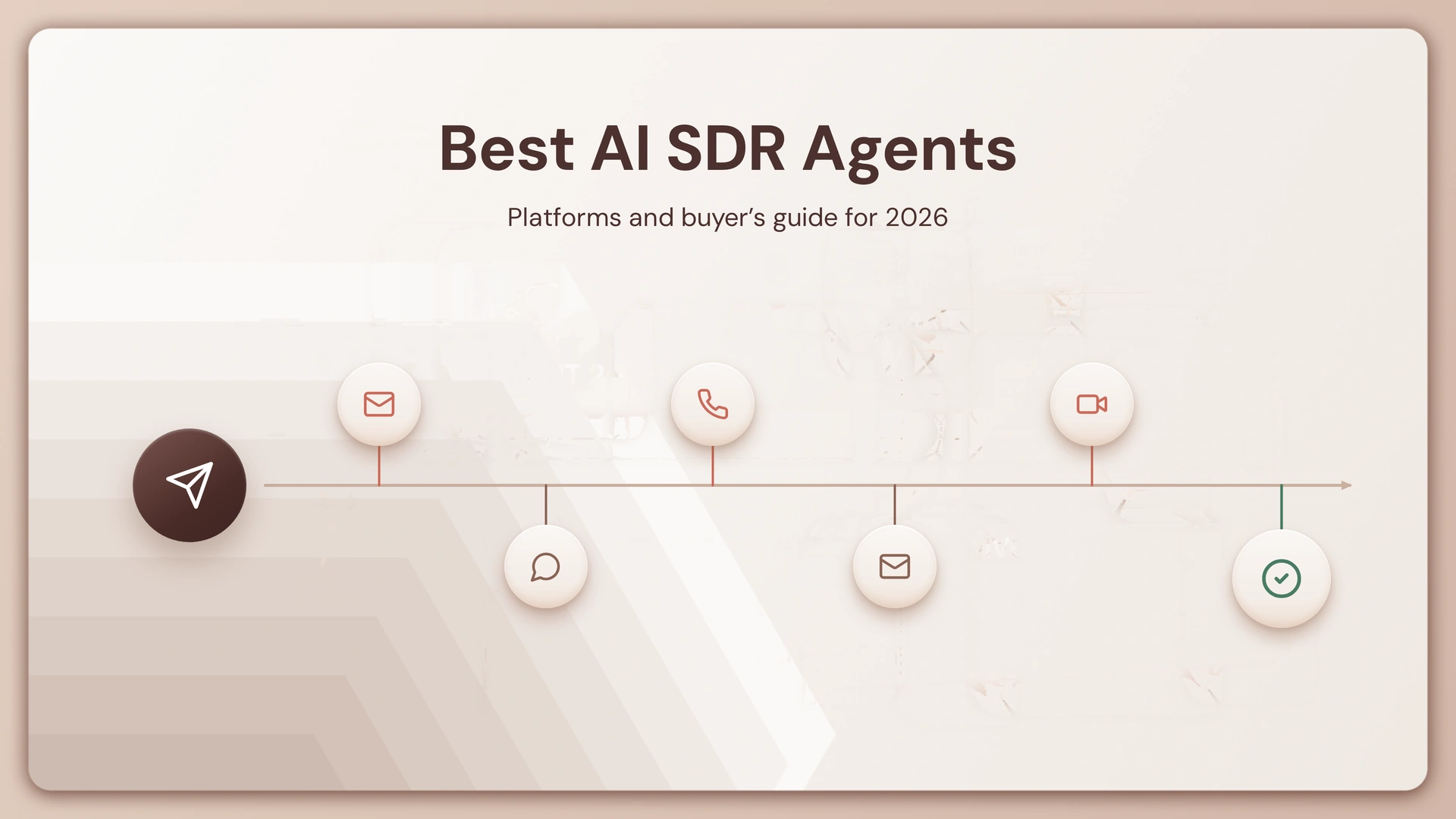
An AI SDR agent is autonomous software that researches prospects, personalizes outreach across email, LinkedIn, and phone, qualifies incoming replies, and books meetings, all without a human running each step. That is the short version. The longer version, the one that actually matters when you are comparing Jazon against Artisan against Salesforce Agentforce SDR, requires understanding what these platforms are built to automate and where they still need a human hand on the wheel.
This guide covers eight AI SDR platforms with fair positioning, the autonomy models each one runs on, a seven-question evaluation framework, and the enterprise deployment details most listicles skip.
What is an AI SDR agent?
An AI SDR (Sales Development Representative) agent is autonomous software that handles the top-of-funnel work a human SDR normally does: researching accounts, writing and sending outreach, reading and responding to replies, and putting a meeting on a calendar.
It is not the same thing as a sales copilot. A copilot drafts an email or summarizes a call and waits for a rep to act. An AI SDR agent executes the workflow itself. It is also not a sales engagement platform like Outreach or Salesloft, which sequence outreach but still depend on a human to build the list, write the copy, and decide when to follow up. For a broader look at how AI SDRs fit inside the wider AI sales agents category, including copilots and revenue intelligence tools, that pillar is worth a read before you shortlist vendors. If your team is still mapping the complex B2B sales process itself, start there instead.
Every AI SDR agent worth evaluating in 2026 is built on four capabilities and sits somewhere on an autonomy spectrum. Both are covered next, because they determine which platform actually fits your team.
Core capabilities of AI SDR agents

Prospect research
The agent pulls web data, social profiles, company news, and intent signals to build a profile on each target account, then prioritizes accounts against your Ideal Customer Profile (ICP), the defined attributes of a company most likely to buy. Some enterprise teams pair this research layer with an internal knowledge tool like Glean for sales so the agent has company context alongside external signals, not just what it can scrape from the open web.
Multichannel outreach
The agent drafts and sends sequences across email, LinkedIn, and increasingly WhatsApp and SMS, running A/B tests on subject lines and message variants at a volume no human rep could sustain. Consistent email sign-offs across thousands of automated touches matter more than they sound. They are one of the few signals a prospect uses to judge whether a message is genuinely from your company or a mass-blast.
Lead qualification
The agent reads replies, scores intent based on opens, clicks, and response content, and separates genuine buyers from polite no’s. Some platforms, including Kathy, Lyzr’s AI competitor analyst, apply the same signal-reading approach to competitive intelligence rather than lead scoring, which shows how portable this research pattern is across go-to-market functions.
Meeting booking
The agent coordinates directly with calendar tools, confirms a time with the prospect, and handles reschedules without looping in a human. This is the capability buyers notice fastest, because it is the one that shows up as a number on a pipeline report. It is also the one most exposed to failure if the qualification step upstream got it wrong.
Best AI SDR agents in 2026

1. Jazon by Lyzr. Jazon is an enterprise AI-native SDR built on framework-agnostic multi-agent orchestration, where specialized agents handle research, message composition, follow-up, and scheduling as a coordinated system rather than one monolithic model. Jazon deploys on the customer’s own cloud, a VPC, on-premise, or a sovereign environment, with full audit trails. Channels include email, LinkedIn, WhatsApp, and SMS. Public references include Sure People, Deloitte, and Trademo. Jazon fits mid-market to enterprise teams that need customization, deep CRM write access, and regulated-industry deployment, not just a hosted SaaS tool. For background on how the underlying agent architecture works, see our guide to AI agent use cases.
2. Salesforce Agentforce SDR. Built on Salesforce’s Atlas Reasoning Engine, Data Cloud, and Einstein Trust Layer, Agentforce SDR autonomously engages inbound prospects, answers product questions, handles objections, and books meetings, grounding every response in CRM data. It is the strongest choice if your revenue stack is already Salesforce-native. The trade-off is ecosystem lock-in. Teams weighing alternatives should read the Jazon vs. Alice comparison.
3. Artisan (Ava). Ava is an autonomous SDR built around a database of hundreds of millions of B2B contacts, a native dialer, and an autonomy dial that lets you review every message, delegate only objection handling, or go fully hands-off. It fits SMB and growth-stage SaaS teams running high-volume outbound who want one consolidated platform rather than stitched-together tools.
4. 11x (Alice). Alice runs on a hierarchical multi-agent architecture with specialized sub-agents for sourcing, research, and messaging, alongside a companion phone agent named Julian. Positioning is unapologetically autonomous-first: Alice is built to run the full outbound cycle without a human in the loop, and enterprise pricing reflects that ambition. See the direct Jazon vs. Alice comparison if this is on your shortlist.
5. Amplemarket. Amplemarket’s Duo runs three specialized agents (Signal, Research, Sequence) that detect buying triggers like job changes and funding events, then build personalized multichannel sequences around them. It operates in a strong human-in-the-loop copilot mode, making it a fit for teams that want AI-augmented judgment rather than full autonomy.
6. AiSDR. AiSDR runs fully autonomous outbound with native two-way HubSpot sync, turnkey domain warm-up, and transparent published pricing starting under $1,000 a month. It is built for teams that want plug-and-play deployment without a long implementation cycle, and it is the platform to compare against Artisan on price-to-autonomy ratio.
7. Qualified. Qualified’s Piper is an inbound specialist that engages website visitors through chat, voice, and video, then follows up by email, all deeply integrated with Salesforce. It does not run outbound sequences or a dialer. It is the right tool for enterprises with high inbound traffic that currently goes unanswered after hours, not for teams needing outbound coverage.
8. Regie.ai. Regie.ai combines AI content generation with sales engagement workflow, writing emails, LinkedIn messages, and call scripts inside a platform called RegieOne, and integrating with Salesforce, HubSpot, Outreach, and Salesloft. It suits teams that want AI-generated content layered into tools they already run, rather than a full workflow replacement.
See how Jazon differs from Alice in the head-to-head comparison if autonomy-first outbound is your priority.
AI SDR autonomy models: fully autonomous vs human-in-the-loop

Fully autonomous. The agent builds lists, sends messages, handles replies, and books meetings without sign-off between steps. Artisan and 11x are built around this model by default, and Jazon supports it for teams that want it. It fits high-volume outbound where speed matters more than every message being perfect.
Human-in-the-loop. The agent drafts and researches but waits for approval before sending. Amplemarket’s copilot mode and most sales copilots operate here. It fits enterprise accounts where brand voice and account sensitivity outweigh speed.
Blended. The agent runs autonomously on repetitive volume work while a human reviews high-value account interactions. Most enterprise teams standardize here after three to six months in production, once they know which accounts need a human touch and which don’t. Jazon supports all three models, which matters if your autonomy needs will change as the deployment matures.
How to evaluate an AI SDR platform: 7 questions
1. What channels do you need? Email is table stakes. LinkedIn is standard. Voice, WhatsApp, and SMS separate serious platforms from email-only tools, so match this to where your buyers actually respond.
2. What CRM do you use? Native Salesforce integration matters more than generic API access. Some teams pair their AI SDR with HubSpot for inbound lead generation to nurture demand the outbound agent doesn’t touch, and HubSpot-native teams may also weigh HubSpot’s own Breeze AI suite before adding a third-party layer. Confirm read and write access before you sign.
3. What autonomy level do you want? Fully autonomous suits high-volume SMB outbound. Human-in-the-loop suits enterprise accounts. Most teams land on blended. If you’re still deciding how much of the role AI should own, a direct comparison of AI SDR versus human SDR output is worth reading before you commit budget.
4. What compliance controls exist? You need TCPA (Telephone Consumer Protection Act) opt-in for voice and SMS, a CAN-SPAM footer for email, and GDPR (General Data Protection Regulation) consent handling for EU contacts, with SPF, DKIM, and DMARC configured for deliverability.
5. Where will the platform be deployed? SaaS works for most teams. Regulated industries need a VPC or on-premise deployment, which is where sovereign, framework-agnostic architecture becomes relevant.
6. What model providers are supported? Framework-agnostic platforms let you choose Anthropic Claude 4, OpenAI GPT-5, Google Gemini 2.5, or Meta Llama 4 rather than locking you to one provider.
7. What is the pricing model? Per-seat, per-lead, per-meeting-booked, and flat platform licenses all exist in this market. Enterprise deployments typically need custom pricing tied to volume and channel mix.
Where AI SDRs work best (and where they don’t)
AI SDRs work best for:
- High-volume outbound where personalization at scale beats occasional human touch
- A repeatable ICP with clear, well-defined qualification criteria
- Coverage across time zones without staffing three shifts
- Reengaging dormant leads and running follow-up sequences no human has time for
- Meeting booking automation once calendar integration is solid
AI SDRs underperform for:
- Complex enterprise deals that require multi-stakeholder navigation and champion building
- Highly regulated industries where every message needs legal review, though human-in-the-loop mode narrows this gap
- Brand-sensitive accounts where tone and relationship carry more weight than volume, the same reason consumer brands like Tissot invest heavily in human-curated engagement rather than scripted automation
- New markets where the ICP is still being discovered
- Founder-led sales where the founder’s own voice is the differentiator
Enterprise deployment considerations
Compliance stack. TCPA, CAN-SPAM, GDPR, and CASL (Canadian Anti-Spam Legislation) need to be built into the deployment layer, not bolted on after launch. Lyzr’s Responsible AI as a Service framework is designed around this requirement.
Email deliverability. SPF, DKIM, and DMARC configuration determines inbox placement more than message quality does. Warmed sending domains and clean IP reputation matter just as much for personalized outreach to individual buyers as they do for loyalty campaigns from consumer brands like Pandora running at scale.
CRM integration depth. Native, bidirectional Salesforce and HubSpot connectors matter. Read-only access is not enough for enterprise use.
Framework-agnostic orchestration. Enterprises run multiple sales tools at once. A unified Control Plane governs agents across that stack without locking you into a single vendor’s architecture.
Sovereign deployment. For BFSI, healthcare, and government, VPC, on-premise, or sovereign-region deployment is often a hard requirement, not a preference.
See how Control Plane governs Jazon and other agents across your enterprise stack.
Frequently asked questions
What is an AI SDR agent?
An AI SDR agent is autonomous software that researches prospects, personalizes outreach, qualifies incoming leads, and books meetings. It differs from sales copilots, which assist a human rep, and from sales engagement platforms, which still require a human to drive the workflow.
What does AI SDR stand for?
AI SDR stands for AI Sales Development Representative. It automates the function a human SDR performs: prospecting, outreach, qualification, and meeting booking, without requiring a person to execute each step.
What are the best AI SDR agents in 2026?
Leading platforms include Jazon by Lyzr for enterprise deployment, Salesforce Agentforce SDR for CRM-native teams, Artisan for SMB outbound, 11x for full autonomy, Amplemarket for signal-based outreach, AiSDR, Qualified for inbound, and Regie.ai for content generation.
How do AI SDR agents work?
They combine four capabilities: prospect research, multichannel outreach, lead qualification, and meeting booking. Some run fully autonomously end to end; others require human sign-off before sending or booking.
Can AI SDR agents replace human SDRs?
They replace a large share of repetitive tasks like list building and initial outreach, but not complex enterprise deals, relationship-heavy sales, or brand-sensitive accounts. Most teams blend AI SDRs with human reps rather than fully replacing them.
What is the difference between an AI SDR and a sales copilot?
An AI SDR autonomously executes the end-to-end workflow, from research through booking. A sales copilot assists a human rep in-flow, drafting emails or summarizing calls, while the human stays in control of every action.
How much do AI SDR platforms cost?
Pricing varies widely. SMB-focused tools often price per lead or per meeting booked, starting under $1,000 a month. Enterprise platforms like Jazon and Salesforce Agentforce SDR typically use custom pricing based on volume and deployment.
Do AI SDR agents work with Salesforce?
Yes. Most major platforms integrate with Salesforce, though integration depth varies. Agentforce SDR has the deepest native tie-in, while Jazon, Artisan, 11x, and Amplemarket all offer Salesforce connectors with different read and write capabilities.
What compliance requirements apply to AI SDR agents?
TCPA governs outbound voice and SMS in the US, CAN-SPAM governs email, GDPR applies to EU prospects, and CASL applies in Canada. Voice outreach specifically requires opt-in consent before an AI agent can place a call.
How do I deploy an AI SDR in production?
Define your ICP, connect your CRM, configure channels and cadences, set the autonomy level, validate compliance controls, and integrate calendars. Regulated industries typically add VPC or on-premise deployment on top of this baseline. See our sales playbook for a step-by-step walkthrough.
Where to go from here
If you are still mapping the category, read the AI sales agents pillar before narrowing a shortlist.
If Jazon is on that shortlist, explore Jazon directly.
If you’re locked into Salesforce and weighing Agentforce SDR against alternatives, the Jazon vs. Alice comparison above lays out the trade-offs directly.
Want to see the workflows before you commit to a platform? Download the sales playbook for concrete deployment steps.
If your evaluation is far enough along that you’re ready to test a platform against your own pipeline, book a demo and bring your actual ICP and CRM setup to the call. The question worth answering before that call: which of the seven evaluation criteria above is your actual blocker, not the one that’s easiest to talk about.
Ready to see an AI SDR in action? Book a demo with Lyzr today to explore how Jazon can support your outreach and revenue goals.
Book A Demo: Click Here
Join our Slack: Click Here
Link to our GitHub: Click Here