A quoting agent was built for a pricing pilot. The pilot ended. The agent didn’t. Its owner moved on, its evaluations stopped, and it still holds keys to the CRM and the email server, which nobody noticed because no one was assigned to notice.
That’s the job description for an agent management platform. The best platforms for enterprise AI agent management give one place to see every agent a company runs, name its owner, control what it can reach and spend, measure whether it earns its cost, and retire it when it doesn’t, whichever cloud or vendor built it.
Here are seven, scored on the same questions. For runtime enforcement alone, see our control plane roundup. This guide covers an agent’s whole life.
Get the short answer
- Lyzr (Studio + OpenController): build agents and manage every agent, yours or anyone else’s, inside your own network.
- Microsoft Agent 365: fleets that live in Microsoft 365, Copilot Studio and Foundry.
- Salesforce Agentforce + AI Control Plane: CRM-centric companies, if you can wait for the new control plane.
- ServiceNow AI Control Tower: enterprises that already run risk and assets in ServiceNow.
- Amazon Bedrock AgentCore + Agent Registry: engineering teams building on AWS.
- Kore.ai Agent Management Platform: cross-framework oversight with evaluation built in.
- IBM watsonx Orchestrate: IBM-led automation programs that want a shared agent catalog.
Agent management became its own category this year
Gartner named the category in 2026. A March report introduced AI agent management platforms (AMPs), and a July market overview defined them as centralized platforms managing custom and marketplace agents across environments, with cost and ROI tracking, governance oversight and sprawl control in one interface.
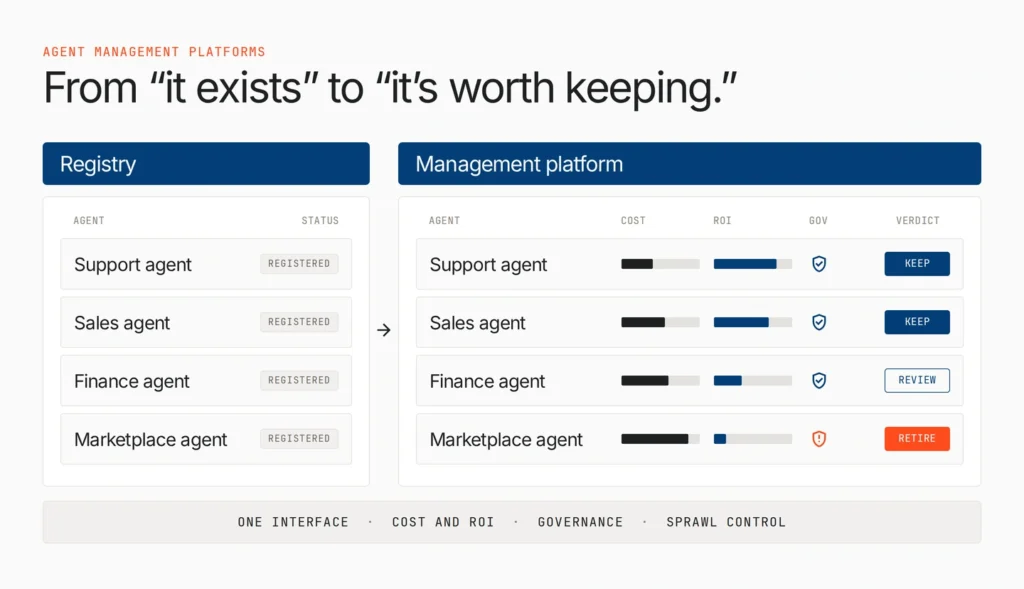
Notice what’s in that list: money. A registry tells you an agent exists. A management platform tells you whether it’s worth keeping.
The pressure is real. Gartner’s July overview reports that close to 60% of organizations have evidence of, or suspect, unauthorized agent use (as summarized by Gravitee, a vendor named in the report). McKinsey’s 2026 AI Trust Maturity Survey of roughly 500 organizations found only about one-third reach maturity level three or higher in strategy, governance and agentic AI controls, and nearly two-thirds name security and risk as the top barrier to scaling agentic AI.
- ~60% (fill 60%, red) “of organizations report evidence of, or suspect, unauthorized agent use.” Gartner Market Overview: AI Agent Management Platforms, July 2026
- ~1 in 3 (fill 33%, amber-brown) “organizations reach maturity level 3+ in strategy, governance and agentic AI controls.” McKinsey AI Trust Maturity Survey, March 2026
- ~2 in 3 (fill 66%, ink) “cite security and risk as the top barrier to scaling agentic AI.” McKinsey, March 2026 Alt text: AI agent management platform statistics 2026
Six jobs an agent management platform has to do
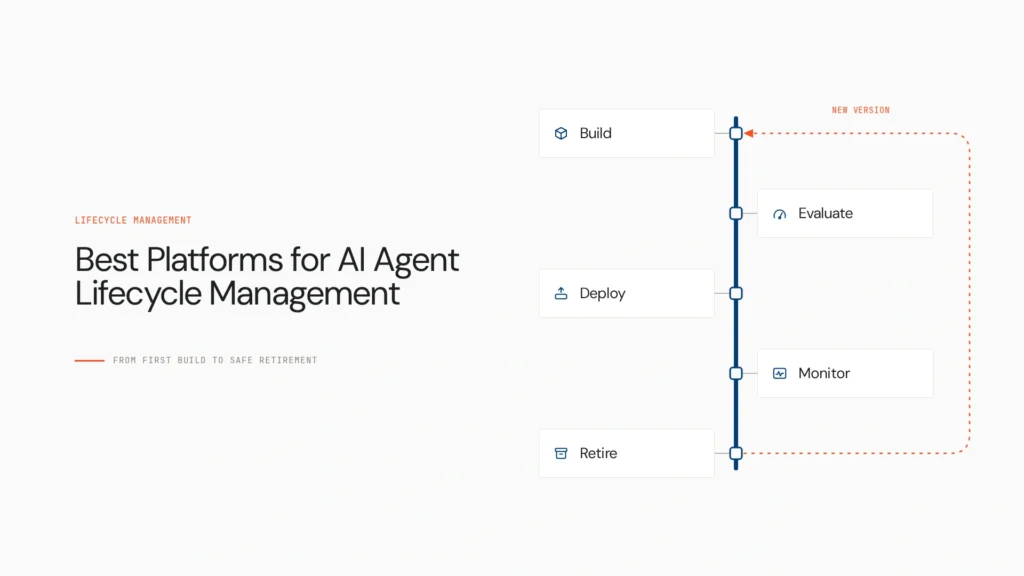
Strip away the product names and every platform here is chasing the same loop.
- Find: Every agent, including the ones nobody registered.
- Own: A named person, a purpose and a risk tier.
- Ship: Versions that pass evals before they go live.
- Run: Identity and policy on every call.
- Measure: Cost and outcome per agent, per team.
- Retire: Revoke access and archive the evidence.
The last two are where most products lack an extensive cover. Measuring means tying token spend to a team and an outcome. Retiring means pulling every credential an agent holds. If a demo never shows an agent being shut down, the reason must be enquired.
The 7 best platforms for enterprise AI agent management
1. Lyzr: Lyzr Studio + OpenController
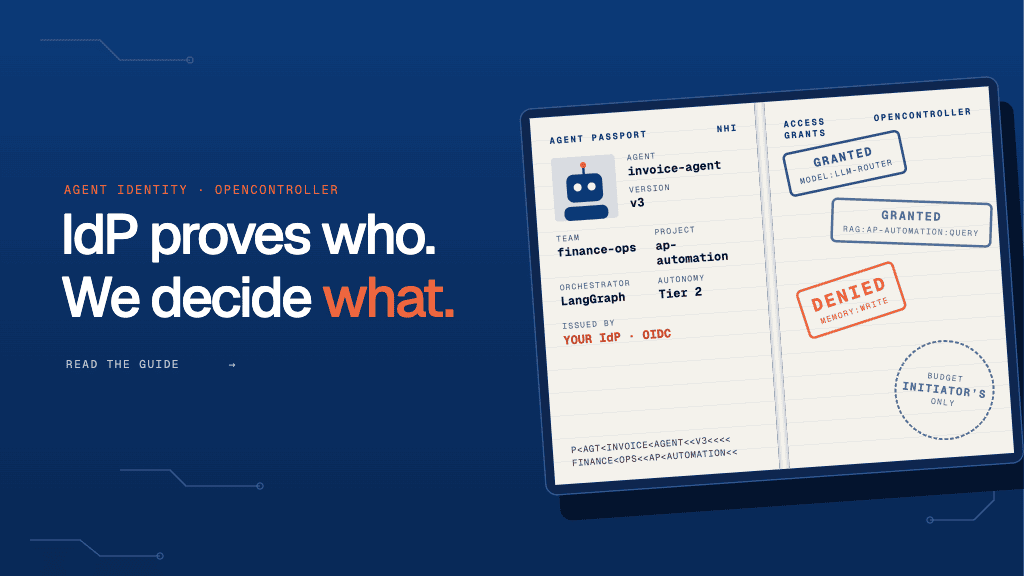
Lyzr splits the problem into two solutions. First, Lyzr Studio where teams build agents and second is OpenController where every agent gets managed, including the ones built on Bedrock, Foundry, LangGraph or a SaaS vendor’s platform. You don’t need the first to use the second.
We learned that split the hard way. While building agents for banks and insurers, we found the trouble never came from the agents we shipped. It came from the dozens nobody had listed, spread across teams and clouds, with invoices and no owners. OpenController grew out of that problem.
It has been mapped to the six jobs described earlier: Find, Own, Ship, Run, Measure, and Retire. It deploys in your VPC, on-prem or air-gapped, and a first environment connects in under a week.
Good fit when your agents already span more than one cloud, framework or vendor, or when data residency rules out a SaaS control plane. Think twice when you run a handful of agents on a single platform whose own console covers you.
The Enterprise Agent Estate Is the Next Infrastructure Decision
Find out why the agents you run deserve the same planning as your cloud and network, and what to decide before the count reaches the thousands. Read the whitepaper:
2. Microsoft Agent 365

Generally available since May 1, 2026, Agent 365 inventories and secures Microsoft 365 Copilot, Copilot Studio and Foundry agents, plus partner agents from vendors such as Zendesk, n8n and Kore.ai. Defender and Intune discover local agents on Windows devices, coding agents included. It costs $15 per user per month standalone, or comes with Microsoft 365 E7.
- Good fit when your agents and your people already live in Microsoft 365.
- Think twice when many agents run elsewhere: registry sync for AWS Bedrock and Google Cloud is in public preview, with lifecycle actions such as stop and delete still listed as coming soon. Per-agent cost tracking isn’t part of the launch.
- Where Lyzr slots in: keep Agent 365 for Copilot agents, and use OpenController for budgets and policy on everything outside Microsoft. See Lyzr vs Microsoft Copilot.
3. Salesforce Agentforce + AI Control Plane
Salesforce bid for the whole category on September 10, 2026 with its Trusted Enterprise AI Harness. The new AI Control Plane promises discovery, identity, policy, lifecycle, evaluation and cost control across Salesforce and third-party AI. MuleSoft Agent Scanners already find agents on Bedrock, Vertex AI and Copilot Studio.
- Good fit when your agents act mostly on CRM data and Salesforce permissions.
- Think twice when you need it soon: industry coverage puts the Harness rollout in Salesforce’s fiscal 2028, which starts February 2027.
- Where Lyzr slots in: OpenController can manage Agentforce and non-Salesforce agents together now. See Lyzr vs Agentforce.
4. ServiceNow AI Control Tower
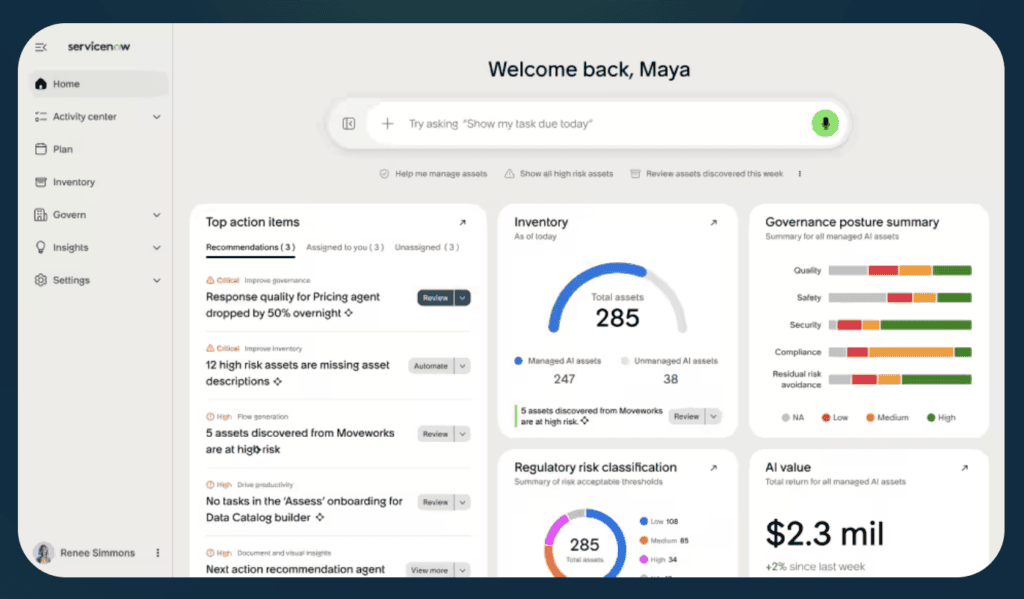
ServiceNow treats agents like any other asset. Knowledge 2026 expanded Control Tower to discover, observe, govern, secure and measure, with about 30 new connectors across AWS, Azure, Google Cloud, SAP, Oracle and Workday, plus Veza’s least-privilege enforcement. It reached general availability in August 2026.
- Good fit when change, risk and approvals already run through ServiceNow.
- Think twice when your ServiceNow data model is patchy, because discovery and risk scoring lean on it.
- Where Lyzr slots in: keep Control Tower as the risk register, and use OpenController in the request path of agents that never touch ServiceNow.
5. Amazon Bedrock AgentCore + AWS Agent Registry
AWS gives builders the parts and lets them assemble management. AgentCore covers runtime, identity, gateway, policy and evaluations. AWS Agent Registry, generally available since August 31, 2026, adds a catalog with approval workflows, CloudTrail audit and cross-account sharing, and auto-detects agents running on AgentCore Runtime and Gateway.
- Good fit when your engineers build custom agents on AWS and want infrastructure-as-code control.
- Think twice when agents run on other clouds: auto-detection covers AgentCore only, so other records are added by hand. Usage is billed per service, so model the meters.
- Where Lyzr slots in: OpenController’s AgentCore adapter puts AWS agents in the same inventory and budget model as everything else.
6. Kore.ai Agent Management Platform
Kore.ai launched its AMP on March 17, 2026 as a management layer separate from its builder. It connects to agents built with LangGraph, CrewAI, AutoGen, Google ADK, AgentCore, Microsoft Foundry and Agentforce, and pairs an evaluation studio with cost and performance tracking across them.
- Good fit when you want pre-production testing and cross-framework monitoring in one console.
- Think twice when you need a long track record: the product is months old, and Kore.ai’s naming has shifted (its Artemis platform followed in May 2026), so confirm which contract includes what.
- Where Lyzr slots in: OpenController adds in-path enforcement and air-gapped deployment where monitoring isn’t enough.
7. IBM watsonx Orchestrate
IBM shipped its Agentic Control Plane on AWS and IBM Cloud in June 2026. Its best idea is the Catalog: teams publish proven agents with semantic versions and bundled dependencies, so nobody rebuilds the same agent twice. Runtime policy, credential health checks and output guardrails share the console.
- Good fit when watsonx already runs your automation and reuse across teams is the goal.
- Think twice when most agents live outside IBM’s stack; ask for a demo on your own frameworks.
- Where Lyzr slots in: one budget and identity model across IBM and non-IBM runtimes.
Seven platforms on one page
| Platform | Finds agents it didn’t build | Owner and lifecycle record | Cost tracked and capped per agent | Policy enforced in the call path | Eval-gated releases | Runs inside your network |
| Lyzr Studio + OpenController | ✓ | ✓ | ✓ | ✓ | ✓ | ✓ VPC, on-prem, air-gapped |
| Microsoft Agent 365 | ✓ | ✓ | ✗ | ◐ | ◐ | ✗ |
| Salesforce Agentforce + AI Control Plane | ✓ | ✓ | ◐ | ◐ | ◐ | ✗ |
| ServiceNow AI Control Tower | ✓ | ✓ | ◐ | ◐ | ◐ | ✗ |
| Amazon Bedrock AgentCore + Agent Registry | ◐ | ✓ | ◐ | ✓ | ◐ | ◐ your AWS account |
| Kore.ai Agent Management Platform | ◐ | ◐ | ◐ | ◐ | ◐ | ◐ private instance |
| IBM watsonx Orchestrate | ◐ | ✓ | ✗ | ✓ | ◐ | ◐ AWS, IBM Cloud |
✓ built in and generally available · ◐ partial, in preview, announced, or limited to the vendor’s own agents · ✗ not in public documentation. Editorial assessment, October 2026. Confirm current features with each vendor.
Pick by where your agents are born
Asking one vendor’s platform to manage its rivals’ agents is like asking one airline to run the airport. It can be done, but you’ll notice whose flights board first. The “preview” labels on most cross-vendor features say the same thing.
So start with where your agents come from.
If the honest answer is “one cloud” or “one suite,” start native and revisit in six months. If it’s “all over the place,” buy the layer that doesn’t care who built the agent. Unsure? Our AI agent governance tools guide breaks down the policy side.
Run a 30-day agent census before you sign
Vendor demos use tidy sample fleets. Yours isn’t. Spend a month counting what you have, then make every shortlisted platform reproduce the result.

- Week 1 · Count. “List every agent across clouds, SaaS apps and laptops. Note how many nobody registered.”
- Week 2 · Claim. “Give each one a named owner. Anything unclaimed goes on a watchlist.”
- Week 3 · Cost. “Attach a monthly spend and one outcome metric to every agent.”
- Week 4 · Cut. “Mark each agent keep, fix or retire. Revoke access for every retire.” Footer with three empty boxes: “Agents found ____ · Without owner ____ · Retired ____”. Light paper background so it prints cleanly. Alt text: AI agent inventory and lifecycle checklist
The numbers from week 1 usually settle the build-versus-buy debate on their own. The week 4 list tells you whether a platform can actually retire an agent, or only label one. Our playbook for taking agents to production covers what happens to the keepers.
Start with the agent you’d least like to explain
Somewhere in your company there’s a quote-assist: live, unowned, still billing. The right platform is the one that finds it, names who’s responsible, shows what it costs and lets someone switch it off in a minute.
Book a demo, connect one environment, and see your real agent count, owners and spend in OpenController.
FAQs
The best platforms for enterprise AI agent management in 2026 include Lyzr Studio with OpenController, Microsoft Agent 365, Salesforce Agentforce, ServiceNow AI Control Tower, Amazon Bedrock AgentCore, Kore.ai AMP and IBM watsonx Orchestrate. Single-vendor fleets can start native; mixed fleets need a vendor-neutral layer.
It’s a central system for every agent a company runs. Gartner describes these platforms as managing custom and marketplace agents across deployment environments, with cost and ROI tracking, governance oversight and controls against agent sprawl in one interface.
No. A registry records that an agent exists and who owns it. Management adds what the registry can’t do alone: enforce policy on calls, attribute spend, gate releases on evals and revoke access when an agent is retired.
Attach a monthly cost (model tokens, tools and infrastructure) and one business outcome to every agent, such as cases resolved or hours saved. Review them together each month and retire agents whose cost keeps rising while the outcome stays flat.
Yes, if it manages agents at the gateway and identity layer rather than inside one runtime. Native consoles mostly govern their own cloud, while cross-vendor sync is often in preview. A neutral layer such as OpenController keeps one inventory across all three.
Related reading:
Best platforms for AI agent control plane management
Best tools for real-time AI agent monitoring
Best tools for AI policy enforcement at scale
RBAC vs ABAC for AI agent platforms
Book A Demo: Click Here
Join our Slack: Click Here
Link to our GitHub: Click Here