Table of Contents
- Beyond Copilots: The Rise of the Agentic Enterprise
- The Numbers Don’t Lie: Agentic AI Adoption in 2026
- Where Agentic AI Is Making the Biggest Impact
- Real-World Results: From JPMorgan to Valeo
- How Agentic AI Actually Works Inside the Enterprise
- The Governance Imperative
- How to Get Started with Agentic AI
Beyond Copilots: The Rise of the Agentic Enterprise
Something decisive has shifted in how enterprises deploy artificial intelligence in 2026.
For the past two years, the corporate world engaged in broad experimentation with generative AI – but that phase is now drawing to a close, replaced not simply by an evolution of existing tools, but by a structural shift in how enterprises deploy intelligence at scale.
The answer is the rise of agentic AI – systems that don’t just respond to prompts but can reason, plan, and pursue complex, multi-step goals autonomously.
Unlike the earlier “copilot” paradigm, where AI supported human tasks, agentic systems are designed to operate with a higher degree of autonomy – they can navigate complex workflows, make real-time adjustments, and execute multi-step processes with limited intervention. In simple terms, copilots assist, but agents act.
The agentic enterprise represents the next stage of business AI: a shift from tools that answer questions to systems that can plan, use software, coordinate tasks, learn from feedback, and move work across departments with human oversight.
For enterprise leaders evaluating platforms like Lyzr.ai, this shift is not theoretical – it is a live competitive imperative happening right now.
The Numbers Don’t Lie: Agentic AI Adoption in 2026
The data coming out of major research firms in 2026 is striking and consistent.
Gartner predicts that 40% of enterprise applications will include task-specific AI agents by the end of 2026, up from less than 5% in 2025.
The agentic AI market is expected to reach $10.86 billion in 2026, up from $7.55 billion in 2025, and is projected to hit $93.20 billion by 2032 at a CAGR of 44.6%.
A striking 88% of executives plan to increase AI budgets because of agentic AI initiatives.
Deloitte’s 2026 State of AI in the Enterprise report shows AI tools are now available to the workforce of about 60% of surveyed organizations across industries including financial services, life sciences, healthcare, technology, and government – signaling a shift from pilots to true enterprise scale.
Companies report average 171% returns on agentic AI deployments, with U.S. enterprises achieving 192% ROI – exceeding traditional automation by 3x.
More than 74% of executives whose organizations introduce agentic AI see returns on their investment in the first year.
A bold data visualization infographic showing 2026 agentic AI market statistics – bar charts showing 40% enterprise app adoption, $10.86B market size, 171% average ROI, and 88% budget increase rate, styled in dark navy and purple tones“April 2026 marked a defining pivot for enterprise artificial intelligence. Landmark launches from EY, Oracle, Salesforce, Hyland, and Microsoft transformed agentic AI from a frontier technology into the new minimum standard for digital ventures.”
Where Agentic AI Is Making the Biggest Impact
Agentic AI is not a one-size-fits-all solution, but certain enterprise domains are seeing outsized gains.
Customer support is an obvious starting point – agents can triage tickets, gather context, draft responses, update systems, suggest refunds, and escalate edge cases.
IT operations is another strong fit, where agents can interpret alerts, collect telemetry, compare changes, open incidents, notify owners, and generate runbooks.
In software teams, agents can create test plans, review pull requests, update documentation, and help manage release checklists. Finance and operations teams can use agents for invoice exceptions, procurement intake, policy checks, reconciliation support, and reporting workflows.
Finance and operations: automated invoicing, forecasting, and expense auditing are accelerating close processes by 30-50%. Security and governance: anomaly detection and policy enforcement agents enable proactive risk reduction. Sales and marketing: lead generation, personalized outreach, and qualification systems are producing 2-3x improvements in pipeline velocity.
Agentic AI Use Cases by Enterprise Function
| Enterprise Function | Key Agentic AI Tasks | Measurable Impact |
|---|---|---|
| Customer Service | Ticket triage, response drafting, escalation routing | 40+ hours saved monthly per small team |
| Finance & Operations | Invoice exceptions, reconciliation, forecasting | 30-50% faster close processes |
| IT & Security | Alert interpretation, incident creation, runbook generation | Proactive risk reduction vs. reactive response |
| Software Engineering | Code review, test plans, documentation, release checklists | Up to 50% cycle time reduction |
| Sales & Marketing | Lead qualification, personalized outreach, pipeline management | 2-3x pipeline velocity improvement |
| HR & Talent | Screening, onboarding workflows, policy Q&A | Significant reduction in administrative overhead |
Real-World Results: From JPMorgan to Valeo
Abstract statistics only tell part of the story – the real proof is in enterprise deployments already in production.
JPMorgan’s adoption of the LLM Suite for agentic orchestration has delivered compelling results: 83% faster research cycles for portfolio managers, automation of over 360,000 manual hours yearly, and rapid production of investment banking documents.
Automotive supplier Valeo offers one of the clearest examples of this transition in practice – the company completed a large-scale deployment of AI models across its global operations, integrating AI into the workflows of its 100,000 employees.
Valeo reports that approximately 35% of its code is now generated or optimized by AI systems.
EY’s Canvas platform processes an extraordinary 1.4 trillion lines of audit data annually across 160,000 global engagements spanning over 150 countries, embedding orchestration and federated governance for 130,000 professionals – signaling the mainstreaming of agentic infrastructure for regulated, mission-critical workflows.
Microsoft’s partnership with Schneider Electric revealed agentic AI’s transformative power for manufacturing – production pilots demonstrated up to 50% cycle reduction in engineering design and documentation, paired with operator-in-the-loop governance.
PepsiCo is working with Siemens and NVIDIA to convert manufacturing and warehouse facilities into high-fidelity digital twins that simulate end-to-end operations – AI agents can identify up to 90% of potential issues before physical modifications occur, already delivering a 20% increase in throughput on initial deployments.
A split-panel illustration showing enterprise AI agents in action across finance, manufacturing, and customer service departments, with data flows connecting autonomous agent nodes to real business outcomes like speed metrics and cost savingsHow Agentic AI Actually Works Inside the Enterprise
Understanding the mechanics behind agentic AI helps leaders make better deployment decisions.
Agentic AI in enterprise refers to AI systems that can perceive, reason, plan, and act autonomously across business processes – without human-in-the-loop approval for each step. Unlike traditional AI that responds to a single prompt, agentic AI sets goals, coordinates across connected systems, and adapts based on results.
What makes agentic AI structurally different from earlier generations of developer tooling is not better prompting, but sustained execution – frontier models can now reason across long-running, multi-step workflows, invoking tools, interpreting results, and iterating over time.
At the heart of agentic AI lies the role of LLMs as reasoning engines – enabling agents to understand context, interpret data, and interact naturally with humans and other machines. Their capabilities extend beyond language: they plan, execute, and reflect. When fused with enterprise data pipelines, these models become the cognitive core of AI-driven enterprise intelligence.
Most businesses’ existing processes were designed around human staff, but agents operate differently – they don’t need breaks or weekends, and they can complete a high volume of tasks continually. When organizations realize this, the opportunities for process redesign become compelling.
AI agent orchestration is where things get particularly powerful – it involves having multiple specialized agents working together like musicians in an orchestra, each playing their part but all coordinated to create something bigger.
The Four Core Capabilities of an Enterprise AI Agent
- Perception: The agent ingests and interprets data from APIs, databases, documents, and live system signals.
- Reasoning: Using an LLM backbone, the agent decomposes complex goals into logical sub-tasks and selects the best course of action.
- Execution: The agent takes real actions – calling tools, updating records, triggering workflows, or messaging stakeholders.
- Reflection: The agent evaluates its own output, checks it against defined criteria, and iterates if needed before closing the loop.
The Governance Imperative: Getting Agentic AI Right
Not every enterprise agentic AI initiative succeeds – and the failure rates are a serious warning.
Gartner warns that over 40% of agentic AI projects will be cancelled by 2027 without proper governance and clear ROI frameworks.
As of early 2026, only 11-14% of enterprise AI agent pilots have reached production at scale, with 86-89% failing to realize durable value.
While leaders rightly see agentic AI as a catalyst for growth, many are finding the technology is increasing operational friction instead of improving productivity – this happens when leaders build on a cracked foundation, allow uncontrolled proliferation of siloed AI agents, or automate legacy processes rather than reimagining them.
Only 23% of enterprises have formal agent identity or inventorying strategies, leading to fragmented control.
The EU AI Act, enforceable from August 2026, classifies most multi-agent orchestration in high-impact sectors as high-risk, triggering requirements for human-in-the-loop oversight, immutable audit trails, scenario-based incident testing, and persistent identity management throughout the agent lifecycle.
The race to expand brings rising risk – from vendor lock-in and compliance exposure to integration complexity and a lack of harmonized success metrics. For innovation and venture leaders, sustainability now hinges on the ability to embed governance, observability, and risk management within every operating layer.
A professional diagram showing a layered enterprise AI governance framework with human oversight at the top, agent orchestration in the middle, and compliance audit trails at the base, using clean corporate design with purple and dark navy accentsHow to Get Started with Agentic AI in Your Enterprise
The path to agentic AI success is clear for organizations willing to approach it systematically.
Forward-thinking organizations are moving beyond pilot projects to implement systematic approaches for agentic transformation – recognizing that effective agentic AI requires more than deploying individual agents, but rather thoughtful integration into systems, workflows, and careful management once agents are rolled out.
Leading enterprises don’t simply layer agents onto existing workflows – instead, they redesign processes to leverage the unique strengths of agents, taking a step back and examining end-to-end processes rather than finding automation opportunities within current operations.
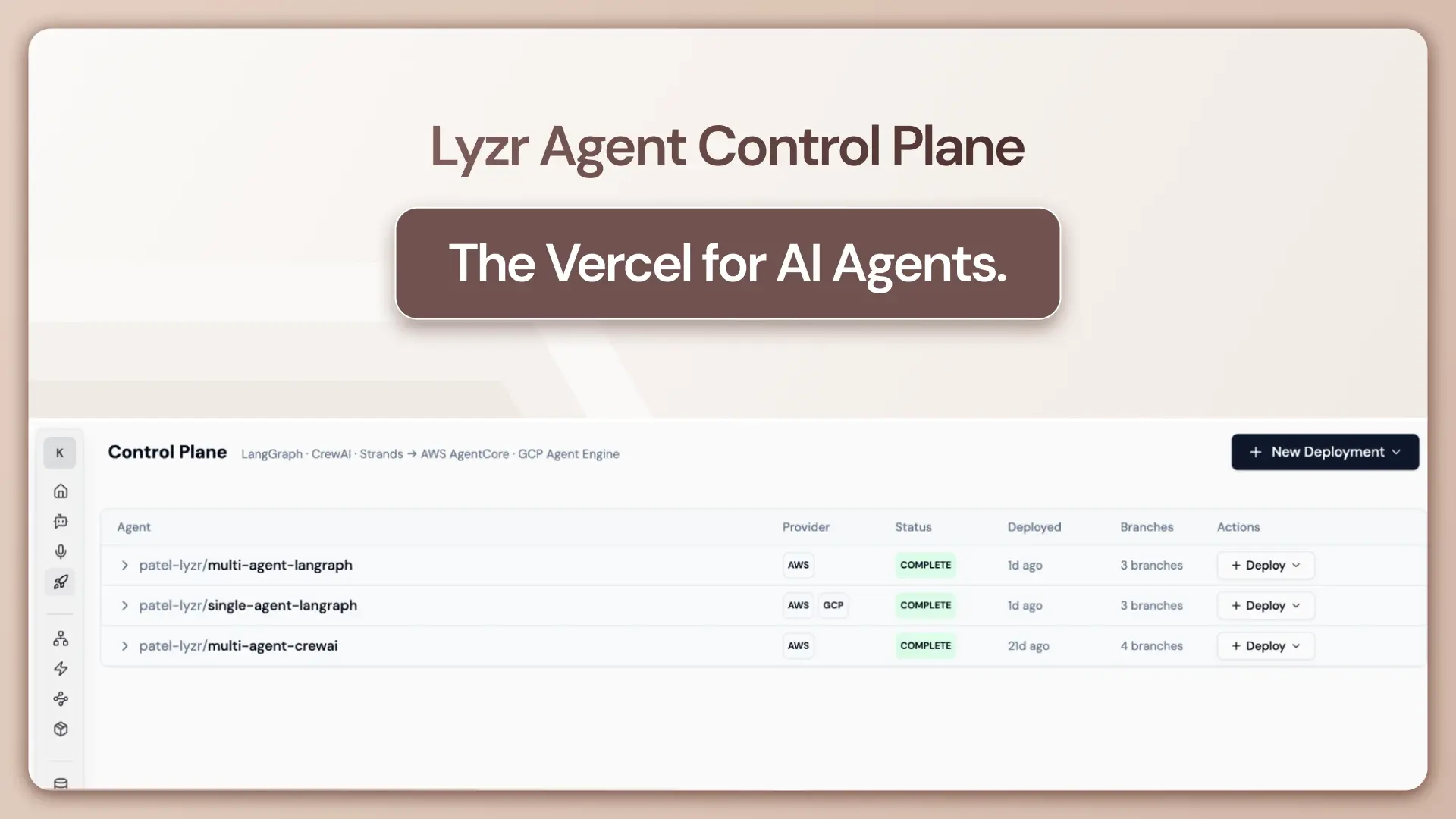
Platforms like Lyzr.ai are purpose-built to help enterprises navigate exactly this challenge – offering pre-built agent frameworks, built-in governance controls, and deep integration capabilities so teams can move from pilot to production without reinventing the wheel.
Here is a practical four-step approach for enterprise leaders ready to act:
- Identify high-ROI, repetitive workflows – Start with processes that are rule-based, measurable, and have clear success criteria. Customer support escalation, invoice processing, and IT incident triage are proven entry points.
- Build your data foundation first – 52% of businesses cite data quality and availability as the biggest barriers to AI adoption, so clean, connected data pipelines must precede agent deployment.
- Deploy with governance baked in – Ensure every agent has a defined identity, scope, audit trail, and escalation threshold. Treat agents as accountable workers, not black boxes.
- Measure, iterate, and scale – Agentic workflows can be measured by completed tasks, avoided escalations, reduced handling time, and faster resolution, giving leaders concrete KPIs to drive scale decisions.
Agentic AI Readiness Checklist for Enterprise Teams
| Readiness Area | Key Question to Answer | Priority Level |
|---|---|---|
| Data Infrastructure | Are your data pipelines clean, connected, and accessible to agents? | Critical |
| Use Case Selection | Have you identified 2-3 measurable, high-value workflows to automate first? | High |
| Governance Framework | Do you have agent identity, scope limits, and audit trails defined? | Critical |
| Human Oversight | Are escalation thresholds and human review gates clearly established? | High |
| Platform Selection | Does your chosen platform support multi-agent orchestration and compliance? | High |
| ROI Metrics | Do you have baseline measurements to compare before and after agent deployment? | Medium |
The Bottom Line: Agentic AI Is the New Enterprise Standard
April 2026 is recognized not as an endpoint, but as a transformative inflection for enterprise AI – agentic AI now establishes the baseline for digital innovation, operational resilience, and sectoral competitiveness.
In 2026, competitive advantage belongs not to organizations touting the most pilots, but to those operationalizing open, compliant agentic orchestration as persistent innovation infrastructure.
The transition to agentic systems is no longer theoretical – it is already underway, reshaping how enterprises operate and compete. The question is no longer whether organizations will adopt AI, but how deeply it will be embedded into their core processes.
For enterprise leaders ready to move from experimentation to execution, Lyzr.ai provides the enterprise-grade agentic AI platform built for exactly this moment – combining powerful multi-agent orchestration with the governance, security, and observability that production deployments demand.
A confident enterprise team in a modern office looking at a large display showing an AI agent dashboard with live workflow automations, green status indicators, and performance metrics – representing successful agentic AI transformationReady to transform your enterprise operations with agentic AI? Explore how Lyzr.ai helps enterprises build, deploy, and govern AI agents at scale.
Book A Demo: Click Here
Join our Slack: Click Here
Link to our GitHub: Click Here