The first AI agent feels exciting. The tenth feels productive. The fiftieth starts raising questions.
- “Which version is live?”
- “Who changed the prompt?”
- “Why did costs suddenly increase?”
- “Can we roll this back?”
Most enterprises do not struggle with building AI agents.
They struggle with running them at scale.
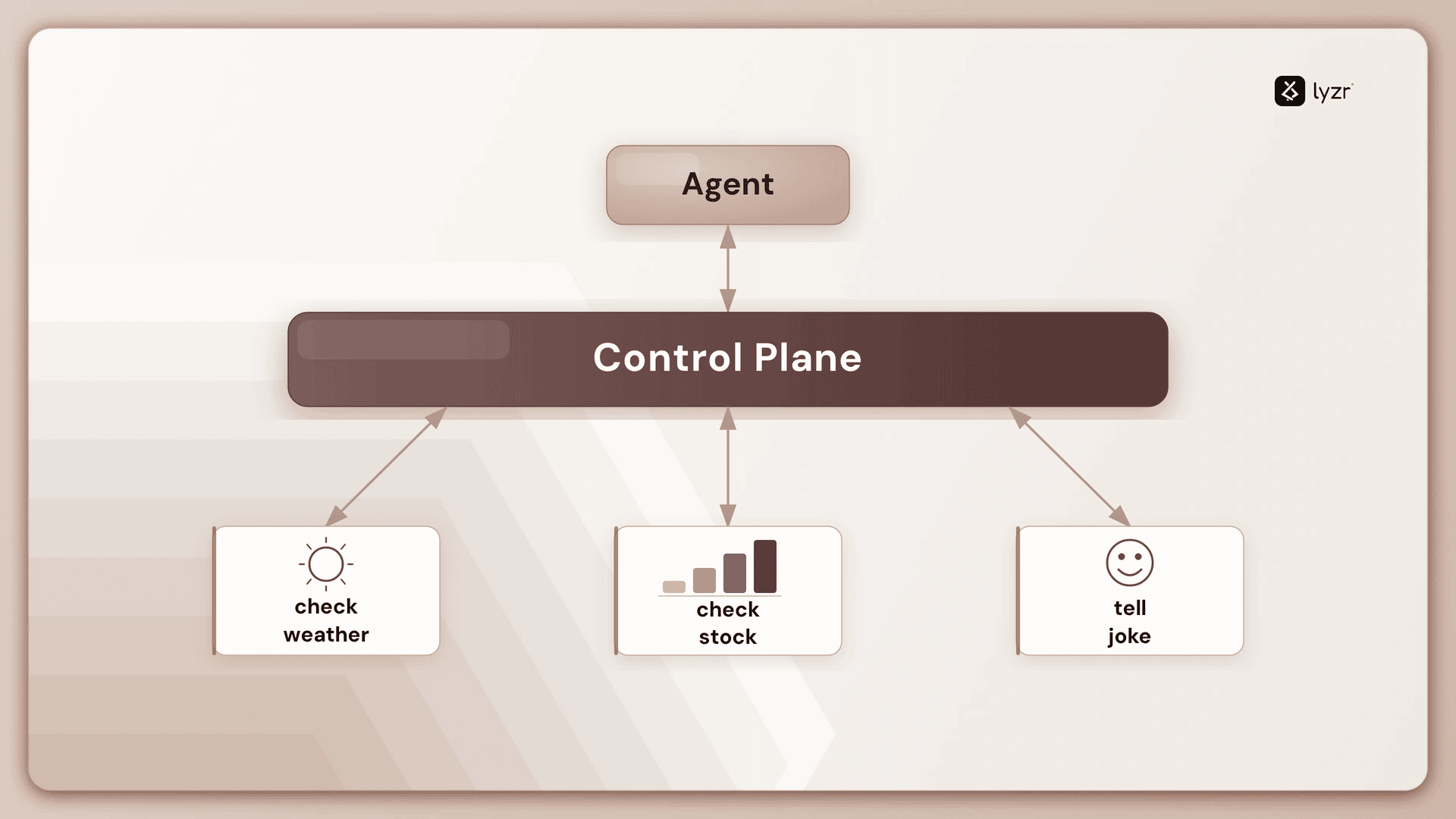
That is where a Control Plane for AI Agents enters the picture.
A conversation every team eventually has
Month 1
Team: “We launched our first AI agent.”
Leadership: “Great.”
Month 3
Team: “We now have ten agents helping support and sales teams.”
Leadership: “Great.”
Month 6
Team: “We have 40 agents across different workflows.”
Leadership:
- “Which one is in production?”
- “Who approved this update?”
- “Can we track failures?”
- “Why are costs increasing?”
Silence.
The issue usually isn’t intelligence.
It is coordination.
So what exactly is a Control Plane for AI Agents?
A Control Plane for AI Agents is a centralized layer that helps organizations:
- Monitor AI agents
- Manage deployments
- Track versions
- Control environments
- Govern access
- Improve visibility
Think of it this way: AI agents are workers.
The control plane is mission control. Without one, every agent behaves like an isolated system. With one, everything becomes manageable.

Quick reality check — where does the score land?
Before moving further, take thirty seconds.
Count how many questions receive a “Yes.”
AI Agent Readiness Checklist
| Question | Yes / No |
| Can every deployed agent be seen from one dashboard? | |
| Can teams instantly rollback changes? | |
| Can production versions be identified immediately? | |
| Can costs be tracked agent-by-agent? | |
| Can approvals happen before deployment? | |
| Can failures be traced quickly? |
Score yourself
0–2 Yes
AI systems are probably running independently.
3–4 Yes
Some controls exist, but visibility gaps remain.
5–6 Yes
The foundation for scalable AI operations is taking shape.
What happens when there is no control plane?
Things usually look fine at first.
Then complexity quietly shows up.
| Problem | What teams experience |
| Agent sprawl | Teams deploy independently |
| Version confusion | Nobody knows what is live |
| Rising costs | Token usage unexpectedly increases |
| Governance gaps | Security becomes difficult |
| Slow troubleshooting | Root causes become difficult to find |
| Deployment risks | Changes become harder to manage |
Small issues become larger operational problems.
AI Agent Control Center
- Active Agents: 84
- Production Deployments: 29
- Pending Reviews: 6
- Failed Runs (24 hrs): 11
- Average Response Latency: 1.4 sec
- Token Spend Today: $2,317
Recently Updated Agents
| Agent | Status | Environment | Last Update |
| Sales Assistant | Running | Production | 2 hours ago |
| Compliance Agent | Review Pending | Pre-prod | 45 minutes ago |
| Knowledge Assistant | Running | Production | 6 hours ago |
| Customer Support Agent | Alert Triggered | Production | 15 minutes ago |
Alert
Customer Support Agent latency increased by 65%
Possible reason: Recent prompt modification detected
Recommended action: Rollback available
The conversation changes from:
“Something broke.”
to
“We know exactly what changed.”
AI agents need environments too
Software teams do not directly push code into production.
AI agents should follow a similar path.
| Environment | Purpose |
| Development | Experiment and test |
| Pre-production | Validate changes |
| Production | Serve end users |
Without environments: Changes become risky.
With environments: Deployments become controlled.
What a Control Plane for AI Agents actually manages
| Capability | Function |
| Agent monitoring | Tracks performance and health |
| Version management | Maintains deployment history |
| Environment control | Separates development and production |
| Governance | Handles permissions and approvals |
| Observability | Tracks logs and failures |
| Cost visibility | Monitors model spending |
| Security | Protects access and systems |
| Deployment workflows | Standardizes releases |
Final thought
AI projects usually begin as experiments.
Experiments become pilots.
Pilots become multiple deployments.
And then teams realize something important:
The challenge was never deploying AI agents.
The challenge was operating them at scale.
A Control Plane for AI Agents acts as the layer that brings visibility, governance, monitoring, and control into one place.
Because once AI agents start multiplying, control stops being optional.
It becomes infrastructure.
Frequently Asked Questions
1. What is a Control Plane for AI Agents?
A Control Plane for AI Agents is a centralized layer for managing, monitoring, deploying, and governing AI agents.
2. Why do enterprises need one?
Enterprises need it to avoid agent sprawl, improve visibility, manage costs, and maintain governance.
3. Can a control plane support multiple environments?
Yes. Most control planes support development, pre-production, and production workflows.
4. Is a control plane different from an AI framework?
Yes. Frameworks help build agents. Control planes help operate them at scale.
Book A Demo: Click Here
Join our Slack: Click Here
Link to our GitHub: Click Here