TL;DR
- Gartner projects that over 40% of agentic AI projects will be canceled by the end of 2027, due to escalating costs, unclear business value or inadequate risk controls, which makes this a decision that carries real budget and career risk.
- The “build” path buys control but the true cost usually runs into six figures for a single enterprise-grade generative AI agent handling autonomous workflows, with pricing running $100,000 to $500,000 and beyond, before ongoing maintenance.
- Research cited by Lyzr found that roughly 88 percent of AI agent pilots never reach production, and separate research shows approximately 95% of generative AI pilots do not deliver measurable financial returns.
- Most enterprises that scale successfully don’t pick a side. They run a hybrid model where vendor platforms absorb standardized work and internal teams build only where the workflow is genuinely proprietary.
- A five-pillar framework (TCO, speed to value, scalability, governance, future-proofing) gives CTOs a repeatable way to score each workflow instead of making one binary bet for the whole company.
Your board wants an AI strategy. Not a pilot, not a slide deck with a roadmap that stretches to 2028. An actual system that ships and shows up in the P&L.
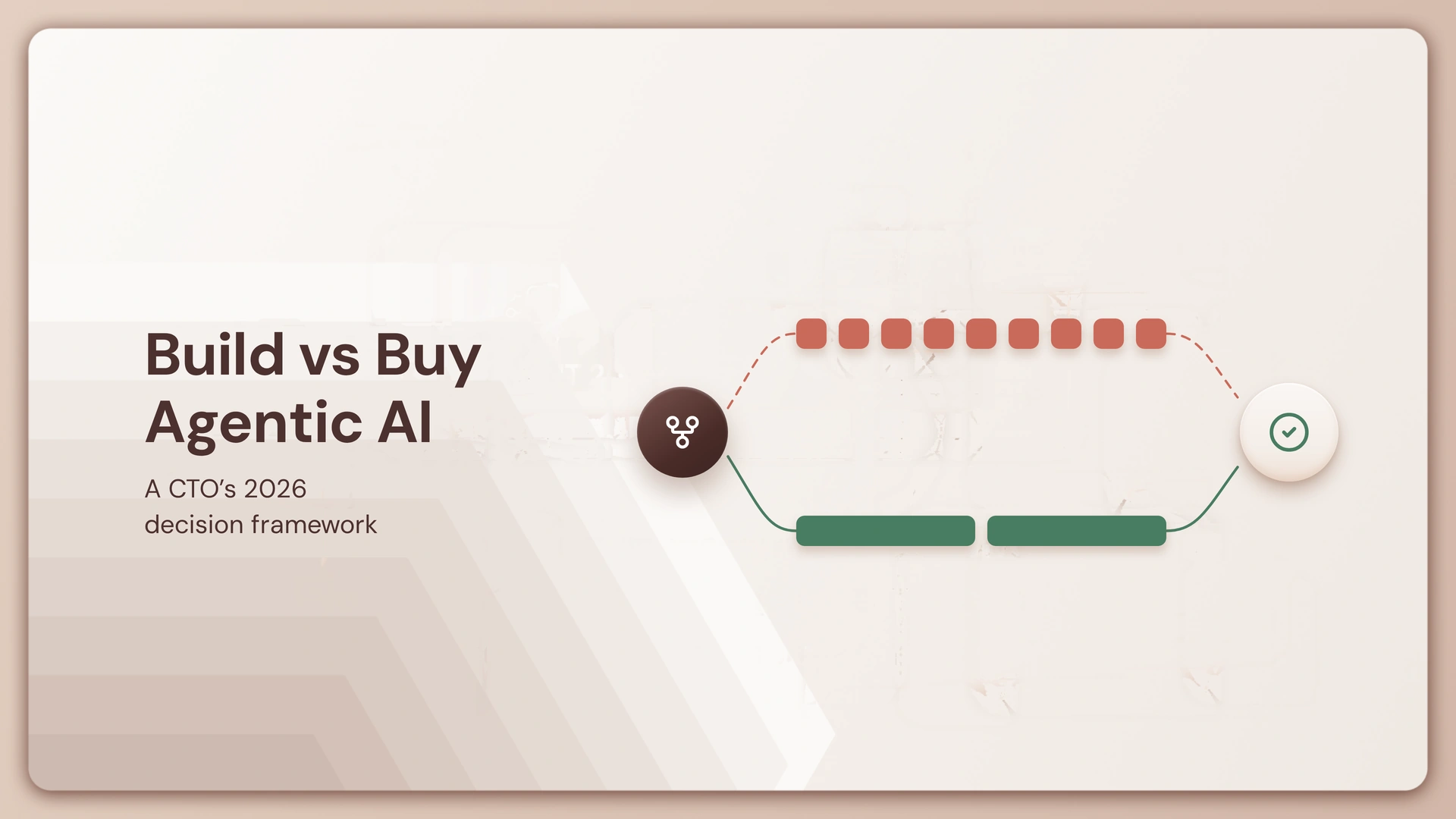
That pressure lands squarely on you. And it collapses into one decision faster than most CTOs expect: do you build your own agentic AI stack, or do you buy a platform that’s already solved the plumbing?
Here’s what makes this decision different from the last twenty “build vs buy” calls you’ve made. Agentic AI systems don’t just run code. They reason, plan, call tools, and take actions across your CRM, your ERP, your ticketing queue, sometimes without a human in the loop. AI tools aren’t traditional software; they’re dynamic, autonomous systems that learn from enterprise context, orchestrate actions across dozens of applications, and evolve as business processes change. The old evaluation checklist for buying software doesn’t map cleanly onto that.
And the stakes aren’t theoretical. Only 17% of organizations have deployed AI agents to date, yet more than 60% expect to deploy within two years. That gap between intention and execution is where budgets get burned and CTOs get asked hard questions in QBRs.
This article walks through what actually drives the build vs buy agentic AI decision at enterprise scale: the real cost of building, the real ceiling of buying, and a five-pillar framework you can apply workflow by workflow instead of betting the whole strategy on one call. For a broader planning view, Lyzr’s agentic AI roadmap playbook covers how this decision fits into a full-year deployment plan.
Why “Build vs Buy” Isn’t the Question Most CTOs Think It Is
The framing itself is slightly wrong, and that’s worth sitting with before you build a scorecard.
Ask a room of engineering leaders “build or buy,” and you’ll get answers rooted in ego, prior experience, or whichever vendor pitched them last quarter. Ask instead “which layer of the stack should we own,” and the conversation changes.
Evaluating an enterprise build-vs-buy AI decision means assessing the system across a six-layer architecture rather than treating it as a single software package, because agentic AI systems don’t just generate text, they autonomously execute multi-step workflows and take actions. Those six layers, roughly: foundation models, orchestration and agent frameworks, retrieval and context infrastructure, evaluation and testing, observability and guardrails, and governance and compliance.
A production-grade enterprise AI stack consists of six core layers evaluated individually during a build-or-buy audit: foundation models, orchestration and agent frameworks executing multi-step agentic workflows, retrieval and context infrastructure including vector databases and RAG loops, evaluation and testing systems that benchmark prompt and model quality, observability and guardrails for latency and drift, and governance and compliance covering data privacy, access controls, and audit logs. Enterprises evaluating retrieval infrastructure specifically should look at how agentic RAG architecture handles context and grounding, since that layer alone determines whether an agent’s answers are trustworthy.
Almost nobody should build all six. Almost nobody should buy all six either. The real skill is knowing which layers create your competitive edge and which are just plumbing everyone needs and nobody should be reinventing.

The Case for Building: What You’re Actually Signing Up For
Building has genuine upside. Full data sovereignty, IP ownership, and an architecture tuned to workflows no vendor has ever seen. For a bank running proprietary underwriting logic or a defense contractor with air-gapped requirements, that control isn’t optional.
But the sticker price on a build project is where most CTOs get blindsided.
The dollar cost is bigger than the demo suggests. A basic rule-based bot might run $5,000 to $25,000. That’s not what enterprises are talking about when they say “agentic AI.” If you’re eyeing enterprise-grade generative AI agents for autonomous workflows, banking and healthcare use cases, or tasks involving complex reasoning, the AI agent pricing range will be $100,000 to $500,000, and counting. A fully autonomous agent that orchestrates workflows and executes tasks starts closer to $100,000 and can easily exceed $500,000 for enterprise solutions. That’s before you staff the team that keeps it running.
The talent war is real and it’s expensive. Reinforcement learning specialists, fine-tuning engineers, RAG (Retrieval-Augmented Generation, the technique of pulling live data into a model’s context window) architects. You’re recruiting against every hyperscaler and every well-funded AI startup for the same twelve hundred people.
The pilot-to-production gap swallows most projects before they ship. Research from Forrester and Anaconda, supported by IDC, indicates that roughly 88 percent of AI agent pilots never reach production. Separately, MIT’s NANDA Initiative found that approximately 95% of generative AI pilots do not deliver measurable financial returns. The problem isn’t usually the model. It’s everything wrapped around it: security scanning, version control, rollback logic, identity registration, none of which shows up in the demo but all of which determines whether an agent survives contact with production traffic.
Governance gets built last, if it gets built at all. Role-based access at the agent, tool, and data level. Immutable audit trails. Compliance mapping to SOC 2, GDPR, or HIPAA. Teams that treat this as a phase-two concern usually find out it was actually phase-zero.
A CTO at a mid-market insurer told a peer group last year that the demo took three weeks. Getting that same agent through security review, connected to the claims system, and observable in production took eleven months. The model was never the bottleneck. The operational scaffolding was.
The Case for Buying: What a Platform Actually Absorbs
Buying reframes the problem entirely. Instead of asking “how do we build AI infrastructure,” you ask “how fast can we put AI infrastructure to work.”
For 90% of enterprise use cases, buying an AI agent platform is the most practical choice, reducing time-to-value from 18 months to weeks and lowering total cost of ownership by eliminating infrastructure maintenance. That’s not a marketing number from a vendor with something to sell you. It’s a pattern showing up across enterprise deployments where the workflow itself, FAQ handling, ticket routing, document summarization, doesn’t need a bespoke architecture to work well.
The trade-off shows up on the other side too. Every off-the-shelf AI agent platform is built around assumptions about how your workflows operate. When your workflows match those assumptions, the platform works well. When they do not, you start running into walls: rigid orchestration logic, limited control over how proprietary data moves through the system, and guardrails you cannot adjust without breaking the platform’s architecture.
That ceiling is exactly why “buy everything” is as naive as “build everything.” According to Dynatrace’s Pulse of Agentic AI 2026, roughly 50% of enterprise agentic AI projects are still in POC or pilot stage, and a meaningful share of those are stuck there because the vendor platform they bought couldn’t flex to the workflow they actually needed.
What a mature enterprise AI agent platform genuinely absorbs: security scanning and audit logging baked in rather than bolted on, model-agnostic orchestration so a Claude outage doesn’t take down your fleet, and a governance layer that’s already been through someone else’s compliance review. You inherit an R&D budget you didn’t pay for directly.
The Hybrid Pattern Almost Everyone Ends Up Running
Here’s the pattern that shows up once you stop asking “build or buy” and start asking “which workflow, which layer.”
Hybrid means vendor platforms handle the 80% of transactions, including simple customer queries, routine scheduling, and baseline copilot interactions, while your own agents own the 20% of complexity that includes fraud detection, compliance reasoning, underwriting logic, and other high-stakes decisions. Most successful enterprises in 2026 run hybrid patterns, using vendor platforms for the 80% and custom agents for the critical 20%. That same split shows up in regulated workflows like AI-driven credit risk assessment, where routine scoring runs on a platform and the edge-case reasoning gets custom-tuned.
This isn’t a compromise position dressed up to avoid making a call. It’s the actual shape the decision takes once you evaluate at the workflow level instead of the org-chart level. In practice, most enterprises that scale AI agents successfully end up in a hybrid by Year 2.
The practical version: a front-end agent handling tier-one support tickets runs on a bought platform because that workflow is commodity and the cost of building it yourself never pays back. A claims-adjudication agent reasoning over proprietary underwriting rules gets built in-house, or gets built on top of a platform’s SDK where your team owns the logic but the platform owns the deployment pipeline, the observability, and the guardrails.
That last model, building differentiated logic on top of governed infrastructure, is where a lot of the “build vs buy” tension actually resolves. You’re not choosing between owning your IP and moving fast. Platforms like Lyzr’s SDK-based approach are built specifically so the agents you design remain your intellectual property, running on infrastructure you don’t have to maintain yourself.
A Five-Pillar Framework for Scoring Each Workflow
Apply these five questions to a specific workflow, not to your AI strategy as a whole. The answer changes depending on which workflow is on the table.
Pillar 1: Total Cost of Ownership. Calculate the fully-loaded three-year cost of building, salaries, recruitment, cloud and GPU spend, monitoring tooling, against the three-year licensing and implementation cost of buying. Enterprise-grade builds routinely land in the $100,000 to $500,000 range per agent before maintenance. Which number is your CFO more comfortable defending in a board deck?
Pillar 2: Speed to Value. Map the realistic timeline from kickoff to a production agent solving a real problem, not a demo. If buying gets you there in weeks instead of the 18-month cycle common to custom builds, what’s the opportunity cost of the wait?
Pillar 3: Scalability and Orchestration. Can you manage dependencies between dozens of agents, not just one? Building a true multi-agent orchestration engine, one that lets agents collaborate, hand off, and recover from a failed model call, is a substantial engineering project on its own. This is the layer most in-house builds underestimate.
Pillar 4: Governance and Observability. Who builds the dashboards, the audit trail, the RBAC layer, the PII detection? A mature platform provides this as a standing feature. Building it from scratch means your security team is now maintaining a second product they didn’t ask for.
Pillar 5: Future-Proofing. The model landscape shifts every few months. Anthropic reached 34.4% business AI adoption in April 2026, overtaking OpenAI’s 32.3%, a shift that would force a re-architecture on any team that hard-coded a single model dependency into their stack. Platforms designed to be model-agnostic absorb that churn for you, which is the core argument behind framework-agnostic platform architecture as a hedge against vendor lock-in.
Score each workflow against these five pillars and a pattern will emerge fast: your commodity workflows buy themselves, and your differentiated ones justify the build.
What Happens When You Get the Call Wrong
The consequences aren’t abstract. Gartner attributes agentic AI project cancellations to organizations that let hype blind them to the real cost and complexity of deploying AI agents at scale, stalling projects from moving into production.
Only 17% of organizations have deployed AI agents to date, yet more than 60% expect to deploy within two years, a gap that widens every quarter a strategy stays undecided.
Part of the confusion in the market comes from vendors who aren’t being straight about what they’re selling. Many vendors contribute to the hype by engaging in “agent washing,” the rebranding of existing products such as AI assistants, RPA, and chatbots without substantial agentic capabilities, and Gartner estimates only about 130 of the thousands of agentic AI vendors are real. If you’re evaluating a “buy” option, that’s a due-diligence line item, not a footnote: ask the vendor to show autonomous multi-step reasoning, not a scripted demo flow. Lyzr’s enterprise AI security platform framework is a useful reference point for what that due diligence should actually cover.
On the flip side, teams that build without a governance plan tend to discover the gap the hard way, usually during a security review that stops a launch six weeks before the date leadership already announced internally.
Frequently Asked Questions
Should enterprises build or buy AI agents?
Most enterprises should buy for the majority of workflows and build selectively for the ones that carry genuine strategic differentiation or handle sensitive, regulated data. Building AI is recommended only when the agent constitutes core intellectual property or requires sovereign control over highly sensitive, regulated data. For everything else, the speed and governance benefits of a platform tend to outweigh the control you’d gain from a custom build.
How much does it cost to build an AI agent in-house?
Costs vary widely by complexity, but enterprise-grade agents handling autonomous, multi-step workflows typically run $100,000 to $500,000, with fully autonomous agents that orchestrate workflows and execute tasks starting closer to $100,000 and easily exceeding $500,000 for enterprise solutions. That figure covers initial development only; ongoing maintenance, model updates, and monitoring add recurring cost on top.
When is it better to build custom AI agents instead of buying a platform?
Building makes sense when your use case requires custom agents, deep tuning, or integration with proprietary systems such as internal data sources or vector databases. It’s also the right call when the workflow itself is a source of competitive advantage rather than a standardized, commodity task.
Can pre-built AI agents be customized for specific business needs?
Yes, but only to a point. Pre-built models are mostly controlled by the respective providers, and while they offer configuration, they don’t offer deep customization. If your workflow needs configuration within existing guardrails, a platform fits well. If it needs the guardrails themselves rewritten, you’re looking at a build or a hybrid approach.
What are the main layers of an enterprise agentic AI stack?
A production-grade stack has six core layers: foundation models, orchestration and agent frameworks, retrieval and context infrastructure (vector databases and RAG loops), evaluation and testing systems, observability and guardrails, and governance and compliance. Each layer can be built or bought independently, which is why the smartest audits evaluate layer by layer rather than making one company-wide decision.
The Decision That Actually Matters
The build vs buy agentic AI question isn’t a one-time architectural memo. It’s a discipline you apply every time a new workflow gets proposed, scored against cost, speed, control, and governance, then routed to the path that fits.
The CTOs getting burned in 2026 aren’t the ones who bought a platform or the ones who built in-house. They’re the ones who made the call once, for the whole company, and never revisited it as their workflows diversified. Gartner’s placement of agentic AI at the Peak of Inflated Expectations, alongside the finding that only 17% of organizations have deployed AI agents to date while more than 60% expect to within two years, tells you where most of the market still sits: intending, not executing.
Execution is the differentiator now. Whether that means adopting a governed agent platform for your commodity workflows, standing up developer-first orchestration for the ones that need to reason and collaborate, or connecting agents you’ve already built to a central production and governance layer, the goal is the same: stop treating build vs buy as a philosophy and start treating it as a workflow-by-workflow scorecard.
What does your next agentic AI workflow actually need, ownership or velocity? That answer is worth pressure-testing before the budget gets signed, not after. For CTOs building that scorecard into a formal review process, Lyzr’s resources for CTOs walk through how peer organizations are structuring these evaluations today.
Book A Demo: Click Here
Join our Slack: Click Here
Link to our GitHub: Click Here