TL;DR
- There is no single best LLM gateway. The right pick depends on what you need controlled: routing, cost, guardrails, self-hosting, or governance.
- LiteLLM wins on self-hosted control and provider breadth. OpenRouter wins on managed model variety. Portkey (now part of Palo Alto Networks) wins on guardrails and compliance depth.
- Kong, Cloudflare, Vercel, AWS, and Azure each make sense only when a gateway needs to sit inside infrastructure you already run.
- A gateway secures API calls. It does not govern what an autonomous agent decides to do with the response, that’s a separate layer.
You already know what an LLM gateway does. You’ve read the explainer, you understand the routing-and-failover pitch, and you’ve probably sketched the architecture diagram yourself.
What you actually need now is narrower: which one of these tools fits the stack you’re running, the team you have, and the compliance requirements you can’t negotiate away. That’s a best LLM gateways question, not an architecture question, and it deserves a different kind of answer than most 2026 roundups give it.
If you haven’t read the foundational piece yet, start with Lyzr’s LLM Gateway Architecture Guide for the underlying components. This article picks up where that one ends: real products, real trade-offs, and a framework for choosing between them.
Start with the constraint instead of the feature list
LLM gateways increasingly overlap on the basics: one API layer, multi-provider access, routing, failover, observability, and some form of security controls. The meaningful differences appear in how much infrastructure you control, where traffic runs, how deeply the gateway handles governance, and how much operational work your team is willing to own.
Before comparing products, establish four constraints:
- Deployment: Does the gateway need to run inside your infrastructure, or can traffic pass through a managed service?
- Governance: Do you need RBAC, SSO, audit trails, and policy enforcement?
- Routing: Is basic failover enough, or do you need more sophisticated routing across providers and models?
- Operations: Do you want your team to run the gateway, or would you rather pay for a managed service?
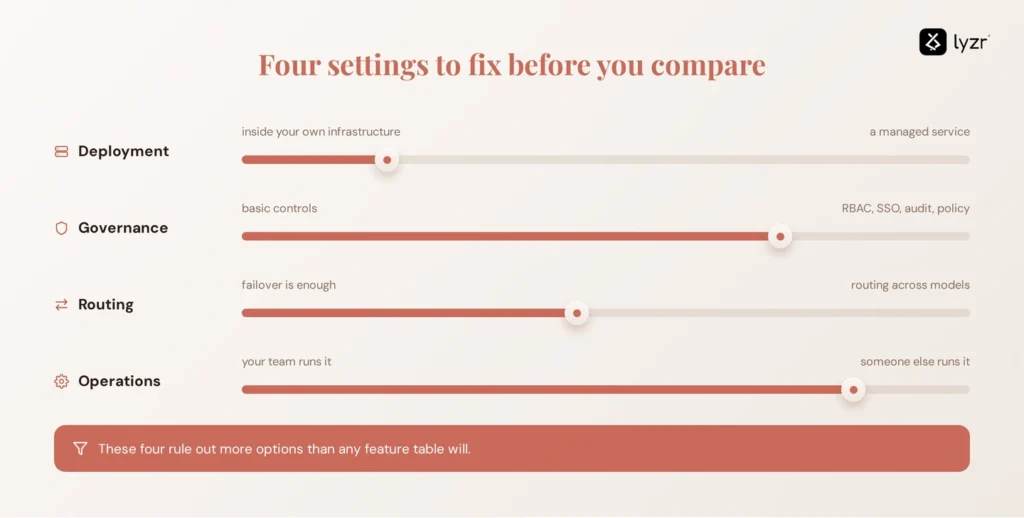
These constraints eliminate a surprising number of options before you get to the feature-by-feature comparison.
How We Compared These LLM Gateways
We evaluated the gateways across the capabilities that matter when moving from experimentation into production: deployment model, provider coverage, routing and failover, observability, cost controls, guardrails, self-hosting, and enterprise governance.
We also considered where each product fits architecturally. Some are standalone gateways, some are extensions of broader API platforms, and others are cloud-native services tied closely to a particular infrastructure ecosystem. They shouldn’t be treated as interchangeable simply because they all sit between applications and models.
The LLM gateways worth shortlisting in 2026
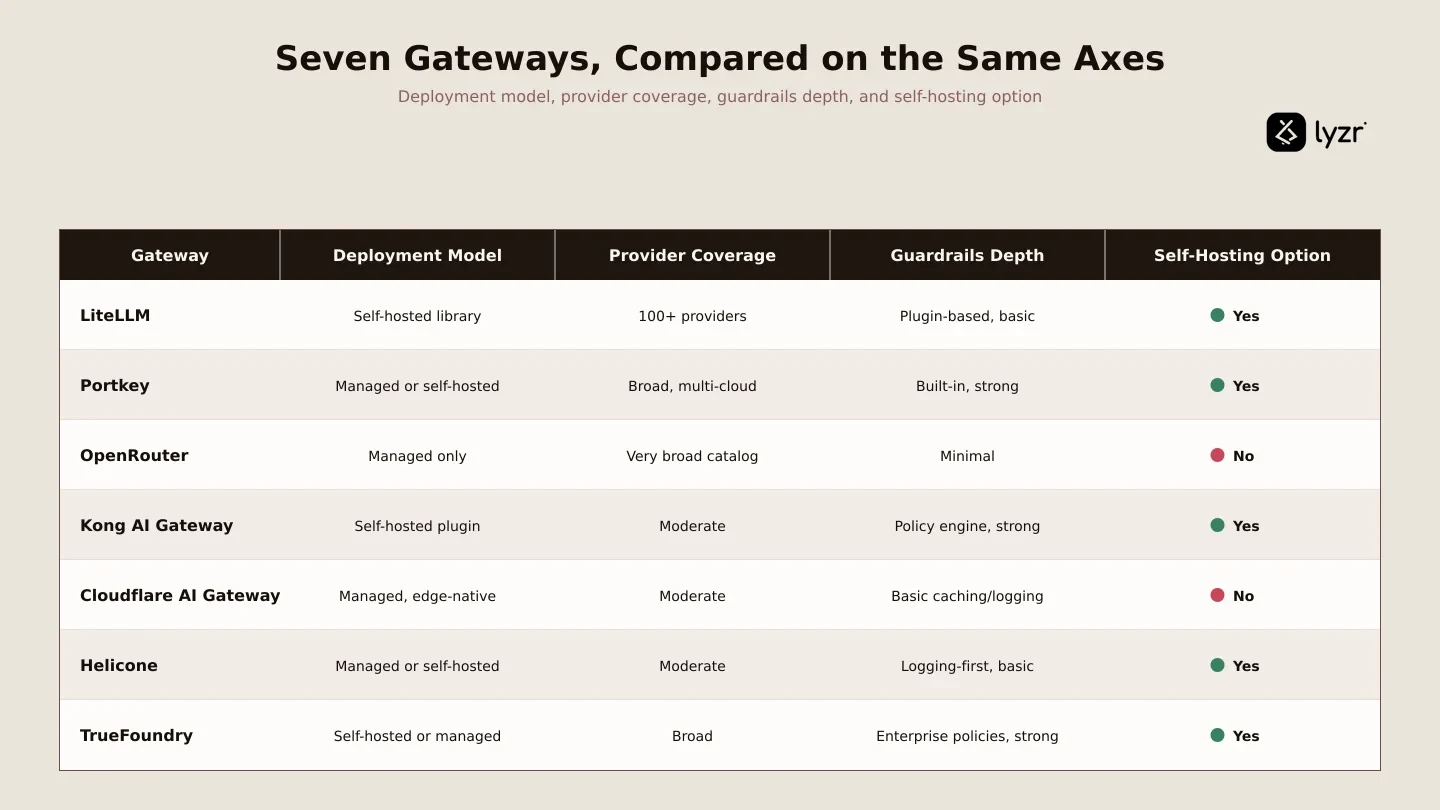
Feature-by-feature comparison table
| Gateway | Deployment | Provider coverage | Self-hosting | Guardrails/governance | Best fit |
|---|---|---|---|---|---|
| LiteLLM | Self-hosted | 100+ providers | Full (Apache 2.0/MIT) | Limited natively; pairs with Presidio/Bedrock Guardrails | Teams that want to own the routing layer |
| OpenRouter | Managed only | 400+ models | Not available | Limited; routing and access layer, not policy engine | Fast access to model variety |
| Portkey (Prisma AIRS) | Managed + open-source core | Broad, enterprise-tier | Enterprise on-prem option | Strong: guardrails, PII redaction, audit trails | Regulated enterprises prioritizing governance |
| Kong AI Gateway | Self-managed or Konnect SaaS | Provider-agnostic via plugins | Full (Apache 2.0 core) | Plugin-based: PII redaction, prompt guard | Teams already running Kong for APIs |
| Cloudflare AI Gateway | Managed, edge network | 20+ native providers | Not available | Beta content moderation, DLP | Edge caching and analytics |
| Vercel AI Gateway | Managed only | ~45 providers | Not available | Not documented as native feature | Vercel/Next.js and AI SDK teams |
| AWS Bedrock / Azure API Management | Managed, cloud-native | Bedrock catalog / Foundry + multi-cloud | Depends on deployment (VPC/APIM instance) | Bedrock Guardrails / Azure Content Safety | Enterprises standardized on that cloud |
Use this table to narrow the field to two or three candidates. The differences that matter become clearer once you look at how each gateway fits your infrastructure and operating model.
LiteLLM: strongest when you want to own the routing layer
LiteLLM is strongest when a team wants to self-host the gateway and control the routing layer without depending on a managed vendor. It ships as an open-source proxy and Python SDK that wraps 100+ LLM providers behind a single OpenAI-compatible API, so existing OpenAI SDK code works with just a base URL change.
The trade-off is operational. You run the Postgres instance, you patch the container, and you own the incident when a dependency breaks. A supply-chain incident in March 2026 saw two PyPI releases backdoored after attackers stole publishing credentials, though PyPI quarantined both within about 40 minutes, a reminder that self-hosting shifts security ownership onto your team, not away from it. It’s also the gateway developers reach for when routing Claude Code through alternate providers, since it exposes the same Anthropic-compatible base URL pattern that coding agents expect.
Decision reason: pick LiteLLM when engineering time is cheaper than a managed subscription and data residency rules out sending traffic through someone else’s SaaS.
OpenRouter: strongest when model variety is the constraint
OpenRouter is strongest when a team needs fast access to the widest catalog of models without building provider integrations one at a time. Its public listing showed 427 models behind one API key as of September 2026, with pricing on most models matching vendor list price directly. The cost lives elsewhere: a 5.5% fee on card credit purchases and a 5% fee on bring-your-own-key traffic above $25,000 of monthly usage.
What it doesn’t do is govern the workflow around the call. OpenRouter can route model calls but does not govern the full path of agentic workflows, tool calls, MCP access, and loop limits still need a separate enforcement layer. That single fact answers the “LLM gateway vs OpenRouter” question more precisely than any feature list: OpenRouter is a model marketplace with routing attached, not a governance control plane.
Decision reason: pick OpenRouter when the team needs to prototype against many models fast and isn’t yet worried about per-agent policy enforcement.
Portkey: strongest on guardrails, now backed by a security vendor’s balance sheet
Portkey changed ownership in 2026. Palo Alto Networks closed its acquisition of Portkey on May 29, 2026, establishing the AI Gateway as a mission-critical control plane for the enterprise. Portkey now serves as the AI Gateway for Prisma AIRS, positioned as the central nervous system that can monitor, route, and secure AI traffic.
That changes the buying conversation. This isn’t a routing tool with security bolted on, it’s a security platform’s gateway, with guardrails, PII redaction, jailbreak detection, and audit trails built into the gateway layer as the primary sell. Its semantic caching and guardrails remain primarily cloud SaaS features, with an enterprise on-premises option available as of April 2026 for teams that can’t send data to a third party.
Decision reason: pick Portkey when the buying conversation is being driven by a security or compliance team, not just an engineering team.
Kong AI Gateway: strongest when you already run Kong
Kong AI Gateway makes sense as a natural add-on rather than a new system to operate, but only for organizations that already run Kong’s API mesh. It extends a decade-old API management platform with LLM-specific plugins, and as of its 3.14 release, it added native agent-to-agent traffic management, token exchange, scope-based tool filtering, and expanded model support for Databricks, DeepSeek, and vLLM.
Its advanced AI plugins and LLM analytics are Enterprise/Konnect-only; the free tier covers mainly basic proxy routing. That matters for budgeting: the plugin architecture is powerful, but the governance features that make it competitive with Portkey sit behind a paid tier.
Decision reason: pick Kong when your platform team already operates Kong for REST and gRPC traffic and wants LLM traffic to inherit the same policy engine.
Cloudflare and Vercel: strongest for edge performance and developer ergonomics, not governance
These two deserve a joint entry because they solve a narrower problem than the others: fast, cheap, managed access with minimal configuration. Cloudflare AI Gateway ships free exact-match caching, analytics, and rate limiting on every plan, and added a universal REST endpoint in May 2026 that speaks OpenAI and Anthropic request formats. Its content-safety Guardrails and DLP features remain in Beta, and it doesn’t offer semantic caching yet.
Vercel AI Gateway trades caching depth for developer experience. It charges the provider’s list price with no platform markup on tokens, on both free and paid tiers, including for bring-your-own-key requests. It has no native guardrails layer and is not self-hostable, traffic runs through Vercel’s network by design.
Decision reason: pick Cloudflare if you’re already on its edge network and want caching plus analytics for free; pick Vercel if your stack is Next.js and the AI SDK and governance isn’t the immediate concern.
AWS Bedrock and Azure API Management: strongest for enterprises that won’t leave their cloud
Both hyperscalers now ship AI gateway capability as an extension of infrastructure you likely already pay for. On AWS, Guardrails for Amazon Bedrock provides content filtering, PII detection and redaction, topic denial, and grounding checks that apply to any model invocation, including Agents and Knowledge Bases. On Azure, Microsoft went further in 2026: it released a dedicated AI Gateway tier of Azure API Management in public preview, with a control plane organized around models, MCP servers, and tools rather than traditional APIs, publishing Foundry-hosted models alongside AWS Bedrock, Google Vertex AI, and OpenAI behind one endpoint.
Neither is a lightweight choice. Both assume you’re already inside that cloud’s IAM, networking, and billing model, and both trade some routing sophistication for deep native compliance tooling (CloudTrail, VPC endpoints, Entra ID).
Decision reason: pick the gateway that matches the cloud your compliance team has already approved, not the one with the longer feature list.
Why Helicone and Braintrust aren’t on this list
Both are frequently mentioned in gateway roundups, and both deserve a note rather than a full entry. Helicone markets itself as an AI gateway and observability platform, but Mintlify acquired Helicone on March 3, 2026, and its services now run in maintenance mode with security patches but limited new development. Braintrust is positioned primarily for evaluation, and its AI gateway is an optional component that provides caching and unified model access, not the platform’s core function. Both are strong observability tools. Both remain relevant products, but they serve different buying priorities. Helicone is now in maintenance mode following its acquisition by Mintlify, while Braintrust’s broader platform is centered on evaluation and observability. Neither fits the specific gateway shortlist this article is trying to build.
Can you route Claude Code through a gateway?
Yes. Any gateway that exposes an Anthropic-compatible base URL can sit between Claude Code and the provider. LiteLLM provides a unified interface to Claude models through Anthropic, Bedrock, and Vertex AI, letting teams use Claude Code with any supported provider while maintaining compatibility, and the pattern is the same for other coding agents: override the base URL and auth token, and the gateway handles retries, cost tracking, and fallback behind the scenes. This is one of the more common self-hosted deployment patterns in 2026, teams standardize coding-agent traffic through the same gateway that already handles their production LLM calls, so cost and audit visibility don’t split across two systems.
What an LLM Gateway Still Doesn’t Govern
An LLM gateway gives an organization a centralized point for controlling model traffic. Modern gateways increasingly add guardrails, identity, policy enforcement, and agent-aware controls, but their primary operating context remains the AI interaction layer.
An autonomous agent introduces another layer of state and responsibility. It has an identity, configuration, tools, permissions, deployment history, evaluation status, and runtime behavior that can span multiple model calls and services. A gateway can govern the interactions flowing through it, while an AI Control Plane provides broader lifecycle context around the agents generating those interactions.
That distinction matters when you’re choosing what to put into your AI stack. You can choose a gateway based on routing, cost, observability, guardrails, and deployment requirements, then use a Control Plane to govern the agents operating above that infrastructure. Lyzr’s OpenController provides this governance layer with capabilities for agent registry, identity, evaluation, and auditability, regardless of which gateway sits underneath.
The Control Plane is not a replacement for the gateway. An organization can continue using LiteLLM, Kong, Prisma AIRS, AWS, Azure, or another gateway for model traffic while using the Control Plane to govern the agents running across that infrastructure.
If you’ve already chosen your gateway, the next question is what governs the agents once that gateway has done its job. Explore Lyzr’s OpenController architecture to see how a Control Plane fits into an existing AI stack, or Book a Demo with Lyzr for a walkthrough.
Frequently asked questions
There isn’t a single best answer. LiteLLM is the strongest choice for self-hosted control, Portkey leads on guardrails and enterprise governance now that it sits inside Palo Alto Networks’ Prisma AIRS, and OpenRouter wins when model variety is the priority. The right pick depends on which of those problems your team is actually solving.
An LLM gateway is a middleware layer that sits between your application and multiple model providers, normalizing their APIs behind one interface while adding routing, failover, cost tracking, and security controls. For the full architectural breakdown, see Lyzr’s LLM Gateway Architecture Guide.
For self-hosted deployments, LiteLLM has the widest adoption and the largest open-source community of any gateway in this comparison. Among managed products, popularity splits by use case rather than concentrating on one vendor.
LiteLLM is the clearest choice for self-hosting. It is designed to be deployed within your own infrastructure, giving you maximum control over data, security, and configuration. Kong AI Gateway is a strong second option for teams that need self-hosted API management alongside LLM routing.
LiteLLM is the most mature and widely adopted open-source option, licensed permissively and covering over 100 providers. Kong’s AI Gateway core is also open-source (Apache 2.0), though its advanced governance plugins sit behind a paid Enterprise tier.
An LLM gateway is the broad category; OpenRouter is one specific implementation of it, built around a hosted model marketplace rather than infrastructure you control. Gateways like LiteLLM or Kong prioritize self-hosting and policy enforcement, while OpenRouter prioritizes catalog breadth and zero-ops access.
A general API gateway manages any HTTP traffic; an LLM gateway is purpose-built for AI-specific concerns like token-based rate limiting, per-model cost tracking, prompt caching, and provider-format translation. Kong and Azure API Management illustrate this directly, since both started as general API gateways and added LLM-specific plugins on top.
Some do, and depth varies significantly. Portkey and Kong ship dedicated guardrail plugins for PII redaction and policy enforcement, AWS and Azure offer guardrails as adjacent cloud services, and OpenRouter and Vercel provide little to no native content policy layer, leaving that responsibility to the application.
Yes, this is the core function nearly every gateway in this comparison performs, whether through load balancing, cost-based routing, or manual fallback chains. The difference is sophistication: some gateways route on simple availability, while others factor in latency, cost tier, and task type.
Yes, by pointing Claude Code’s base URL and auth token at the gateway instead of directly at Anthropic’s API. LiteLLM is the most commonly documented option for this pattern, since it preserves full Anthropic API compatibility while adding routing and fallback across providers.
No. A gateway secures and observes individual API calls, but an autonomous agent makes decisions across multiple calls, tool invocations, and system interactions that a gateway never sees as a single unit of work. Governing that behavior, the agent’s reasoning, its tool access, its accountability trail, requires a dedicated control layer built for agents rather than requests.
Book A Demo: Click Here
Join our Slack: Click Here
Link to our GitHub: Click Here