TL;DR
- An LLM gateway is a middleware layer that gives applications one interface for calling multiple model providers, while centralizing routing, auth, rate limits, caching, and cost tracking.
- It solves a traffic problem: how requests reach OpenAI, Anthropic, Gemini, Bedrock, or a self-hosted model.
- It is not the same as an API gateway, an MCP gateway, or an AI control plane, though the categories increasingly overlap.
- Open-source options like LiteLLM and Bifrost compete with managed gateways like Portkey, Kong AI Gateway, and Cloudflare AI Gateway. OpenRouter is closer to a hosted routing service than infrastructure you own.
- Once an enterprise has more agents than it can track, the gateway stops being enough. That’s where a control plane takes over.
Somewhere in most engineering orgs right now, there’s a spreadsheet.
It lists which team uses which model. Which API key belongs to which project. Which service still calls a model version someone meant to deprecate two quarters ago.
Nobody built that spreadsheet on purpose. It accumulated the way technical debt always does: one integration at a time, each one reasonable in isolation.
One team wires up OpenAI for a chat feature. Another prefers Claude for long-document reasoning. A third routes through AWS Bedrock because that’s where their data already sits. Each choice made sense on its own. Together, they produce an organization that has no idea what it’s spending, no fallback when a provider has a bad day, and no consistent way to answer “which model touched this data.”
An LLM gateway is the infrastructure response to that problem. This piece covers what it is, how it works, what it does and doesn’t replace, and where it fits next to the broader idea of an AI control plane.
What Is an LLM Gateway?
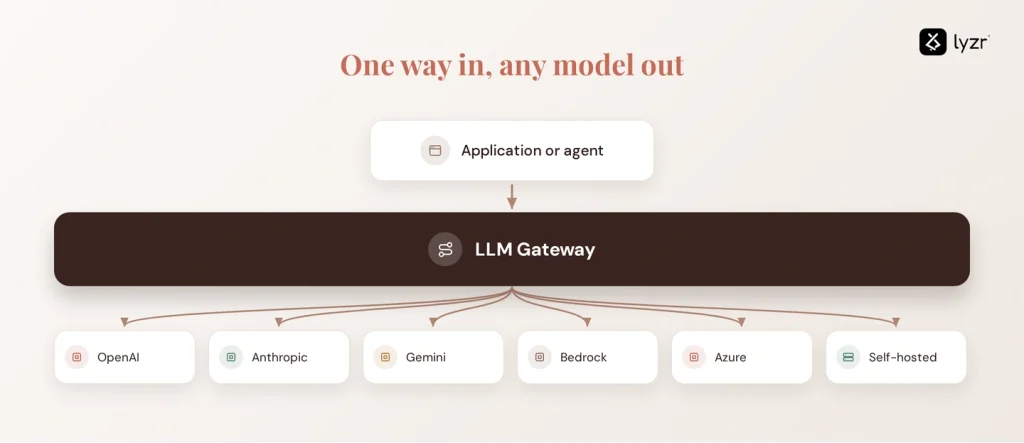
An LLM gateway is a middleware layer that sits between your applications and one or more large language model providers, giving every request a single point of authentication, routing, and observability instead of a separate integration per provider.
Without one, the architecture looks like this: each application talks directly to its own provider.
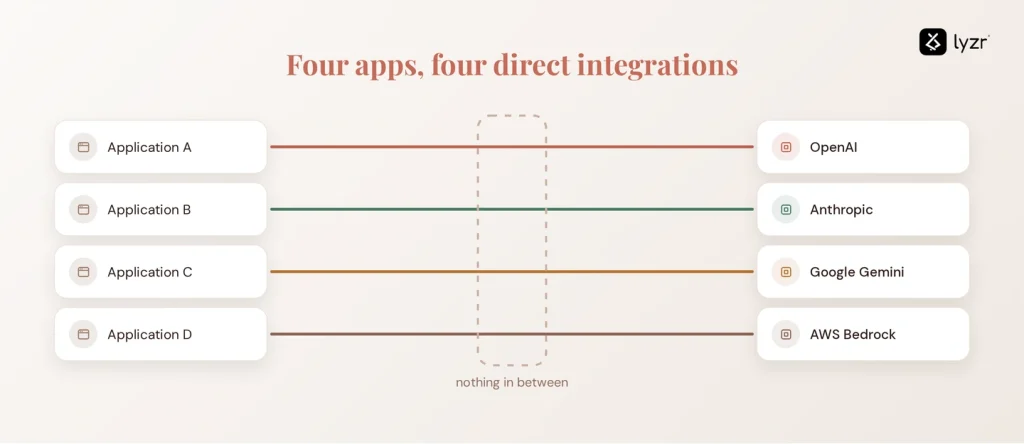
Every team ends up re-solving the same list of problems: which SDK version, whose key, what happens on a 429, how tokens get logged.
A gateway collapses that fan-out into one layer.
The Challenges Without an LLM Gateway: Why Do You Need One?
You need a gateway once more than one team or more than one model provider is involved in production traffic. Not before. One service calling one provider does not need a routing layer, it needs a good client library.
What changes at that threshold is that four costs stop being theoretical.
Provider lock-in. Integrating directly against a single provider couples your system to their API surface, their rate limits, and their roadmap. When prices rise, latency degrades, or a compliance requirement rules that provider out, switching is no longer a config change. It becomes a project: every call site has to be found, rewritten, and retested, usually by the team least able to spare the time. See LLM Agnostic Solutions: The 2026 Enterprise AI Guide.
Cost blindness. Models price differently per token, and input and output tokens rarely cost the same. Without a shared logging layer, spend arrives as one invoice per provider with no way to attribute it to a team, a feature, or a customer. Nobody can say what a given feature costs to run, which means nobody can say whether it is worth running.
Fragile reliability. When your primary provider degrades, your application returns an error and your users are the ones who discover it. A gateway absorbs that failure instead, detecting it and rerouting the request to another available model or provider. The incident still happens. It just shows up in your dashboards rather than your support queue.
Scattered governance. Rate limits, access policy, and PII handling get copy-pasted from service to service, drift apart over time, and then have to be audited one service at a time. Enforced once at the gateway, they apply to every call by default, which is exactly the gap an enterprise AI security platform is built to close.
None of this argues for building a gateway on day one. It argues for knowing the point at which not having one costs more than having one, and recognising that the point arrives earlier than most teams plan for.
How Does an LLM Gateway Work?
At the request level, a gateway acts as an intelligent proxy: it authenticates the caller, decides where the request goes, applies policy, and forwards it.
The typical lifecycle:
- The application sends a request to the gateway’s endpoint instead of directly to a provider.
- The gateway authenticates the caller and checks permissions.
- A routing rule picks the model or provider, based on cost, latency, availability, or a fixed mapping.
- Policies apply: rate limits, guardrails, PII checks.
- The gateway forwards the formatted request using its own stored provider credentials.
- The response returns through the gateway, gets logged, optionally cached, and passed back.
Model traffic breaks several assumptions a traditional gateway was built on at once: requests are billed by the token rather than priced per call, responses stream back incrementally, the threat model includes prompt injection, and useful caching depends on the meaning of a request rather than an exact URL match.
That’s the specific engineering problem an LLM gateway architecture is built to absorb.
LLM Gateway: Core Capabilities
Capability varies by product, and no single gateway does all of this equally well. The core set that has become standard:
Core LLM Gateway Capabilities
| Capability | What It Solves |
|---|---|
| Model routing | Sends requests to the right model based on cost, latency, or task |
| Fallback and retries | Switches provider automatically on an outage or rate limit |
| Key management | Stores provider credentials centrally instead of in application code |
| Token-aware rate limiting | Caps usage per key, team, or model, not just per request |
| Cost and usage tracking | Attributes spend by team, app, or model |
| Caching | Avoids repeat calls for identical or near-identical prompts |
| Guardrails | Screens prompts and responses for PII or policy violations |
| Observability | Logs latency, error rate, and token counts per request |
A gateway is closely related to but broader than an LLM proxy, which handles basic request forwarding; the gateway adds routing intelligence, policy enforcement, and observability on top.
LLM Gateway vs API Gateway
An API gateway is not obsolete once you add an LLM gateway. They solve related but distinct problems.
Traditional API traffic is usually endpoint-based: a client calls /orders, /users, or /payments, and the gateway applies API policies. LLM traffic is model-provider-based.
An application calls OpenAI, Anthropic, Gemini, or Bedrock, and the gateway has to understand models, tokens, context windows, streaming responses, and usage cost.
In most enterprise stacks the two coexist. The API gateway continues to manage general service traffic. The LLM gateway sits specifically in front of model calls, often as a service the API gateway routes to.
How to Choose an LLM Gateway

The right question isn’t “which is best.” It’s which combination of these fits your constraints:
- Provider support – does it cover the models and clouds you already run, not just the popular ones
- Routing logic – can you route on cost, latency, or workload, not just a static list
- Reliability – retries and fallback, not just uptime monitoring
- Deployment model – cloud, VPC, self-hosted, or air-gapped
- Governance – per-team access and rate limits, not global settings only
- Agent and MCP support – does it stop at the model call, or extend to tool traffic if your roadmap needs that
Open-Source LLM Gateways
You don’t need to evaluate ten products here. Two shapes cover most of the decision.
LiteLLM is the most widely deployed open-source option.
It gives a single, unified interface to call 100+ LLM providers using the OpenAI format, and can be used as a Python SDK or deployed as a centralized proxy server for a team or organization.
The open-source gateway is MIT-licensed and production-grade, with enterprise adding SSO, RBAC, audit logs, and support on top of the same core, not a different one.
Bifrost, built by Maxim AI, targets teams optimizing for raw throughput.
It’s a high-performance, open-source LLM gateway built in Go that offers ultra-low latency, unified APIs across providers, intelligent routing, failover, and deep observability.
Both are self-hostable, including on Kubernetes, which matters if data residency or air-gapped deployment is a requirement rather than a preference. Managed alternatives (Portkey, Kong AI Gateway, Cloudflare AI Gateway) trade some of that control for less operational overhead, typically layering governance, guardrails, or edge caching on top of a hosted core.
Popular LLM Gateway Solutions
The pattern repeats regardless of stack. The gateway sits between your application and wherever the model actually runs.
On AWS, a gateway sits in front of Bedrock-hosted and third-party models, giving applications one endpoint instead of one per model family. On Azure, the same logic applies to Azure AI-hosted deployments. For Claude, a gateway provides a consistent application-side interface while the routing layer forwards eligible requests to Anthropic. For LangChain, gateways abstract provider connectivity out of the chain logic;
this lets a team use one API key to call models across configured providers and switch providers by changing a model ID, while the gateway traces every call and applies centralized policy.
Where the LLM Gateway Ends and the Control Plane Begins
An LLM gateway manages the path to the model. It doesn’t manage what happens once that model is embedded inside dozens of autonomous agents making decisions across a business.
That’s a different, harder question: who owns each agent, what can it touch, and can you prove what it did after the fact.
IDC’s research with Lenovo found that only about 12% of enterprise AI proof-of-concepts reach production at scale, a number consistent with Forrester and Anaconda’s separate finding that roughly 88% of AI agent pilots stall before getting there.
The gap usually isn’t model quality. 82% of executives feel confident that their existing policies protect them from unauthorized agent actions, while only 14.4% report all AI agents going live with full security or IT approval.
That confidence-versus-reality gap is exactly what a control plane is built to close. Where the gateway asks “which model handles this request,” the control plane asks “which agent is allowed to exist, what can it access, and who’s accountable for its output.”
A full control plane typically includes identity, the LLM gateway itself, agent-level policy hooks, and observability, not one of those in isolation. Lyzr’s Control Plane is one working example of this: it wraps the LLM gateway rather than replacing it, adding a governed deployment pipeline, an agent registry, Okta-based identity, and an evaluation gate in front of every agent, so the same governance layer applies regardless of which framework built the agent or which model it’s calling underneath.
Control Plane for Hyperscalers
Meet Lyzr: Governance Above the Model Layer
You can centralize model traffic with a gateway. The harder question is who governs the AI agents built on top of it once there are dozens or hundreds running in production.
Lyzr’s Control Plane operates at that layer, independent of which LLM gateway or model sits underneath it.
Agents built on LangChain, Agentforce, Bedrock, or anywhere else are registered, evaluated, identity-mapped, and governed from a single control plane, without rebuilding a single one. This is the same “any framework, any cloud, any LLM” principle behind framework agnostic platforms built to escape vendor lock-in.
Each agent receives its own identity, tied to its registry entry, giving security and compliance teams fine-grained access control and an audit trail for every action an agent takes. Platform teams responsible for that rollout can see how this fits into a broader rollout through Lyzr for Platform Teams.
The gateway decides which model answers a request. The control plane decides which agent was allowed to ask, and keeps the record of what it did next.
Frequently Asked Questions
It’s a middleware layer between applications and multiple LLM providers, giving them a single interface while centralizing routing, authentication, cost tracking, and observability.
The LLM gateway governs what goes into and out of the model, while the MCP gateway governs what the model does after it decides to call a tool. They cover different moments in the same request.
An API gateway is a reverse proxy that sits between clients and backend services, handling routing, authentication, and rate limiting for general application traffic, not specifically model calls.
Yes. It gives a single, unified interface to call 100+ LLM providers in the OpenAI format, deployable as a self-hosted proxy or Python SDK.
It’s a narrower relative of a gateway that handles basic request forwarding, without the routing intelligence, policy enforcement, or observability a full gateway adds.
If more than one team or model provider touches production traffic, yes. Below that, direct integration is often simpler and faster to ship.
Yes. LiteLLM is self-hosted, giving you complete control over your data and configuration, and Bifrost, Kong AI Gateway, and several others support the same deployment model.
Yes, at the model-call level. Some gateways now reach agents and MCP servers through the same endpoint, not just LLMs directly, though deeper agent governance typically requires a layer above the gateway.
Book A Demo: Click Here
Join our Slack: Click Here
Link to our GitHub: Click Here
Got a use case in mind?
8 weeks from use case to agents running in production.
Platform, people and FDEs, all in. Bring your environment. We'll co-build and stay until it's live.
Talk to UsFree resource
101 AI Agents Use Cases
100+ production-ready AI agent use cases across Marketing, Sales, HR, Banking, Insurance, Operations and a lot more
Download now