In 2023, the conversation was about generative AI, systems that could write, summarize, and create. In 2024, the conversation was about AI agents, software that could take actions on your behalf. In 2026, the conversation has moved again. It’s now about agentic AI: the broader paradigm of AI systems that can plan, decide, and act autonomously toward goals.
Every major AI vendor, Google, Salesforce, IBM, Microsoft, NVIDIA, AWS, Red Hat, now treats agentic AI as the defining category of the next decade of enterprise software. MIT Sloan calls it “the next evolution of generative AI.” Gartner has named it among the top strategic technology trends for 2026.
And yet, despite the hype, roughly 5% of enterprise agentic AI projects ever reach production. The other 95% die in prototype, failing security review, lacking observability, or hitting integration walls. The gap between what agentic AI promises and what enterprises actually deploy is now the central question.
This guide explains what agentic AI is, how it differs from AI agents and generative AI, how it actually works, the architecture behind it, real examples from enterprise deployments, the leading platforms in the space, and what separates the agentic AI projects that ship from the ones that don’t.
What is Agentic AI?

Agentic AI is artificial intelligence that can plan, decide, and act autonomously toward goals, without requiring a human in every step.
That’s the short answer. Three things are doing the work in that definition:
- Autonomy. An agentic AI system makes decisions and takes actions on its own. It doesn’t wait for prompts; it operates against goals.
- Goal orientation. An agentic AI isn’t just reacting to its environment, it’s working toward a defined objective and adjusting its approach when the situation changes.
- Action-taking. Agentic AI doesn’t just generate text or recommendations. It uses tools, calls APIs, executes code, updates systems, and interacts with the world to achieve its goals.
The term “agentic” comes from the philosophical concept of agency, the capacity to act independently and purposefully. Applied to AI, it describes systems that have moved beyond responding to commands to actively pursuing outcomes.
A concrete example: a traditional AI system can answer the question “what flights are available from San Francisco to Tokyo next Friday?” An agentic AI system can complete the full task, search for flights, compare options against your travel preferences, book the cheapest one that meets your criteria, update your calendar, notify your hotel, and email you the confirmation. Same starting input. Fundamentally different system underneath.
Agentic AI vs. AI agents: what’s the difference?
This is the most-asked question on the agentic AI SERP, and the most-confused terminology in the entire category. Let me clear it up.
An AI agent is a specific software entity. Agentic AI is the broader paradigm.
Think of it this way:
- AI agent is a noun. (“I’m building three AI agents for customer support.”)
- Agentic AI is descriptive. (“We need to make our software more agentic.”)
Or in another framing borrowed from Google Cloud’s explanation: AI agents are the building blocks; agentic AI is the system you build with them. AI agents are individual tools in a toolbox. Agentic AI is the coordinated use of those tools to accomplish something larger.
A more complete comparison:
| AI Agent | Agentic AI | |
|---|---|---|
| What it is | A specific software entity | A category and paradigm of AI |
| Word type | Noun | Adjective / descriptive |
| Scope | Individual unit | The full system and approach |
| Example sentence | “This agent handles customer onboarding.” | “Our customer onboarding system is agentic.” |
| Implementation | A discrete piece of software with a defined role | An architecture that may include one or many agents |
| Relationship | Building block | What you build with the building blocks |
In practice, the terms are used interchangeably in casual conversation, and that’s usually fine. But when you’re making purchasing decisions, designing architectures, or comparing vendors, the distinction matters. A vendor selling “AI agents” is offering you specific software entities. A vendor selling “agentic AI” is offering you an entire approach to building intelligent systems.
For a deeper dive into AI agents specifically, read our guide to what AI agents are
Agentic AI vs. generative AI: the category shift
If “agentic AI vs AI agents” is the most-asked question, “agentic AI vs generative AI” is the most-misunderstood. Here’s what’s actually going on.
Generative AI creates. Agentic AI acts.
Generative AI is the category of systems that produce new content: text, images, code, audio, video. ChatGPT writing a poem, Midjourney generating an image, GitHub Copilot suggesting code completions. The output is content, and the system is reactive: you ask, it generates.
Agentic AI is the category of systems that work toward goals. They might use generative AI as part of how they reason or communicate, but their purpose is to take actions in the world, not to create content. The output is change: something happens because the agentic AI did it. As organizations embrace ai native development, understanding the distinction between generative and agentic AI becomes essential for designing systems that align with specific business objectives and operational requirements.
The cleanest way to see the difference: generative AI can write you a marketing campaign. Agentic AI can launch it, monitor its performance, and adjust the strategy when it underperforms, without you in the loop for each step.
| Generative AI | Agentic AI | |
|---|---|---|
| Primary purpose | Create content | Take actions toward goals |
| Output | Text, images, code, media | Real-world or system change |
| Interaction model | Request → response | Goal → autonomous execution |
| Example | ChatGPT writing an email | An agent sending the email after deciding it’s appropriate |
| Autonomy level | Reactive (waits for prompts) | Proactive (pursues goals) |
| Relationship to the other | Component of agentic systems | Often uses generative AI internally |
Here’s the most important insight that most explanations miss: agentic AI is not a replacement for generative AI, it’s built on top of it. Most modern agentic AI systems use large language models (the foundation of generative AI) as their reasoning engine. The difference is what’s wrapped around the LLM: planning, memory, tool access, and the ability to act.
For more on this specific comparison, see our piece on agentic AI vs LLM.
The three waves of AI and where agentic AI fits

The clearest way to understand agentic AI is to see it as the third wave in a sequence, each wave building on the last.
Wave 1: Predictive AI (2010s)
The first mainstream wave of enterprise AI. Neural networks trained on historical data could classify, predict, and detect patterns. Use cases included fraud detection, demand forecasting, recommendation engines, and image recognition. Predictive AI is reactive and analytical: it tells you what’s likely to happen based on what’s happened before.
Wave 2: Generative AI (2022–2024)
The wave triggered by ChatGPT’s launch in late 2022. Large language models and diffusion models could create new content, text, images, code, audio, that hadn’t existed before. Use cases expanded into content marketing, customer support drafting, code generation, and creative production. Generative AI is reactive and creative: it tells you something new in response to your prompt.
Wave 3: Agentic AI (2024–present)
The current wave. AI systems that don’t just create or predict, but plan, decide, and act. Use cases include autonomous customer support, end-to-end procurement workflows, automated code maintenance, and multi-step research synthesis. Agentic AI is proactive and autonomous: it doesn’t wait for prompts; it works toward goals.
The waves don’t replace each other, they layer. Predictive AI still powers fraud detection. Generative AI still drafts content. Agentic AI uses both as components inside larger systems that take action. The thing that’s new in 2026 isn’t any single technology, it’s the integration of all three into systems that can operate autonomously at enterprise scale.
How agentic AI works: the four-stage loop

Every agentic AI system, regardless of platform or vendor, operates through the same fundamental loop: Perceive → Reason → Act → Learn. Understanding this loop is the easiest way to understand what’s happening inside agentic AI under the hood.
Stage 1: Perceive
The agentic AI gathers information from its environment. This might mean reading a user’s message, querying a centralized company system via Glean, calling an API for current data, processing an uploaded document, or pulling telemetry from a connected system. The key shift from earlier AI categories is that perception is active, the system decides what information it needs and goes to get it, rather than passively receiving inputs.
Stage 2: Reason
The agentic AI processes what it perceived and figures out what to do. A large language model serves as the reasoning engine, interpreting the goal, breaking it into sub-tasks, evaluating options, and forming a plan. This is where techniques like chain-of-thought reasoning, tree-of-thoughts planning, and retrieval-augmented generation (RAG) come in. The system isn’t just generating text, it’s generating decisions.
Stage 3: Act
The agentic AI executes its plan. This is where most “AI” systems stop and agentic AI continues. The system uses tools, APIs, databases, browsers, code execution environments, integrations with enterprise systems like Salesforce or SAP, to actually do things. Update a record. Send an email. Place an order. Trigger a workflow. This is where a modern workflow automation platform enables AI agents to coordinate actions across multiple business applications without requiring constant human intervention. The “Model Context Protocol” (MCP), introduced by Anthropic and now broadly adopted, is the increasingly-standard way that agentic systems connect to tools.
Stage 4: Learn
The agentic AI evaluates the outcome of its actions and uses that feedback to improve. This might mean updating internal memory, adjusting strategy for similar future tasks, or escalating to a human when results don’t match expectations. The learning stage is what makes agentic AI different from a one-shot automation: it gets better with experience.
The four stages aren’t strictly sequential, production agentic AI systems often run them in tight loops, replanning when actions fail or when new information arrives. But every agentic system, at every level of sophistication, is doing some version of perceive-reason-act-learn.
Agentic AI architecture: the six building blocks
Under the hood, every production-grade agentic AI system shares six architectural components. Strip out any one and the system breaks.
1. The LLM (reasoning engine). Large language models such as GPT-5, Claude, Gemini, Llama, or an open-weights alternative serve as the system’s brain. It interprets goals, plans actions, and generates outputs. Most modern agentic systems are model-agnostic, meaning they can swap LLMs based on cost, performance, or compliance requirements.
2. Memory. Both short-term (the context of the current task) and long-term (facts, preferences, past interactions). Memory is typically implemented through vector databases, dedicated memory layers, or retrieval-augmented generation. Without memory, every interaction starts from zero.
3. Tools and APIs. The agentic AI’s hands. How it queries databases, calls external services, executes code, scrapes web pages, or triggers actions in enterprise systems. MCP (Model Context Protocol) is now the standard way to expose tools to agentic AI systems.
4. Knowledge base. Typically a vector database connected via RAG, giving the system access to enterprise data, documentation, or proprietary information without retraining the underlying model. This is how agentic AI grounds its reasoning in current, organization-specific facts.
5. Orchestration layer. For systems involving multiple agents or multiple steps, this coordinates which agent runs when, what data they share, and how handoffs work. Cloud-native orchestration is increasingly available through services like AWS Bedrock Agents, Google Vertex AI Agent Builder, and Azure AI Foundry, and platform-neutral orchestration via dedicated layers like Lyzr’s orchestration framework.
6. Governance and observability. Logging, audit trails, guardrails, hallucination management, and policy enforcement. This is the layer that decides whether an agentic AI system can be deployed in regulated industries or high-stakes use cases. In enterprise settings, it’s often the most important layer, and the most overlooked.
For deeper architectural detail, read our piece on agentic AI architectures.
Real-life examples of agentic AI in enterprises
Theoretical definitions only get you so far. Here’s what agentic AI looks like when it’s actually deployed in enterprises, drawn from anonymized real-world implementations across banking, insurance, retail, software, and HR.
Example 1: Automated code maintenance and migration
A mid-sized U.S. property and casualty insurer used agentic AI to automate the migration of legacy codebases to current versions of programming frameworks. Without agentic AI, developers spent significant time on repetitive, error-prone update work. With agentic AI, the system reads the existing codebase, identifies which updates are needed, generates the migrations, runs tests, and flags edge cases for human review. Developer productivity on maintenance tasks improved substantially, freeing engineering time for more complex work.
Example 2: Automated claims processing in insurance
A leading European insurer deployed agentic AI to automate motor claims processing end-to-end. The system handles intake, classification, evidence gathering, valuation, and decision-making, escalating to human adjusters only when claims fall outside defined parameters. Through the deployment, the insurer automated 91% of eligible motor claims, cut average processing times by 46%, and improved customer satisfaction by 9 points on NPS. The architecture is hierarchical: a manager agent receives claims and delegates to specialist agents for each step.
Example 3: HR and recruitment automation
A global beverage and snacks company deployed agentic AI to optimize recruitment across high-volume hiring functions. The system scans applicant profiles across multiple sourcing platforms, evaluates candidates against role requirements, schedules initial screenings, and creates ranked shortlists for hiring managers. The agentic approach replaced manual resume screening that previously consumed significant recruiter time, allowing the recruitment team to focus on candidate experience and strategic hiring decisions.
Example 4: Supply chain and inventory management in fast fashion
A leading European fast fashion retailer uses agentic AI to optimize supply chain decisions across thousands of SKUs and hundreds of stores. The system forecasts demand using historical sales data, current trends, and external signals; adjusts inventory allocation in real-time; and triggers procurement actions when stock falls below thresholds. The agentic approach allowed the retailer to reduce overproduction while keeping stock levels aligned with localized customer preferences.
Example 5: Banking customer onboarding
A multi-customer pattern across Lyzr’s banking clients: sequential agentic AI orchestration across five specialist agents, document verification, credit check, compliance screening, account agreement generation, and account provisioning. Each agent handles its specialized step under unified governance, identity, and audit. The pattern reduces customer onboarding from days to minutes for routine cases, with human review reserved for edge cases or high-risk applications.
Example 6: Cross-functional internal AI at a Fortune 100 enterprise
A Fortune 100 consumer goods enterprise deployed agentic AI as an internal employee assistant routing layer. A triage agent receives employee requests, identifies which domain they belong to (HR, finance, IT, operations), and routes the conversation to specialist agents. Each specialist agent runs its own sequential workflow under unified governance. Employees get faster answers; the company gets centralized audit and policy enforcement across all domains.
The common pattern across these deployments: agentic AI works in production when the agents themselves are paired with the right orchestration, governance, and integration infrastructure. The technology is real. The deployment difficulty is real. Both are true at the same time.
The best agentic AI tools and platforms in 2026
The agentic AI landscape in 2026 has consolidated into roughly ten serious platforms, each with a different positioning. Here’s how the major players fit:
Enterprise cloud platforms (full-stack agentic AI):
These platforms are tightly integrated with their parent cloud’s ecosystem. They’re the right choice when your enterprise is heavily committed to one cloud and intends to stay there.
Microsoft Copilot Studio

Best for: Enterprises already standardized on Microsoft 365, Teams, Azure, and Entra ID.
Copilot Studio is Microsoft’s full-stack agentic AI platform, designed for organizations building agents that work inside the Microsoft ecosystem. It offers a low-code builder with deep native integration to Microsoft Graph, SharePoint, Outlook, Teams, and Azure AI Foundry, making it the fastest path to production for Microsoft-native enterprises. The trade-off is Microsoft-lock-in: agents built here are designed for the Microsoft stack and don’t port easily to other environments.
Salesforce Agentforce

Best for: Sales, service, and marketing teams operating on Salesforce’s Customer 360 platform.
AgentForce is Salesforce’s agentic AI layer, with autonomous agents that act directly on Salesforce data, opportunities, cases, accounts, and customer interactions. It’s the strongest option for organizations whose primary business workflows already live in Salesforce, because the integration is native rather than bolted on. As with Microsoft, the constraint is that Agentforce is purpose-built for the Salesforce ecosystem and limited outside it.
Google Vertex AI Agent Builder
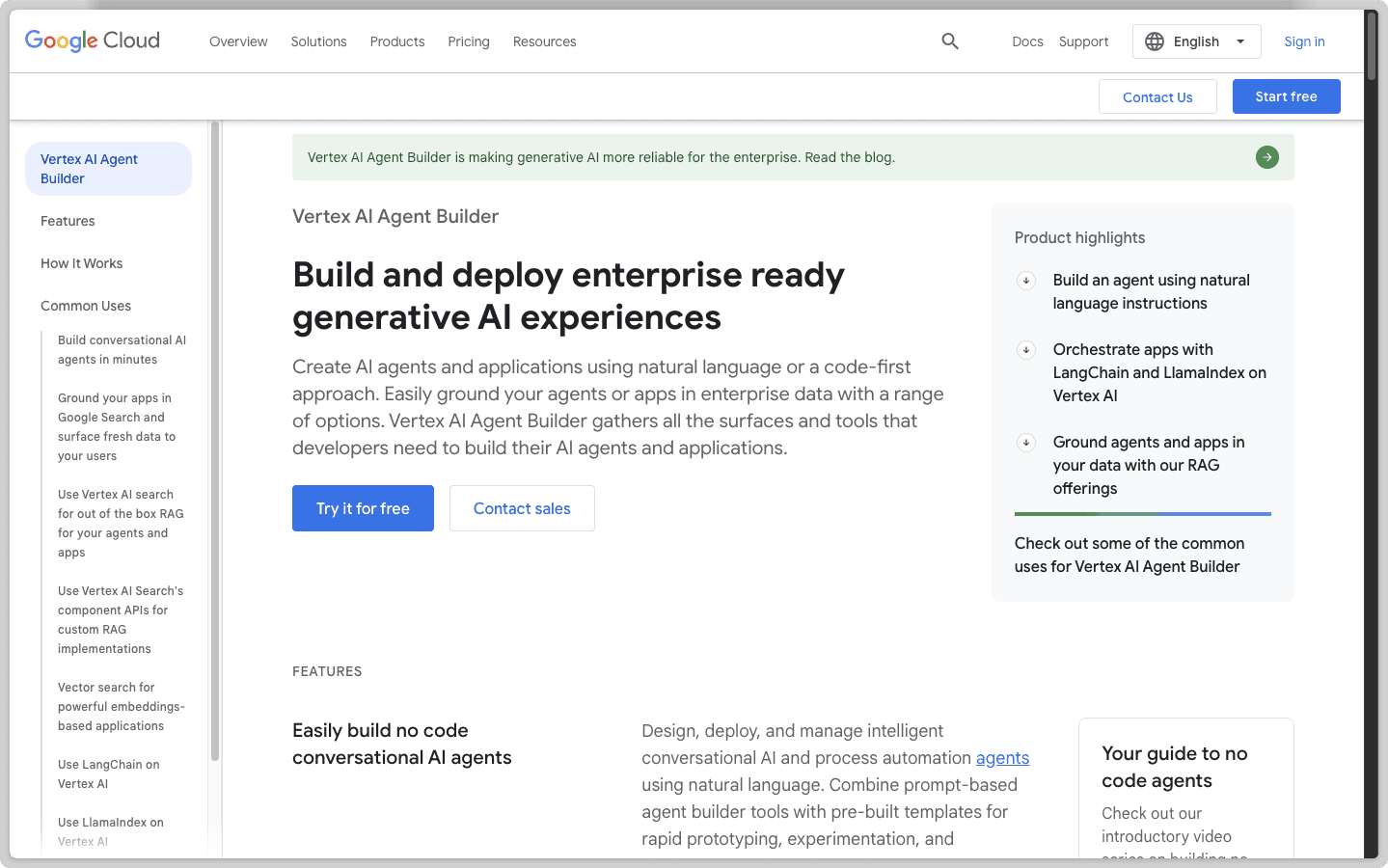
Best for: Enterprises on Google Cloud that want tight integration with Gemini models and Google’s data stack (BigQuery, Looker, Workspace).
Vertex AI Agent Builder is Google Cloud’s agentic AI offering, leveraging Gemini as the reasoning engine and integrating natively with Google’s machine learning, data, and search infrastructure. It’s particularly strong for organizations building agents that need to operate on large datasets in BigQuery or grounding agents in proprietary enterprise data. The platform requires significant Google Cloud investment to use effectively.
AWS Bedrock Agents (Agent Core)

Best for: Enterprises with significant AWS investment, particularly those building agents that need to integrate with AWS services like Lambda, S3, and DynamoDB.
AWS Bedrock Agents is Amazon’s agentic AI stack, built on top of Bedrock’s foundation model marketplace. It’s increasingly common in enterprises that have standardized on AWS for their cloud infrastructure, because it offers fast paths to production using AWS-native security, networking, and identity. Bedrock Agents works best when the surrounding agentic workflow lives inside AWS; cross-cloud deployments require additional architectural work.
IBM watsonx Orchestrate

Best for: Regulated industries, banking, insurance, healthcare, government, where governance and compliance are non-negotiable from day one.
watsonx Orchestrate is IBM’s enterprise-grade agentic AI offering, positioned around governance, audit trails, and compliance for regulated deployments. It’s particularly strong when paired with IBM’s broader data and AI portfolio (Cloud Pak for Data, watsonx.governance), and benefits from IBM’s deep relationships with enterprise procurement teams. The trade-off is heavier implementation and slower iteration than the cloud-native alternatives.
Independent agentic AI platforms:
These platforms are not tied to any single cloud or ecosystem. They’re the right choice when you need cross-framework orchestration, multi-cloud deployment, or freedom from any one vendor’s roadmap.
Lyzr

Best for: Cross-framework, multi-cloud enterprises running agentic systems built on multiple frameworks (Lyzr, LangChain, CrewAI, Agentforce, Copilot) that need to be governed centrally.
Lyzr is a cross-framework agentic AI platform with native control plane positioning, accepting agents from any framework and managing them under unified governance, observability, and identity. It’s strong for Fortune 500 enterprises with heterogeneous AI stacks that don’t fit neatly into any single hyperscaler’s ecosystem. As an independent platform, Lyzr’s field organization is smaller than the hyperscalers’, which buyers should weigh in their evaluation.
Cohere

Best for: Enterprises with strict data sovereignty requirements that want to train and deploy agentic AI on their proprietary data.
Cohere offers enterprise-grade language models with a strong emphasis on private deployment, model customization, and security. It’s particularly strong for organizations in regulated industries that need to keep their data and models inside their own infrastructure rather than passing through third-party APIs. Cohere is more model-centric than platform-centric, meaning it’s strongest when paired with other components for the full agentic stack rather than used as a complete agentic platform on its own.
Glean

Best for: Internal employee-facing assistants and enterprise search use cases, particularly knowledge work where finding and synthesizing information across systems is the primary job.
Glean is built around enterprise search depth and knowledge retrieval, with agentic features layered on top of an underlying search platform. It’s the strongest option for organizations whose primary agentic AI use case is helping employees find, synthesize, and act on information scattered across SaaS tools, document systems, and internal databases. Glean is less suited for external-facing or transactional agent use cases beyond the assistant pattern.
Open-source agentic AI frameworks:
These frameworks are free to use and modify, but require significant engineering investment to take to production. They’re the right choice when you need maximum flexibility, want to avoid vendor lock-in, or have the engineering capacity to operate your own infrastructure.
LangGraph

Best for: Developer-led teams building custom agentic systems, particularly those already invested in the broader LangChain ecosystem.
LangGraph is a graph-based orchestration framework built on top of LangChain, designed for developers who need fine-grained control over agent state, branching logic, and multi-step workflows. It’s the most-adopted open-source orchestration framework in 2026 and benefits from LangChain’s broader tooling ecosystem (LangSmith for observability, LangServe for deployment). Production deployment requires self-managed infrastructure for governance, observability, and reliability.
CrewAI

Best for: Rapid prototyping of multi-agent systems with role-based collaboration patterns (“a crew of agents working together”).
CrewAI is an open-source framework for orchestrating multi-agent systems using a role-based metaphor: you define agents with specific roles, give them tasks, and the framework handles coordination. It’s particularly strong for getting to a working prototype quickly when your use case involves multiple specialized agents collaborating. CrewAI’s primary gap is around production-grade governance and observability, which typically need to be added through additional tooling for enterprise deployments.
OpenAI Agents SDK

Best for: OpenAI-first development teams that have standardized on GPT-class models and want OpenAI’s official agentic patterns.
The Agents SDK is OpenAI’s official framework for building agentic systems on its models, with native support for handoff orchestration, function calling, and the broader OpenAI tool ecosystem. It’s increasingly the standard for teams that have committed to OpenAI as their primary model provider and want a supported, documented path to production. As with any model-provider-specific SDK, the trade-off is that switching models later requires re-architecture.
Microsoft AutoGen

Best for: Researchers and engineering teams experimenting with multi-agent conversation patterns, particularly in Python environments.
AutoGen is Microsoft’s open-source framework for building multi-agent systems where agents communicate through structured conversations to solve problems collaboratively. It’s strong for use cases involving complex reasoning, code generation, and research-style problem solving, and is widely adopted in academic and research settings. Production deployment requires additional work to add governance, identity, and observability layers.
How to choose between them
The right choice depends on three questions, in order of importance:
- Which cloud is your enterprise committed to? If you’re 100% on Microsoft, Salesforce, AWS, or Google, the cloud-native option will be the fastest path to production. If you’re multi-cloud or cloud-agnostic, an independent platform makes more sense.
- How much custom development are you willing to do? Open-source frameworks (LangGraph, CrewAI, AutoGen, OpenAI Agents SDK) give you maximum flexibility but require significant engineering investment to reach production. Commercial platforms (Microsoft, Salesforce, Lyzr, Glean) offer faster paths to production with more constraints.
- Do you need cross-framework orchestration? If your enterprise has already deployed agents built on multiple frameworks, common in Fortune 500 environments, you need a layer that can govern all of them. This is where independent control plane platforms become essential.
For head-to-head comparisons, see Lyzr vs Microsoft Copilot, Lyzr vs Salesforce Agentforce, Lyzr vs LangGraph, Lyzr vs CrewAI, and Lyzr vs Google AgentKit.
The 5% problem: why most agentic AI projects don’t ship
Roughly 5% of enterprise agentic AI projects ever reach production. The other 95% die in prototype.
The cause is overwhelmingly not agent quality. The vast majority of stalled agentic AI projects can build working demos. What kills them is the gap between “works in a demo” and “ships under enterprise governance at scale.” Agentic AI consulting can help enterprises close this gap by assessing production readiness, defining governance requirements, and mapping the integrations needed before agents move beyond prototype.
Six gaps account for most production failures:
1. Governance and approval workflows. Production agentic systems need dev → UAT → pre-prod → production promotion paths with explicit human approvals. Most prototyping tools have no concept of this. Without it, the system never passes CISO review.
2. Observability and audit. Logging conversations isn’t enough. When a regulator asks “why did this agentic system approve this loan?”, “the LLM said so” isn’t an answer. Production agentic systems need full traceability of every decision.
3. Hallucination control. A 2% hallucination rate is fine for a chatbot drafting customer-service replies. It’s catastrophic for an agentic system processing financial transactions or medical records. Production deployment requires explicit hallucination management, not vibes-based confidence scores.
4. Cross-framework coordination. Real enterprises run agentic systems built on multiple frameworks. An orchestration layer that speaks every framework is essential at scale. Most prototypes lock into one.
5. Multi-cloud reliability. Production agentic AI can’t go down because one cloud region had an outage. Enterprise deployments need cross-cloud failover and policy-based routing, capabilities that don’t exist in single-cloud prototyping tools.
6. The platform-plus-people gap. Production agentic AI requires both the right platform and the operational know-how to ship it. Plenty of vendors sell one or the other. Combining both with proven enterprise deployment experience is rarer than the marketing suggests. Most enterprises lack clear metrics or performance indicators for generative AI initiatives tracking AI adoption at the team and tool level is often the first step toward changing that.
The 5% of agentic AI projects that ship have closed these gaps deliberately. The 95% that don’t, haven’t.
For the full diagnostic and remediation framework, read How to Take AI Agents to Production.
The future of agentic AI: 2026 and beyond
Predictions about the future of agentic ai are easy and usually wrong. But three trends in agentic AI are clear enough by mid-2026 that they’re worth taking seriously.
Trend 1: Control planes are becoming the dominant deployment pattern. As enterprises accumulate agentic systems built on different frameworks, some on LangChain, some on Microsoft Copilot Studio, some on Salesforce Agentforce, the question of who governs the whole portfolio becomes urgent. Control plane platforms (which include Lyzr’s control plane, IBM’s watsonx Orchestrate, and emerging entries from the hyperscalers) are the answer. Expect this to be the dominant infrastructure category for the next 24 months.
Trend 2: Open protocols are reducing vendor lock-in. MCP (Model Context Protocol) for tool access, A2A (Agent-to-Agent) for inter-agent communication, and emerging standards for cross-platform orchestration are starting to define how agentic systems communicate with each other and with tools. The vendors that adopt open protocols will benefit from enterprise procurement trends; the ones that don’t will face increasing pressure.
Trend 3: Pre-built agentic AI is replacing custom builds for common workflows. The 2024-era pattern of “every enterprise builds its own AI agents from scratch” is giving way to SaaS-grade pre-built agentic systems for routine workflows, HR, finance, IT support, procurement. Custom development is increasingly reserved for genuinely differentiated use cases. This mirrors the trajectory of every previous enterprise software wave.
What’s not clear yet: how agentic AI will reshape job functions, how regulators will respond (the EU AI Act is the first major attempt; more will follow), and how the economics will evolve as model costs continue to fall. These are real open questions, and anyone telling you otherwise is selling something.
For the deeper data on where agentic AI adoption is heading, see Lyzr’s State of AI Agents 2026 report.
Frequently asked questions about agentic AI
What is agentic AI in simple terms?
Agentic AI is artificial intelligence that can plan, decide, and take action toward goals on its own, without needing a human to direct every step. Where traditional AI responds to prompts and generative AI creates content, agentic AI does work autonomously.
What’s the difference between agentic AI and AI agents?
AI agents are specific software entities, discrete pieces of software that perform defined roles. Agentic AI is the broader paradigm and category. AI agents are the building blocks; agentic AI is the system you build with them. The terms are often used interchangeably, but technically, AI agents are noun-form and agentic AI is descriptive.
What’s the difference between agentic AI and generative AI?
Generative AI creates content, text, images, code, audio. Agentic AI takes actions toward goals. Most agentic AI systems use generative AI as their reasoning engine, but they go beyond content creation to actually do things in the world. Generative AI writes the email; agentic AI sends it after deciding it’s appropriate.
Is ChatGPT an agentic AI?
ChatGPT in its standard chat form is primarily generative AI, it responds to prompts by generating text. OpenAI’s newer features (tool use, web browsing, code execution, agent mode) move it into agentic AI territory by giving it the ability to take actions, not just generate content. The line is blurring as more LLMs add agentic capabilities.
What is an example of agentic AI?
A common enterprise example: an agentic AI handling customer support that can read a customer’s message, look up their account, identify what they need, take corrective action (issue a refund, update a record, escalate to a specialist), and confirm with the customer, all in one interaction, without a human in the loop for routine cases.
How does agentic AI work?
Agentic AI works through a four-stage loop: perceive (gather information), reason (decide what to do using a large language model), act (use tools and APIs to execute), and learn (evaluate the outcome and improve). The system runs this loop continuously, replanning when actions fail or new information arrives.
What are the components of agentic AI architecture?
Production-grade agentic AI systems have six components: an LLM as the reasoning engine, memory (short-term and long-term), tools and APIs, a knowledge base, an orchestration layer, and a governance/observability layer. Remove any one and the system breaks.
What are the best agentic AI tools and platforms?
The leading platforms in 2026 include Microsoft Copilot Studio, Salesforce Agentforce, Google Vertex AI Agent Builder, AWS Bedrock Agents, IBM watsonx Orchestrate, Lyzr, Cohere, and Glean, plus open-source frameworks like LangGraph, CrewAI, OpenAI Agents SDK, and AgentGPT. The right choice depends on your cloud, your custom development appetite, and whether you need cross-framework orchestration.
Why do most agentic AI projects fail?
Roughly 95% of enterprise agentic AI prototypes never reach production. The dominant failure modes are governance gaps, weak observability, uncontrolled hallucination rates, framework lock-in, multi-cloud reliability issues, and the platform-plus-people gap. Agent quality is rarely the actual problem.
Is agentic AI the future of AI?
Agentic AI is the dominant frontier of AI development in 2026, with every major AI vendor investing heavily in the category. It’s not replacing generative AI or predictive AI, it’s building on top of them. Whether it’s “the future” or one stage of a longer evolution depends on how AI capabilities continue to develop in the coming years.
What is agentic AI on AWS?
On AWS, agentic AI is typically built and deployed using AWS Bedrock Agents (also called Agent Core), which integrates with Bedrock foundation models, AWS Lambda, and the broader AWS service ecosystem. AWS also partners with independent platforms like Lyzr for cross-cloud agentic AI deployments, see the Lyzr AWS partnership for more.
Book A Demo: Click Here
Join our Slack: Click Here
Link to our GitHub: Click Here