A new hire starts on Monday. Before then, six systems must agree about her: HR has her record, IT needs a laptop and a login, payroll needs bank details, facilities needs a badge, and her manager needs a 30-day plan. Every one of those systems now ships its own AI agent. None of them owns Monday.
That gap is what you’re really paying for when you shortlist the best AI workflow automation platforms for enterprises. The good ones let agents act across systems, mix fixed rules with judgment, pause for a person when stakes rise, and leave a trail an auditor can follow. Here are six, sorted by origin, because origin predicts where each runs out of road.
The shortlist
- Lyzr Studio: prebuilt agents for HR, sales, marketing and support plus your own custom agents, chained into cross-vendor workflows. Runs as SaaS, in your VPC or on-prem.
- ServiceNow AI Platform: IT, HR and employee-service processes already on ServiceNow, now with Moveworks’ assistant on board.
- Microsoft Copilot Studio: Microsoft 365 and Power Platform estates that want agents governed through Entra.
- Salesforce Agentforce 360: sales, service and marketing work grounded in CRM data, priced per action.
- UiPath Maestro: long-running processes mixing agents, robots and people, legacy screens included.
- Workato Agent Studio: companies whose integrations already run on Workato recipes and connectors.
Plenty of agents, few finished workflows
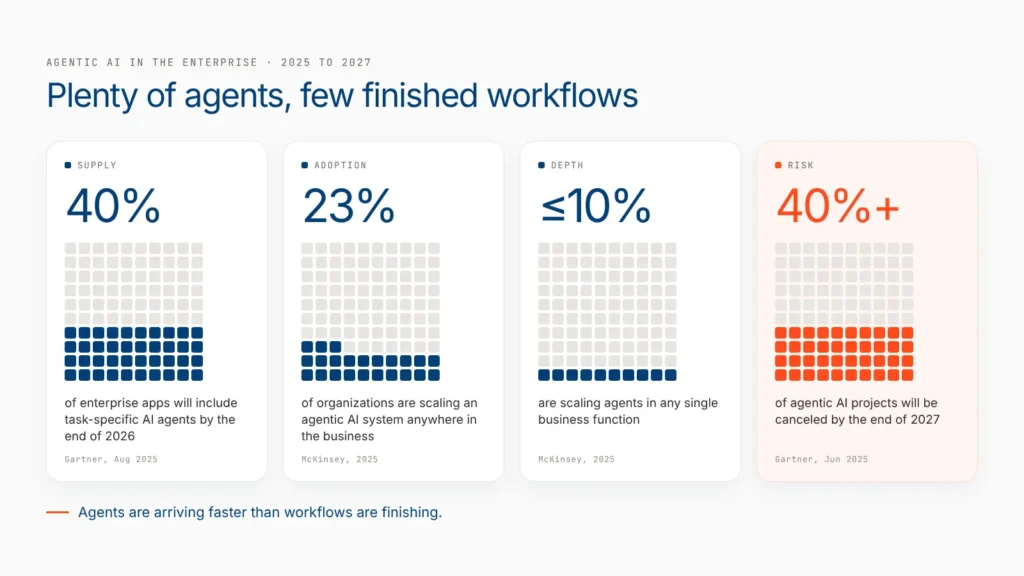
The supply side is booming. In August 2025, Gartner predicted that 40% of enterprise applications would include task-specific AI agents by the end of 2026, up from less than 5% in 2025.
The demand side looks thinner. McKinsey’s 2025 State of AI survey found 23% of organizations scaling an agentic AI system somewhere, and no more than 10% doing so in any single function. Gartner’s other forecast is blunter: over 40% of agentic AI projects will be canceled by the end of 2027 over costs, unclear value or weak risk controls. It also reckons only about 130 of the thousands of “agentic” vendors are the real thing.
Our read: agents inside each application are getting genuinely useful. Projects die in the space between applications, where no agent has the authority or context to finish the job. So the workflow platform matters more than the model.
Why do most agent pilots never reach production? Lyzr’s white paper measures what separates the ones that do: 95% task success, an 8-week median to a first production agent, and five questions to ask any agent vendor before you sign. Read the white paper:
What we checked
| Criterion | What we checked | Why it matters |
| Cross-system reach | Can agents act in systems the vendor doesn’t own | Onboarding, procurement and claims cross departments |
| Prebuilt agents | Ready agents for HR, sales, support or procurement | Time to the first working workflow |
| Custom building | Low-code and pro-code tools for your own agents | Your exceptions are specific to you |
| Fixed steps plus judgment | Deterministic steps alongside agent decisions | A payroll step can’t be “probably right” |
| Deployment choice | SaaS, your VPC, on-prem | HR and finance data have residency rules |
| Suite independence | Does it work without the vendor’s own core suite underneath | Avoids a migration just to get agents |
Based on public documentation, October 2026. Lyzr makes one product here, and we say where others fit better.
Six AI workflow automation platforms for enterprises compared
1. Lyzr Studio: start from a ready agent, finish across systems
Lyzr Studio is a low-code platform for building, testing and deploying agents, and it treats the workflow as the unit of work. Agents coordinate in two ways: a manager agent delegating to specialists, or DAG workflows where steps run in a defined order. Real processes need both. The order of onboarding steps is fixed; which access bundle a new analyst gets is a judgment call.
You rarely start from a blank canvas. Lyzr ships prebuilt agents for revenue (Jazon), marketing (Skott), HR (Diane), customer support (Jeff) and procurement, plus 100+ templates. Custom agents built in Studio cover the steps only your company has, and every agent is callable through an API the moment it’s created.
Studio connects to Salesforce, SAP, ServiceNow and SharePoint, runs as SaaS, in your VPC or on-premises, and lists SOC 2, GDPR, HIPAA and ISO 27001 compliance, with Responsible AI built in. AirAsia MOVE’s CTO credits it with a 95% reduction in agent response time across support operations.
Pick it if a workflow crosses systems from different vendors, or has to run inside your own network.
Skip it if one suite already holds the entire process and its built-in agent covers the job.
2. ServiceNow AI Platform
Relaunched at Knowledge 2025 with AI Agent Fabric to connect agents and an AI Control Tower to govern ServiceNow and third-party agents. In December 2025 it closed the Moveworks acquisition, adding an employee-facing AI assistant, enterprise search and a reasoning engine already used by 5.5 million employees. Knowledge 2026 then rolled that technology into Otto, ServiceNow’s new front door for employee requests. At Knowledge 2026, Control Tower moved into every product and package rather than being sold as an add-on, and Workflow Data Fabric reportedly reaches 450+ systems.
The installed base is the argument: 23 million employees use its employee portal every month, generating an estimated 40 million-plus cases a year. For the new hire, the IT and HR halves of onboarding may already sit on one data model.
Best for: IT, HR and employee-service workflows that already live on ServiceNow.
Watch out for: licensing is shifting to AI-inclusive bundles, so check your renewal before buying extras.
3. Salesforce Agentforce 360
Released at Dreamforce in October 2025. Agentforce Builder builds and tests agents in natural language, Agent Script pins down guardrails, if/then logic and handoffs, and the Atlas Reasoning Engine blends model reasoning with business rules. Data 360, formerly Data Cloud, grounds agents in structured records and unstructured files like PDFs, and Agentforce Vibes gives Salesforce developers an AI coding partner.
Pricing has moved too. Since May 2025, Flex Credits charge per action, about $0.10 each, alongside the original $2 per conversation. That suits short, frequent tasks. A multi-step workflow that fires dozens of actions per case is worth costing out before you commit.
Best for: sales, service and marketing workflows anchored in CRM records.
Watch out for: the further a workflow travels from Salesforce data, the more integration work it takes. Compare Lyzr and Agentforce.
4. Microsoft Copilot Studio

Multi-agent orchestration is generally available across Fabric agents, the Microsoft 365 Agents SDK and the open A2A protocol. May 2026 brought computer-using agents to GA and a redesigned workflows experience, and the roadmap targets September 2026 for an agent node that puts a reasoning step inside a workflow. Agent 365, the governance layer, went GA on May 1, 2026 as a $15 per user per month add-on.
Agent 365 licenses the person, not each agent, so agents acting for a licensed user are covered, and every agent gets its own Entra Agent ID. Copilot Studio agents also reach 1,400+ Power Platform connectors and any MCP server, which makes its cross-system reach real rather than theoretical.
Best for: organizations standardized on Microsoft 365, Entra and the Power Platform.
Watch out for: cost spreads across capacity, licences and Agent 365, so model it at production volume. The agent usage estimator Microsoft expanded in April 2026 helps with exactly that. See Lyzr vs Microsoft Copilot.
5. UiPath Maestro

Maestro went GA on April 30, 2025, orchestrating long-running BPMN processes across agents, robots and people. Since April 2026 it also runs self-hosted in Automation Suite, and since September 2026 coding agents can author Maestro Flow orchestrations with approvals and durable state.
The platform plugs into third-party agent frameworks, including LangChain and Microsoft’s, so agents built elsewhere can join a Maestro process. During its preview alone, UiPath said Maestro ran more than 11,000 process instances. The September release also added automation discovery, which mines email, messaging, wikis and business systems for repetitive work and returns a prioritized backlog. That tackles the hardest question in any program: what to automate first.
Best for: enterprises with an RPA program and older apps that have screens but no APIs.
Watch out for: robots that click through interfaces break when screens change, so keep them to the steps APIs can’t reach.
6. Workato Agent Studio

Workato’s no-code agents, called Genies, act across thousands of apps through its connectors and ask for consent and manager approval before privileged actions, with role-based access and audit trails standard. August 2026 updates let one Genie serve Slack, Teams and custom interfaces at once and run for up to 30 minutes.
Beyond custom builds, Workato sells pre-built Genies for core functions and an Agent Orchestrator that coordinates Workato, custom and third-party agents from one control plane. Agent Studio lists SOC 2, PCI and ISO compliance, and seven new prebuilt MCP servers in August 2026 stretched Genies into billing, IT service and sales tools, with every action attributed to the person who authorized it.
Best for: companies with years of Workato recipes behind their integrations.
Watch out for: a Genie is only as dependable as the recipes it calls, so audit the old ones first.
All six AI Workflow Automation Platforms compared side by side
✓ built in · ! partial, depends on setup, tier or region · ✗ not offered or not the focus. Editorial assessment from public documentation, October 2026.
| Platform | Cross-system reach | Prebuilt agents | Custom low-code building | Fixed steps plus judgment | Your VPC or on-prem | Suite independence |
| Lyzr Agent Studio | ✓ | ✓ | ✓ | ✓ | ✓ | ✓ |
| UiPath Maestro | ✓ | ! | ✓ | ✓ | ✓ | ✓ |
| Workato Agent Studio | ✓ | ✓ | ✓ | ✓ | ✗ | ✓ |
| ServiceNow AI Platform | ✓ | ✓ | ✓ | ✓ | ! | ! |
| Microsoft Copilot Studio | ✓ | ✓ | ✓ | ✓ | ✗ | ! |
| Salesforce Agentforce 360 | ! | ✓ | ✓ | ✓ | ✗ | ! |
Every vendor now has a builder, so that column tells you little. The gaps open in the last two: three of the six work best with their own suite underneath, and only Lyzr and UiPath run fully inside your environment. Lyzr is the one platform that clears every column, and it does so with agents and APIs rather than robots.
How to evaluate and build an enterprise AI workflow
Test every shortlisted vendor on four points before you sign:
- Start somewhere they don’t own. Trigger the workflow from a system outside the vendor’s suite and watch whether the agent still has context.
- Run one step by rule. Pick a step that must never vary, like a tax field or an access level, and ask them to show it ran as a fixed rule, not as a model’s guess.
- Leave an approval pending overnight. Put a manager sign-off mid-workflow, come back the next morning, and check that the workflow resumes with everything it knew.
- Price it at ten times the pilot. Per-user and per-action pricing look alike at 50 runs and very different at 50,000.
Here is the new-hire workflow from the opening, built in Lyzr Agent Studio. Diane, Lyzr’s HR agent for hiring, onboarding and people ops, picks up the new record from the HRIS and starts onboarding. A custom agent reads the role and proposes the access bundle and laptop configuration, then raises the requests in ServiceNow. A DAG workflow keeps the fixed order: payroll before access, access before day one. The manager approves the bundle. By Friday, Monday is ready, with a record of who approved what.
The same pattern holds for procurement, claims and support:
- Start from a prebuilt agent for the part of the process every company shares.
- Build a custom agent in Agent Studio for the rules only your company has.
- Chain them into a workflow with orchestration, keeping a person on every step that moves money or grants access.
Explore Lyzr Agent Studio to build your first cross-system workflow, or book a demo to map one end to end on your own systems.
FAQ
RPA repeats fixed steps, often through screens. AI workflow automation adds agents that make bounded decisions inside the flow while fixed steps stay fixed. Most enterprises run both.
Use the built-in agent when one application holds the whole process. Add a cross-system workflow platform when a process touches three or more systems from different vendors.
It depends on how many systems the workflow touches. Building the agent is quick; integrations, approvals and testing take longer. On Lyzr, a proof of concept can be delivered in under 72 hours. Start with one cross-system workflow, not a department-wide rollout.
It can be, if the platform controls where data lives and who signs off. Look for VPC or on-prem deployment, human approval on steps that move money or grant access, role-based permissions and an audit trail. Lyzr Agent Studio offers all four.
Book A Demo: Click Here
Join our Slack: Click Here
Link to our GitHub: Click Here