Choosing the best tools for RAG evaluation usually starts with a wrong answer that retrieval was supposed to prevent. In a preregistered Stanford study, commercial legal research tools built on retrieval-augmented generation each hallucinated between 17% and 33% of the time (Magesh et al., Journal of Empirical Legal Studies, 2025).
Retrieval reduced hallucination compared with a general-purpose chatbot, but it did not remove it, so you have to measure it. That is a reliability question, and it belongs in your AI agent governance plan. Six tools cover it: Lyzr, Ragas, DeepEval, TruLens, Arize Phoenix and LangSmith.
TL;DR
- Lyzr: evaluation inside a governed agent platform, pairing Agent Eval checks with Opencontroller audit trails, request-path policy enforcement and controlled releases.
- Ragas: Apache 2.0 library that scores retrieval and generation separately, with reference-free options.
- DeepEval: pytest-native framework that turns RAG metrics into CI/CD tests.
- TruLens: MIT-licensed, OpenTelemetry-native scoring built around the RAG Triad.
- Arize Phoenix: self-hostable tracing with retrieval and faithfulness evaluators, under a source-available license.
- LangSmith: managed datasets, offline and online evaluators, and multi-turn evaluation, across many frameworks.
What is RAG evaluation?
RAG evaluation is the practice of scoring a retrieval-augmented generation system in two parts: whether the retriever fetched the right context, and whether the generator answered faithfully from it. Teams run it on test sets before release and on live traffic afterward.
Retrieval gets context precision and context recall. Generation gets faithfulness, also called groundedness, and answer relevance. TruLens bundles context relevance, groundedness and answer relevance as the RAG Triad. Ragas calls the last one response relevancy. The Ragas paper describes reference-free scoring, though some metrics still want ground truth.
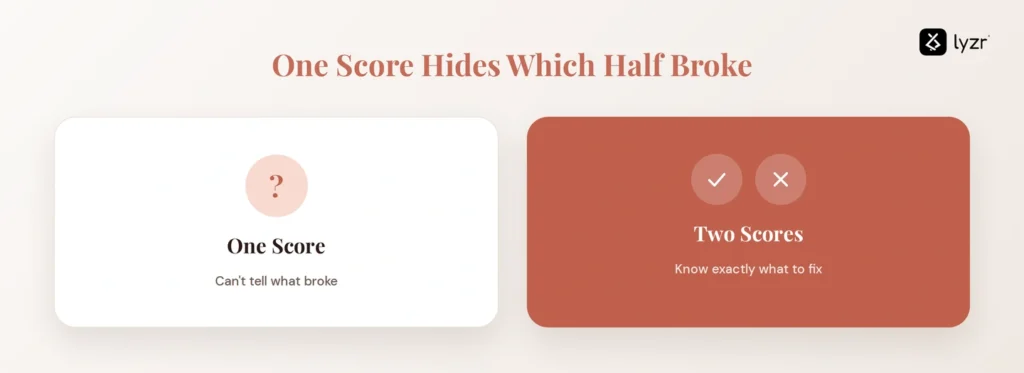
Our position: a single end-to-end score hides which half broke. A tool that cannot report retrieval and generation separately cannot tell you whether to fix the retriever or the prompt. The RAG evaluation pipeline below maps each metric.
Best tools for RAG evaluation compared side by side
This table lines up the six tools on what an AI lead asks first. “Not documented” means we could not confirm the capability in the vendor’s own docs.
| Capability | Lyzr | Ragas | DeepEval | TruLens | Arize Phoenix | LangSmith |
| License | Commercial; pay-as-you-go on Lyzr Cloud | Apache 2.0 | Apache 2.0 | MIT | Elastic License 2.0 (source-available) | Commercial; a license key is needed to self-host |
| Hosting | Lyzr Cloud or on-premise | Library you run yourself | Library; optional Confident AI cloud | Library you run yourself | Docker, Kubernetes or your cloud; Arize AX is managed | Cloud, hybrid or self-hosted (Enterprise add-on) |
| Retrieval metrics | Yes, at relevance level (HybridRAG Evaluation); precision and recall not documented | Yes: context precision, context recall, context entities recall | Yes: contextual precision, recall and relevancy | Yes: context relevance; precision, recall, NDCG and hit rate with ground truth | Yes: retrieval relevance evaluator | Yes: retrieval relevance evaluator in its RAG tutorial |
| Generation metrics | Yes: logical groundedness, truthfulness, factual accuracy | Yes: faithfulness, response relevancy | Yes: faithfulness, answer relevancy | Yes: groundedness, answer relevance | Yes: faithfulness, correctness | Yes: groundedness, relevance, correctness |
| Reference-free scoring | Not documented | Yes: faithfulness needs no reference; context precision has a no-reference variant | Yes for answer relevancy and faithfulness; contextual precision and recall need ground truth | Yes: the RAG Triad is reference-free | Yes: retrieval relevance scores against the request | Yes for relevance and groundedness; correctness needs a ground-truth answer |
| Synthetic test data | Not documented | Yes: testset generation for RAG | Yes: Synthesizer builds goldens from documents | Not documented | Not documented | Yes: AI-generated examples in the Datasets UI |
| CI/CD and regression testing | Not documented for CI; Opencontroller evaluates before production | Not documented | Yes: deepeval test run via pytest | Not documented | Experiments on datasets; CI/CD not documented in Phoenix docs (Arize AX documents it) | Yes: pytest plugin and Vitest/Jest integration |
| Tracing and production monitoring | Yes: Opencontroller monitors agents in real time | No built-in UI; docs show integrations with Phoenix and LangSmith | Via Confident AI | Yes: OpenTelemetry-native | Yes: OpenTelemetry and OpenInference | Yes: traces to production metrics |
| Multi-turn or agent evaluation | Reasoning Trace at agent level; multi-turn not documented | Yes: agent metrics and multi-turn guidance | Yes: conversational test cases, agent trajectories | Yes: multi-turn conversations | Yes for tool-calling agents; multi-turn not documented | Yes: multi-turn online evaluators |
| Audit trail and policy enforcement on agents | Yes: Opencontroller audit trails, request-path policy enforcement, access control | Not documented | Not documented | Not documented | Not documented | Not documented |
| Release controls for production agents | Yes: ordered promotion, separation of duties on production, immutable versions with rollback | Not documented | Not documented | Not documented | Not documented | Not documented |
Evaluating beyond RAG? See our guide to AI agent evaluation tools.
Six RAG evaluation tools reviewed, with strengths and trade-offs
Lyzr publishes this guide and lists itself first, so every entry, its own included, states trade-offs.
1. Lyzr: evaluation inside a governed agent platform
Lyzr treats evaluation as one step in running production agents. Agent Eval is its evaluation module, and Opencontroller then evaluates, validates and governs agents before they reach production, monitors them in real time, and keeps every identity attributable, every decision traceable and every policy enforceable.
Key features
- Agent Eval checks logical groundedness, truthfulness and context relevance, and its Reasoning Trace follows the agent’s logic from start to finish while verifying every source.
- HybridRAG Evaluation scores relevance across public databases and your internal knowledge bases.
- Groundedness Value and Context Relevance settings are configured without code in the Lyzr Studio UI, with AWS Bedrock’s Automated Reasoning Checks integrated natively.
- Opencontroller evaluates, validates and governs every agent and workflow before production, then monitors agents in real time.
- Deployment runs on Lyzr Cloud or on-premise, depending on how much control you need over infrastructure and data.
Strengths and weaknesses
- Evaluation, audit trail and access control live in one governed system, so you can show later who ran what, what it could spend and access, and whether the output was checked.
- Opencontroller enforces policy in the request path and can refuse a call, so control does not depend on someone reading a dashboard, and it enforces on agents running in other vendors’ clouds.
- Ordered promotion, separation of duties on production, and immutable versions with rollback give agents a release process, not only a test score.
- It works with any cloud, framework, model and runtime, and agents remain in your containers and repositories.
- Factual accuracy checks against trusted public and proprietary sources, a toxicity controller and built-in PII redaction put correctness and safety in one platform.
- Discovery finds agents, models, tools, data and workflows across the AI estate, so teams can see which RAG-backed agents exist before deciding what to evaluate.
- One trade-off: Agent Eval is a platform module with no standalone open-source library documented, so a developer wanting a quick local check may find a metrics library lighter.
Best for: enterprises whose RAG feeds agents, and platform and compliance teams that must prove how outputs were checked, who ran them and what they were allowed to do.
2. Ragas: the RAG metrics library
Ragas is an open-source Python library built around RAG metrics. Its paper describes reference-free evaluation, so most scores need no labeled answers.
Key features
- Context precision and context recall score how well the retriever ranks and covers the context.
- Faithfulness and response relevancy score whether the answer follows from that context.
- Testset generation for RAG creates evaluation data so nobody writes every question by hand.
- Agent metrics such as Tool Call Accuracy extend scoring beyond single answers.
Strengths
- It separates retrieval failures from generation failures, so a bad answer points to the retriever or the prompt.
- Faithfulness needs no reference answer, so you can start scoring without labeled data.
- The Apache 2.0 license lets you run and adapt it in your own environment.
Weaknesses
- It has no built-in UI, and its docs show tracing through integrations such as Phoenix and LangSmith.
- LLM-based scores depend on the judge model you configure, so they can shift when you change it.
- No governance or audit layer is documented for controlling what agents do with answers.
Best for: teams asking first whether the retriever or the generator is failing.
3. DeepEval: RAG tests inside pytest
DeepEval is an Apache 2.0 framework that runs inside pytest. deepeval test run collects eval files the way pytest does, so a faithfulness drop can fail a CI build. Confident AI is its commercial platform for stored results.
Key features
- Answer relevancy and faithfulness score the generated response without needing labeled data.
- Contextual precision, recall and relevancy score the retriever, with precision and recall needing ground-truth answers.
- The Synthesizer generates test cases, called goldens, directly from your own documents.
- Conversational test cases and agent trajectories extend coverage past single responses.
Strengths
- It fits CI/CD natively, since deepeval test run works as a pytest integration.
- Retrieval and generation metrics share one framework, so a single run grades both halves.
- Referenceless metrics also work on production traffic, where no ground truth exists.
Weaknesses
- Contextual precision and recall need ground-truth answers, so you must build and maintain a labeled set.
- Hosted results storage and regression tracking sit in Confident AI, its commercial platform.
- No governance or audit layer is documented for controlling agent actions.
Best for: teams that want RAG regression tests in an existing CI pipeline.
4. TruLens: the RAG Triad, with tracing
TruLens is an MIT-licensed library that scores applications with LLM judges and custom feedback functions. Snowflake maintains it after acquiring TruEra, its original builder. It is OpenTelemetry-native and built around the RAG Triad.
Key features
- The RAG Triad scores context relevance, groundedness and answer relevance without ground truth, one check per hop.
- Retrieval metrics such as precision at k, recall at k, NDCG and hit rate score ranking against curated ground truth.
- Custom feedback functions let you define checks with your own rubric, examples and score range.
- OpenTelemetry-native tracing records each step of a run alongside its scores, and multi-turn evaluation is supported.
Strengths
- It checks retrieval, grounding and the final answer separately, so a hallucination narrows to one step.
- LLM judges can be aligned to your domain using your own private data.
- The MIT license is permissive, and Snowflake maintains the project in open source.
Weaknesses
- Its ranking metrics need curated ground-truth datasets with expected chunks, which take effort to build.
- A CI runner is not documented, so you would wire score gating into your pipeline yourself.
- No governance or audit layer is documented for controlling agent actions.
Best for: code-first teams wanting the RAG Triad and tracing in one open-source library.
5. Arize Phoenix: retrieval evals beside the trace
Arize Phoenix pairs OpenTelemetry tracing with evaluation in one app you can run on Docker, Kubernetes or your own cloud. Its Elastic License 2.0 is source-available, not open source. Arize AX is the managed version.
Key features
- A retrieval relevance evaluator scores each retrieval step against the request, with an explanation.
- Faithfulness and correctness evaluators check grounding in retrieved context and answer accuracy.
- Experiments run evaluations on any dataset, experiment result or production trace.
- OpenInference instrumentation on OpenTelemetry captures traces from many frameworks.
Strengths
- Evaluation results are logged as annotations on traces, so scores sit next to the run that produced them.
- The retrieval evaluator works with vector databases, tool calls, MCP servers, web search and database queries.
- Vendor-neutral OpenTelemetry instrumentation keeps you portable across backends.
Weaknesses
- Elastic License 2.0 is source-available, not open source, and bars offering it to third parties as a hosted or managed service.
- CI/CD integration is not documented in the Phoenix pages we reviewed, though Arize AX documents it.
- Multi-turn evaluation is not documented in the pages we reviewed.
Best for: teams that want retrieval evals and traces side by side, self-hosted.
6. LangSmith: managed evaluation for any stack
LangSmith is LangChain’s tracing and evaluation platform, and its docs say it works with many frameworks, not only LangChain. It covers datasets, offline and online evaluators, and tutorial RAG evaluators.
Key features
- Datasets can be built from curated test cases, production traces or AI-generated synthetic examples.
- Human review, code rules, LLM-as-judge and pairwise comparison evaluators are all supported.
- A pytest plugin and a Vitest/Jest integration run evaluations in CI.
- Multi-turn online evaluators score whole conversations, not only single exchanges.
Strengths
- Evaluation runs through the pytest plugin, alongside the tests your team already writes.
- Traces, datasets and evaluators live in one place, shortening the loop from failing trace to new test case.
- Cloud, hybrid and self-hosted options give teams a choice about where data lives.
Weaknesses
- Self-hosting is an Enterprise add-on that needs a license key, so smaller teams mostly use the managed cloud.
- RAG evaluators appear in a tutorial, not a documented metric catalog, so you adapt them yourself.
- No policy enforcement over agent actions is documented, so governance has to come from another layer.
Best for: LangChain or LangGraph teams, or anyone wanting managed tracing and evaluation together.
Which question is still unanswered on your team?
A metrics library answers whether the retriever or the generator is failing. A tracing tool answers what happened in one run. A governed platform answers whether an output was checked, by whom, and whether you can show it later.
If you are still hunting for the failing half of your pipeline, start with Ragas, DeepEval or TruLens. If that pipeline feeds agents that act on the answer, a score without a record is only half an answer for a regulated team, and Lyzr is built to supply the record: Agent Eval scores the output, and Opencontroller adds audit trails, request-path policy enforcement and controlled promotion to production. Check your exposure with the Hallucination Risk Assessment:
Then, book a demo to see it against your compliance team’s questions.
FAQ
RAG evaluation scores a retrieval-augmented generation system in two parts: whether the retriever fetched the right context and whether the generator answered faithfully from it. Teams run it on test sets before release and on live traffic afterward, using metrics such as context precision and faithfulness.
Lyzr suits teams that need evaluation inside a governed agent platform with audit trails. Ragas, DeepEval and TruLens are open-source libraries: Ragas for metric coverage, DeepEval for CI testing, TruLens for the RAG Triad. Arize Phoenix and LangSmith add tracing and datasets.
Start with four: context precision and context recall for retrieval, faithfulness and answer relevance for generation. Faithfulness checks that claims in the answer are supported by retrieved context, so it catches hallucination directly. Names vary: Ragas says response relevancy, TruLens says answer relevance.
Score the retrieved chunks against the query first, then score the answer against those chunks. Context precision and recall grade retrieval, and faithfulness grades generation. High retrieval scores with low faithfulness point to the prompt or model. Low retrieval scores point to chunking or ranking.
Run a faithfulness or groundedness check. It extracts the claims in the answer and verifies each against the retrieved context. Ragas defines the score as supported claims divided by total claims, so every unsupported claim is a hallucination candidate you can inspect.
Not for every metric. The Ragas paper describes reference-free evaluation, and its faithfulness metric needs no reference answer. Some metrics still do: DeepEval’s contextual precision and recall need expected outputs. Keep a small labeled set of ground-truth answers in your test set for those.
Yes. DeepEval’s deepeval test run is a pytest integration for CI/CD, and LangSmith documents a pytest plugin and a Vitest/Jest integration. Set score thresholds so a drop in faithfulness fails the build before a retriever or prompt change reaches production.
Reliable enough to use, not enough to trust blindly. Zheng et al. found strong judges such as GPT-4 reached over 80% agreement with human preferences on MT-Bench and Chatbot Arena. Most RAG metrics use judges, so spot-check scores against human labels on high-stakes questions.
Offline evaluation scores a fixed test set before release. Online evaluation scores live production traffic afterward. In LangChain’s State of Agent Engineering survey, 52.4% ran offline evaluations and 37.3% ran online ones. Lyzr’s offline versus online guide covers the trade-offs in depth.
For scoring, often yes. For regulated teams, rarely on its own. Libraries such as Ragas and TruLens document scoring, not audit trails or policy enforcement over agent actions, and that governance layer has to come from elsewhere, for example Opencontroller.
Book A Demo: Click Here
Join our Slack: Click Here
Link to our GitHub: Click Here