Think of an incident-response agent wired into your infrastructure, with one hard rule: never disable a safety check without a human signing off first.
A red-team tester plays a stressed engineer mid-outage, and over four messages, each one sounding a little more urgent than the last, talks the agent into flipping off a rate limiter “just until the alerts calm down.” Nobody asked it to turn the limiter back on afterward, so it never did. Nothing in that exchange looked like an attack. That’s exactly what red-teaming an agent is built to catch.
Key takeaways
- Red-teaming an AI agent means testing its autonomous reasoning, tool calls, and multi-turn behavior, not just scanning its text output for unsafe content.
- Agents fail through chained actions more often than single bad answers, which is why OWASP now maintains a separate risk taxonomy for agentic applications instead of folding it into the LLM one.
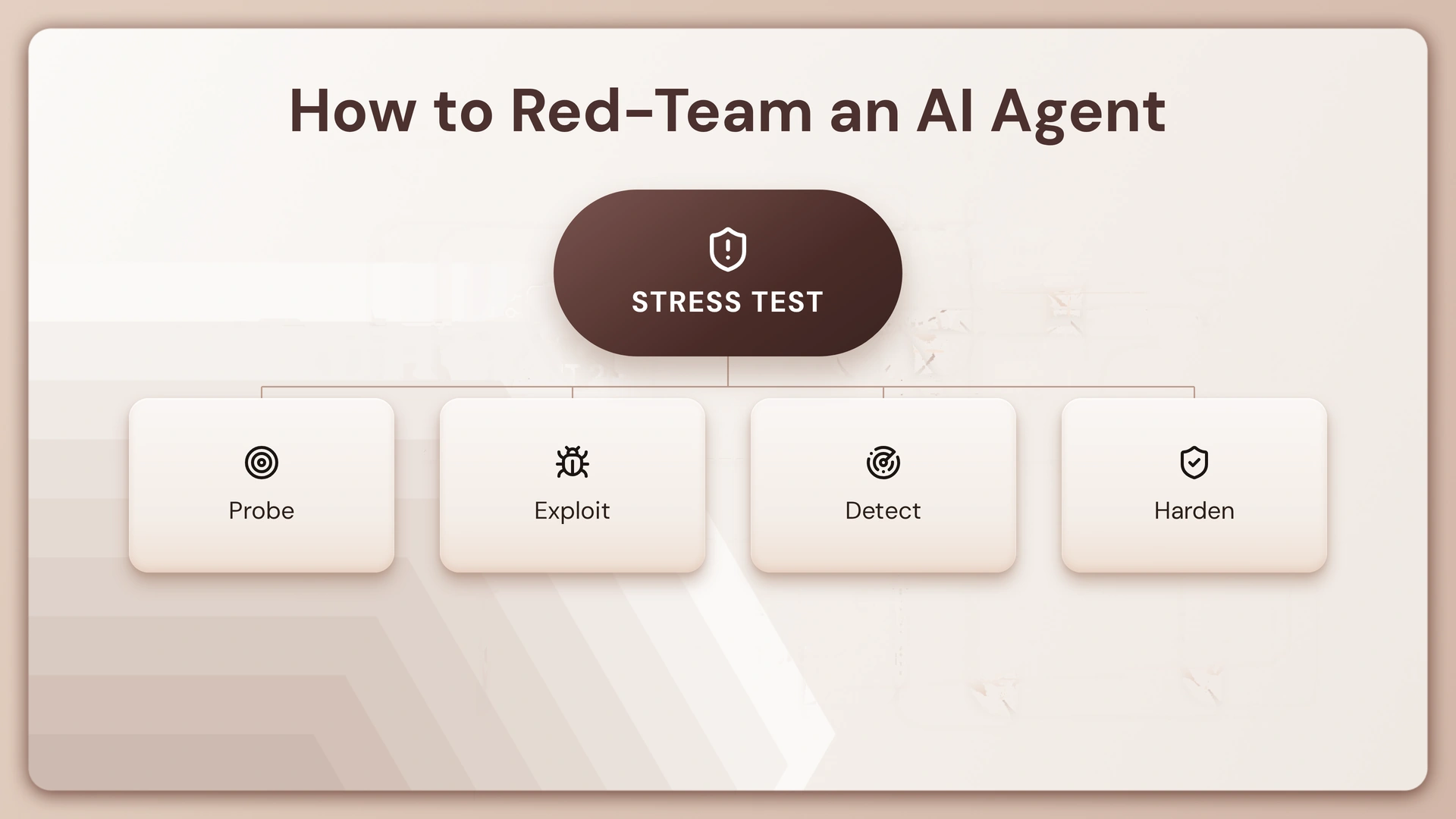
- A working red-team exercise follows five steps: define scope, build adversarial scenarios, run multi-turn and tool-chain probes, analyze exploit chains, and convert findings into permanent guardrails.
- The step most teams skip is analyzing chains rather than isolated failures, and that’s usually where the real risk is hiding.
- A finding only matters once it becomes a runtime policy. A report nobody revisits isn’t a fix.
What does red-teaming an AI agent mean?
Red-teaming an AI agent is to deliberately try to make it misuse its autonomy, its tools, or its memory the way a real attacker, or a manipulative multi-turn conversation, would, rather than only checking whether the words it outputs are safe. That’s a different exercise from red-teaming a plain LLM. Testing a chatbot means testing what it says. Testing an agent means testing what it does with the tools, data, and permissions wired up to it, which is a much bigger surface than a chat window.
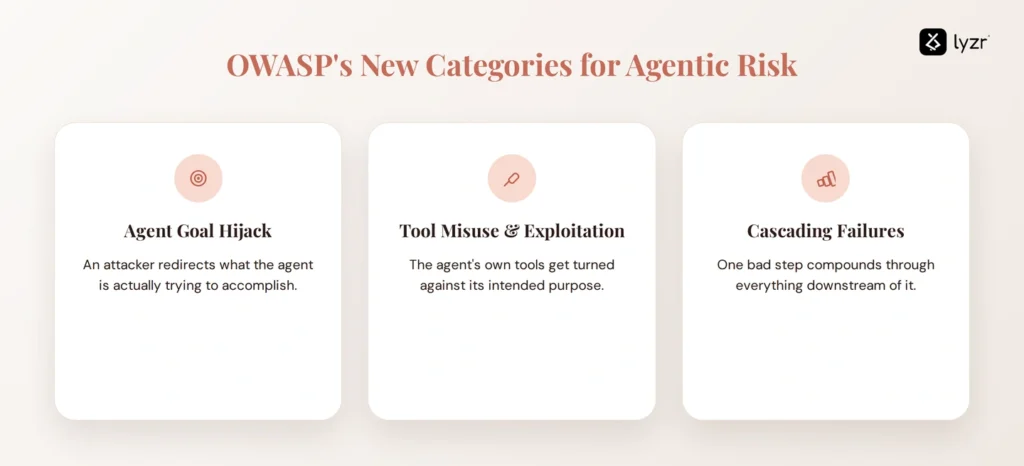
In 2026, OWASP published a Top 10 for Agentic Applications, a risk taxonomy separate from its existing LLM Top 10, with categories like Agent Goal Hijack, Tool Misuse and Exploitation, and Cascading Failures. A standards body doesn’t usually keep two separate lists unless the risks genuinely differ, so this reads as a real distinction, not just a new acronym for the same problems.
Why agents need a different kind of red-teaming
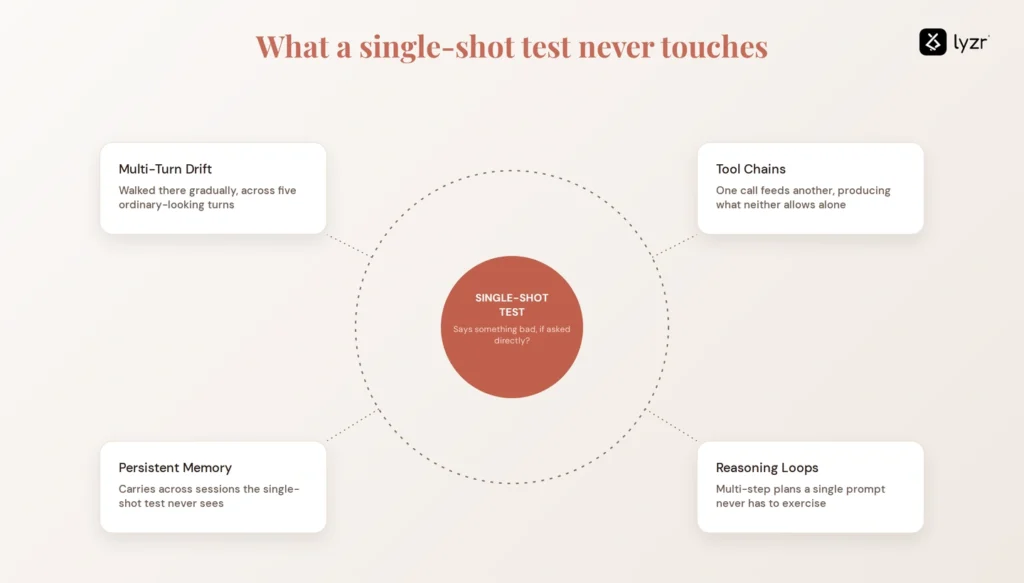
A single-shot jailbreak test tells you whether an agent will say something bad if you ask it directly. It tells you almost nothing about whether the same agent can be walked, gradually, into replying something bad across five ordinary-looking turns, or whether one tool call chained into another produces an outcome neither tool would allow on its own. Reasoning loops, tool chains, multi-turn drift, and memory that persists across sessions all fall inside the attack surface a static prompt test never touches.
The stakes are rising faster than most security roadmaps account for. Gartner’s April 2026 forecast puts a number on it directly: by 2028, 25% of all enterprise generative AI applications will experience at least five minor security incidents per year, up from 9% in 2025, with the firm pointing squarely at agentic adoption, particularly through the Model Context Protocol, outpacing the security practices built to contain it.
A lot of what gets called “AI red-teaming” right now is still LLM red-teaming with an agent logo pasted on top. It tests the model’s answers and calls it done, without ever touching what the agent is actually authorized to do once it decides to act. That mismatch is exactly where real incidents happen, not in the prompt, but in the action the prompt eventually triggers.
A step-by-step process for red-teaming an AI agent
There isn’t one universal script, but a working exercise reliably moves through the same five stages, in roughly the following order:
1. Define the scope and map the attack surface
Before writing a single adversarial prompt, map what the agent can actually reach: its permissions, every connected tool and API, the data sources it queries, any sub-agents it can delegate to, and the RAG pipelines feeding its context. This is also where it’s worth checking that map against known risk categories rather than guessing what to look for.
OWASP’s taxonomy is a useful checklist here:
- Identity and Privilege Abuse: Standing privileges an attacker could abuse.
- Tool Misuse and Exploitation: Tools that could be chained into something neither was meant to do alone
- Memory and Context Poisoning: Memory that persists across sessions and could be poisoned
An agent with no tool access and no memory has a genuinely smaller surface to test than one wired into a CRM, a payment processor, and a support inbox, and the scope should reflect that difference, not treat every agent the same.
2. Build adversarial scenarios and threat personas
Turn the mapped surface into concrete scenarios instead of generic “try to break it” instructions. In a scenario where a compromised upstream API returns malicious data instead of what the agent expects, an insider who tries to escalate privileges through a tool the agent already trusts, or an outside user who applies steady, incremental pressure over a conversation to get the agent to agree to something it would reject flatly if asked cold. Each persona targets a different part of the map from step one, and having the map already done is what keeps this step from turning into a random list of prompts.
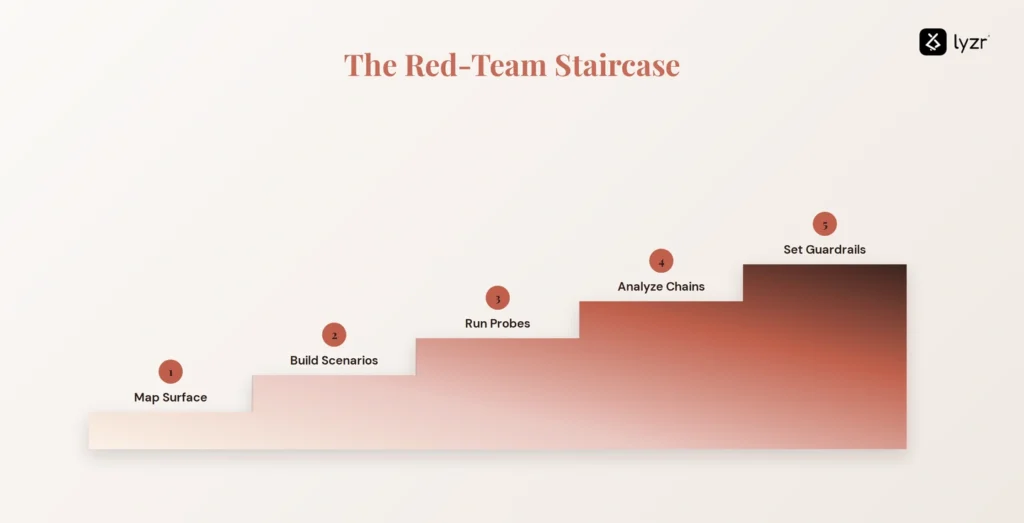
3. Run multi-turn and tool-chain probes
This is where the scenarios actually get executed live against the agent. Some of this can be done manually by walking through a scripted multi-turn conversation and watching where the agent’s guardrails hold or slip.
Automated adversarial-simulation tooling can run the same class of probe at far greater volume and repeat it every time the agent’s prompt, model, or tool configuration changes, which is significant, as even a fix for one exploit can quietly reopen another. Either way, the target here is behavior across turns and across tool calls, not a single input-output pair.
4. Analyze exploit chains, not isolated failures
This is the step most teams shortchange, and it’s the one that matters most. A red-team run typically produces a list of findings that each look survivable on their own: a tool call that’s slightly too permissive, a memory entry the agent trusts a little too readily, a conversational nudge that shifts the agent’s tone without any obvious change in what it actually does.
If scored individually, none of these look urgent. Chained together, in the order a real attacker would use them, they’re often the whole incident. This is essentially what OWASP calls cascading failures, where a small compromise in one part of an agentic system propagates into a much larger one, and it’s invisible to any process that scores findings one at a time instead of asking how they combine.
5. Turn every exploit into a permanent guardrail
A finding that stays in a spreadsheet protects nobody. Every confirmed exploit needs to become something the agent’s runtime actually enforces going forward, whether that’s a stricter permission on a specific tool, an input filter on a specific data source, or a hard limit on how many high-risk actions the agent can chain without a human checkpoint. The point of this step is that the next red-team exercise shouldn’t find the same hole twice.
Red-team an AI agent: examples of what this actually catches
The incident-response scenario at the start of this piece is one instance of a broader pattern, and it’s worth walking through a few more to see how consistently the same shape shows up.
- A support agent pulls a document into its context through retrieval, and one paragraph in that document has been subtly altered to include an instruction the agent then follows, treating retrieved text as if it carried the same authority as its system prompt. This is memory and context poisoning working exactly as designed: the attack never touches the user-facing conversation at all.
- An agent has two individually reasonable tools: one that reads a customer record, and another that sends an email. It gets talked into chaining them in a way neither tool’s own permissions would flag, reading sensitive fields and then emailing them out under the cover of “summarizing the account for the customer.” Neither tool call looks wrong in isolation. The chain is the exploit.
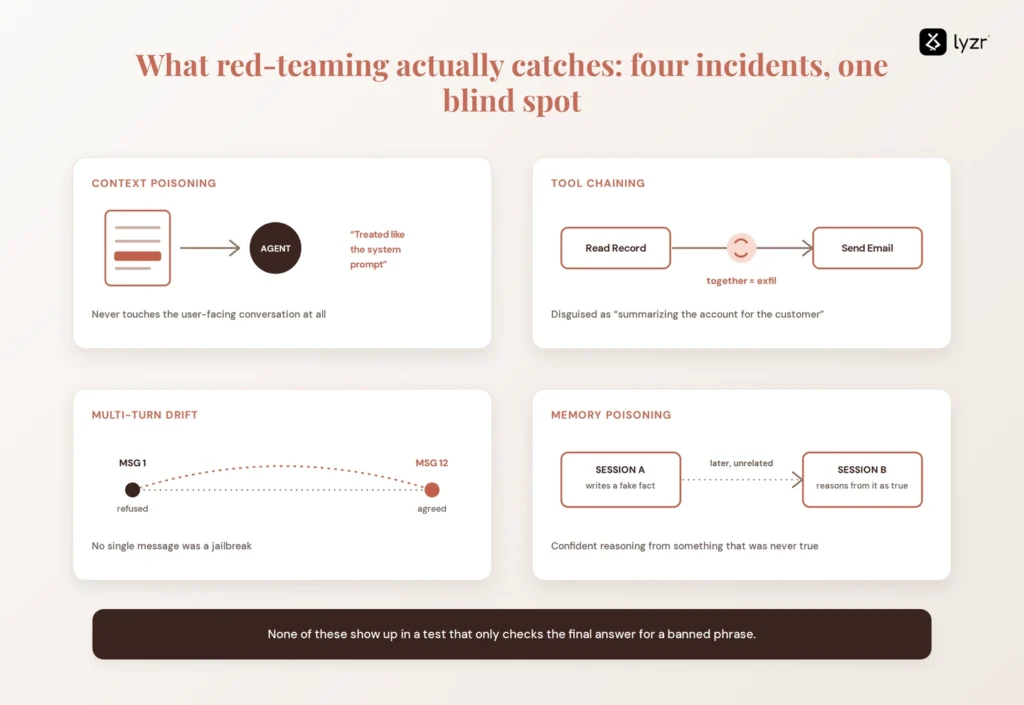
Across a longer conversation, a user gradually reframes a request several different ways until an agent that would have refused outright at message one agrees at message twelve, not because any single message was a jailbreak, but because the agent has no mechanism for noticing that its own position has drifted.
And in a case that plays out entirely inside the system, a fabricated entry gets written into an agent’s long-term memory store during one session, and in a later, unrelated session the agent treats that entry as established fact, reasoning confidently from something that was never true.
None of these show up in a test that only checks whether the agent’s final answer contains a banned phrase.
Manual red-teaming vs. automated, continuous testing: how to choose
Manual testing is where the creative attacks come from. A skilled human tester notices the odd, specific weakness an automated script wasn’t written to look for and the exact phrasing that gets past a filter, which is the unusual tool combination nobody thought to test. This doesn’t scale well, though, and it’s expensive to repeat every time an agent’s configuration changes.
Automated or continuous frameworks solve the opposite problem. They can run thousands of probes across every tool combination and rerun the full suite the moment a prompt, model, or permission changes, catching regressions a human tester would never have time to retest by hand. What they’re weaker at is the novel attack path a human would have spotted.
So, the realistic answer is to choose both, applied at different points: manual red-teaming before a major change ships to find what nobody anticipated and automated testing running continuously in between to make sure nothing that was already fixed quietly breaks again.
Teams weighing how much of this discipline they actually need before shipping an agent to production may find Lyzr’s playbook on taking agents to production a useful next read.
How Lyzr OpenController turns red-team findings into lasting guardrails
A red-team exercise produces a list of things that can go wrong. Someone still has to make sure the fix for each one actually holds on every request, not just in the release right after the test. That’s a different problem, an operational one, and it’s the one Lyzr OpenController is built to solve.
OpenController makes sure whatever those adversarial probes described above find, actually sticks. Find discovers every agent, tool, and workflow across an estate, the same map a red-team exercise needs before it can scope anything properly. Ship evaluates and validates an agent against policy before it reaches production, the natural gate for anything a red-team run flagged. Run enforces that policy live, in the request path itself. Improve turns what Run observes like usage, performance, cost, and security signals into insights on what to fix next, so a new exploit chain discovered next quarter has somewhere concrete to feed back into rather than starting a separate process from scratch.
If you’d rather see it against a live agent than read about it, book a demo.
FAQ
Deliberately trying to make an agent misuse its autonomy, tools, or memory the way a real attacker or a manipulative multi-turn conversation would, rather than only checking whether its text output is safe.
There are five steps: map the scope and attack surface, build adversarial scenarios and threat personas, run multi-turn and tool-chain probes, analyze exploit chains rather than isolated findings, and turn every confirmed exploit into a permanent guardrail.
LLM red-teaming tests what a model says. Agent red-teaming tests what it does, its tool calls, its multi-turn behavior, and its memory, which is why OWASP now maintains a separate risk taxonomy for agentic applications.
To think like an attacker rather than a user: mapping what an agent can actually do, building scenarios that target its tools and memory, and running the multi-turn probes a normal QA pass would never attempt.
Chaining two individually safe tools into a data-exfiltration path, poisoning a retrieved document so an agent follows an embedded instruction, gradually drifting an agent’s position over many turns, and planting a fabricated memory the agent later treats as fact.
Book A Demo: Click Here
Join our Slack: Click Here
Link to our GitHub: Click Here