“What happens when one of the AI agents you are running crashes mid-task?”
Most people’s response will point to the framework’s retry logic.
That’s the wrong layer to credit, and it’s an easy mistake to make, since frameworks are what get funded, demoed, and written about. What actually decides whether a crashed agent quietly resumes where it left off, or silently drops a customer’s refund mid-flight, is a layer most teams never chose on purpose: the runtime running underneath it.
Key Takeaways
- An AI agent runtime is the execution layer that runs agents in production: compute, state, tool calls, and security boundaries. A framework only supplies the reasoning logic.
- Gartner expects more than 40% of agentic AI projects to be canceled by the end of 2027, largely over cost, unclear value, and weak risk controls, not bad reasoning.
- Every production-grade runtime handles roughly the same five jobs: orchestration, state and session management, tool sandboxing, identity and isolation, and observability and budgets.
- Clean architecture assumes execution goes to plan. Two things break that once agents run for real: suspension that shouldn’t burn compute, and execution graphs the agent plans as it goes rather than one written in advance.
- The right runtime depends on the workload, not the model. A low-risk internal tool can run on something thin and homemade; an agent touching money or personal data cannot.
- Lyzr’s OpenController sits above whatever runtime an agent already runs on, giving one place to discover, vet, monitor, and improve agents instead of stitching that together per framework.
What is an AI agent runtime?
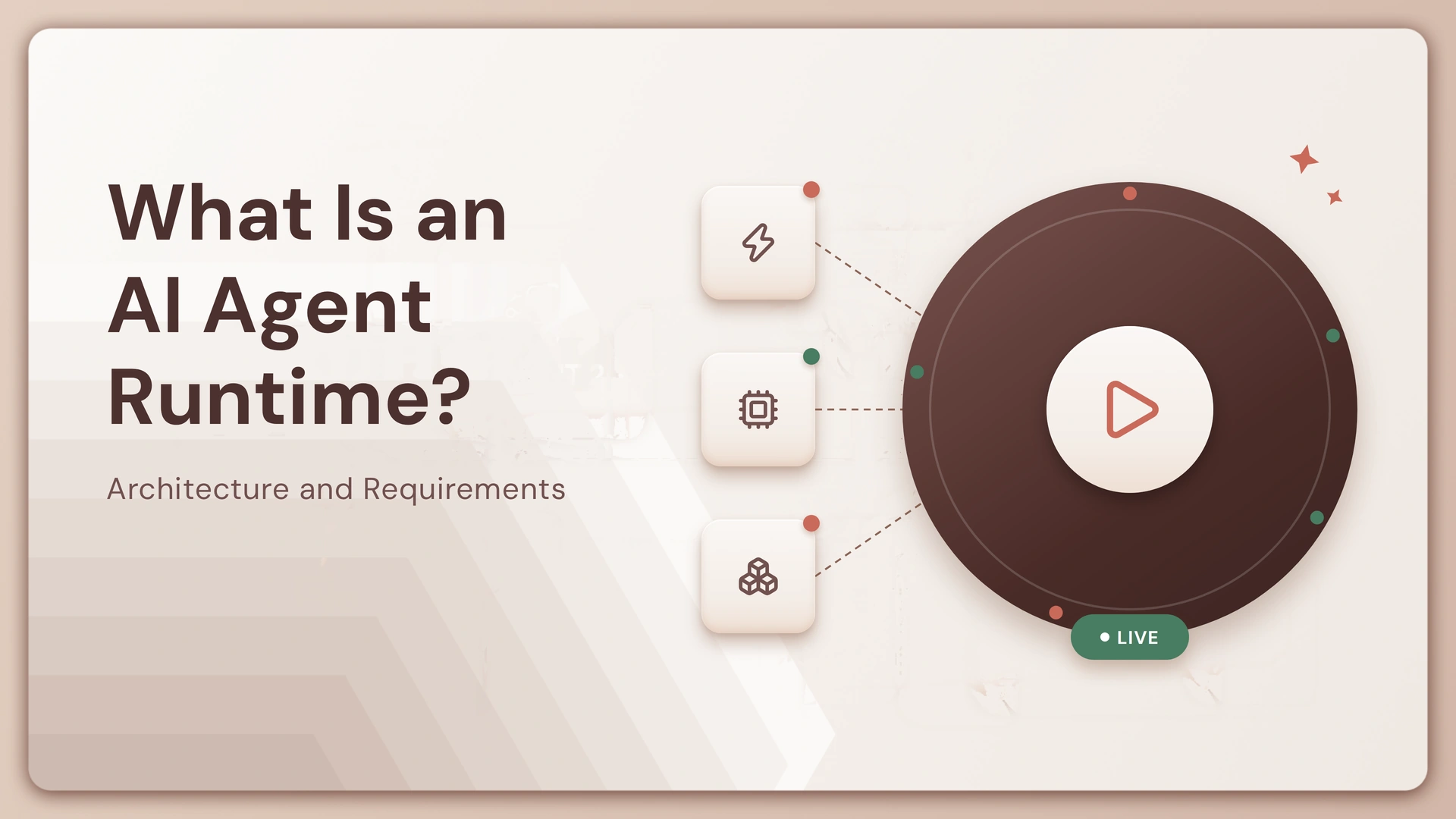
An AI agent runtime is the software layer that actually executes an AI agent once it leaves the notebook. It allocates compute for each run, tracks where a multi-step task sits in its life cycle, carries out the tool and API calls an agent decides to make, and enforces the boundaries around what it’s allowed to touch.
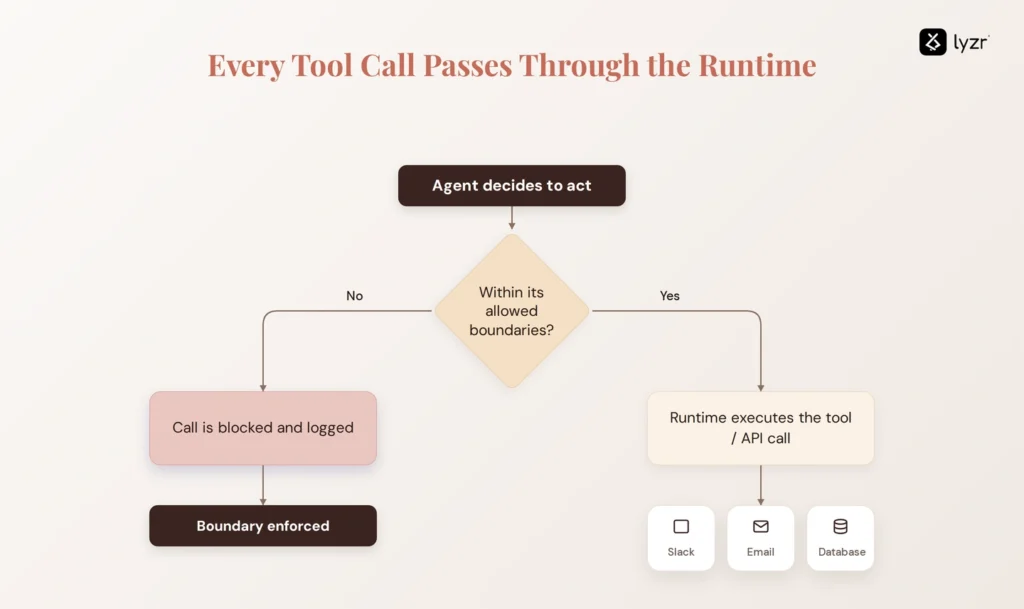
If a framework is the blueprint for how an agent should think and act, the runtime is the building itself: the wiring, the fire doors, the meter that tracks how much power got used. You can draw a beautiful blueprint and never think about any of that until the day the building has actual people in it.
That’s roughly when most teams meet their runtime for the first time: not while designing the agent, but while keeping it alive after launch. Gartner has been blunt about how often that transition goes wrong. It expects more than 40% of agentic AI projects to be canceled by the end of 2027, citing escalating costs, unclear business value, and inadequate risk controls, not bad reasoning, as the drivers.
AI agent runtime vs. AI agent framework: what’s the difference?
Most of the confusion around this term comes from framework marketing that quietly borrowed runtime language. It helps to separate the two cleanly.
A framework gives you the logic: how an agent breaks a goal into steps, decides which tool to call next, and checks whether a step actually worked before moving on. This is essentially the reasoning-and-acting loop that academic work like ReAct formalized back in 2022: alternate between generating a thought and taking an action, then feed the result back into the next thought. Frameworks are where that loop gets written as code you can read and modify.
A runtime has to exist for that loop to run somewhere real, more than once, for more than one user, without a human babysitting every step. It provisions compute for each invocation, persists the agent’s state so a crash or a restart doesn’t erase where it was, executes tool calls inside some kind of boundary, and produces the logs someone will eventually need for an audit. None of that is reasoning. All of it is what lets reasoning survive contact with production.
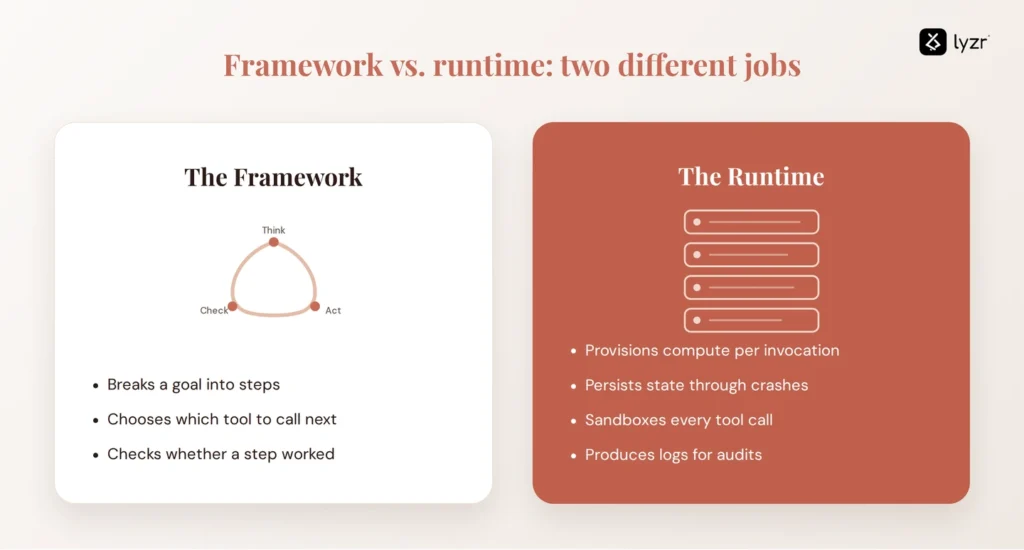
Here’s the part that trips people up: a framework’s agent loop can run on nothing more than a bare script and a database table. That’s a runtime too, just a thin, homemade one with no crash recovery and no sandbox. The real question was never whether you have a runtime. It’s whether the one you have was built for what production actually does to an agent.
Core architecture of an AI agent runtime
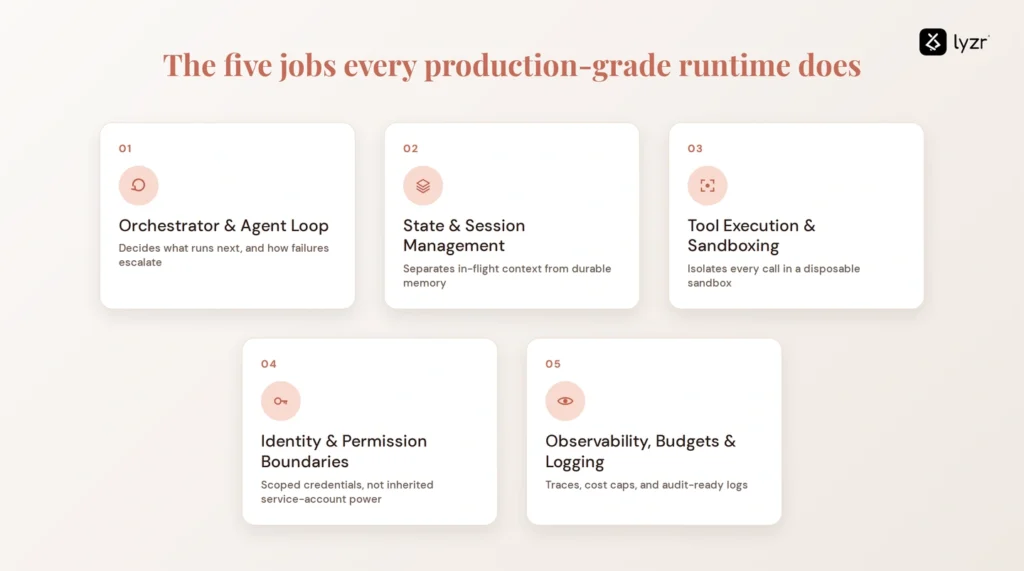
Almost every production-grade runtime does roughly the same five jobs, whether it’s built in-house or bought off the shelf. None of them are optional once an agent handles real users or real money.
The orchestrator and the agent loop
This is the part that actually drives execution. It decides what step runs next, whether two subtasks can run in parallel or have to wait on each other, and what happens when a step throws an error instead of a result. It’s the runtime-side counterpart to the reasoning loop a framework defines, except the orchestrator also has to handle that loop failing partway through, not just succeeding. A step that errors out needs a defined retry or escalation path, or agents end up either giving up silently or retrying the same failing action forever.
State and session management
An agent’s state splits into two things that behave differently: the immediate, in-flight context of the current step, and durable memory that has to survive across sessions and days. A runtime that conflates the two either forgets everything on restart or drags an ever-growing pile of irrelevant history into every new call. This is also where durable execution matters most. If a process crashes mid-tool-call, the runtime needs to know whether that call already completed before retrying it, or a payment can get issued twice and nobody notices until reconciliation
Tool execution and sandboxing
Every time an agent calls a tool, a database query, a code interpreter, or an internal API, that call has to happen somewhere isolated enough that a bad or manipulated instruction can’t reach anything it shouldn’t. This is usually where lightweight, disposable sandboxes come in: short-lived isolated environments spun up per call, then discarded.
When OWASP’s GenAI Security Project published its Top 10 risks and mitigations for agentic AI security in December 2025, tool misuse and exploitation was one of three headline categories, alongside behavior hijacking and identity or privilege abuse. A sandbox with no real permission boundary around it is just a slower way to have the same problem.
Identity, isolation, and permission boundaries
Every agent, arguably every session, needs its own identity and scoped credentials that don’t automatically inherit whatever the underlying service account is allowed to do. OWASP called this out as its own top-level risk category, which often gets missed in practice. An agent that can read a customer record should not, by default, also be able to export the entire table, even if the same API key technically permits both.
Observability, budgets, and logging
Eventually someone has to be able to answer what an agent did, why, what it cost, and who signed off on it. That means step-level traces, token and dollar budgets that can hard-stop a runaway loop, and logs detailed enough to support a real audit rather than a vague summary after the fact. NIST’s generative AI risk profile treats this kind of traceability, documented, reviewable evidence of system behavior, as a baseline part of managing AI risk, not an optional feature bolted on afterward.
Two things clean architecture doesn’t anticipate
The five jobs above assume execution goes roughly as planned. But two things break that assumption once an agent is running for real, and neither shows up until it does.
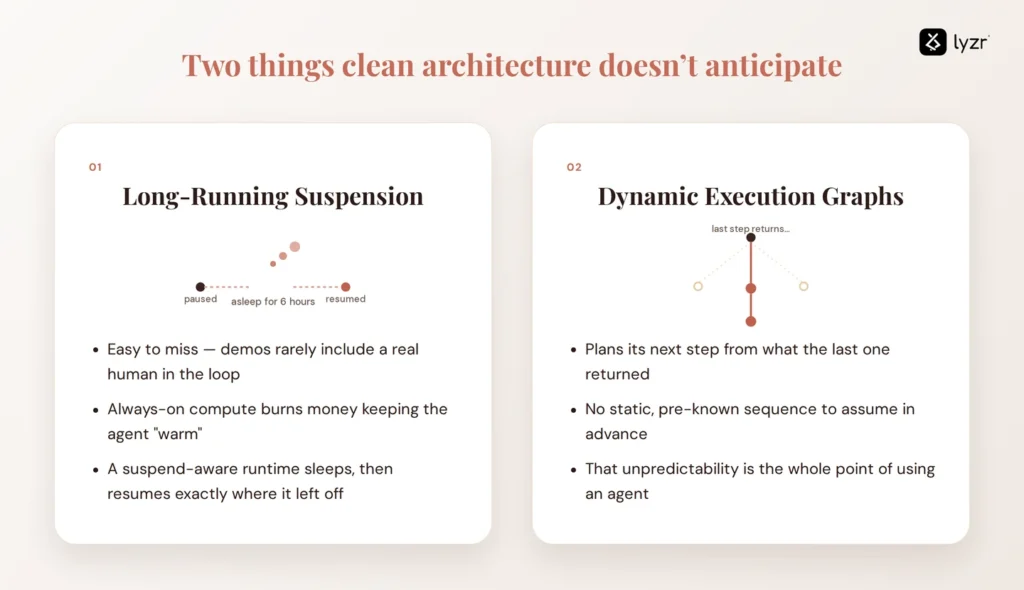
- Dynamic execution graphs: Agents increasingly plan their own next step instead of following one written in advance, deciding at each point which tool to call based on what the last step returned. That’s the point of using an agent instead of a fixed workflow, but it means the runtime can’t assume a static, pre-known sequence the way a traditional pipeline does.
- Long-running suspension: Easy to miss because demos rarely include a real human in the loop. An approval workflow might pause an agent for six hours waiting on a manager’s sign-off. A runtime built around always-on compute burns money keeping that agent “warm” the whole time; one built for suspension can put it to sleep and wake it exactly where it left off.
Choosing a runtime for your stack
There’s no universal answer here, and anyone selling you one hasn’t run enough agents in anger to know better. What actually decides it is the shape of the workload: how long a task realistically runs, how much of it needs to survive a pause or a crash, how dangerous the tools are if something goes wrong, and how much appetite the team has for operating infrastructure versus paying someone else to.
A small internal tool that queries one read-only API and never touches money can live on a thin, homemade runtime for a long time. An agent that issues refunds, touches personal data, or runs unattended overnight can’t get by on that same thin setup, no matter how good the underlying model is. The gap between those two cases is architecture, not intelligence, and it’s usually the part teams budget for last.
Where a governance layer like OpenController fits in
Most enterprises don’t end up with one runtime and stop there. Agents get scattered across a handful of frameworks and at least one managed execution service, each with its own idea of logging, its own idea of a sandbox, and no shared view of what’s actually running or what it’s allowed to do.
That’s the gap Lyzr’s OpenController is built to close, not by replacing whatever runtime an agent already runs on, but by sitting above it: discovering agents and workflows across the estate, evaluating and validating each one before it reaches production, monitoring behavior and cost signals in real time once it’s live with policy enforced in the request path rather than logged after the fact, and turning what it sees into decisions a team can act on instead of a dashboard nobody opens.
If durable state, tool boundaries, identity, budgets, and auditability are the job descriptions for a runtime, OpenController is Lyzr’s answer to a more specific problem: most organizations are running several runtimes’ worth of agents with one team’s worth of visibility into any of them. If that sounds familiar, book a walkthrough and see how it closes the gap.
FAQ
An AI agent runtime is the software layer that actually executes an AI agent once it leaves development. It allocates compute for each run, tracks state across a multi-step task, carries out tool and API calls, and enforces the security boundaries around what an agent can touch in production. A framework only supplies the reasoning behind those actions.
An AI agent’s architecture has two layers: the reasoning side (perception, planning, memory, and tool use, usually built with a framework) and the execution side underneath it. That execution layer, the runtime, is what actually runs the reasoning in production: an orchestrator, state management, tool sandboxing, identity, and observability.
A production-grade runtime handles roughly five jobs: an orchestrator that drives the agent loop, state and session management for durability, tool execution and sandboxing for safe tool calls, identity and permission boundaries per agent, and observability with budgets and logging. All five matter once an agent handles real users or money.
A framework supplies the logic: how an agent plans, chooses tools, and checks its own steps. A runtime is what lets that logic run reliably in production, more than once, for more than one user: compute, state persistence, tool execution boundaries, and logging. Most confusion comes from framework marketing borrowing runtime language.
Technically, any agent loop running on a server is already a runtime, even a bare script writing to a database. The real question is whether that thin, homemade setup can survive a crash mid-task, a six-hour approval pause, or an agent that touches money or personal data, which is where most homemade runtimes fall short.
Book A Demo: Click Here
Join our Slack: Click Here
Link to our GitHub: Click Here