Table of Contents
ToggleThere is a specific kind of meeting that happens in large banks right now. A team of smart people sits around a table, someone pulls up a slide deck, and the phrase “AI-powered” appears seventeen times. The demo shows a chatbot that can check account balances. Everyone nods. The meeting ends. Nothing changes.
Meanwhile, a competitor’s compliance team just cut their AML investigation time in half. Their loan officers are approving credit in hours instead of days. Their KYC analysts, who used to spend mornings on document verification, are now spending those mornings on the genuinely suspicious cases that actually need a human brain. This is the gap that defines AI agents in banking in 2026 – not the gap between banks that have AI and banks that don’t, but the gap between banks that have deployed AI agents in workflows that matter, and banks that are still running chatbot demos and calling it transformation.
For three years, “AI agents in banking” mostly meant a slide in a strategy deck or a proof-of-concept that never left the lab. That is changing because the surrounding scaffolding has finally matured: reliable tool-calling, structured outputs, orchestration frameworks, and evaluation harnesses good enough to trust an autonomous system with a regulated workflow. The result is that agentic AI in banking has crossed from demo to deployment. The banks moving first are discovering that the hard part was never the intelligence – it was the governance. And the banks that figure out governance early are building an infrastructure advantage that compounds quietly, steadily, and at machine speed.
What “Agentic AI” Actually Means in a Banking Context
The word “agent” gets applied to everything from a basic FAQ bot to a fully autonomous system that can file a Suspicious Activity Report. That range of usage creates confusion, and confusion leads to misaligned expectations, which leads to failed deployments. The working definition that matters for enterprise practitioners is this: agentic AI in financial services refers to AI systems that can autonomously plan, reason, and execute multi-step workflows across banking operations – without continuous human direction.
Unlike earlier generations of AI that required a human to interpret outputs and decide what to do next, agentic systems take action. They create SAR filings, process loan applications, route disputes, update CRM records, and generate regulatory reports. A generative AI tool drafts a loan analysis. An agentic system gathers the data, runs the analysis, checks compliance, prepares documentation, and routes it for approval – all without a human in the loop for routine decisions. That is a fundamentally different capability, and it will fundamentally change how banks operate.
The practical implication for an enterprise AI practitioner: you are not evaluating a model. You are evaluating an operating system. The model is one component. The orchestration layer, the tool integrations, the governance controls, the audit trail – these are the things that determine whether your agent survives contact with a regulator.
The Back-Office First: Where AI Agents in Banking Are Actually Delivering ROI
In 2026, the banks getting measurable returns from AI are not deploying it in customer-facing channels first. They are deploying AI agents in back-office operations: KYC verification, loan document processing, transaction monitoring, and regulatory reporting. These are the workflows where manual processing is slowest, error rates are highest, and the cost of getting it wrong is measured in compliance fines, not customer complaints. Three use cases are pulling ahead of the field.
90% Reduction in KYC onboarding time (Dutch financial institution, IDC/Neurons Lab 2026) 50% AML investigation time saved per case (EY, 2026) 2.3x Average ROI on agentic AI within 13 months (IDC, 2026)KYC and AML: The Compliance Treadmill, Automated
Know Your Customer verification is the operational equivalent of running on a treadmill set slightly faster than your natural pace – exhausting, relentless, and going nowhere if you are doing it manually. Regulatory enforcement actions for AML and KYC violations have risen by 31%, often linked to outdated or inconsistent customer data. Meanwhile, 55% of firms report losing potential customers due to poor risk visibility, and over 60% of firms describe periodic KYC reviews as a major operational strain. Agentic AI allows the KYC process to be reimagined entirely – no longer bound by sequential processing, no longer dependent on analysts spending their days on highly manual activities.
The production results are striking. A large Dutch financial institution using a combination of AI innovations for its KYC and compliance processes achieved a 90% reduction in onboarding time and cut staff workload by 30%. On the AML side, EY found that when used for manual, time-intensive Anti-Money Laundering investigations, agentic AI led to a 50% time reduction per investigation – a saving of two hours of human labor per case.
Lyzr’s KYC Processing Agent automates the entire Level-1 investigation workflow – from identity verification and sanctions screening to continuous risk monitoring – while generating immutable audit trails that satisfy regulatory explainability requirements.
Loan Origination: Cutting Weeks to Hours
Despite the front-end digitization many banks have invested in, loan processing remains one of the most document-heavy, delay-prone workflows in banking. A single application can often trigger up to 20 separate process steps, many of which are still manual, with highly skilled analysts frequently reduced to data-shufflers, spending days re-keying income proofs, chasing missing statements, and cross-checking reports against rigid core systems. Agentic AI changes that structural constraint entirely.
AI-driven origination workflows are reducing application-to-decision time from 5-10 business days to 24-48 hours for standard commercial loans, and institutions that have deployed AI-enhanced commercial underwriting report a 40-60% reduction in analyst time per commercial loan. Lyzr’s AI Loan Origination Agent automates the full pipeline – document collection, verification, credit analysis, and decisioning – with adaptable workflows for personal, auto, mortgage, SME, and commercial loans, connecting directly to loan management, CRM, and risk assessment systems.
Transaction Monitoring: Cutting Alert Noise
Compliance automation typically delivers 30-50% reduction in manual workload on AML and KYC workflows, while fraud detection agents reduce false positive rates by 60% or more in mature deployments. Banks deploying agents for transaction monitoring are not eliminating the compliance function – they are reducing the volume of alerts that reach human analysts to a workable level, letting those analysts spend their time on the cases that actually require investigation. The regulatory requirement to review all alerts still applies; the agent pre-screens and prioritizes, turning an unmanageable daily queue into a tractable one.
⏳ Generating image…The Governance Gap: What Most Banks Are Getting Wrong in AI Agents Deployments
The move from demo to deployment has exposed a problem that was invisible during the lab phase. Governance maturity is lagging deployment speed by a wide margin. Banks are adopting AI faster than they are governing it, creating operational, compliance, and security risks that legacy controls were never designed to manage. The gap between investment and governance is becoming a business issue, not just a technology problem.
The regulatory environment is tightening around this gap in real time. FINRA’s 2026 oversight report notes that the use of autonomous AI agents is rapidly evolving and may present novel regulatory and supervisory considerations, recommending that member firms consider enterprise-level supervisory processes specifically covering the development and use of AI agents. On the US regulatory front, on April 17, 2026, the Federal Reserve, OCC, and FDIC issued revised interagency model risk management guidance designated SR 26-2, which superseded the long-standing SR 11-7. The revised guidance states that generative and agentic AI are novel and rapidly evolving and outside its formal scope, while signaling plans to issue a request for information addressing banks’ use of AI.
In Europe, the compliance stakes are higher and the deadlines are fixed. AI use cases common in fintech – including credit scoring, fraud detection, and automated decision-making affecting access to financial services – are explicitly classified as high-risk under the EU AI Act, with non-compliance penalties reaching up to €35 million or 7% of worldwide turnover. Financial regulators expect complete traceability for AI-driven customer interactions, with every AI decision, escalation, and interaction logged with timestamps and accessible for internal audits and regulatory reviews.
The governance requirements are not a checklist – they are an architectural constraint. Fragmented data creates blind spots, while regulators require transparent audit trails for every automated decision. A human-in-the-loop model is the most effective way to manage these risks without sacrificing efficiency.
This is precisely what Lyzr’s Responsible AI module addresses – built-in compliance controls, audit trails, and human-in-the-loop gates that make every agent action traceable and defensible. It is not bolted on after the fact; it is part of the core architecture.
⏳ Generating image…The First-Mover Advantage in AI Agents Is Already Compounding
According to a Wolters Kluwer survey, 44% of finance teams expected to use agentic AI in 2026, a steep increase over the prior year. But adoption intent and production deployment are very different things. Organizations can achieve an average 2.3x return on agentic AI investments within 13 months – yet 99% of companies plan to put agents into production while only 11% have done so, due to implementation challenges. That gap between intent and execution is exactly where the first-mover advantage is being built.
The divergence between leaders and laggards is measurable and widening. The headline shift of 2026 is from experimentation to governed deployment – banks have moved from asking whether to use AI agents to asking how to supervise them. Visionaries now anticipate the rise of the “10x bank,” where a single individual leads a team of AI co-workers to deliver exponentially greater output. In this model, growth is no longer constrained by headcount; success depends on an organization’s ability to reinvent work and shape a human-and-agent workforce with almost limitless capacity.
Highest-ROI Use Cases for AI Agents in Banking: 2026 Comparison
| Use Case | Key Efficiency Gain | Regulatory Consideration |
|---|---|---|
| KYC Automation | Up to 90% reduction in onboarding time; 30% staff workload cut | EU AI Act high-risk classification; explainability required |
| AML Investigation | 50% time reduction per case; 2 hours of human labor saved per SAR | FINRA supervisory oversight; immutable audit trails mandatory |
| Loan Origination | 40-60% analyst time reduction; decision cycle compressed to 24-48 hours | Model risk management (SR 26-2); ECOA adverse action notices |
| Transaction Monitoring | 60%+ false positive reduction; human analysts focused on high-risk cases | BSA/AML program integrity; SAR filing accuracy standards |
| Regulatory Reporting | Multi-system data aggregation; automated template population | SR 26-2 documentation requirements; DORA operational resilience |
Building the Infrastructure: A Phased Approach That Actually Works
The single most common failure mode in banking AI deployment is not bad models – it is good models sitting on bad infrastructure. A joint report from IFC and the SME Finance Forum shows that 37% of financial institutions name unstructured, siloed, or poor-quality data as their number-one barrier to achieving AI goals. Most AI failures in banking happen not because models are weak, but because execution is layered on top of systems never designed for autonomy. In the OpenText study, 69% of institutions said they prefer buying third-party AI tools rather than building their own solutions – a preference driven by shorter time to value, stronger security, and easier explainability for compliance reviews.
A production-grade agentic deployment in banking requires three infrastructure layers working together:
- Orchestration: The ability to coordinate multiple agents, manage state across multi-step workflows, and handle exceptions without human intervention at every branch point. Lyzr’s Orchestration as a Service runs multiple models and tools as one coherent system, eliminating the integration complexity that kills most enterprise AI projects.
- Governance: Audit trails, human-in-the-loop controls, and explainability outputs baked into every agent action, not retrofitted after deployment. Lyzr’s Hallucination Manager keeps agent responses grounded in trusted data – critical in a regulated environment where a single hallucinated regulatory citation can trigger a compliance incident.
- Integration: Agents that connect to your existing core banking infrastructure without requiring rip-and-replace. The agentic platform infrastructure needed for banking deployments requires pre-built integrations with core banking systems, document processing capabilities, and compliance-grade audit trails. Lyzr’s Knowledge Graph links your data so agents reason from real institutional context, not generic training data.
The phasing that works in practice: start with a single, high-volume, auditable workflow. For well-scoped use cases with pre-built integrations to core banking, CRM, and risk systems, production deployment is achievable in as little as four weeks, while more complex multi-agent implementations spanning compliance, operations, and analytics simultaneously typically take eight to twelve weeks. The key variable is integration readiness: how cleanly existing systems expose data and whether governance requirements are defined upfront.
Measure success not by the number of pilots launched – but by the number of use cases that reach production scale. KYC document verification or AML alert triage are both strong first deployments: high volume, auditable, and with immediate measurability on accuracy, cycle time, and escalation rates.
Lyzr’s Agentic OS for Banking provides the production-ready scaffolding to go from pilot to compliant deployment without replacing your core systems. For implementation frameworks, blueprints, and case studies:
Banking Playbook
The Competitive Question Nobody Is Asking Loudly Enough
Here is the scenario that keeps senior banking technologists up at night, though few say it in public: customers’ AI agents will autonomously shop for loans, negotiate terms, move funds, and switch providers in seconds. When a customer’s personal AI agent can compare loan terms across twelve institutions in four seconds and initiate an application at the best rate without the customer lifting a finger, the banks that win are the ones whose systems can respond to that agent interaction intelligently. Speed, precision, personalization at the moment of contact – these become the competitive surface.
The frame that matters for enterprise AI practitioners in banking in 2026 is not “how do we use AI to do what we already do, faster?” – it is “what does our institution look like when every workflow has an intelligent layer, and how do we build the infrastructure to get there safely?” Unlike rule-bound bots or isolated machine learning models, agentic AI represents a new architecture: modular, intelligent agents that act autonomously, adapt to context, respect compliance frameworks, and can orchestrate complex multi-step workflows across departments. Instead of automating isolated tasks, agentic systems are designed to drive full business outcomes – from KYC processing to cross-border payment optimization.
Lyzr’s enterprise AI agent platform for financial services is built for exactly that transition – production-ready agents, responsible AI governance, and the deployment support to get from concept to compliant operation without the months of integration work that typically slow banking AI projects to a crawl.
Frequently Asked Questions
What are AI agents in banking, and how do they differ from chatbots?
AI agents in banking are autonomous systems that can plan, execute, and adapt across multi-step workflows – like processing a loan application or filing a Suspicious Activity Report – without requiring human direction at each step. Where a chatbot responds to a prompt and follows a rigid script, an agentic system acts toward an outcome, working across multiple tools, data sources, and channels simultaneously. Agentic AI in banking is moving from proof-of-concept to production in 2026, with banks beginning to deploy autonomous systems that execute regulated workflows such as KYC verification, AML screening, fraud investigation, and customer operations.
What are the highest-ROI use cases for AI agents in banking in 2026?
The highest-ROI use cases for AI agents in financial services in 2026 are: KYC and AML automation (agents handle document collection, identity verification, and watchlist screening); loan origination (agents orchestrate credit bureau calls, document collection, risk scoring, and decisioning); customer service resolution (agents handle multi-step account queries, disputes, and service changes end-to-end); regulatory reporting (agents aggregate data from multiple systems and populate reporting templates); and trade operations (agents manage exception handling and settlement fails).
How do banks manage regulatory compliance when deploying AI agents?
Regulatory compliance for banking AI agents requires governance to be built into the architecture, not added afterward. Financial regulators expect complete traceability for AI-driven interactions. Every AI decision, escalation, and customer interaction must be logged with timestamps and accessible for internal audits and regulatory reviews – a requirement that is non-negotiable under NYDFS Part 500, SR 26-2, DORA, and the EU AI Act’s high-risk system requirements. In practice, this means immutable audit trails for every agent decision, human-in-the-loop controls for high-stakes actions, and explainability outputs that satisfy model risk management requirements. Lyzr’s Responsible AI module provides these controls natively.
Can AI agents integrate with legacy core banking systems?
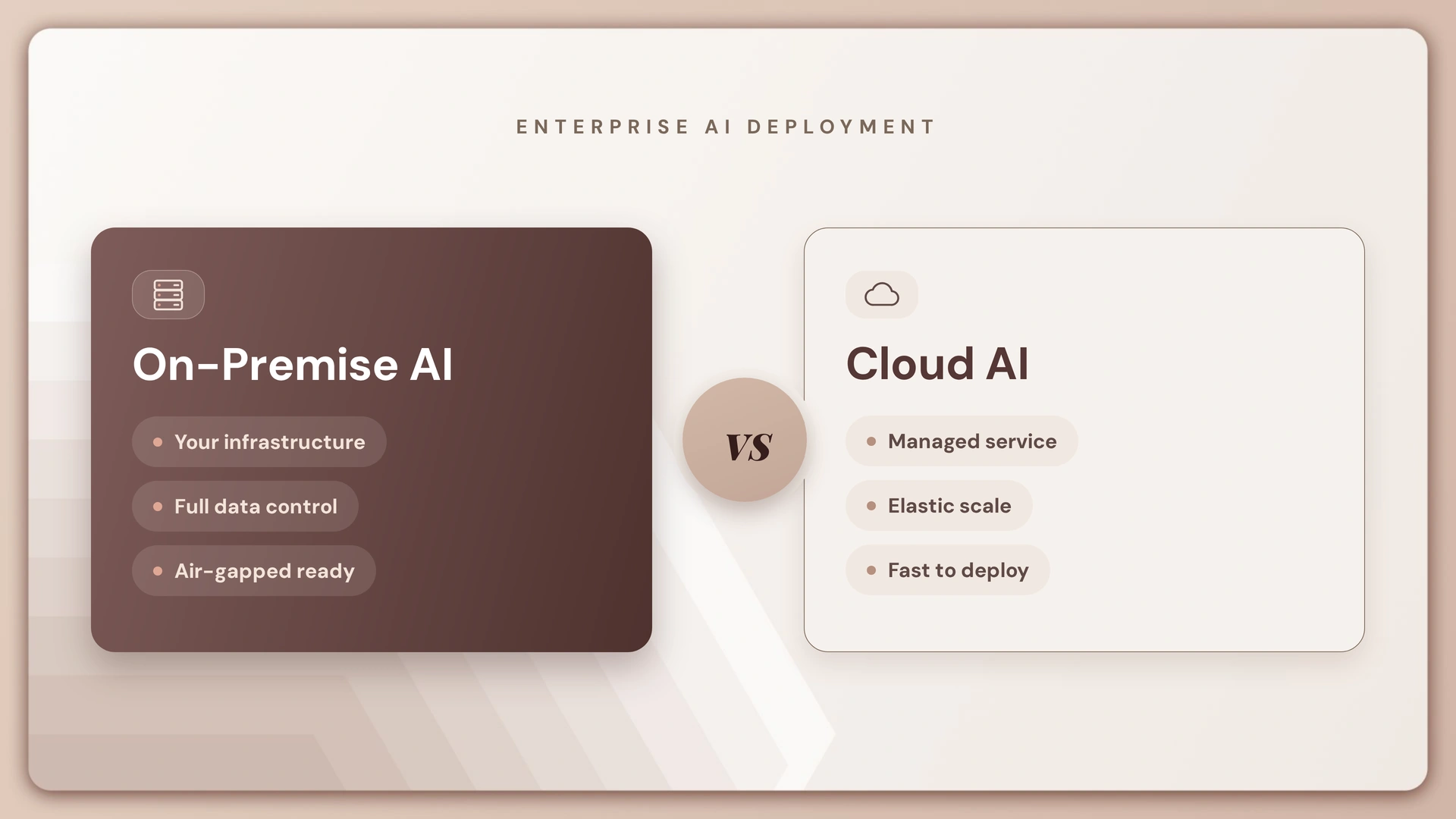
Yes, without requiring replacement of existing infrastructure. Leading platforms maintain SOC 2 Type II, PCI-DSS, and GDPR compliance, with architecture designed to support AML/KYC frameworks across jurisdictions. The practical approach is to build an orchestration layer above your existing systems, connecting agents to data sources through secure API integrations. Lyzr’s platform offers native connectors for major core banking and ERP systems, with on-premise and private cloud deployment options that ensure sensitive data never leaves your controlled environment.
What does the regulatory environment look like for AI agents in banking in 2026?
Regulation is tightening, but unevenly across jurisdictions. On April 17, 2026, the Federal Reserve, OCC, and FDIC issued revised interagency model risk management guidance designated SR 26-2, which superseded the long-standing SR 11-7. The guidance states that generative and agentic AI are outside its formal scope, while signaling plans to issue a request for information addressing banks’ use of AI. In Europe, the EU AI Act’s high-risk deadline of August 2, 2026, mandates that high-risk AI systems in the financial sector comply with specific requirements for transparency, traceability, and human oversight. This means AI compliance will be assessed alongside capital adequacy, liquidity risk, and operational resilience – not as a separate silo.
How long does it take to deploy a production-ready AI agent in banking?
For well-scoped use cases with pre-built integrations to core banking, CRM, and risk systems, production deployment is achievable in as little as four weeks. More complex multi-agent implementations spanning compliance, operations, and analytics simultaneously typically take eight to twelve weeks. Lyzr’s pre-built banking blueprints are designed to compress that timeline significantly, with agents deployable without writing code and a Forward Deployment Engineer assigned to guide the production path.
What ROI can banks expect from AI agent deployments?
Organizations can achieve an average 2.3x return on agentic AI investments within 13 months, with ROI expected to grow as adoption of AI scales. In specific banking functions, the returns are more dramatic: KYC processing time reductions of up to 90%, AML investigation time cut by 50% per case, and loan origination cycles compressed by 40-60% or more. Banks using Lyzr’s Agent Amadeo have reported up to 300% ROI, 50% faster processing times, and up to 95% time savings on manual workflows like KYC, underwriting, and regulatory documentation.
The Infrastructure Decision That Defines the Next Five Years
The banks that will lead in 2030 are making a specific infrastructure decision right now. Not which LLM to use. Not which use case to pilot. The decision is whether to build an agentic operating layer – the orchestration, governance, and integration infrastructure that makes autonomous agents viable in a regulated environment – or to keep treating AI as a collection of point tools.
The headline shift of 2026 is from experimentation to governed deployment, and a clear gap is emerging between the market leaders, the chasing pack, and the laggards. Banks are concentrating on procedural, auditable work, including financial-crime detection, regulatory-change triage, controls testing, and continuous transaction monitoring, with deployments emphasizing governed environments where every agent decision is traceable and a human approves outputs. The gap is not about which banks have the most advanced models. It is about which banks have the infrastructure to deploy those models in workflows that matter, at the speed that the market demands, with the governance that regulators require.
That infrastructure exists today. The question is whether your institution builds it now, while the first-mover advantage is still available – or waits until the gap is too wide to close.
Talk to a Lyzr strategist. Get a custom banking AI architecture review in 48 hours.
Abstract visualization of the agentic banking future – network of interconnected AI agents handling compliance, lending, and operations flows across a modern financial institution, with warm earth tones and a human oversight layer illustrated above – lyzr enterprise banking AIBook A Demo: Click Here
Join our Slack: Click Here
Link to our GitHub: Click Here