AI agents are no longer experimental projects sitting inside innovation teams. They are becoming part of everyday business operations.
Sales teams use agents to research accounts. Support teams use them to resolve customer issues. Finance teams rely on them for reconciliation and reporting. Engineering teams use them to review code, analyze logs, and automate workflows.
As adoption grows, a new challenge emerges.
Organizations can quickly answer questions like:
- How many applications are running in production?
- Who owns a particular database?
- Which cloud resources are connected to sensitive systems?
But many struggle to answer a much simpler question: How many AI agents are currently operating across the organization?
And if that answer is unclear, the next set of questions become even harder.
Who owns those agents? What data can they access? Which versions are approved for production? Are multiple teams building the same agent without realizing it?
This is the problem that an AI Agent Registry is designed to solve.
It is also the first thing analysts now tell CIOs to build. Gartner’s April 2026 guidance on agent sprawl lists a centralized agent inventory, including shadow agents, as step two of six, right after setting policy. Gartner also expects the average Fortune 500 enterprise to go from fewer than 15 agents in 2025 to more than 150,000 by 2028. You cannot govern, secure, or reuse what you have not registered.
What Is an AI Agent Registry?
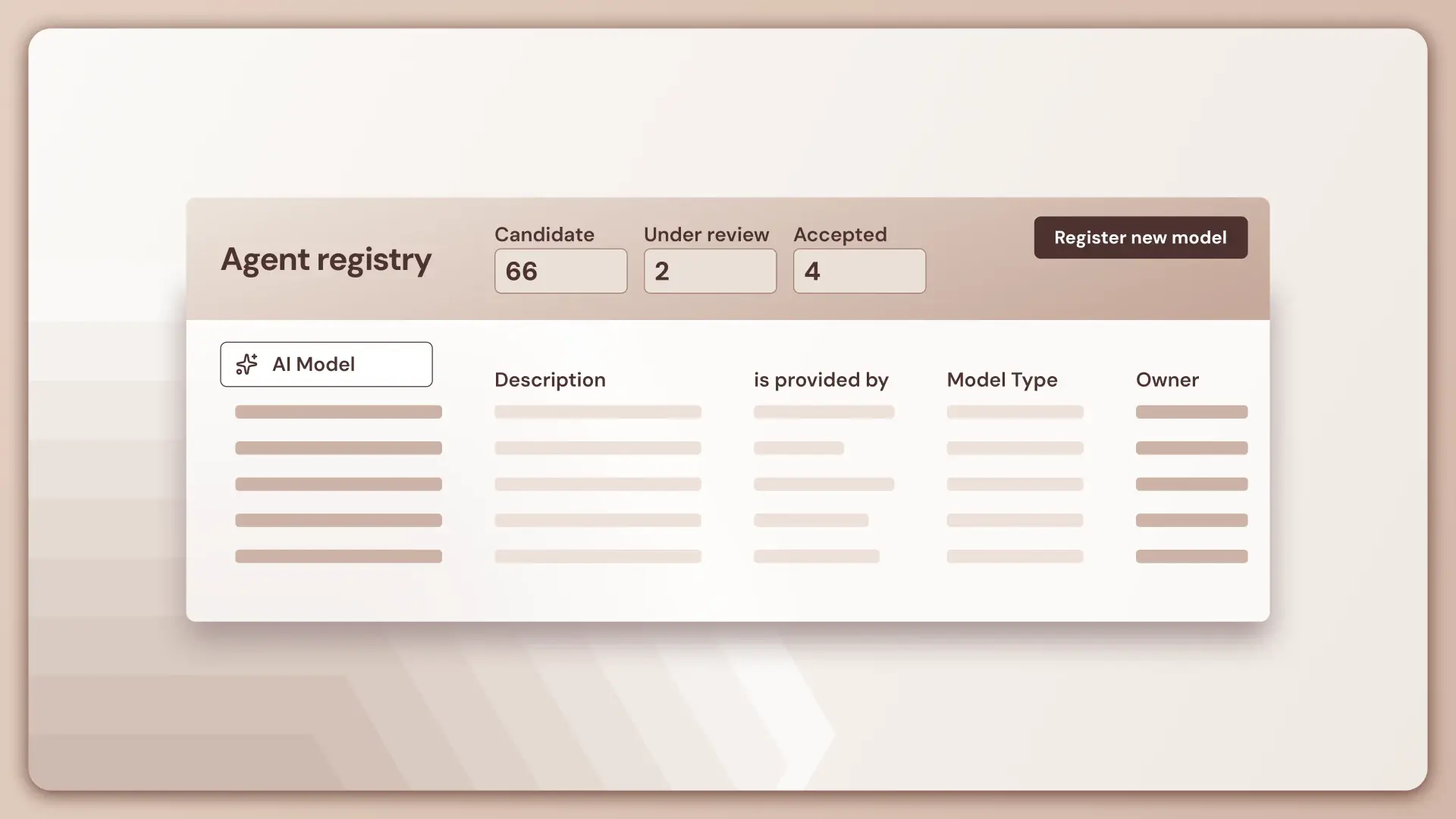
An AI Agent Registry is a centralized repository that catalogs, tracks, governs, and manages AI agents across an organization.

Think of it as the system of record for AI agents.
Instead of agents being scattered across cloud environments, repositories, business units, and development teams, the registry creates a single place where organizations can understand their entire AI agent ecosystem.
Every registered agent includes information such as:
- Purpose and business function
- Ownership and accountability
- Deployment status
- Version history
- Access permissions
- Connected systems
- Governance and compliance approvals
The goal is simple: provide complete visibility into every AI agent operating within the enterprise.
AI Agent Registry vs AI Agent Marketplace
The terms are sometimes used interchangeably, but they serve different purposes.
| AI Agent Registry | AI Agent Marketplace |
| Focuses on governance and management | Focuses on discovery and distribution |
| Tracks ownership and compliance | Highlights available agents |
| Supports lifecycle management | Supports adoption and usage |
| Designed for operational control | Designed for accessibility |
Many organizations eventually use both, with the registry serving as the source of truth behind the marketplace experience.
Why AI Agent Registries Will Become Core Enterprise Infrastructure
Every major technology shift creates a new management layer. Virtual machines required hypervisors. Containers required orchestration platforms.
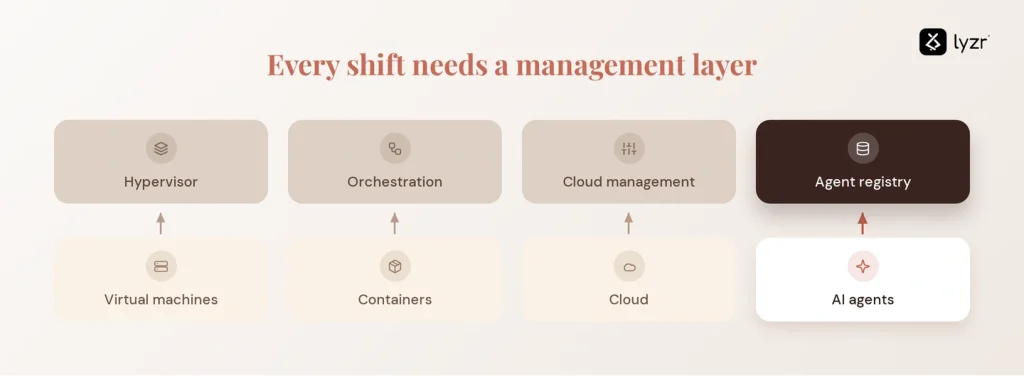
Cloud environments required cloud management systems.
AI agents are creating a similar need.
As organizations move toward hundreds or thousands of autonomous systems operating across departments, a centralized system for visibility, governance, and lifecycle management becomes essential.
An AI Agent Registry fills that role.
It provides the foundation for understanding what agents exist, what they do, who owns them, and how they interact with the rest of the enterprise technology stack.
Without that foundation, scaling AI agents becomes increasingly difficult.
The goal is simple: provide complete visibility into every AI agent operating within the enterprise.
What a good registry entry looks like
A registry is only as useful as the fields it enforces. The minimum set that lets you answer an auditor, a security reviewer and a product team with the same record:
| Field | Example | Who uses it |
| Agent ID and name | dispute-resolver-v2.3 | Everyone |
| Named human owner | One person, not “the marketing team” | Security, compliance |
| Business function / use case | Card dispute triage, BFSI | Product teams searching for reuse |
| Framework and runtime | LangGraph on AWS Bedrock AgentCore | Platform engineering |
| Environment and status | Production · live / non-prod · evaluating / retired | Operations |
| Version and commit | v2.3 · a71a73d | Incident response, rollback |
| Identity | Dedicated Okta identity, scoped | Security |
| Access scope | Systems and data the agent can reach | Security, compliance |
| Evaluation results | RAI, hallucination, relevance, date last run | Compliance, QA |
| Approvals | Who approved, when | Audit |
| Risk classification | High / medium / low, with rationale | Governance |
| Connected systems and knowledge sources | CRM, ticketing, KB version | Operations, data governance |
Most fields above should be populated by the deployment pipeline, not typed in by hand. A registry that depends on people remembering to update it is a spreadsheet with a better name.
The Growing Problem of AI Agent Sprawl
The conversation around AI agents often focuses on building them. Much less attention is given to managing them once they enter production.
This creates a challenge similar to what organizations experienced during the rise of SaaS applications.
Initially, every new application solved a specific business problem. Over time, teams purchased software independently, creating overlapping capabilities, fragmented ownership, and governance challenges.
AI agents are following a similar path.
Without a centralized registry, organizations frequently encounter issues such as:
| Challenge | Impact |
| Duplicate agents performing similar tasks | Wasted development effort |
| Unclear ownership | Slower issue resolution |
| Outdated agent versions | Inconsistent outputs |
| Excessive permissions | Increased security risk |
| Lack of audit trails | Compliance concerns |
| Limited discoverability | Reduced agent reuse |
What begins as innovation can quickly become operational complexity.
Why Traditional Asset Management Systems Are Not Enough
At first glance, it might seem like existing application inventories or service catalogs can solve this problem.
In practice, AI agents introduce entirely new management requirements.
Unlike traditional software, AI agents are dynamic systems.
They interact with multiple applications, access enterprise data, execute workflows, maintain memory, and make decisions based on changing inputs.
As a result, organizations need visibility beyond standard infrastructure metadata.
For example, an AI Agent Registry may track:
| Registry Attribute | Why It Matters |
| Underlying model | Understand dependencies and performance |
| Prompt versions | Track behavioral changes |
| Knowledge sources | Verify information origins |
| Connected applications | Assess operational impact |
| Access permissions | Strengthen security controls |
| Agent owner | Establish accountability |
| Risk classification | Support governance requirements |
| Deployment history | Monitor production changes |
This level of visibility is difficult to achieve through traditional asset management systems.
The Role of an AI Agent Registry in Enterprise Governance
Enterprise AI initiatives often succeed or fail based on governance.
Building an agent is relatively straightforward. Managing hundreds of agents operating across departments is considerably more challenging.
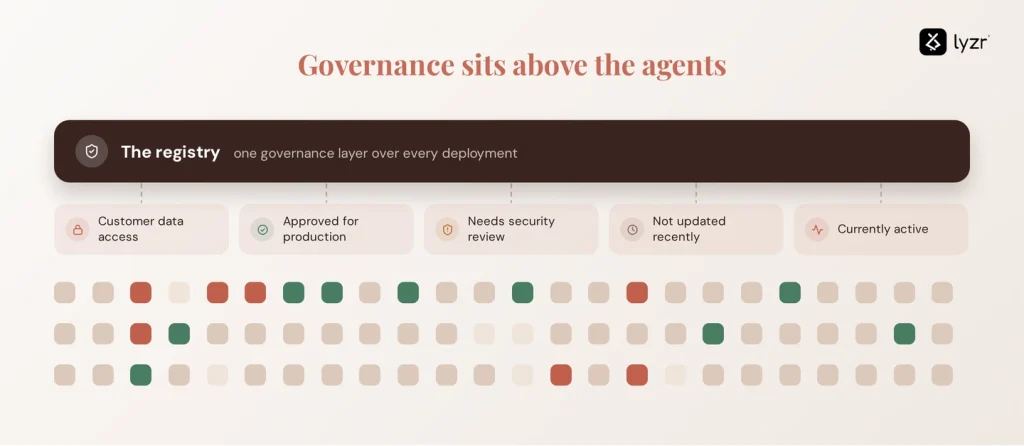
An AI Agent Registry creates a governance layer that sits above the agents themselves.
Instead of treating agents as isolated deployments, organizations can manage them as part of a broader ecosystem.
This allows teams to answer critical questions such as:
- Which agents access customer data?
- Which agents are approved for production use?
- Which agents require security review?
- Which agents have not been updated recently?
- Which agents are currently active?
The ability to answer these questions becomes increasingly important as AI adoption scales.
A Practical Example of Why AI Agent Registries Matter
Consider a company that has deployed several hundred AI agents across sales, support, operations, and engineering teams.
A product team decides to build an agent for customer onboarding.
Before development begins, the team searches the AI Agent Registry.
The search reveals:
- An onboarding agent already exists.
- The agent has been approved by compliance.
- Multiple business units actively use it.
- The latest version includes integrations the team needs.
Instead of creating another standalone solution, the team extends the existing agent.
The result is faster deployment, reduced duplication, and greater consistency across the organization.
This is one of the most valuable outcomes of an AI Agent Registry: turning AI development from isolated efforts into reusable organizational assets.
How to Build an AI Agent Registry (Even Before You Buy Anything)
- Discover first. Email every department head and your SaaS admins for a list of every AI agent and vendor AI feature in use. Frame it as inventory, not audit, so people disclose. Include IDE assistants and agency-built agents.
- Fix the schema. Use the twelve fields above. Resist adding more until the first twelve are reliably populated.
- Name one owner per agent. A person, not a team.
- Classify risk by autonomy and blast radius. What can the agent do without a human seeing it? If it is wrong, what breaks?
- Make registration a deployment prerequisite. Even manually: no registry entry, no production credentials. Then automate it in the pipeline.
- Tie identity to the entry. One identity per agent, no shared service accounts.
- Review on a cadence. Quarterly: is the owner still the owner, is the scope still accurate, when was it last evaluated, should it be retired?
Steps 1–4 are a spreadsheet and a quarter of effort. Steps 5–7 are where a control plane earns its keep.
What a Registry Looks Like Once It’s Built
The concept is straightforward. The implementation is where most organizations get stuck, building a registry as a standalone project rather than as a byproduct of how agents actually get deployed.
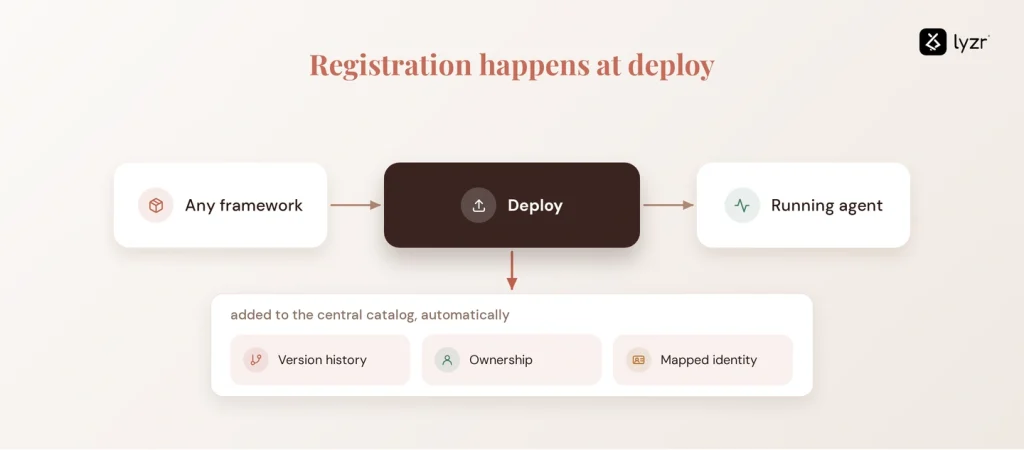
Lyzr’s approach embeds the registry directly into the deployment pipeline: every agent, regardless of the framework it was built on, is added to a central catalog automatically the moment it’s deployed, complete with version history, ownership, and a mapped identity. Lyzr Agent Control Plane: The Vercel for AI Agents walks through exactly how that registration happens as part of the deployment process itself, rather than as a compliance exercise bolted on afterward.
What Makes an AI Agent Registry Actually Stay Accurate?
The single design decision that separates registries that work from registries that rot: is registration a prerequisite for deployment, or a form someone is supposed to fill in afterward?
If it is a form, the registry is complete for about six weeks. If it is a gate, it is complete by construction, because the pipeline that deploys the agent is the same pipeline that registers it.
The registry is also what an auditor sees first. “Something accessed our CRM at 2pm” becomes “Agent dispute-resolver-v2.3, owned by X, accessed Y at 14:32, running version a71a73d, which passed RAI and hallucination evaluation on this date.”
This is how the Lyzr Agent Control Plane handles it:
- Every agent, from any framework (LangGraph, CrewAI, Strands, Agentforce, custom code), is registered automatically as part of deployment. Unregistered agents cannot deploy.
- There are two registries, non-prod and production, and an agent appears in the production registry only after it has cleared the evaluation gate and received named approval.
- Registration is tied to identity: on registration the agent receives its own Okta identity, scoped to the environment. When the agent is retired or fails evaluation, the registry entry and the identity are cleaned up together.
- Every entry carries owner, version, framework, target runtime, deployment status and full version lineage, and is searchable by team, function or use case, which is what stops three teams building the same agent.
Final Thoughts
The future of enterprise AI is not defined by a handful of agents running isolated workflows. It is defined by large ecosystems of interconnected agents working across business functions.
As those ecosystems grow, visibility becomes just as important as innovation.
An AI Agent Registry provides the structure needed to manage AI agents at scale. It helps organizations improve governance, reduce duplication, strengthen security, and create a reliable system of record for their AI operations.
If you are earlier in the journey, start with how agent sprawl happens quarter by quarter and the Sprawl Audit. If you already have a dozen agents on three frameworks, the next read is what a control plane as a service actually does.
Building agents may be the first step in an AI strategy.
Knowing how to manage them is what determines whether that strategy can scale.
Frequently Asked Questions
A centralized system of record that catalogs every AI agent an organization runs, with its purpose, named owner, framework, runtime, version, access scope, evaluation results and approval status. It is the inventory that governance, security and reuse all depend on.
At minimum: agent ID, owner, business function, framework and runtime, environment and status, version and commit, identity, access scope, evaluation results, approvals, risk classification, and connected systems. The pipeline should populate most of these automatically.
No. A CMDB tracks servers, applications and licenses. An agent registry tracks things a CMDB cannot see: the model, prompt version, knowledge sources, autonomy level, evaluation history and the human accountable for behavior. They complement each other.
A registry is for governance and control (ownership, compliance, lifecycle). A marketplace is for discovery and adoption (browse, try, reuse). Most enterprises run both, with the registry as the source of truth behind the marketplace.
Discover every agent and vendor AI feature, fix a twelve-field schema, assign one owner per agent, classify by risk, make registration a prerequisite for deployment, tie each agent to its own identity, and review quarterly. Beyond a dozen agents, automate registration inside the deployment pipeline.
No. Protocol-level registries (A2A agent cards, MCP server registries) let agents and tools discover each other at runtime. An enterprise agent registry is a governance record for humans and auditors. A control plane can use both; the governance registry is the one that answers “who owns this and was it approved?”
The Act does not use the word “registry”, but its high-risk obligations (now due December 2027) require documentation, logging, human oversight and traceability that are impractical without one. ISO/IEC 42001 similarly expects an AI system inventory. A registry is how you produce that evidence on demand.
Book A Demo: Click Here
Join our Slack: Click Here
Link to our GitHub: Click Here