Over the last two years, enterprise AI has moved from experimentation to expectation.
What started as isolated pilots, chatbots, copilots, internal assistants, has now become a business priority.
But scaling AI inside an enterprise is not just a technology challenge.
It comes down to execution:
- Who defines the use case
- Who integrates into existing systems
- Who ensures governance and reliability
- Who owns deployment across teams
No single company handles all of this alone.
That’s why leading enterprises are not just adopting AI, they are aligning with partner ecosystems that can execute end-to-end.
What This Report Covers
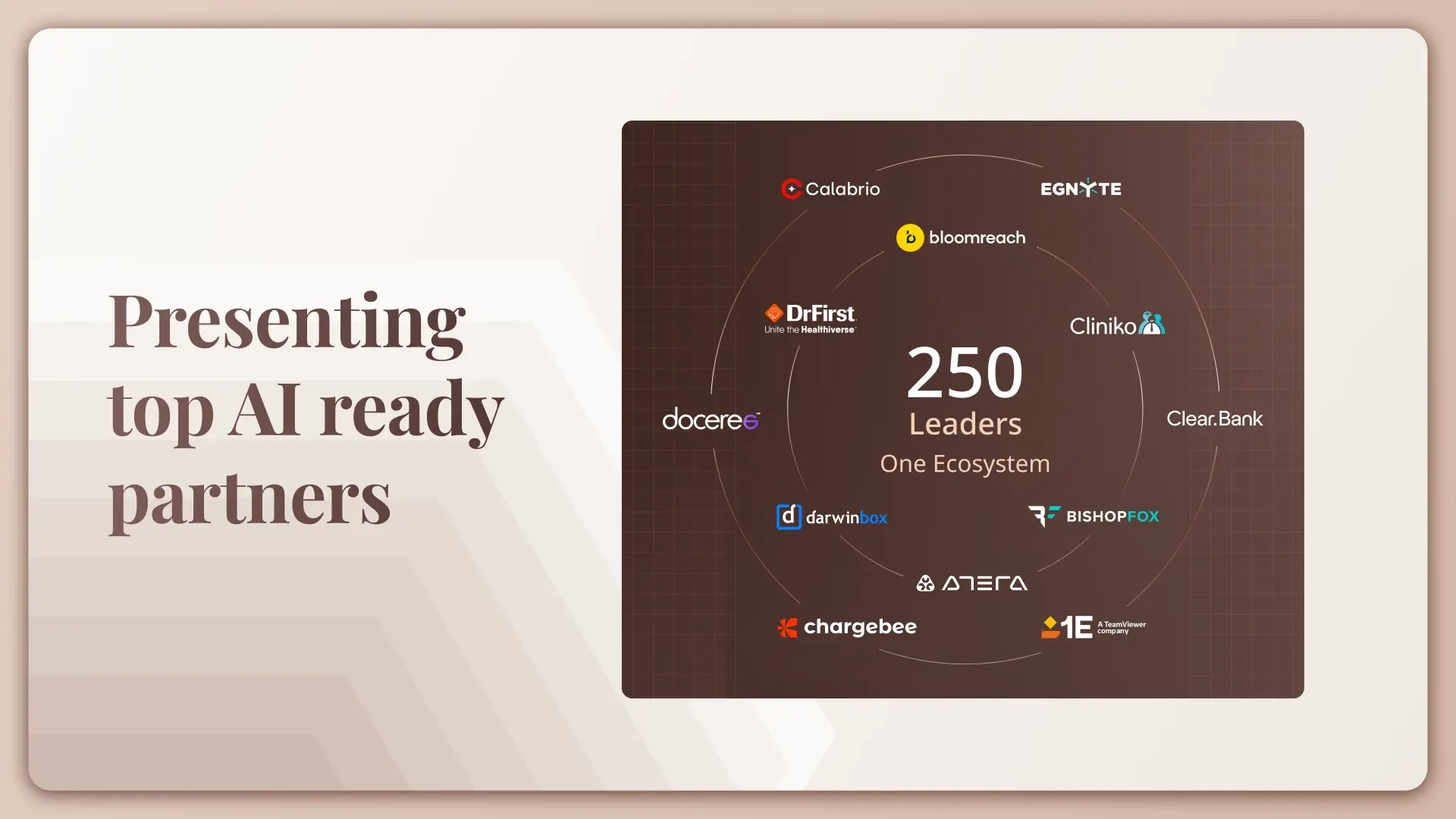
This report breaks down the Lyzr partner ecosystem as a system of execution, not just a directory.
Inside this report
- How the ecosystem is structured
- Types of partners involved
- Industry-wise categorization
- Why these partners exist in the ecosystem
- What this reveals about enterprise AI adoption

The Shift: From AI Platforms to Execution Networks
Most platforms focus on features. But enterprise AI success depends on execution layers. Lyzr operates as an infrastructure layer, while partners handle execution.
Traditional Model vs Ecosystem Model
| Traditional AI Adoption | Ecosystem-Led Adoption |
| Buy software | Deploy solutions |
| Internal experimentation | Partner-led execution |
| Siloed teams | Cross-functional rollout |
| Slow time-to-value | Faster deployment cycles |
Industry-wise Bifurcation of the Partner Ecosystem
The ecosystem can be understood by the role each partner plays.
Healthcare
| Company | Website |
|---|---|
| Aledade | https://aledade.com |
| Arcadia | https://arcadia.com |
| Axuall | https://axuall.com |
| Bamboo Health | https://bamboohealth.com |
| Cedar | https://cedar.com |
| CipherHealth | https://cipherhealth.com |
| Clarify Health | https://clarifyhealth.com |
| Cliniko | https://cliniko.com |
| Datavant | https://datavant.com |
| Doceree | https://doceree.com |
| Dozee | https://dozee.io |
| DrFirst | https://drfirst.com |
| ekincare | https://ekincare.com |
| Elation Health | https://elationhealth.com |
| Experity | https://experityhealth.com |
| Flatiron Health | https://flatironhealth.com |
| Greenway Health | https://greenwayhealth.com |
| Healthplix | https://healthplix.com |
| HealthStream | https://healthstream.com |
| Hinge Health | https://hingehealth.com |
| Huma Therapeutics | https://huma.com |
| Komodo Health | https://komodohealth.com |
| Kyruus Health | https://kyruushealth.com |
| Lumeris | https://lumeris.com |
| MedBridge | https://medbridge.com |
| Medikabazaar | https://medikabazaar.com |
| Niramai Health | https://niramai.com |
| Practo | https://practo.com |
| SigTuple | https://sigtuple.com |
| Thyrocare | https://thyrocare.com |
BFSI
| Company | Website |
|---|---|
| Alloy | https://alloy.com |
| Array | https://array.com |
| Bankable | https://bnkbl.com |
| Blend Labs | https://blend.com |
| ClearBank | https://clear.bank |
| Coalition Insurance | https://coalitioninc.com |
| ComplyAdvantage | https://complyadvantage.com |
| DriveWealth | https://drivewealth.com |
| Form3 | https://form3.tech |
| Galileo Financial | https://galileo-ft.com |
| Glia | https://glia.com |
| i2c Inc. | https://i2cinc.com |
| Jumio | https://jumio.com |
| Lendingkart | https://lendingkart.com |
| LoanPro | https://loanpro.io |
| Mambu | https://mambu.com |
| Modulr | https://modulrfinance.com |
| MX Technologies | https://mx.com |
| Nymbus | https://nymbus.com |
| OakNorth | https://oaknorth.com |
| Ocrolus | https://ocrolus.com |
| Open Financial | https://open.money |
| Paymob | https://paymob.com |
| Perfios | https://perfios.com |
| Provenir | https://provenir.com |
| Setu | https://setu.co |
| Signzy | https://signzy.com |
| Solarisbank | https://solarisgroup.com |
| TrueLayer | https://truelayer.com |
| Zeta | https://zeta.tech |
Consulting
| Company | Website |
|---|---|
| AArete | https://aarete.com |
| AND Digital | https://and.digital |
| Anunta Tech | https://anuntatech.com |
| Chartis Group | https://chartis.com |
| Clarkston Consulting | https://clarkstonconsulting.com |
| Cprime | https://cprime.com |
| Credera | https://credera.com |
| Dalberg Group | https://dalberg.com |
| Detecon | https://detecon.com |
| DHR Global | https://dhrglobal.com |
| Efficio Consulting | https://efficioconsulting.com |
| Elixirr | https://elixirr.com |
| Gate One | https://gateone.com |
| Impact Advisors | https://impact-advisors.com |
| Jade Global | https://jadeglobal.com |
| Kellton Tech | https://kellton.com |
| Nous Group | https://nousgroup.com |
| Pariveda Solutions | https://pariveda.com |
| Projective Group | https://projectivegroup.com |
| Quinnox | https://quinnox.com |
| Roboyo | https://roboyo.global |
| Sagentia | https://sagentia.com |
| Tenthpin | https://tenthpin.com |
| Trigent Software | https://trigent.com |
| Verinext | https://verinext.com |
SaaS / Tech
| Company | Website |
|---|---|
| Docker | https://docker.com |
| Fivetran | https://fivetran.com |
| Chargebee | https://chargebee.com |
| CleverTap | https://clevertap.com |
| Darwinbox | https://darwinbox.com |
| Druva | https://druva.com |
| Egnyte | https://egnyte.com |
| Exabeam | https://exabeam.com |
| Facilio | https://facilio.com |
| Freshworks | https://freshworks.com |
| Gainsight | https://gainsight.com |
| Highspot | https://highspot.com |
| Iterable | https://iterable.com |
| Juspay | https://juspay.in |
| Lattice | https://lattice.com |
| LaunchDarkly | https://launchdarkly.com |
| MoEngage | https://moengage.com |
| Netcore Cloud | https://netcorecloud.com |
| Nylas | https://nylas.com |
| Pendo | https://pendo.io |
| Postman | https://postman.com |
| Sentry | https://sentry.io |
| Whatfix | https://whatfix.com |
| WebEngage | https://webengage.com |
| Zylo | https://zylo.com |
1. Implementation & System Integration Partners
These partners sit closest to enterprise execution.
What they do
- Design AI use cases
- Integrate into CRM, ERP, internal systems
- Handle deployment and scaling
Why they matter
AI doesn’t fail at ideas—it fails at integration.
2. AI & Data Consulting Firms
These partners operate at the strategy layer.
What they do
- Identify high-impact use cases
- Map business problems to AI solutions
- Define governance and compliance
Why they matter
Without the right use case, AI remains unused.
3. Cloud & Infrastructure Partners
These partners ensure systems run reliably.
What they do
- Manage cloud environments
- Optimize infrastructure for AI workloads
- Ensure security and scalability
Why they matter
Enterprise AI requires production-grade environments—not experiments.
4. Product & Engineering-Led Firms
These partners build on top of AI infrastructure.
What they do
- Develop vertical AI applications
- Create reusable frameworks
- Package solutions for deployment
Why they matter
They make AI repeatable, not one-off.
5. Reseller & GTM Partners
These partners focus on distribution.
What they do
- Expand market reach
- Drive sales pipelines
- Support go-to-market efforts
Why they matter
Adoption depends on reach, not just capability.
Snapshot: Partner Roles at a Glance
| Partner Type | Core Role | Business Impact |
| Implementation Partners | Integration & deployment | Faster execution |
| Consulting Firms | Strategy & use case design | Better alignment |
| Cloud Partners | Infrastructure & scaling | Reliability |
| Product Firms | Build solutions | Repeatability |
| GTM Partners | Distribution | Market expansion |
What Connects These Partners
Despite differences, clear patterns emerge.
Common Traits Across the Ecosystem
| Pattern | What It Means |
| Close to enterprise workflows | Already embedded in business systems |
| Focus on use cases | Solving real problems, not demos |
| Speed-driven execution | Faster deployment cycles |
| Co-build approach | Shared ownership with Lyzr |
Why These Partners Are Part of the Ecosystem
The ecosystem is not random.
Each partner joins for clear, practical reasons.
Value Exchange Model
| What Partners Get | What Lyzr Enables |
| AI infrastructure | Ready-to-deploy agent frameworks |
| Faster GTM | Pre-built modules and support |
| New revenue streams | Enterprise-grade solutions |
| Technical enablement | Training and certifications |
| Co-selling opportunities | Shared pipeline and growth |
Key Drivers
1. Access to ready infrastructure: No need to build AI systems from scratch
2. Faster deployment cycles: Reduced time from idea to execution
3. Revenue expansion: AI becomes a new service line
4. Capability building: Partners scale alongside demand
What This Reveals About Enterprise AI Adoption
Looking at the ecosystem reveals deeper trends.
1. AI Adoption Is Distributed
Different teams across the enterprise need AI:
- Sales
- Operations
- Customer support
- Finance
This creates demand for multiple specialized implementations.
2. Execution Is the Differentiator
Most companies have access to AI models.
The difference lies in:
| Factor | Impact |
| Deployment speed | Faster ROI |
| Integration quality | Better adoption |
| Scalability | Long-term success |
3. Ecosystems Are Becoming the Moat
Just like cloud ecosystems defined earlier leaders, AI ecosystems will define the next wave.
Winning companies will have:
- Strong partner networks
- Repeatable deployment models
- Industry-specific solutions
How the Ecosystem Works (Simple View)
Lyzr → Provides AI infrastructure
Partners → Build + Deploy solutions
Enterprises → Consume outcomes
This model shifts AI from capability → execution.
Conclusion
The Lyzr partner ecosystem is not just a list of companies.
It reflects how enterprise AI is actually being adopted.
Instead of isolated tools, what’s emerging is a collaborative execution model.
What this ecosystem represents
- Operators bringing AI into workflows
- Consultants shaping strategy
- Engineers deploying systems
- Partners expanding reach
Together, they turn AI from potential into production.
Book A Demo: Click Here
Join our Slack: Click Here
Link to our GitHub: Click Here