There is a quiet reckoning happening inside the boardrooms of regulated enterprises. It rarely makes headlines, but it is reshaping vendor decisions, infrastructure commitments, and the AI architectures that financial institutions, government agencies, insurance carriers, and healthcare systems are building around.
The trigger is usually one of three moments.
A new data localisation law lands in a target jurisdiction, and someone has to map every AI workflow to where its data actually goes. A security audit reveals that customer queries, employee data, or citizen records are being processed on infrastructure the organisation does not own. A regulator asks a question no one has a clean answer to: where exactly is your data when your AI model thinks?
That question used to be rare. In 2026, it is everywhere. And most organisations are not fully prepared for what it means.
The buyers we work with at Lyzr (CTOs, CISOs, and Heads of AI at $1B+ regulated enterprises in banking, insurance, government, and healthcare) tell us the same story. They want the productivity gains from generative AI and AI agents. They cannot put their data into public-cloud SaaS AI. What they need is a different architecture entirely: AI infrastructure that runs inside their own perimeter, processes data in their own jurisdiction, maintains audit trails their regulators will accept, and gives them the freedom to switch models without rebuilding their stack.
That architecture has a name. It is called sovereign AI, and it is the most important infrastructure conversation senior technical leaders in regulated industries are having right now.
What is sovereign AI?
Sovereign AI is the practice of building, deploying, and governing AI systems entirely within an organisation’s own infrastructure, data perimeter, and legal jurisdiction. The defining property is control: control over where data resides, control over what models run on which workloads, control over who can access the system, control over the audit record of every decision the system makes.
Three distinctions matter, because the terminology gets muddled in vendor marketing.
Data sovereignty is about where data is stored, processed, and which jurisdiction governs it. It is a property of data, not of AI systems. You can have data sovereignty without sovereign AI.
Sovereign cloud is about cloud infrastructure that meets local jurisdictional and regulatory requirements. It is a property of compute, storage, and network infrastructure. You can run on a sovereign cloud and still not have sovereign AI.
Sovereign AI is the layer above both. It is the capacity to run the entire AI lifecycle (from data ingestion through model selection, inference, and the actions that AI agents take based on those inferences) inside controlled boundaries that the organisation owns. McKinsey makes this distinction clearly: data sovereignty is the foundation, but sovereign AI is the intelligence layer built on top.
For regulated industries, this distinction is operational, not philosophical. You can satisfy GDPR data residency requirements (data sovereignty) while still routing AI queries to external LLM providers whose decisions you cannot audit (no sovereign AI). The first half passes the audit. The second half does not.
Why sovereign AI matters now for regulated industries
The case for sovereign AI used to be mostly theoretical. In 2026 it is becoming mandatory across four geographies and four industry verticals at the same time. Here is the regulatory landscape every senior technical leader in BFSI, insurance, government, and healthcare needs to track.

United States
For US-headquartered regulated enterprises, the relevant overlay includes:
- HIPAA for healthcare entities and business associates, with specific implications for AI systems that process protected health information
- GLBA (Gramm-Leach-Bliley Act) for financial institutions handling consumer financial information
- SOX for public companies, with AI-driven financial controls increasingly under audit scope
- OCC and Federal Reserve guidance on model risk management (the SR 11-7 framework that now extends to AI/ML models)
- FedRAMP and FISMA for federal agencies and contractors
- NIST AI Risk Management Framework as the de facto baseline for federal and federally-regulated AI deployments
- State-level laws including California’s CCPA/CPRA, Colorado’s AI Act, and New York’s DFS guidance for financial services
The pattern: US regulators are treating AI systems as critical infrastructure subject to existing sectoral frameworks, with new AI-specific overlays accelerating.
United Kingdom
UK regulated enterprises operate under:
- UK GDPR for personal data residency and lawful basis requirements
- Bank of England, PRA, and FCA guidance on operational resilience and model risk management
- Sector-specific obligations under the FCA Consumer Duty for financial services and Care Quality Commission rules for healthcare
- DORA (Digital Operational Resilience Act) for in-scope financial entities operating across EU borders
Middle East
The Middle East regulatory landscape has tightened sharply since 2024:
- UAE PDPL (Personal Data Protection Law) and DIFC Data Protection Law for Dubai-based entities
- ADGM Data Protection Regulations for Abu Dhabi Global Market participants
- Saudi Arabia PDPL and the SAMA cybersecurity framework for KSA financial institutions
- CBUAE AI guidelines from the UAE Central Bank with specific implications for banking AI deployments
- Qatar Financial Centre AI guidelines for QFC participants
The regional pattern: data must remain in-region, audit trails must be available to local regulators in local language, and cross-border AI inference (sending queries to LLM providers hosted elsewhere) increasingly requires explicit regulator approval.
India
India’s regulatory landscape moved from advisory to mandatory in 2023-2025:
- DPDP Act (Digital Personal Data Protection Act 2023) with explicit data localisation provisions
- RBI guidance on AI/ML model risk management for banks and NBFCs
- IRDAI guidelines for AI use in insurance underwriting and claims
- SEBI regulations for AI in securities markets
- MeitY framework for responsible AI across government deployments
For Indian enterprises, the practical implication is that AI inference on regulated data (banking customer data, insurance claims data, healthcare records) increasingly cannot be routed to externally-hosted LLM APIs without explicit data protection officer approval and a documented compliance basis.
The pattern across all four geographies
Across the US, UK, Middle East, and India, three forces are converging:
- Data localisation requirements are tightening. What used to be guidance is becoming statute.
- Regulators are treating AI as critical infrastructure. The frameworks that govern financial systems, healthcare records, and government operations now extend to the AI systems that process those domains.
- The compliance cost of getting this wrong is no longer hypothetical. Enforcement actions, fines, and remediation orders are becoming visible across all four geographies.
This is why sovereign AI has moved from a future concern to a present constraint. Senior technical leaders who are designing AI architectures today need to design them assuming the regulatory environment that exists in 2026, not the one that existed in 2022.
For the broader context on why responsible AI practices are increasingly mandatory, see our blog on responsible AI.
The four pillars of sovereign AI
Across the major frameworks (McKinsey, NIST, Cisco, HPE, OpenText), the same four pillars show up. Different organisations name them slightly differently, but the substance is consistent. Any sovereign AI architecture has to address all four.
Infrastructure sovereignty. The compute, storage, and network infrastructure that runs the AI sits within the organisation’s controlled environment. In practice, this means on-premises deployment, private cloud, sovereign cloud, virtual private cloud, or air-gapped infrastructure. The defining test: can the organisation point to the physical or logical location where the AI inference is happening, and can it verify that location matches its regulatory obligations?
Data sovereignty. Data is processed, stored, and retained in jurisdictions and infrastructure that meet the organisation’s legal and regulatory requirements. This goes beyond storage residency. It includes training data provenance, inference data routing, model output logging, and the audit retention period that local regulations require.
Model sovereignty. The organisation has explicit control over which models handle which workloads, what data those models have access to, and how model behaviour is governed across deployments. Model sovereignty does not require the organisation to train its own models from scratch. It requires the organisation to know what each model can see and do, and to be able to switch models without rebuilding the surrounding architecture.
Operational sovereignty. The day-to-day operation of the AI system (who can access it, who can change its configuration, who can audit its behaviour) sits with the organisation, not with an external vendor. This is the pillar that most enterprise AI deployments fail on. It is also the pillar that becomes critical when AI agents are taking autonomous actions on the organisation’s behalf.
The trap most enterprises fall into: treating these pillars as theoretical. The organisations that operationalise sovereign AI well treat each pillar as a set of engineering requirements with measurable indicators and accountable owners. The ones that struggle treat them as a procurement checkbox.
The dependency nobody planned for
When regulated enterprises moved fast on AI adoption between 2023 and 2025, the priority was capability. Can this model do what the workflow needs? How quickly can it be integrated? What does the API cost?
What received less attention was control. AI workloads were handed off to external APIs. Sensitive queries left organisational boundaries and travelled to infrastructure owned by third parties, often in different jurisdictions. Decisions made by these models were opaque, with limited visibility into how outputs were generated or what data influenced them. This was an acceptable trade-off when AI was experimental. It becomes much harder to justify when AI is embedded in critical regulated workflows.
Here is what that looks like in practice, across the four industry verticals.
| Scenario | Industry | The hidden risk |
|---|---|---|
| A US bank routes loan assessment queries through an external AI API | BFSI | No verifiable record of decision logic for fair lending audit; cross-border data movement that may not meet OCC model risk management standards |
| A UK insurance carrier uses a hosted AI for claims triage | Insurance | Customer health data crossing borders; lack of audit trail for FCA Consumer Duty obligations |
| A Middle Eastern central bank uses a globally-hosted AI for regulatory analysis | BFSI / Government | Sensitive regulatory data leaving jurisdiction; potential violation of CBUAE data residency requirements |
| An Indian healthcare network uses an external chatbot for patient triage | Healthcare | Patient data leaving India under DPDP Act constraints; lack of audit trail for IRDAI/MoHFW oversight |
| A US federal agency uses a hosted LLM for internal document summarisation | Government | FedRAMP and FISMA exposure; potential disclosure of CUI to non-cleared infrastructure |
| A UK financial services firm uses external AI for ABM personalisation on regulated customer data | BFSI | UK GDPR violations; PRA model risk concerns |
| An Indian public sector bank uses external AI for KYC document processing | BFSI | RBI data localisation requirements; DPDP Act exposure |
| A Saudi insurance firm uses globally-hosted AI for underwriting | Insurance | SAMA cybersecurity framework violations; cross-border data movement risk |
None of these are edge cases. They reflect how AI adoption has actually happened across regulated industries: fast, useful, and quietly dependent on systems the organisation does not own or fully understand.
The cost of unwinding this dependency increases every quarter. Sovereign AI is the architectural pattern that prevents the dependency from forming in the first place.
What sovereign AI actually requires
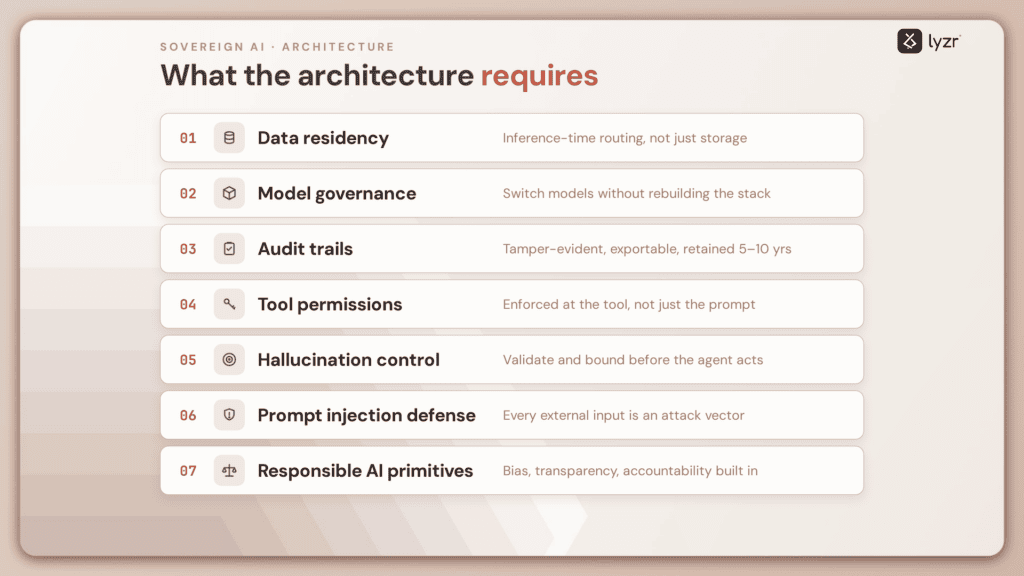
Beyond the four pillars, here is what implementing sovereign AI requires in practice. This is the depth that CTOs, CISOs, and Heads of AI need before making architectural commitments.
Data residency configuration
Every AI workflow needs explicit configuration for where data is processed. This is not the same as where it is stored. A query about a UK customer that gets routed to a US-hosted LLM for inference has moved across jurisdiction even if the database record stays in London. Sovereign AI requires inference-time residency, not just storage residency.
The implementation pattern: configurable routing rules that send sensitive queries to in-jurisdiction infrastructure (on-prem, private cloud, or sovereign cloud) and allow lower-sensitivity queries to use external models where the economics make sense.
Model governance and portability
The architecture must support running multiple models, switching between them without rebuilding integrations, and maintaining a clear record of which model handled which workload. The CTO buyer’s test: if your primary LLM provider changes their pricing, terms of service, or availability tomorrow, how long does it take to switch?
For organisations dependent on a single LLM provider with deep integrations, the answer is months. For organisations with model-agnostic architectures, it is hours. The difference is whether the architecture treats models as substitutable components or as foundational dependencies.
Audit trail architecture
Every AI action in a regulated context needs an audit trail that captures what was asked, what data was retrieved, which model handled the inference, what output was produced, and what action (if any) was taken on the basis of that output. This audit trail needs to be tamper-evident, exportable for regulator review, and retained for the period that local regulations require (typically 5 to 10 years depending on industry and jurisdiction).
For the technical architecture behind agent reasoning audit trails specifically, see how AI agent tracing works.
Tool and permission enforcement
When AI agents have access to tools (CRM systems, financial platforms, healthcare records, customer databases), the permission model on those tools becomes the actual boundary of what the agent can do. A poorly scoped agent with broad permissions is a regulatory incident waiting to happen. Sovereign AI requires permission enforcement at the tool level, not just the prompt level, with explicit escalation paths when the agent encounters situations outside its authority.
Hallucination control
In a regulated workflow, an AI hallucination becomes either a credibility issue (if the hallucination is surfaced to a human) or an operational incident (if the hallucination drives an agent action). Sovereign AI architectures need explicit hallucination bounds, with pre-action validation, confidence thresholds, and rollback capabilities. Lyzr’s Hallucination Manager is built specifically for this requirement.
Prompt injection defense
When an AI system processes external content (customer emails, third-party documents, web pages, partner API responses), every piece of that content is a potential injection vector. Lyzr’s research team published AgentDefender, a benchmark evaluation and neural embedding approach for detecting agent prompt injection attacks. For sovereign AI deployments in regulated industries, prompt injection defense is no longer optional. The full context lives in our prompt engineering pillar.
Responsible AI primitives
Bias monitoring, output validation, transparency mechanisms, and accountability structures all sit inside the sovereign AI architecture. They are not separate from it. Lyzr’s Responsible AI as a Service provides these primitives at the platform layer.
Sovereign AI for AI agents
Most of the sovereign AI conversation in the broader market is still focused on LLMs producing text, with humans taking the resulting actions. That framing is becoming out of date.
In 2026, the high-leverage AI deployments in regulated industries increasingly involve autonomous AI agents that take actions themselves. A KYC agent processes a customer’s documents and triggers an account opening. A claims agent evaluates an insurance claim and routes it to settlement. A regulatory monitoring agent reviews policy changes and updates internal compliance documentation. A clinical decision support agent reads patient records and surfaces recommendations to physicians.
This shift changes the sovereign AI calculus in five important ways.

1. The blast radius is larger. A chatbot producing a biased response affects one user. An agentic system processing 10,000 loan applications per day applies its decisions at scale, simultaneously. Sovereign AI for agents has to grapple with consequence multiplication that does not exist in single-turn chatbot deployments.
2. The audit trail becomes structural, not optional. When a human makes a regulated decision, the audit trail is the record of what they thought. When an agent makes the decision, the audit trail must capture the full reasoning chain: every tool the agent called, every piece of data it retrieved, every alternative path it considered, and the action it ultimately took. This is a regulatory requirement in BFSI and healthcare, and it is becoming one in insurance and government. For the technical architecture, see our agentic reasoning guide.
3. Permission enforcement has to be airtight. When an agent has access to enterprise tools, the security boundary moves from the prompt to the tool itself. The CISO question becomes: what can this agent access, what can it do with that access, and how is that bounded by the same identity and access management framework that governs human users?
4. Hallucination becomes operational risk, not just credibility risk. When a chatbot hallucinates, a user sees the wrong answer. When an agent hallucinates, the agent takes the wrong action based on the wrong belief. The Hallucination Manager is specifically built for the agent context, providing pre-action validation, confidence thresholds, and rollback capabilities.
5. Prompt injection moves from research problem to enterprise threat. When an agent processes external content, every input is a potential injection vector. The AgentDefender research Lyzr published addresses this directly, with a neural-embedding approach to detecting injection attempts before the agent acts on them.
The honest framing: sovereign AI for AI agents is a harder discipline than sovereign AI for chatbots. It requires deeper engineering, more architectural primitives, and more sophisticated governance. Most regulated enterprises have not built this competency yet. The ones that figure it out first will be the ones running AI agents at production scale in 2027 while their competitors are still running pilots.
For the production deployment perspective, see the playbook on how to take AI agents to production and the agent orchestration guide.
Sovereign AI by industry
The sovereign AI architecture is consistent, but the deployment patterns differ meaningfully by industry. Here is how the four target verticals are operationalising sovereign AI in 2026.

Banking and financial services
BFSI is the most demanding vertical for sovereign AI because the regulatory overlay is the densest. The deployment patterns we see across $1B+ regulated banks include:
- KYC and customer onboarding agents that process identity documents, run AML checks, and complete account opening within the bank’s perimeter. Lyzr’s KYC compliance agent and customer onboarding agent blueprints are the reference architecture
- Loan origination and servicing agents with explicit fair lending audit trails, satisfying OCC SR 11-7 model risk management requirements. See the AI loan origination agent and AI loan servicing agent blueprints
- Regulatory monitoring agents that track policy changes and update internal compliance documentation. See the regulatory monitoring agent blueprint
- AML and fraud detection agents running entirely on in-perimeter infrastructure. See the AML agent blueprint
For the full BFSI deployment context, see Lyzr’s banking agents overview, Amadeo (Lyzr’s banking AI agent), and the Banking Playbook. For dispute management specifically, see the BFSI guide to dispute management.
Insurance
Insurance deployments centre on claims, underwriting, and regulatory compliance:
- Claims processing agents that triage incoming claims, validate documentation, and route to appropriate handling. See the claims processing agent blueprint
- Policy underwriting support agents that assist human underwriters with risk evaluation while maintaining clear audit trails. See the policy underwriting support agent blueprint
- Regulatory compliance audit agents for IRDAI, FCA, NAIC, and SAMA reporting obligations. See the regulatory compliance audit agent blueprint
- Partner quality assurance agents for monitoring third-party claim handlers. See the partner quality assurance audit agent blueprint
- Litigation document extraction agents for legal-bound document review. See the document extraction for litigation agent blueprint
For the broader insurance context, see Lyzr’s insurance agents overview and Benjie (Lyzr’s insurance AI agent).
Government
Government sovereign AI deployments tend to span citizen services, document processing, and intelligence workflows. The defining requirements are FedRAMP authorisation (US), classified-environment compatibility, and air-gapped or sovereign-cloud deployment options. For the deployment overview, see Lyzr’s government deployments.
Healthcare
Healthcare deployments centre on HIPAA-bounded clinical decision support, patient record analysis, claims processing, and regulatory reporting. The architectural requirement is patient data residency combined with full audit trails that satisfy HIPAA, state medical board oversight, and (for global health systems) GDPR cross-border restrictions. For the deployment overview, see Lyzr’s healthcare agents.
The CTO, CISO, and Head of AI lens
Senior technical leaders evaluating sovereign AI architectures look at the same problem through three different lenses. Here is what each role specifically needs to verify before signing off on a sovereign AI deployment.
What the CTO evaluates
The CTO’s evaluation centres on architecture, deployment options, integration, and total cost.
- Deployment topology. Can the architecture deploy on-premises, in a private cloud, in a sovereign cloud, in a VPC, or air-gapped? Can different parts of the workload run in different topologies?
- Model portability. Can the architecture run multiple LLMs simultaneously, switch between them, and remain operational when any one model becomes unavailable?
- Integration patterns. How does the architecture connect to existing enterprise systems (core banking platforms, policy administration systems, EHR systems, government records systems)?
- Performance characteristics. What are the latency, throughput, and scaling profiles under realistic load?
- Total cost of ownership. What does the architecture cost over a three-to-five-year horizon compared to alternatives?
The Lyzr architecture addresses these through Lyzr Agent Studio (the core platform), Lyzr Architect (the no-code agent builder), and the modular Agents as a Service approach.
What the CISO evaluates
The CISO’s evaluation centres on security, identity, audit, and threat models.
- Security certifications. SOC 2 Type II, ISO 27001, FedRAMP authorisation status, industry-specific certifications (PCI DSS for payment data, HITRUST for healthcare).
- Identity and access management. How does the system integrate with existing IAM infrastructure? Can permissions be enforced at the user, agent, and tool levels?
- Audit trails. Are agent reasoning chains and action records exportable, tamper-evident, and retained for the required regulatory period?
- Encryption. At rest and in transit, with key management that the organisation controls.
- Threat model. How does the architecture defend against prompt injection, model extraction, data exfiltration, and adversarial agent manipulation?
The Lyzr architecture addresses these through Responsible AI as a Service, Hallucination Manager, and the AgentDefender prompt-injection defense framework.
What the Head of AI evaluates
The Head of AI’s evaluation centres on model governance, evaluation frameworks, lifecycle management, and AI talent enablement.
- Model governance. What is the framework for selecting, evaluating, and retiring models? How is model risk documented for regulatory review?
- Evaluation frameworks. What benchmarks does the platform support? How is model performance tracked over time, and how is drift detected?
- Lifecycle management. How are agents versioned, tested, deployed, and rolled back? What does the path from prototype to production look like?
- Responsible AI alignment. How does the platform ensure outputs align with the organisation’s ethical commitments and regulatory obligations?
- Talent enablement. How quickly can the organisation’s AI team become productive on the platform? What does the learning curve look like?
The Lyzr architecture addresses these through Agent Studio, Cognis (the persistent memory layer), Knowledge Graph, Knowledge Base, and Orchestration as a Service.
The gap in most enterprise AI stacks
Most enterprise AI deployments today were not designed for sovereign control. They were designed for capability and time-to-market, with sovereignty considerations added later (if at all). The common patterns:
- Built around a single model or provider. Switching costs are high; vendor leverage is built into the architecture from day one.
- Data flows outward by default. Inference requires sending data to externally-hosted infrastructure, often in different jurisdictions.
- Governance depends on contracts, not systems. The protection sits in the master service agreement, not in the technical architecture. When contracts change, the protection changes.
- Audit is reactive. When a regulator asks a question, the answer has to be reconstructed from logs that were not designed for audit purposes.
- Permission enforcement is at the application layer. When agents access tools, the boundary depends on application-level controls that often lack the granularity regulators expect.
- Hallucination control is best-effort. If it exists at all, it is implemented at the prompt level rather than at the architectural level.
This is the gap between what regulated enterprises now need (control, compliance, flexibility, auditability) and what their current AI systems were built to provide (speed, capability, integration).
Closing the gap requires architectural change, not policy change.
How Lyzr enables sovereign AI
The Lyzr platform is purpose-built for the sovereign AI use case in regulated industries. The architecture exposes five primitives that together constitute a sovereign AI deployment, all operating within the customer’s controlled environment.
1. The agent platform. Lyzr Agent Studio is the core platform where agents are designed, configured, tested, deployed, and versioned. Studio includes built-in support for tool-level permission enforcement, agent reasoning audit logging, and multi-model routing. For organisations that prefer no-code or low-code agent building, Lyzr Architect provides the visual interface on top of the same architectural primitives.
2. Memory. Cognis is the persistent memory layer with explicit data governance. Memory contents are stored, accessed, and retained according to configurable policies that align with the customer’s regulatory obligations. Memory governance is where most enterprise AI privacy incidents originate, and Cognis is designed for the regulated context.
3. Knowledge integration. Knowledge Base as a Service and Knowledge Graph as a Service ground agent reasoning in the customer’s own data. Every retrieved fact carries source attribution, so the audit trail captures not just what the agent said, but what it based its reasoning on.
4. Orchestration. Orchestration as a Service coordinates multi-agent workflows under unified governance. When responsibility is distributed across several specialised agents (research → analysis → drafting → review → approval), orchestration makes the responsibility traceable end-to-end.
5. Governance. The trust layer includes Responsible AI as a Service, Hallucination Manager, and the AgentDefender prompt-injection defense framework. This is the layer that makes the architecture deployable in BFSI, insurance, government, and healthcare.
Together, these five primitives form what Lyzr calls the Agent Control Plane: the production infrastructure that lets regulated enterprises deploy AI agents responsibly at scale, within their own perimeter, with the audit and governance characteristics their regulators expect.

For the specific deployment context, see the industry pages above (Banking, Insurance, Government, Healthcare) and the operational discipline behind production deployment in the Agents to Production playbook.
For the types of agents that run on this architecture in production, see agent types in production.
Sovereign AI deployment patterns
Sovereign AI is not a single architecture. It is a spectrum, with different deployment patterns suited to different regulatory contexts and operational requirements. The four common patterns:
Full on-premises. The entire AI stack (compute, models, memory, orchestration, governance) runs inside the organisation’s own data centres. The strictest pattern, suited to defence, classified-environment government work, and the most stringently-regulated banking and healthcare workloads.
Private cloud. The AI stack runs in the organisation’s dedicated private cloud environment (typically AWS GovCloud, Azure Government Cloud, Google Cloud for Government, or an equivalent regional sovereign cloud). Strong sovereignty characteristics with the operational benefits of managed infrastructure.
Sovereign cloud. The AI stack runs on a cloud provider’s sovereign-cloud offering (specifically designed for jurisdictional compliance). Increasingly common in the EU, UK, Middle East, and India.
Virtual private cloud (VPC) with hybrid. Some workloads run on dedicated VPC infrastructure with strong perimeter controls; lower-sensitivity workloads use external models with explicit routing rules. A pragmatic pattern when the organisation has a mix of high-sensitivity and lower-sensitivity AI use cases.
Air-gapped. The AI stack runs in a fully disconnected environment with no external network access. Reserved for the most sensitive use cases (defence intelligence, classified government work).
The right pattern depends on the regulatory overlay, the data sensitivity, the operational requirements, and the budget. Most regulated enterprises end up with a combination: some workloads on-premises or in air-gapped environments, others in private or sovereign cloud, others in carefully-bounded VPCs.
For the architectural decision framework, see the Agents to Production playbook.
Sovereign AI in the EU and UK
The EU and UK regulatory landscape deserves its own deep treatment, because the overlay is the densest and the enforcement timeline is the most aggressive. The EU AI Act has moved from draft to in-force. GDPR enforcement remains active. NIS2 has added a critical-infrastructure cybersecurity layer. DORA has tightened operational resilience requirements for in-scope financial entities.
For UK enterprises, the picture is similar but with UK-specific divergence (UK GDPR, PRA and FCA guidance, Bank of England operational resilience requirements).
Where to go from here
If you’re building sovereign AI architecture:
- Lyzr Agent Studio, the core agent platform
- Lyzr Architect, the no-code agent builder
- Responsible AI as a Service, the governance layer
- Hallucination Manager, the trust primitive
- Orchestration as a Service, the multi-agent coordination layer
- Cognis, the persistent memory layer
- Knowledge Base and Knowledge Graph, the retrieval layers
- Agents as a Service, the modular deployment model
If you’re applying sovereign AI to your industry:
- Banking agents, Amadeo, Banking Playbook
- Insurance agents, Benjie
- Government deployments
- Healthcare agents
- BFSI guide to dispute management
If you’re in the EU or UK:
- Sovereign AI for EU and UK enterprises, the companion pillar covering GDPR, the EU AI Act, NIS2, DORA, and member-state requirements
If you’re researching the technical foundations:
- AgentDefender research paper, Lyzr’s research on agent prompt injection defense
- State of AI Agents 2026 report, enterprise data on agent deployment patterns
- AI agent compliance frameworks glossary
- How to take AI agents to production, the operational discipline
- Responsible AI the broader governance context
- Agentic reasoning and Agent orchestration for the technical depth
If you’re evaluating vendor alternatives:
If you want to talk to our team:
Book a demo to see the Lyzr Agent Control Plane in action for your sovereign AI use case
Frequently asked questions
What is sovereign AI?
Sovereign AI is the practice of building, deploying, and governing AI systems entirely within an organisation’s own infrastructure, data perimeter, and legal jurisdiction. It covers four dimensions: infrastructure sovereignty (where compute runs), data sovereignty (where data is processed and stored), model sovereignty (which models handle which workloads), and operational sovereignty (who controls the day-to-day operation of the system).
What’s the difference between sovereign AI and data sovereignty?
Data sovereignty is about where data is stored, processed, and which jurisdiction governs it. It is a property of data. Sovereign AI is the broader concept that includes data sovereignty plus the AI-specific layers above it: which models run, how decisions are made, what audit trails exist, and how the entire AI lifecycle stays inside controlled boundaries. You can have data sovereignty without sovereign AI, but not the other way around.
How is sovereign AI different from sovereign cloud?
Sovereign cloud is cloud infrastructure that meets local jurisdictional and regulatory requirements. It is a property of compute, storage, and network infrastructure. Sovereign AI is the layer above sovereign cloud: the AI systems, models, agents, and governance that run on top. Sovereign cloud provides the foundation; sovereign AI provides the intelligence layer.
Does sovereign AI require on-premises deployment?
No. Sovereign AI requires control over where AI runs, but that control can be exercised through several deployment patterns: full on-premises, private cloud, sovereign cloud, VPC with hybrid, or air-gapped. The right pattern depends on the regulatory context, data sensitivity, and operational requirements.
Is sovereign AI compliant with GDPR?
A well-architected sovereign AI deployment can satisfy GDPR requirements for data residency, lawful basis, data subject rights, and audit trails. Compliance depends on the specific implementation: data residency configuration, audit trail architecture, consent management, and the contractual relationships with model providers.
What industries need sovereign AI?
Sovereign AI is most urgent in regulated industries where data residency and audit trails are required by law: banking and financial services, insurance, government, healthcare, defence, and critical infrastructure. It is also becoming relevant for any organisation with cross-border data movement concerns, sensitive intellectual property, or strategic dependence on AI infrastructure.
How do you implement sovereign AI?
Implementation typically follows five steps: (1) inventory existing AI deployments and map them to regulatory obligations; (2) identify the gap between current architecture and sovereign requirements; (3) choose the appropriate deployment topology for each workload; (4) implement the engineering primitives (data residency, model governance, audit trails, permission enforcement, hallucination control, prompt injection defense); (5) operationalise governance with clear ownership and ongoing oversight. The Agents to Production playbook covers the operational discipline.
What’s the cost difference between sovereign AI and public cloud AI?
Sovereign AI typically has higher upfront infrastructure costs and lower per-query inference costs than public cloud AI. The total cost depends heavily on workload volume, model selection, and architecture. For regulated enterprises with high query volumes, sovereign AI is often cost-competitive or cheaper than public cloud AI within a 2-3 year horizon, while providing the regulatory characteristics that public cloud AI cannot match.
Can sovereign AI use the same LLMs as public AI?
Yes. Sovereign AI architectures can run open-weight models (Llama, Mistral, DeepSeek, Qwen) on-premises or in sovereign cloud environments. They can also access closed-weight models (GPT, Claude, Gemini) through deployment patterns that maintain the sovereignty characteristics (private deployment, BYO-cloud, or vendor-specific sovereign offerings). The model-agnostic architecture is what enables this.
How does sovereign AI handle AI agents specifically?
Sovereign AI for AI agents is a harder discipline than sovereign AI for chatbots, because agents take actions rather than just produce text. It requires additional primitives: agent reasoning audit trails, tool-level permission enforcement, hallucination control before actions are taken, prompt injection defense for adversarial inputs, and explicit bounds on agent autonomy. Lyzr’s Agent Control Plane is purpose-built for this discipline.
Book A Demo: Click Here
Join our Slack: Click Here
Link to our GitHub: Click Here