Every December, HR leaders get the same gift: a new list of priorities. AI. Skills. Wellbeing. Internal mobility. Leadership development. Employee experience. Each item is defensible on its own. Together, they are becoming impossible to run.
That is the real story behind HR trends 2026. Not another line item to add to the list, but a growing recognition that the list itself is the problem. Enterprises cannot keep stacking priorities onto a structure built for a slower, more linear version of work. Something underneath has to change, and this year, it is.
This piece is not another ranked list of predictions. It uses eight things actually happening in HR right now as evidence for a single argument: the HR operating model is being rebuilt around workflows, not functions, and a new category of technology, the autonomous HR engine, is emerging to run it.
TL;DR
- The HR checklist model (add AI, add skills, add wellbeing, repeat) is hitting its limit. The fix isn’t a ninth priority, it’s a different operating model.
- Eight forces in HR right now, from agentic AI to skills-based work to accountability, are not separate trends. They point to the same shift: HR organizing around workflows and outcomes instead of siloed functions.
- An “autonomous HR engine” is a distinct category from chatbots, copilots, and single-purpose AI agents. It coordinates multiple HR workflows across systems while humans retain control of judgment calls.
- Enterprise AI in HR is still maturing. According to Deloitte’s Global Human Capital Trends research, only 16% of organizations report having fully redesigned roles and processes to integrate AI.
- CHROs who move first in 2026 will spend less time picking AI tools and more time redesigning the work those tools sit inside.
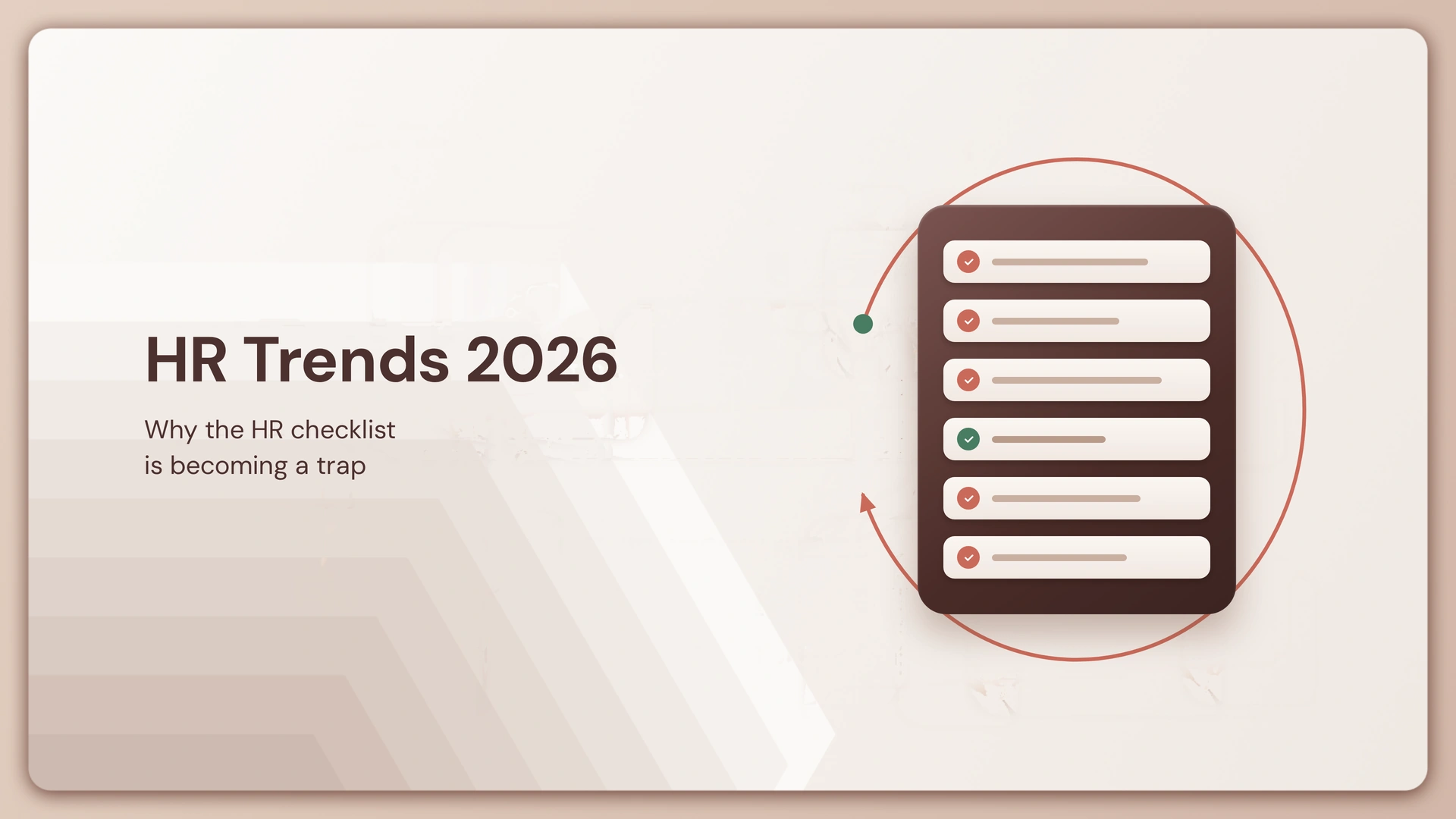
The HR checklist is becoming a trap
The trap isn’t any single priority on the list. It’s the assumption that HR can keep adding new capabilities to an operating model that was never designed to hold them.
Skills frameworks get bolted onto a job-title-based HRIS. AI copilots get layered onto processes nobody has redesigned. Wellbeing programs try to compensate for workloads that keep growing because AI made everyone’s output expectations rise, not fall.
What if the answer isn’t adding another HR priority, but changing how HR work actually gets done? That’s a harder question than “which AI tool should we buy,” which is exactly why most organizations avoid asking it.
8 HR trends shaping 2026
None of these eight developments is new in isolation. What’s new is what happens when you stop reading them as a list and start reading them as one movement.
From AI experiments to AI operating models
The question in HR has changed. It used to be “where can we use AI.” Now it’s “how does this workflow need to change because AI exists.”
That’s a meaningfully different question. It forces a conversation about permissions, governance, human checkpoints, and what “done” actually means for a given process, not just which tool sits on top of it.
The gap between ambition and execution is still wide. According to a PwC survey, 55% of HR leaders say their current technology doesn’t meet evolving business needs, and 51% admit they cannot measure the ROI of their technology investments. Buying another point tool doesn’t close that gap. Redesigning the workflow around it does.
From HR automation to autonomous HR engines
Automation, copilots, and AI agents solve narrow problems well. None of them, on their own, run an entire HR workflow end to end. That gap is where the autonomous HR engine concept comes from, and it’s worth defining precisely, which the next section does in full.
From job titles to skills-based work
According to Workday’s Global State of Skills research, 55% of employers have already begun shifting to a skills-based model, and another 23% plan to within the next year. That’s nearly four out of five enterprises in motion or about to be.
A job title is a static label. A skills profile is a live data point that can be matched to project work, internal openings, and reskilling paths in real time. Organizations are increasingly structured around what people can do, not what their offer letter says they were hired to do. The World Economic Forum’s Future of Jobs Report projects generative AI will accelerate skill changes by up to 68% by 2030, which is exactly why static job architecture is becoming a liability rather than a foundation.
Human-machine collaboration becomes an operating principle
AI adoption isn’t primarily a technology problem. It’s an operating-model problem wearing a technology costume.
Deloitte’s 2026 Global Human Capital Trends research found that 59% of organizations are taking a tech-focused approach to AI, and those organizations are 1.6 times more likely to fail to see AI returns exceed expectations compared to organizations taking a human-centric approach. The difference isn’t the software. It’s whether the organization redesigned roles, decision rights, and workflows around the new division of labor between people and systems, or just handed people a new tool and hoped.

AI literacy becomes an organizational capability
A single training module doesn’t make someone AI-literate any more than one budgeting class makes them a finance leader. Real AI literacy means employees know when to trust an AI output, when to verify it, what data is safe to share with it, and where a human judgment call is non-negotiable. That has to live inside daily workflows, not a slide deck employees complete once a year and forget.
Wellbeing becomes infrastructure
Wellbeing stops being a perk when the thing threatening it is how work itself is designed. According to Gartner, 75% of HR leaders believe their managers are overwhelmed by the growing complexity of their jobs, and SHRM research finds roughly a third of workers report poor management from the people meant to support them.
AI can absorb the administrative load that’s crowding out actual management. It can also make things worse, quietly increasing workload and blurring boundaries when it’s deployed without thinking about human capacity. The difference is entirely in how the workflow around the tool is designed.
Internal mobility becomes a strategic workforce lever
Skills data only matters if it changes what happens next for a real employee. Internal mobility is where that data gets tested against a live decision: does this person move into this role, or does the company hire externally again.
Most enterprises still default to the external hire. A McKinsey analysis found only 12% of US HR leaders engage in genuine strategic workforce planning, the discipline that connects future work needs to the skills already sitting inside the building. Skills intelligence paired with agentic workflows is what finally makes internal mobility a first option instead of an afterthought.
Human accountability becomes more important as AI becomes more autonomous
“Will AI replace HR” is the wrong question for 2026. The right one is: who is accountable when a human and an AI system made a decision together, and it went wrong.
As agentic systems take on more multi-step work, accountability has to be designed in deliberately, through audit trails, escalation paths, and explicit ownership of the final call. More autonomy for the system means more clarity about human responsibility, not less.
The real HR trend for 2026: redesigning the HR operating model
Read back through those eight trends and a pattern emerges. None of them is really about a tool or a program. Each one is evidence that the underlying HR operating model is shifting shape.
The traditional model runs on functions: people flow through processes, processes run on systems, systems are staffed by teams organized around HR disciplines like recruiting or L&D. It’s a model built for a world where change happened once a year, at review cycle pace.
The emerging model runs on workflows: the starting point is the work itself, then the workflow that gets it done, then the AI agents handling the repeatable parts of that workflow, then a human checkpoint for judgment calls, then a measured outcome. Skills-based structures, internal mobility, agentic AI, and human-machine collaboration aren’t four separate initiatives competing for budget. They are four expressions of the same underlying redesign.

This is why the checklist approach fails. You cannot bolt a workflow-based capability onto a function-based structure and expect it to hold weight. The structure has to change first.
Comparing AI approaches in HR
| Approach | What it does | Example |
|---|---|---|
| Chatbot | Answers predefined employee questions | Responds to a policy lookup query |
| Copilot | Assists a human who is still doing the task | Suggests edits to a job description |
| Automation | Follows predefined, fixed rules | Sends a standard offer letter template |
| AI agent | Executes a multi-step task within defined permissions | Sources and shortlists candidates for one role |
| Autonomous HR engine | Coordinates multiple AI-driven workflows across HR systems, with human oversight built in | Manages the full offer-to-onboard process end to end |
Notice what isn’t in that definition: humans removed from HR. An autonomous engine doesn’t replace HR judgment, it clears the repetitive, high-volume work away so that judgment has somewhere to land. This is a coordination layer, not a replacement for the people who decide what “good” looks like.
What HR leaders should do differently in 2026
Redesigning an operating model isn’t a single project. It’s a set of decisions CHROs need to make deliberately, in this order.
- Audit workflows before you shop for tools. Map the repetitive, high-volume, rules-based work first. Let that map decide the technology, not the other way around.
- Decide where humans stay in control. Name, in writing, which decisions in each workflow require human approval, judgment, or escalation before any AI system touches them.
- Build AI literacy into the work itself. Retire the annual training module. Embed guidance into the moment someone is actually using the tool.
- Connect AI to what you already run. A new HR automation layer that doesn’t talk to your existing HRMS becomes a fifth disconnected system, not a fix. Enterprises that have gone through painful Workday alternative evaluations after failed rip-and-replace projects know this cost firsthand.
- Measure outcomes, not adoption. Track cycle time, cost per hire, query deflection, and employee experience. The number of AI tools deployed is not a metric that means anything to the business.
What will HR look like by 2030?
Grounded in what’s already visible, not speculation: 2024-2025 was experimentation with copilots and generative AI point tools. 2026 is the pivot toward workflow redesign and early agentic deployment. 2027-2028 is AI becoming embedded in operating models rather than sitting on top of them. By 2030, human-machine collaboration is simply how work gets organized, not a project with a name.
The future of HR was never a contest between people and machines. It’s an organization deciding, deliberately, what each one is actually better at.
Activate your autonomous workforce today
Diane, Lyzr’s HR agent suite, is a practical example of what this category looks like in production, not a claim that it’s the only way to build one.
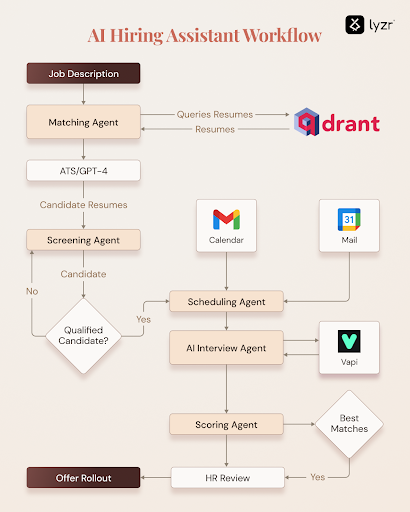
As an AI Hiring Assistant, Diane screens candidates against role requirements instead of a recruiter working through a resume pile manually.
As an Employee Onboarding Agent, she coordinates IT provisioning, document collection, and new-hire questions across the first week.
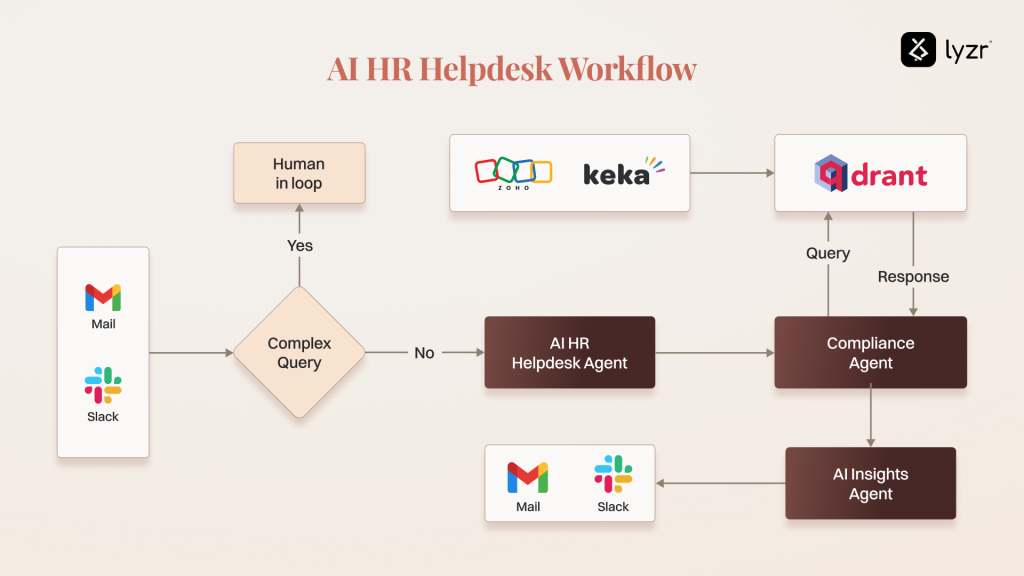
As an HR Helpdesk Agent, she handles the repetitive policy questions that otherwise consume an HR team’s day, connecting into systems your teams already run, including BambooHR integrations where relevant.
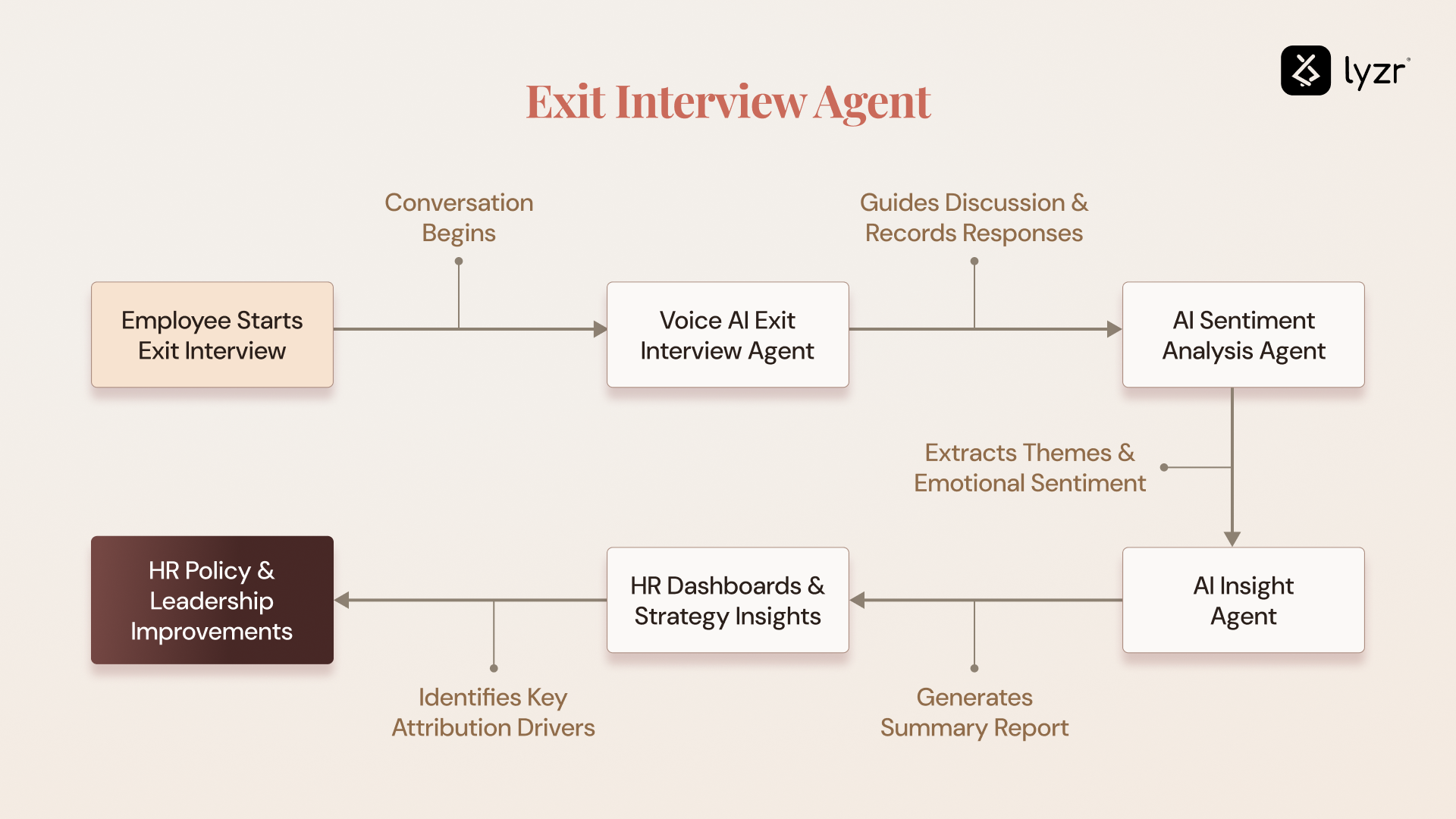
And as an Exit Interview Agent, she feeds attrition patterns back into workforce planning before they become a retention crisis.
None of that runs on hope. It runs on an enterprise-grade platform with deployment control, a built-in hallucination manager, and human-in-the-loop checkpoints where judgment is required. Teams building something more specific to their own workflows can prototype it directly in Agent Studio. Real deployment results are documented in Lyzr’s case studies, and the workflow-by-workflow breakdown is in the HR Automation Playbook.
The category matters more than any single product in it. Start by mapping your own workflows, then book a demo to see what coordinating them autonomously actually looks like.
The checklist was never the point
HR didn’t fail by having too many priorities. It failed by trying to run all of them through a model that was never built to hold more than one at a time.
The organizations that get 2026 right won’t be the ones with the longest AI tool list. They’ll be the ones that asked a harder question first: not what should we add, but what should we stop running the old way. That question doesn’t have a universal answer. It has to be worked out workflow by workflow, inside your own organization, starting now.
FAQs
What are the top HR trends for 2026?
The trends that matter aren’t isolated items. AI moving from pilots to operating models, skills-based structures replacing job titles, agentic workflows, and accountability frameworks are all expressions of one shift: HR redesigning around workflows instead of functions.
What is the biggest challenge facing HR in 2026?
The biggest challenge is treating every new priority as a separate initiative instead of recognizing they all require the same underlying fix, a redesigned operating model built around workflows and outcomes.
How is AI impacting HR?
AI is moving HR from point tools toward coordinated workflow automation. It’s changing how recruiting, onboarding, and employee support get executed, while raising new questions about governance, accountability, and where human judgment stays essential.
What is an autonomous HR engine?
It’s an AI-enabled layer that coordinates and executes multiple HR workflows across systems while keeping humans in control of decisions that require judgment or escalation. It’s distinct from chatbots, copilots, automation, and single-purpose AI agents.
What will HR look like in 5 years?
By 2030, human-machine collaboration is expected to be a normal part of how work is organized rather than a distinct initiative, with AI handling coordinated, repeatable workflows and humans focused on judgment, strategy, and exceptions.
What are the top HR priorities for 2026?
Redesigning workflows around AI, building genuine skills intelligence, treating internal mobility as a strategic lever, and defining clear accountability as AI systems take on more autonomous work.
How will AI impact HR roles?
Roles heavy in repetitive, transactional work will shrink or change shape. Roles focused on judgment, workforce strategy, and managing human-AI collaboration are expected to grow in importance.
What are the key HR goals for 2026?
Moving from isolated AI tools to redesigned workflows, closing the gap between skills strategy and actual internal mobility decisions, and building accountability structures for AI-assisted decisions.
What is trending in HR now?
Agentic AI workflows, skills-based workforce structures, and a renewed focus on wellbeing as a workload and design issue rather than a benefits line item.
What global HR challenges are coming and how can HR leaders prepare?
Talent scarcity in AI-relevant skills, regulatory complexity around AI use in employment decisions, and rising employee expectations for how AI is used at work. Preparing means building governance and workflow discipline now, before scale makes retrofitting harder.
Book A Demo: Click Here
Join our Slack: Click Here
Link to our GitHub: Click Here