Choosing the best tools for multi-agent evaluation and benchmarking starts with an awkward result: adding agents often barely moves the benchmark. Cemri et al. report minimal gains on popular benchmarks, then catalogue 1,600+ annotated traces from seven frameworks and name 14 failure modes. One category, inter-agent misalignment, lives between agents, so a final-answer score cannot show it. It belongs in your AI agent governance plan too. Six tools take it on: Lyzr, DeepEval, Arize Phoenix, LangSmith, Maxim AI and Galileo.
TL;DR
- Lyzr: evaluation built into a governed agent platform, with Agent Eval reasoning traces, Opencontroller audit trails and request-path policy enforcement.
- DeepEval: Apache 2.0, pytest-style framework that scores agent trajectories in CI.
- Arize Phoenix: self-hostable, source-available tracing with session-level evals.
- LangSmith: managed multi-turn evaluators that score whole agent conversations.
- Maxim AI: simulation-first testing for multi-turn agents, with human review.
- Galileo: nine agentic metrics, including Agent Flow, now part of Cisco’s Splunk.
What is multi-agent evaluation?
Multi-agent evaluation is scoring how a group of cooperating AI agents performs on your own tasks, both end-to-end and at each agent and handoff. Benchmarking is the narrower job of running a fixed task set so results compare across versions or models.
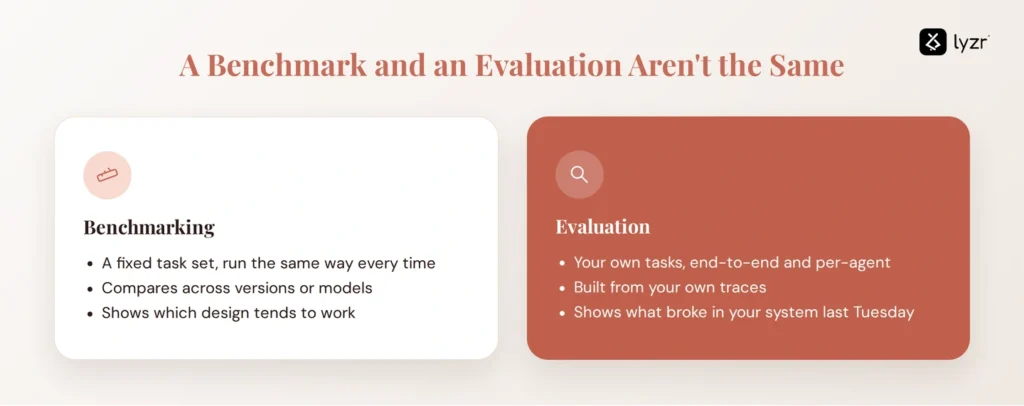
A benchmark shows which design tends to work; an evaluation shows what broke in your system last Tuesday. LangChain’s benchmark of single-agent, supervisor and swarm designs shows design matters: the single agent fell off sharply with two or more distractor domains. Our position: the benchmark that predicts production behavior is a test set built from your own traces.
Best tools for multi-agent evaluation and benchmarking compared side by side
“Not documented” means we could not confirm the capability in the vendor’s own pages.
| Capability | Lyzr | DeepEval | Arize Phoenix | LangSmith | Maxim AI | Galileo |
| License | Commercial; pay-as-you-go on Lyzr Cloud | Apache 2.0; Confident AI is the commercial cloud | Elastic License 2.0 (source-available) | Commercial; self-hosting needs an Enterprise license key | Hosted platform with free sign-up; license not stated | Commercial platform; now part of Cisco’s Splunk |
| Hosting | Lyzr Cloud or on-premise | Library you run yourself; optional Confident AI cloud | Docker, Kubernetes or your cloud; Arize AX is managed | Cloud, hybrid or self-hosted (Enterprise add-on) | Cloud; self-hosting with VPC isolation documented | SaaS, VPC or on-premises |
| Multi-agent support | Not documented on the Agent Eval page; Opencontroller governs agents on any cloud, framework, model and runtime | Not documented as a dedicated feature | Not documented as a dedicated feature | Yes: evaluation tutorial covers a parent agent routing to specialist sub-agents | Yes: integration docs describe workflow traces across a multi-agent system | Yes: Agent Flow is documented for multi-agent systems |
| Multi-turn or session evaluation | Not documented | Yes: ConversationalTestCase and conversation metrics | Yes: session-level evaluation of whole conversations | Yes: multi-turn online evaluators score intent, outcome and trajectory | Yes: multi-turn simulation with end-to-end evaluation | Yes: Conversation Quality and User Intent Change metrics |
| Agent-level metrics | Yes at reasoning level: Reasoning Trace, Logical Groundedness, Factual Accuracy; tool-call metrics not documented | Yes: Task Completion, Tool Correctness, Step Efficiency, Plan Adherence | Yes: Tool Selection, Tool Invocation, Tool Response Handling | Yes: final-response, trajectory and single-step evaluation | Yes: pre-built and custom evaluators; named agent metrics not documented | Yes: Action Completion, Agent Efficiency, Tool Selection Quality, Agent Flow |
| Agent or conversation simulation | Not documented | Yes: Conversation Simulator | Not documented | Not documented | Yes: text and voice simulation runs | Not documented |
| CI/CD and regression testing | Not documented for CI; Opencontroller evaluates and validates before production | Yes: deepeval test run via pytest | Yes: pytest plugin records tests as experiments | Yes: pytest plugin; Vitest/Jest for JS/TS | Yes: GitHub Actions for agent evaluations | Not documented |
| Fixed-dataset experiments (benchmarking) | Not documented | Yes: datasets with regression tracking in Confident AI | Yes: datasets and experiments | Yes: datasets with offline evaluation | Yes: offline evals | Yes: offline evals, per its homepage |
| Audit trail and policy enforcement on agent actions | Yes: every identity attributable, every decision traceable, request-path policy enforcement, access and spend limits | Not documented | Not documented | Not documented | Not documented; SOC 2 Type 2 stated | Yes for runtime guardrails; audit trail not documented |
Multi-agent evaluation tools reviewed: features, strengths and weaknesses
Lyzr publishes this guide and lists itself first. Each entry states its trade-offs.
1. Lyzr: evaluation inside a governed agent platform
Lyzr treats evaluation as part of running production agents. Agent Eval checks factual accuracy, logical groundedness, truthfulness and context relevance, while Opencontroller governs agents on any cloud, framework, model and runtime.
Key features
- A Reasoning Trace follows an agent’s logic from start to finish and verifies every source it relied on, so reviewers can see why an answer was given
- Factual Accuracy, Truthfulness and Logical Groundedness checks compare outputs against trusted public and proprietary data sources, catching unsupported claims before they reach users
- Access, permissions and spend limits are enforced per agent, with ordered promotion and separation of duties on production, so no single person can push an unreviewed change live
- Automatic discovery finds agents, models, tools, data and workflows across the whole AI estate, which gives governance teams an inventory they did not have to build by hand
Strengths and weaknesses
- Evaluation, audit trail and access control sit in one governed system, so test results and deployment records live in the same place instead of being stitched together across separate tools
- Every identity is attributable, every decision traceable and every policy enforceable, which gives auditors and security reviewers a real record of what happened and not just a quality score
- Policy is enforced in the request path, so a non-compliant agent call is refused outright rather than flagged after the damage is already done
- Immutable versions make rollback a pointer move, so a misbehaving agent can be reverted cleanly and quickly without rebuilding or redeploying anything from scratch
- It governs agents that already exist on any cloud, framework, model and runtime, and Agent Eval adds a deterministic, ML-powered Toxicity Control that detects and mitigates harmful content
- Agent Eval runs on Lyzr Cloud with pay-as-you-go pricing that scales with usage, or on-premise for teams that need complete control over their infrastructure and data
- Minor trade-off: Agent Eval is a platform module, so teams that only want a lightweight open-source library for quick local test runs may find it heavier than a pytest-style framework
Best for: enterprises running several agents in regulated settings that must show who ran what, under which policy, and how it was checked.
2. DeepEval: agent tests that run like pytest
DeepEval is an Apache 2.0 framework that runs evaluations like pytest tests. Confident AI is its optional cloud.
Key features
- Task Completion and Step Efficiency metrics score an agent’s complete trajectory, showing whether it finished the job and whether it took an efficient path to get there
- Tool Correctness and Plan Adherence metrics check that the agent selected the right tools and then followed the plan it set for itself
- ConversationalTestCase lets you score a multi-turn conversation as one interaction, using conversation-level metrics rather than judging each reply in isolation
- A Conversation Simulator generates synthetic dialogues so you can test agents against many scripted conversations without waiting for real users
Strengths
- Pytest-style CI/CD fit through the deepeval test run command, so a failing metric can block a release inside the pipelines your team already uses
- Metrics can be applied end to end, treating the system as a black box, or placed on individual components to see which part of an agent caused a problem
- Open source under Apache 2.0, with the hosted Confident AI layer optional, so a team can start free on its own infrastructure
Weaknesses
- No dedicated multi-agent evaluation section is documented, so scoring handoffs between agents means assembling that logic yourself from the general trajectory metrics
- Dashboards, shared reports and regression tracking across runs need the separate Confident AI cloud, which adds a second product to adopt
- No audit trail or governance layer is documented for agent actions, so it scores behavior but does not control or record who was allowed to act
Best for: teams wanting agent regression tests in an existing CI pipeline.
3. Arize Phoenix: session and tool-use evals beside the trace
Arize Phoenix pairs OpenTelemetry tracing with evaluation in one app you can self-host. Arize AX is the managed version.
Key features
- OpenTelemetry and OpenInference instrumentation captures model calls and tool use as traces, so evaluations attach to what the agent actually did
- Session-level evaluation scores whole conversations for properties such as coherence, goal completion and frustration, which cannot be seen one turn at a time
- Tool Selection and Tool Invocation evaluators check whether the agent chose the right tool and called it with proper parameters, alongside a Tool Response Handling metric
- A pytest plugin runs evals as tests and records them as experiments, so evaluation results can be reviewed and compared after each change
Strengths
- Traces and evaluations live together in one app you can self-host, so debugging a bad run and scoring it happen in the same place
- Built on open OpenTelemetry standards, so your instrumentation is not locked to one vendor and can move with you if your stack changes
- Recorded experiments give a history of eval results over time, which makes it easier to spot when a change made agent quality better or worse
Weaknesses
- No dedicated multi-agent view is documented in the pages reviewed, so teams must interpret multi-agent behavior from general traces and session evaluations
- The Elastic License 2.0 is source-available rather than open source, which some legal and procurement teams treat differently when they approve tools
- Agent simulation and governance features such as audit trails are not documented, so those needs have to be met with other tools
Best for: teams already emitting OpenTelemetry data who want self-hosted agent evals.
4. LangSmith: multi-turn scoring and pattern discovery
LangSmith is LangChain’s tracing and evaluation platform. Its tutorial covers a parent agent routing to specialist sub-agents.
Key features
- Multi-turn online evaluators score whole threads rather than individual exchanges, so quality is judged across the full conversation instead of one reply at a time
- Scoring covers semantic intent, semantic outcome and trajectory, including tool-call patterns, which shows what the user wanted, what actually happened and how it unfolded
- An Insights Agent analyzes traces automatically to surface usage patterns, common agent behaviors and failure modes, so nobody has to review thousands of traces by hand
- Final-response, trajectory and single-step evaluation are all shown in its complex-agent tutorial, which gives teams a template for testing agents at several levels
Strengths
- Threads tie separate turns into one conversation that a judge scores end to end, which suits agents whose failures only show up over several turns
- A documented multi-agent tutorial shows how to test routing between sub-agents, giving teams a concrete starting point rather than only general guidance
- Pytest and Vitest/Jest plugins bring evaluations into standard CI workflows for both Python and JavaScript or TypeScript teams
Weaknesses
- Each workspace is capped at 10 multi-turn online evaluators, which can limit how many distinct conversation checks you run at once
- Insights is available only on the Plus and Enterprise plans, so teams on lower tiers do not get automated failure-pattern discovery
- Self-hosting is an add-on to the Enterprise plan, so teams with strict data residency needs must commit to the highest tier
Best for: teams on LangChain tooling that want managed multi-turn scoring.
5. Maxim AI: simulate the conversation before users do
Maxim AI is an evaluation and simulation platform; its homepage now leads with its Bifrost gateway.
Key features
- Text and voice simulation runs test agents across many scenarios before launch, so failures surface in a safe environment instead of in front of customers
- Pre-built and custom evaluators, including AI-based, human and programmatic options, score end-to-end agent quality against the standards your team defines
- Human evaluation pipelines run alongside automated evals, adding a last-mile review for the cases where automated judges are not trustworthy enough
- GitHub Actions integration runs agent evaluations in CI, so regressions are caught automatically whenever a prompt or agent changes
Strengths
- Scenario-based simulation lets teams find failures before real users see them, including across many personas and edge cases that are hard to test by hand
- Self-hosting options include in-VPC deployment, which helps teams with stricter data control requirements keep evaluation data inside their own environment
- SOC 2 Type 2 compliance is stated on its product page, which shortens the security review for many enterprise buyers
Weaknesses
- Multi-agent tracing appears in one integration page rather than a dedicated guide, so teams need to piece together how to evaluate handoffs
- Named agent-level metrics such as tool selection or plan adherence are not documented on the pages reviewed, unlike several other tools here
- No audit trail or policy enforcement on agent actions is documented, so governance requirements would need a separate layer
Best for: teams testing multi-turn agent behavior across many scenarios before launch.
6. Galileo: a deep agent metric catalog, now inside Splunk
Galileo is an AI observability and evaluation platform, now part of Cisco’s Splunk, which describes it as covering evaluation and protection for multi-agent systems.
Key features
- Agent Flow validates agent trajectories against user-specified natural-language tests and is documented for multi-agent systems, so teams can define correct behavior in plain language
- Agent Efficiency and Action Completion metrics judge whether agents reach their goals and whether they do so by efficient paths without wasted steps
- Tool Selection Quality and Tool Error metrics flag wrong or failing tool calls, helping teams find where an agent chose badly or where a tool broke
- Eval scores can control agent actions, tool access and escalation paths, which turns offline evaluation into a runtime safeguard
Strengths
- Nine documented agentic metrics cover goals, tool use, reasoning and conversation quality, which is one of the broadest built-in catalogs in this comparison
- Deployment as SaaS, in a VPC or on-premises suits varied security needs, so regulated and cloud-first teams can both adopt it
- Offline evals can become production guardrails, so the same checks used in testing can intercept problems once agents are live
Weaknesses
- Agent Flow suits multi-agent systems with well-defined paths or interactions, so open-ended agent behavior may be harder to validate with it
- CI/CD and simulation features are not documented on the pages reviewed, so regression testing and scenario testing may need other tools
- No audit trail is documented for agent actions, so it protects and scores behavior without providing a full record of who acted
Best for: teams wanting many agent metrics plus runtime guardrails.
Pick the question you cannot answer today
A test framework answers whether a change broke behavior. An evaluation platform answers which agent or handoff went wrong. A governed platform answers whether an agent was allowed to act, and whether you can prove it later.
If the first two are your gap, DeepEval, Arize Phoenix, LangSmith, Maxim AI and Galileo each cover that job. If a regulator is asking, a score without a record will not hold up, and Lyzr’s Agent Eval plus Opencontroller audit trails supply the record. Check your governance with the Agent Governance Maturity Assessment below, then book a demo.
FAQ
Lyzr suits teams needing evaluation inside a governed platform with audit trails. DeepEval suits CI regression tests, Arize Phoenix self-hosted tracing, LangSmith multi-turn scoring, Maxim AI scenario simulation, and Galileo agentic metrics.
Single-agent evaluation stops at one agent’s output or trajectory. Multi-agent evaluation also scores handoffs, attributes each failure to a specific agent and checks passed context, which a final-answer score cannot isolate.
Yes. DeepEval’s deepeval test run works like pytest, Phoenix and LangSmith have pytest plugins, and Maxim documents GitHub Actions for agent evaluations. Set score thresholds so a regression fails the build before release.
Track task completion, tool-call accuracy, handoff quality and token cost, per agent and end to end. Anthropic reports multi-agent systems use about 15 times more tokens than chats, so cost belongs on the dashboard.
Cemri et al. sort 14 failure modes into three categories: system design issues, inter-agent misalignment and task verification. They built the taxonomy from 150 traces with inter-annotator agreement of kappa 0.88.
Score each handoff as its own step: did the receiving agent get the context it needed, choose the right tool next, and stay on goal? Galileo’s Agent Flow and LangSmith’s trajectory evaluation test this, and Phoenix scores tool selection.
MultiAgentBench (Zhu et al.) measures task completion and milestone-based collaboration across star, chain, tree and graph structures. τ-bench (Yao et al.) simulates a user talking to a tool-equipped agent and adds a pass^k consistency metric.
Agent simulation runs conversations against your agents before launch, so failures surface without real users. Use it when live testing is risky. DeepEval has a Conversation Simulator, and Maxim runs text and voice simulations.
Reliable enough to use, not enough to trust blindly. Zheng et al. found strong judges such as GPT-4 reach over 80% agreement with human preferences, matching agreement between humans, so spot-check judge scores by hand.
For scoring and CI, often yes. For regulated teams, rarely alone: DeepEval and Phoenix document scoring and tracing, not audit trails or policy enforcement over agent actions. That layer must come from elsewhere, for example Lyzr’s Opencontroller.
Book A Demo: Click Here
Join our Slack: Click Here
Link to our GitHub: Click Here